

Big Sur International Marathon
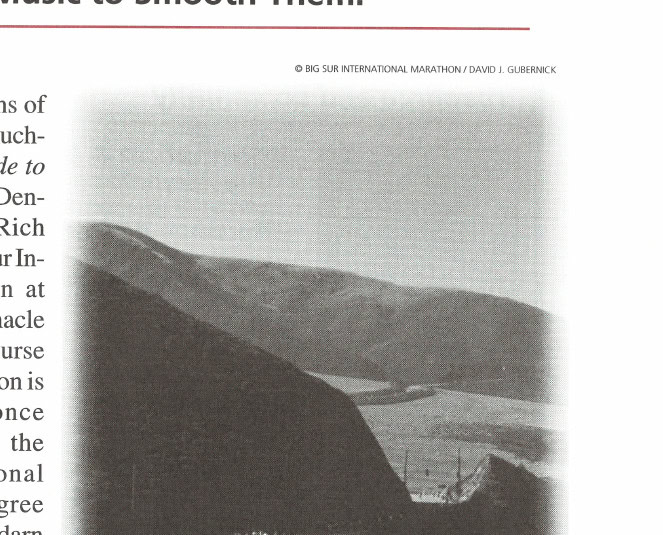
IN THE two editions of the deceased and much-missed Ultimate Guide to Marathons, authors Dennis Craythorn and Rich Hanna rated the Big Sur International Marathon at 100 percent—the pinnacle of marathons. Of course we know that perfection is impossible, but once you’ve experienced the Big Sur International Marathon, you’ll agree that it comes pretty darn close, even if you have to negotiate one of toughest course profiles of any well-known road marathon.
Even during “bad” years, Big Sur has its charms. One year excessive rains washed away part of Highway 1 (the Pacific Coast Highway), so the race was run out-and-back from the usual finish line in Carmel. Another year the race was run in the face of a vicious storm whose headwinds were strong enough to make small children airborne, but the race went on nonetheless. On a good day, which most of the Big Sur race dates have been, the course does flirt with perfection.
The race had what can kindly be described only as “humble beginnings.” Judge Bill Burleigh put together the race in 1986 as a way of sharing with other runners the joy of running in such gorgeous scenery. The inaugural event managed to attract 1,800 runners, but the fact that they faced fierce headwinds combined with the generous helping of hills (especially Hurricane Point near the 10-mile mark) may have accounted for a decline in entrants in its second year.
The second year, however, was marked by perfect conditions and one of the most extraordinary marathon runs ever by an American. Oakland, California’s Brad Hawthorne, who was no stranger to hills, unleashed a remarkable 2:16:39, which still stands as the course record. Considering Big Sur’s infamous hills, it is almost impossible to theorize what Hawthorne’s performance would have translated to on a gentler course. (Hawthorne returned to the course in 1989 and for the six years after that dominated the winner’s circle.)
Bill Burleigh’s efforts to secure sponsors for the race—and his efforts were Herculean—seemed to be going nowhere. Buoyed by the course’s spectacular scenery, marathoners increasingly wanted to do the race, and the numbers grew steadily. One of the big draws was the entertainment along the course that helped distract a runner’s consciousness from the unrelenting hills. For 1989 the race committee arranged to have a 26-piece orchestra perform atop Hurricane Point, a sure magnet to soften the runners’ efforts to top out.
A MAJOR SPONSOR APPEARS
A significant turning point for the race came in 1990 when Runner’s World magazine came aboard as a major sponsor. Suddenly the Big Sur International Marathon had credibility and clout within the world of running, which made it easier to lure other sponsors. The race filled to its 3,000 capacity and added 1,000 walkers. In 1992 a 5K race was added.
The marathon has successfully weathered whatever the fickle weather that roars in off the ocean has thrown at it. In 1995 storms wiped out the Carmel River Bridge about 200 yards from the finish line. At the 11th hour
The Basics
Big Sur International Marathon
PHONE: 831/625-6226
FAX: 831/625-2119
E-MAIL: info@bsim.org
WEB SITE: www.bsim.org
RACE DIRECTOR: Wally Kastner
YEAR ESTABLISHED: 1986
SANCTION/CERTIFIED: USATF
START TIMES: 7:00 A.M. (marathon and marathon relay)
COURSE RECORDS:
| Open men: | Brad Hawthorne, 2:16:39, 1987 |
| Open women: | Svetlana Vasilyeva, 2:41:34, 1996 |
| Masters men: | Brad Hawthorne, 2:28:23, 1997 |
| Masters women: | Suzanne Morris, 2:52:24, 1999 |
PRIZE MONEY: For male and female open, 1st $2,500; 2nd $1000; 3rd $500; 4th $250; 5th $175; for male and female masters, 1st $250; 2nd $100; 3rd $50
TIE-IN EVENTS: Marathon Relay, 21-Mile Power Walk, 10.6-Mile Walk, 9-Mile Walk, and 5K
NUMBER OF VOLUNTEERS: 2,000+
MARATHON FINISHERS IN 2002: 2,518
MALE/FEMALE FINISHERS: 62% males, 38% females
COURSE MARKINGS: each mile
WATER STATIONS: 12 along the course (every two miles) and at finish
FUTURE RACE DATES: always the last Sunday of April
ENTRY COST FOR 2003: $97
AREA HOTELS: The Monterey Marriott (350 Calle Principal, Monterey, CA 93940; 831/649-4234) is the official race hotel; special rates for marathoners, although a two-night minimum is required.
GETTING THERE: The Monterey/Carmel area is served by the Monterey Peninsula Airport (race sponsor United Airlines is a carrier, as are American and America West). Both the San Francisco and San Jose airports are also within a two-hour drive. Monterey and Carmel are along scenic California Highway 1 (Pacific Coast Highway), which is accessible from major Highway 101 by taking either Route 156 from Prunedale or Route 68 from Salinas.
Must See/Must Avoid
MUST SEE
Monterey Bay Aquarium (886 Cannery Row, Monterey, CA 93940, 831/648-4888, www.montereybayaquarium.org) is famous throughout the world for its spectacular innovations in presenting undersea life while also serving as a major research center. Among the most fascinating exhibits are the million-gallon aquarium, the three-story tall kelp forest, sea otters, and jellyfish. Hours of operation are 9:30 A.M. to 6:00 P.M. from Memorial Day to Labor Day and 10:00 A.M. to 6:00 P.M. the rest of the year; it’s closed on Christmas. It is advised that potential visitors order tickets in advance for holiday seasons as the place is usually sold out far in advance.
17-Mile Drive at Pebble Beach is as scenic as much of the marathon course but not quite as dramatic, as it’s closer to sea level. Famed for its world-class golf courses, the drive is breathtaking. Along the drive you’ll see the Lone Cypress, the community’s symbol, as well as Seal and Bird Rocks, Fanshell Beach, Spanish Bay, Cypress Point Lookout, Point Joe, and Carmel Bay. There is an $8 fee for entrance to the drive, which can be accessed at five different gates of the Pebble Beach Resort. Once inside, though, you can drag the drive out as long as you want. You can buy a gourmet picnic lunch at the Pebble Beach Market next to The Lodge at Pebble Beach.
Cannery Row Antique Mall (471 Wave St., Monterey, CA 93940, 831/655-0264, www.antiqnet.com/canneryrow) features 175 dealers in 21,000 square feet. If you like to take something of an antique nature home with you as a souvenir of your marathon weekend, this is the place. Professional Antique Mall magazine named Cannery Row Antique Mall “antique mall of the year.” It’s open seven days a week, 10:00 to 5:30 Monday to Saturday, and 10:00 to 5:00 on Sundays.
National Steinbeck Center (One Main Street, Salinas, CA 93901, 831/796-3833, www.steinbeck.org) is the hub of Steinbeck events in the Monterey County area. When Steinbeck’s books came out, the citizens of Salinas would have loved to hang him from a convenient telephone pole in payback for the way he portrayed his neighbors. But Steinbeck won the Nobel Prize for Literature, and as his fame grew the area decided to capitalize on his local settings for his novels (including In Dubious Battle, Of Mice and Men, The Red Pony, The Grapes of Wrath, Cannery Row, The Wayward Bus, Travels with Charley, East of Eden). He would get a big charge out of how he is portrayed today. February 27, 2002, marked the centennial of his birthday, and the county held yearlong celebrations. Even though the celebrations
…will be over by the time of the 2003 marathon, there will still be plenty to enjoy for Steinbeck fans.
Old Fisherman’s Wharf (P.O. Box 465, Monterey, CA 93942, 831/649-6544, www.montereywharf.com) is your typical conglomeration of restaurants (nearly a dozen) and gift shops. It’s a very short walk from the race headquarters at the Marriott and the expo at the conference center (walk toward the bay by going through Custom House Plaza and you’re there). It offers a terrific variety of eating options for your Saturday night prerace feed. The wharf was originally built in 1845 for landing supplies for the West Coast as they were shipped around Cape Horn, as Monterey was the major port on the western side of the country. The shipping gave way to whaling and later to sardine fishing (talk about different ends of the sealife spectrum). You can take whale-watching trips from the wharf with a number of tour operators.
Monterey Wine Country (Monterey County Vintners and Growers Assn., P.O. Box 1793, Monterey, CA 93942, 831/375-9400, www.montereywines.org) isn’t quite as famous as Napa Valley or Sonoma County, but it ranks right up there as one of California’s premier wine areas. (Blackstone Winery in Gonzales is one of the gold-level sponsors of the marathon even though it isn’t a member of the Vintners and Growers Association.) Ask for the “Wine Tasting Map & Guide” before you visit, so you can plan a day’s worth of tasting.
MUST AVOID
The region is so tourist oriented and much of it so upscale that there isn’t much to be warned against—just monotonously delightful diversions around almost every corner.
a one-lane Bailey bridge was set up to accommodate the runners. In 1997 gale-force winds battered the course. Wally Kastner, a retired marine lieutenant colonel, was hired as race director in 1998 and was immediately presented with a welcome-to-Big-Sur challenge when El Niño rainstorms all winter long knocked out major sections of Highway 1, simply washing them down into the sea. Nature along the continent’s western shore is anything but benign. Kastner came up with an out-and-back course with the turnaround coming at the famous and scenic Bixby Bridge.
By 2001 marathoners had become used to signing up while expecting anything to happen to them. But 2001 was a disappointment for the pessimists. It turned out to be about as perfect a day as a runner could want: everything ran like a well-oiled machine. The 2002 race suffered a similar fate, except that one of the pylons for the start banner fell as the race began.
THE COURSE ITSELF
So what’s this infamous course actually like? Is it as draining as everyone says? In two words: you betcha!
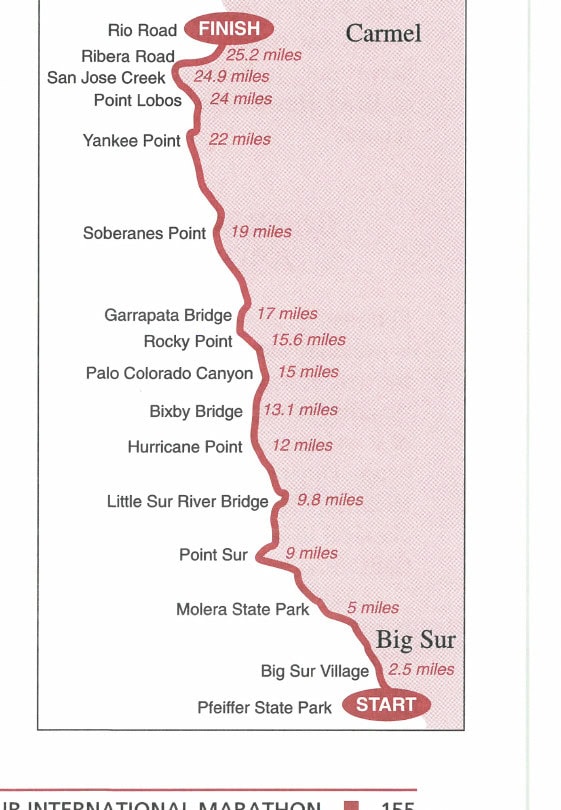
It begins among the redwood forests near Pfeiffer State Park, 26 miles south of Carmel along Highway 1. The start area is tight and confined because at that point Highway 1 has left the open expanses of grazing land above the ocean and has twisted itself along the shoulder of the rugged mountain range above the ocean.
Runners are bused to the staging area at the state park maintenance area while it’s still dark. Buses leave the Custom House Garage in Monterey and the Carmel Middle School beginning at 4:00 A.M., and they leave the Embassy Suites Monterey Bay and the Monterey Marriott at 4:45 A.M.! It is surreal to ride the buses south along Highway 1 in the dark, the scarlet taillights of buses in front forming an eerie, serpentine glow.
Once dropped off at the start, however, runners can only wait and shiver in the cold. Some runners suggested that the buses leave later from Monterey and Carmel to get runners to the start; others suggested erecting tents to keep runners warm until the start. Still others resented the fact that runners who arrived later got to line up in the front, pushing back early arrivals.
The start area has no space for parking vehicles. In fact, to turn around, the buses need to overshoot the start area to reach a restaurant parking lot down the road that is large enough to accommodate their wide turning radius.
The start is 300 feet above sea level, and runners lose 200 feet of that within the first five miles as the two-lane road drops through quaint motel and campground areas, the road occasionally undulating a bit but generally plummeting toward the more open and sweeping areas beyond the fringe of the forests. As the course comes out of the trees and into the open, runners reach a small hill as the ocean vista presents itself like a pan-and-scan film suddenly morphing to wide-screen letterbox format.
Between 5.5 miles, where the course flattens, and Point Sur at 9 miles (175 feet elevation), some minor rises become molehills when placed against the upcoming challenge between 9.8 miles (Little Sur River Bridge) and Hurricane Point at 12 miles. The course dives toward the Little Sur, and as soon as runners cross the bridge they begin the ugly climb to Hurricane Point. The Little Sur River Bridge is at 40 feet; Hurricane Point is 560 feet. The math speaks for itself. The uphill grind serves only to build additional awe at Brad Hawthorne’s 2:16 course record!
DISTRACTIONS ABOUND
Fortunately, all sorts of entertainment is provided along the course for distraction, although one Colorado “music critic” complained that too much of it was provided by middle school bands. Other runners loved the entertainment. “Music for every taste, from classical to jazz,” wrote a Saratoga, California, runner.
After Hurricane Point, the course is overall downhill but rolls over smaller hills to get there. The famed and scenic Bixby Bridge, where Jonathan Lee plays a grand piano for your musical entertainment, is at 275 feet elevation and marks the halfway point of the course.
From there on, the course features long rolls up and down long hills, but the trend is always down to the lowest point on the course: San Jose Creek at 24.9 miles, which is 10 feet above sea level. From there the course climbs again to 90 feet as it crosses Ribera Road at 25.2 miles and then drops to 25 feet as it finishes on Rio Road.
Many runners complained about the extreme camber of the road, worse between miles 22 and 24 in Carmel Highlands, something difficult to avoid in engineering a paved road with Highway 1’s many curves. Others would like to see the relay done away with so that marathoners won’t have to suck the exhaust fumes coming from the relay race buses squeezing past.
The finish area is about as well organized as that of any other marathon in the world. After the runner has crossed the finish line, it’s an easy right turn into Marathon Village, where race sponsors have huge tents to service the runners with everything from food and drink to sweatbag pickup to massages to meeting areas.
A constant cycle of buses arrive to take tired, but happy, runners back to Carmel or Monterey where they boarded the buses a seeming lifetime ago. For those who stayed in Big Sur on Saturday night (and who got to sleep in well beyond those who commuted from Carmel and Monterey), shuttle buses from Marathon Village back to Big Sur run until 1:00 P.M.
The course has a five and one-half hour cutoff, which is strictly enforced. Highway 1 reopens to vehicular traffic in both directions at 12:45, and it doesn’t have sidewalks for late finishers. Since the scaffolding for the finish area is built directly on and across Highway 1, the 15-minute interval between the official end of the race and the start of traffic is taken up with disassembling the entire finish area, which is a ballet of volunteer workers functioning like worker ants to reopen the highway. Backing up a few miles, many runners comment very favorably on the fresh strawberries provided at the mile-23 aid station and at the finish area.
The awards ceremony is held precisely at 11:30 A.M. for the relay and at noon for the marathon and is done quickly and efficiently. Division winners receive Asics running shoes.
THE LEAD-IN
The marathon weekend begins with the race packet pickup at the Health and Fitness Expo at the Monterey Conference Center, which is conveniently located across the street from the Marriott race headquarters hotel. The expo is pleasantly medium sized, and packet pickup is efficient and well organized, though some runners were confused when they tried to change from one event to the other at the registration tables.
Asics, the marathon’s shoe/clothing sponsor, has a large display that takes up the middle of the expo hall and features the official Big Sur merchandise. Plenty is available to eat and drink as Gatorade handed out energy bars all day and a local organic farm company (Earthbound Farm) served tasty and nutritious salads. The expo was open from noon to 7:00 P.M. on Friday and from 8:00 A.M. to 6:00 P.M. on Saturday.
In conjunction with the expo, the marathon presented a series of race clinics in the Steinbeck Forum upstairs in the conference center. Jeff Galloway did three clinics; sports psychologist JoAnn Dahlkoetter presented a clinic based on her book Your Performing Edge; Hugo Ferlito (chairman of the marathon board) gave a humorous slide presentation that traced the history of the marathon; and Susan Love presented a clinic on mind games and motivation for first-time marathoners.
PEDESTRIAN PATHWAYS
For those who feel the need to get in one last tension-relieving jog before the big race, the Conference Center and Marriott are a great anchor to Monterey’s famous bike/pedestrian Recreation Trail, on which you can jog on over for a tour of Cannery Row, made famous in John Steinbeck’s books. California was celebrating the 100th anniversary of his birth during…
Runner’s Highs/Runner’s Lows
| HIGHS | LOWS |
|---|---|
|
|
2002 by encouraging every Californian to read at least one of his books. You can also jog by the even-more-famous Monterey Bay Aquarium. Breathtaking views are always just around the next corner.
The Saturday night pasta dinner was presented in two seatings (5:00 and 6:00 P.M.) at the Marriott for $20. The pasta was average: one vegetarian and the other meat based. A jazz trio entertained during the pasta feeds. Dole provided pineapple juice and caesar salads. Some runners found the pasta feed registration confusing and several runners felt that the $20 price was extremely high for what was provided, especially in an area “where there are such good restaurants available.”
Those who didn’t take advantage of the official pasta feed and headed out on their own faced a formidable challenge: deciding which of a rich variety of restaurants would best serve their needs and their pocketbooks. The Monterey/Carmel area is saturated with good restaurants, many of them reasonably priced and within walking distance of the Marriott in downtown Monterey. At the other extreme, dozens of upscale restaurants are available in trendy Carmel. If you go hungry in Monterey/Carmel, it’s by choice.
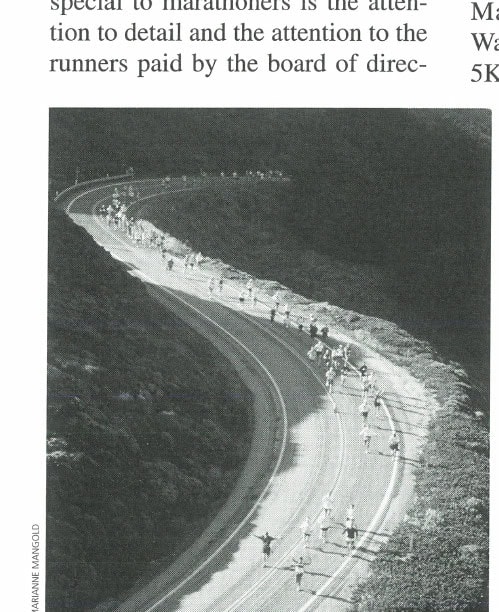
Of course one of the things that makes the race so enjoyable is the setting: a spectacular meeting of sea, sand, and mountain scenery. On a bright-sun day the contrasts among the turquoise of the sea, the blondes of the sand, and the greens of the steep hillsides that reach to the electric blue skies nearly remove subtleties from the colors and turn them into what are, for the Big Sur area, primary colors.
Vacation Paradise
The fact that it is extremely easy to tack vacation days on following the marathon weekend adds to the charm. If you’re going to travel from Minnesota to Monterey, it would be foolish not to stay an extra two or three days to take in the Aquarium and Cannery Row and drive the rental car to its limit along the Pacific Coast Highway. The Monterey area is, of course, eager to accommodate since tourism is its lifeblood.
But what makes Big Sur extra special to marathoners is the attention to detail and the attention to the runners paid by the board of directors, and Big Sur’s board is HUGE. All weekend, board members circulate while wearing their signature blazers, each sporting a nametag so that runners know exactly to whom they are talking when they stop one of the board members with a question. A board member who doesn’t have the answer will lead you to someone who does. “The race directors and volunteers made me feel welcome and happy to have me there,” one Maryland runner stated.
For a race sporting a half dozen simultaneous events (Marathon, Marathon Relay, 21-Mile Power Walk, 10.6-Mile Walk, 9-Mile Walk, 5K) and more than 10,000 participants, Big Sur manages to exhibit a charming split personality: extremely efficient but with down-home friendliness.
On the negative side, if you have failed to sign up to run the race within a day or two of the September 1 opening of on-line registration, you’re pretty much out of luck unless you take part in the race’s lottery (see its Web site).
Nothing’s perfect. But the Big Sur International Marathon does its best to come close.
The Bottom Line
We have weighed various aspects of a marathon within a 1,000-point scoring grid. Besides the author of the article, two dozen runners at the race were randomly chosen to score the race for us (BSIM = Big Sur International Marathon). The results follow:
1. History/Tradition
Evaluate the race’s sense of history and tradition.
[Possible points: 30 BSIM score: 24]
2. Entry Form
Is the race entry form clear, concise, attractive, complete, and easy to fill out?
[Possible points: 20 BSIM score: 19]
3. Entry Cost
For most races, the entry fee covers between 30 and 50 percent of the cost of putting on the event. Rate the value of your dollar relative to this race.
[Possible points: 30 BSIM score: 25]
4. Locale/Scenics
Is the race held in an area that is easy to get to and scenic and offers adequate food and housing services and nonrace activities for family and friends?
[Possible points: 50 BSIM score: 49]
5. Registration
Is registration well organized and efficient? Does it bog down unnecessarily?
[Possible points: 20 BSIM score: 19]
6. Prerace Activities
Evaluate activities, such as pasta feeds, parties, and so on, during the days before the race.
[Possible points: 50 BSIM score: 44]
7. Expo
Does the expo offer a fair number and variety of booths relative to the race’s size? Are there quality exhibitors and good guest speakers?
[Possible points: 50 BSIM score: 44]
8. Course
Take into consideration the following: degree of difficulty, certified, sanctioned, quality of road or trail surface, adequate mileage and directional markers, aid stations, medical coverage, race communications, accessibility to course for friends and family, typical weather, and so on.
[Possible points: 400 BSIM score: 372]
9. Race Amenities
This category includes race T-shirt, finisher’s medal, finisher’s certificate, adequate and efficient finish area, ease of sweatbag retrieval, showers, postrace refreshments, awards ceremony, raffles, results postcard, results book, and so on.
[Possible points: 250 BSIM score: 243]
10. Volunteers
Are the volunteers experienced and adequate in number?
[Possible points: 100 BSIM score: 98]
Total Score for Big Sur International Marathon
937 points
| Marathon | Score |
|---|---|
| Kiawah Island Marathon (vol. 6, issue 5) | 825 points |
| Lake Tahoe Marathon (vol. 6, issue 4) | 867 points |
| Las Vegas International Marathon (vol. 1, issue 5) | 831 points* |
| Motorola Marathon (vol. 5, issue 6) | 876 points |
| Napa Valley Marathon (vol. 2, issue 5) | 913 points |
| Ocean State Marathon (vol. 5, issue 5) | 886 points |
| Philadelphia Marathon (vol. 1, issue 4) | 838 points |
| Pittsburgh Marathon (vol. 1, issue 6) | 904 points |
| Portland Marathon (vol. 3, issue 3) | 943 points |
| Quad Cities Marathon (vol. 4, issue 3) | 885 points |
| Royal Victoria Marathon (vol. 5, issue 4) | 918 points |
| San Francisco Marathon (vol. 1, issue 2) | 804 points |
| Santa Clarita Marathon (vol. 4, issue 4) | 866 points |
| Shamrock Sportsfest Marathon (vol. 2, issue 6) | 866 points |
| Steamtown Marathon (vol. 3, issue 5) | 892 points |
| Vancouver International Marathon (vol. 1, issue 1) | 851 points* |
| Wineglass Marathon (vol. 1, issue 3) | 839 points |
| Yukon River Trail Marathon (vol. 5, issue 1) | 870 points |
The Las Vegas score went up due to the race moving its expo from tents at Vacation Village to one of the major downtown hotels and expanding the expo. The finish line area has also been improved: with the new finish line area, the 90-degree turn into the final 70 yards is now a thing of the past.
At Vancouver, the score has gone up based on several factors: many of the bridges (major uphills) have been removed from the course, as has the industrial area on the far end of the Lions Gate Bridge. In addition, the entire event has been consolidated into one area (the BC Place complex, which is one of the few remaining structures from Expo ’86), which contains the Vancouver Marathon offices, fitness and health expo, seminars, and the start/finish areas.
This article originally appeared in Marathon & Beyond, Vol. 6, No. 6 (2002).
← Browse the full M&B ArchiveMore like this
1,000+ stories from 19 years of Marathon & Beyond
The complete archive of the legendary long-distance journal — digitized and free to read.
