

Boston’s Pseudo “100th”
THE BOSTON Marathon celebrated its “100th” running in 1996 with a well-hyped, very long party, which at times stretched to over 13 miles. It was the largest mobile birthday party in world history, and certainly the fittest. The statistics are staggering: 37,500 carefully-selected runners, 1.5 million spectators, 13,000 tubes of petroleum jelly, 105,000 gallons of water, 10,000 trash bags, 60,000 PowerBars. We could go on, but the party was premature.
The serpentine line of runners that wound through suburban Massachusetts toward downtown Boston panted and partied joyously. Was the event successful? Doubtless, it was. Unfortunately, the 1996 race was a monumental false start for celebration. It was definitely not the 100th. Repeat. Not the 100th! Everyone back to Hopkinton! The real 100th running of the Boston Marathon is scheduled for April 21, 1997.
The venerable Boston Athletic Association (BAA), which considers itself the keeper of the Boston Marathon flame, did not flunk math. It knows perfectly well how to count the years since the first great race on Patriots’ Day, April 19, 1897. A running event has taken place every year for 100 consecutive years, but the race held on April 19, 1918, in the midst of the Great War, was a 10 × 2.5-mile relay race, not a marathon. Here’s what happened.
THE KHAKI-WHITE RELAY
On February 3, 1917, the United States broke diplomatic relations with Germany and by early April declared war. On April 19, 1917, New York’s Bill Kennedy won the 21st Boston Marathon in 2:28:37.
For its part, the BAA announced that it would do everything possible for men in the service. The BAA’s contribution to the war effort turned out to be the cancellation of their marathon for 1918. It was replaced with a military relay. The BAA did not make the silly rule that turned the relay from an athletic event to a publicity stunt. The military decided that the racing soldiers would wear their full service uniforms and carry batons with a patriotic message inside. The rules had two effects: They made the race a mockery, and they made it very difficult for the military relay teams to run well.
Navy men wore their whites, with spit-polished, high-laced boots and spats; big collars with thin blue stripes; and a navy blue kerchief. The Army teams wore regulation khaki: shirts with buttons, collars, and cuffs; and pants with belts and flap pockets.
In this “novelty marathon,” as the Boston Evening Transcript called it, each member on 10-man teams ran roughly 2.5 miles. The exchange zones were marked with red shields for Army and blue shields for Navy. Sixty automobiles transported the runners. All had undergone military training that stressed calisthenics but not running. Few were in serious running shape.
Only one of the 140 men in the race had run the marathon before—Al Harrop of Fall River, Massachusetts, who had finished seventh in 1911 in 2:32. A handful of others among the 140 had been decent runners in civilian life.
The “race” was a farce, a procession of fatigued men in dress uniforms, each running alone carrying a baton down the middle of the road. The event was neither a race nor a parade. Few spectators lined the course, and for the first time in years automobile traffic was not a problem. The race simply did not generate spontaneous public interest. The teams ran so slowly that Harrop’s 1911 time would have beat all but six of the relay teams. Clarence DeMar, who won the 1911 race, would have been able to beat all of the teams. The entire sham proved to be neither good athletics nor good public relations for the services involved.
In the wake of the military relay fiasco, the BAA could have set things right, but it chose not to. Once done, it was easier to leave the mistake in place. Each subsequent running provided an opportunity to rectify the miscount, but at every running, that opportunity was ignored. Each year it became more difficult to fix the error. The BAA would have had to risk embarrassment and admit their mistake publicly that the “22nd” Boston Marathon was not a marathon but a relay race. Historically, the BAA has not found it easy to admit mistakes.
A HISTORY OF HUBRIS
Hubris has driven the Boston Marathon since its inception and drives it still. The hubris of the BAA is a pride that is simultaneously attractive and dangerous. From the establishment of the BAA in the late 1880s to the $25 increase in entry fee for the 1997 race, a degree of insolence and arrogance and sometimes even swagger has characterized the BAA institution. This pridefulness is not a reflection of a specific individual but more of the institution itself. This haughtiness is attractive because it is the mystical spark that ignites runners and spectators alike and keeps the race alive—and special. But the danger of pridefulness is that it can blind an organization to progress.
Birth of the BAA
The BAA confidently entered the world in 1887, when prominent members of Boston society met in the offices of Robert F. Clark to formulate plans for a new athletic club. They chose the unicorn as their symbol—the mythical single-horned horse, the quintessentially unattainable beast. The BAA was not begun as a running club but as a club for wealthy men who wanted “to encourage all manly sports and promote physical culture.” The very bluest of the Boston bluebloods joined—the Adamses, Saltonstalls, Lowells, Cabots, and Lodges.
A Palace to Athletics
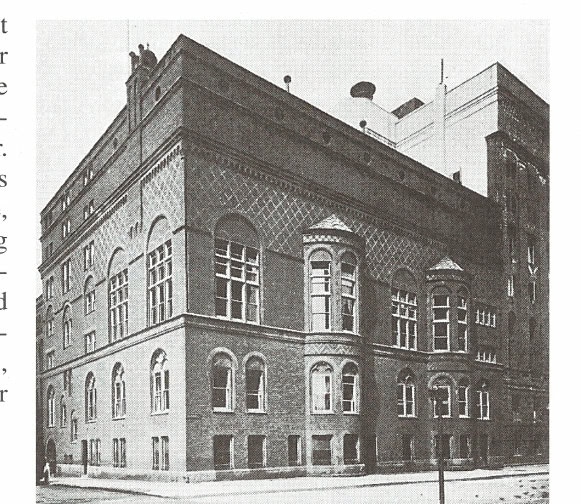
The BAA’s magnificent clubhouse on Exeter Street was a shrine to the club’s success and a symbol of wealth and power. In May 1887, ground was broken for the clubhouse, which featured amazing amenities—the best indoor swimming pool and track in the country, Turkish baths, billiard rooms, a wine room, a cigar room, and windows adorned with red tapestry curtains. Like lords, members could drink and smoke while luxuriating in overstuffed chairs and gaze at walls featuring the best of the taxidermist’s art. But in the 1930s the country—and the BAA—fell on hard times. Over-invested in the stock market like so many of its members, the BAA lost its buildings and most of its other holdings, such as its golf course, boathouse, and shooting range. Stripped of its empire, the BAA clung tenaciously to the symbols of power.
An Exclusive Race?
The passage of half a century did not add wisdom, humility, or economic security to the organization. World War II did to the Boston Marathon what World War I had done. Potential runners were now soldiers. The BAA did not cancel the marathon, but the 1945 field was down to 67 men, from a high of 285 in 1928. Through the 1950s the BAA and the race teetered near economic death. Fiery Scotsman Jock Semple and refined but nonetheless passionate Will Cloney held together with a shoelace what was left of the marathon. The once elegant offices of the BAA now resided in a closely guarded cardboard box in Semple’s massage room at the old Boston Garden.
Semple ruled the BAA’s cardboard box empire like a junkyard dog. His intolerance of anyone who disrespected the marathon or its runners surfaced again and again in the coming decades, sometimes with embarrassing results.
Semple and Cloney bluntly discouraged the uninitiated and unprepared from running the race. They rightly feared that the marathon might degenerate from an athletic event with Olympian ideals to a freak-show street parade. With saintly zeal they defended the elite status of the revered but ravaged Boston Marathon. Runners still paid no entry fee. The race was penny poor, but to Semple and Cloney, noble as gold.
Women were simply not allowed to enter. It was unthinkable; that is, until Roberta (Bobbi) Louise Gibb ran the race unofficially in 1966. And, who can forget the 1967 race, in which Kathrine Switzer (running with an official number assigned to K. Switzer) was nearly injured as Jock Semple tried, literally, to knock her out of the race. As he lunged to rip off her number, Semple had shouted, “Get the hell out of my race.” After the dust had settled, Cloney commented, “I’m terribly disappointed that American girls force their way into something where they are neither eligible or wanted.”
By the early 1970s the Boston Marathon fields had grown to over 1,000. A method to limit them—beyond Jock’s crusty arbitrariness—had to be adopted. The introduction of qualifying times kept the numbers under control. Boston became the first and only road race beyond the Olympic Marathon to limit its
entries. While other races went begging for participants, runners had to prove themselves before they were allowed to pin on a coveted Boston Marathon number. Runners grumbled, but they rose to meet the stern requirements of the prideful race and qualified in record numbers.
Bad Business Dealings
By the mid-1960s, the BAA needed sponsorship to move beyond its cardboard box status. The organization moved slowly and sometimes unwisely in its business dealings. In 1965, Will Cloney confidently and unilaterally made a handshake agreement with the Prudential Life Insurance Company, whose massive 52-story office tower (and then tallest building in Boston) now served as the finish line. In exchange, Prudential agreed not to make any commercial tie-ins with the race and to install toilets and showers in their underground garage as a courtesy to marathon finishers.
In the early 1980s Cloney unilaterally and confidently signed a fundraising contract with Boston lawyer Marshall Medoff, essentially turning the marathon over to him. The contract allowed Medoff to keep any money raised over the sum of $400,000. Medoff immediately set off and raised $712,000. The contract rendered the BAA board powerless. The scandal in the Boston papers was delicious. The courts finally stepped in and undid the BAA’s foolishness, decreeing that the marathon is a public trust and not the sole property of any one person to give away or sell. Cloney resigned as race director, and the BAA board of governors was forced by the court to step in and sort out the mess. But the attitudes, arbitrariness, and inertia of the organization had not changed.
Clinging to the Past
When marathon racing turned professional in the 1980s, the BAA sat still. The esteemed Bostonians who constituted the BAA board seemed trapped in a 19th century world view. To them, tradition and status alone would continue to attract a world-class field to their race. But the runners followed the money to London and Rotterdam. In 1984 and 1985, the Boston Marathon dropped from the world’s foremost marathon to just another local road race. In two years, the Boston Marathon had, by its arrogance, set itself on a road less celebrated. There were predictions that the race would not reach its 100th anniversary. If anyone was planning a party, it was a wake.
John Hancock Steps In
In 1986, John Hancock adopted the Boston Marathon. Hancock vice president David D’Alessandro sensed that a match between a long-running, respected, venerable, even patriotic event and a company named after America’s most prominent patriotic signator on the Declaration of Independence might be wonderfully symbiotic. D’Alessandro could see clearly because he was not part of the old BAA establishment, so the match worked.
The massive Hancock company owns the building that now houses the BAA on Clarendon Street in Boston. Millions of dollars of sponsorship money flow in and out of that office. The new, huge, glass Hancock tower looks down at the BAA building, casting a shadow that reminds one of the 19th century origins of the BAA. Power, money, and tradition once again rule. Perhaps now more than ever.
The Boston Marathon has become a business, yet the race still burns with the blue flame of its rich history. The fiery objective of the race is to provide an arena for athletes to perform a simple but often profound physical, mental, and sometimes spiritual task. But the BAA must balance the demands of the purist runner and the needs of its prime sponsor.
SO WHY THE PREMATURE PARTY?
Why at some point didn’t the BAA correct the simple error of misnumbering their races? Because it would have called attention to one more in a long line of blunders, and why bother if an army of protesters isn’t clamoring for truth in advertising?
Quite simply, the BAA and its sponsors celebrated the “100th” a year early because they could. Because they had the power to do it. But in doing so, the BAA missed a golden opportunity. The BAA could have celebrated both the 100th anniversary of the first Boston Marathon and the 100th running of the race in April of 1997. This is an opportunity not mathematically possible under normal circumstances, but possible in this case because of the cancellation of the 1918 race. All the BAA had to do was step forward and make things right. But why do that and miss out on running the “100th” Boston during the same year as the Centennial Games and the 100th anniversary of the first Olympic marathon, and beat the Olympic Games to the punch by three months?
They didn’t. They couldn’t bear to. Instead, the BAA raised the entry fee for 1997 by 50 percent. So if you are one of the anticipated 15,000 competitors running the 1997 Boston Marathon, get your $75 worth by knowing that you are part of the REAL 100th running of the Boston Marathon on its 100th anniversary. And, don’t worry—the BAA won’t quibble over one year.
This article originally appeared in Marathon & Beyond, Vol. 1, No. 2 (1997).
← Browse the full M&B ArchiveMore like this
1,000+ stories from 19 years of Marathon & Beyond
The complete archive of the legendary long-distance journal — digitized and free to read.
