

Bright Days In Budapest
First impressions are written in ink; second impressions start with the application of a pencil eraser. The first time Hungary made an impression on me was in 1956, when I was 10 years old. We had been taught that the world was divided into two camps: the evil sneaky Commies and the rest of us. Our class of 36 snot-nosed kids knew where Hungary was located because we had geography classes several times a week. But now the good nun who pumped information into us all day explained that people in Hungary, people behind the Iron Curtain, had revolted against their Soviet masters and there was fighting in the streets of Budapest. We knew Budapest was the capital of Hungary because we had studied capitals of the world. We even had an inkling of what the Austro-Hungarian Empire had been.
For a week, we followed the Hungarian Revolt in the newspapers. Then we heard that a Hungarian family had fled their homeland and had arrived in a town a dozen miles down the road. The newspaper carried a story. Even though we never met the Hungarian family, we felt a connection, since the ancestors of most of the kids in our class came from Central and Eastern Europe.
Many years later there was great exhilaration when The Wall came down in Germany. I felt just as exhilarated that the Iron Curtain had been lifted from the long-suffering, long-stifled countries of Eastern Europe. Warsaw and Prague and Budapest were suddenly more accessible to the outside world, and those capitals reveled in their newly won freedoms.
When an opportunity to attend the 20th annual Budapest Marathon in early October 2005 appeared, the decision to go took less time than it takes to run a 40-yard dash. Any other decision would have elicited a good rap on the knuckles with a reinforced yardstick from the spirit of my fourth-grade teacher.
Getting to Budapest was lengthy but easy. Get on a plane in San Francisco, change planes in London, get off a plane at Ferihegy Airport outside Budapest, and catch a shuttle into the downtown. The ride to downtown is through outskirts that are distinctly Eastern European but also strangely familiar: there are small strip malls, weathered houses, the
occasional gas station and garage, and the occasional Soviet-era, cheesy cheesebox apartment building. Signs in English coexist with Hungarian signs, and a visitor quickly realizes where all the letter Zs that the rest of the world doesn’t use ended up.
THE CITYSCAPE The transition to downtown Budapest is a matter of traversing a few blocks. The transition is startling, especially if it occurs after dark. The downtown is lit up and very much alive with traffic and pedestrians and clubs and bars and people spilling out of hotel lobbies for a night out: nothing like the film noir images of clandestine comings and goings from the Communist era. There are posters on walls indicating that there is a major pornography convention in town the same weekend as the marathon. The first impression at the hotel bar is that it’s cheaper in Budapest to drink good wine than it is to drink average beer. Hungary is famed for its wine grape growing and is duly proud of the quality of its wines. I had had a little experience with Hungarian wine years ago and kept a label of a 1975 Janoshegy-Johannesberger (Hungarian Gewurztraminer) Ausbruch that I enjoyed. At the hotel, a bottle of Dreher beer costs $5 while a 750-liter bottle of very good Balatonlelle merlot from the St. Donatus Winery costs $11. Hungarians have not yet changed over to the euro; they still use the forint, about 200 of which equal one U.S. dollar.
A walk around the downtown to get the tightness out of the legs is a little spooky because around each corner, in each little alleyway, along each building façade, there are people lurking. In the contrasting lights of nighttime Budapest, the lurkers seem sinister. At closer inspection, they aren’t government security agents but statues—statues everywhere. Apparently if you pick up a stray piece of litter and deposit it in a refuse receptacle, they erect a statue to you. There may be more statues in Budapest than there are living residents.
A stroll along the Pest side of the Danube with the Buda Castle on the Buda side of the river reflecting off the water is refreshing. The following morning I will find that the famed Blue Danube isn’t blue at all but more like the dishwater green of San Francisco Bay. Long tourist boats ply the river, and barges are pushed upstream by stolid tugs.
The two-car commuter trains whiz along on both sides of the river and appear to be quite efficient and busy. Supposedly half the workers in Budapest use public transportation, which, as I will find over the next few days, is a good thing, because it is virtually impossible to find a place to park. There are 1.8 million people in Budapest. In the whole of Hungary, there are more than 2.5 million cars and some 400,000 commercial vehicles, many of them polluting diesel. Most of the nearly 3 million vehicles are seemingly fighting for the same parking space on the streets of Budapest. There are no parking garages, so people park wherever they
can find a space. In fact, there are signs along some streets indicating that it is perfectly all right to park halfway on the sidewalk. Hungary joined the European Union on May 1, 2004, and one of the by-products of that membership is that Budapest is crawling with EU bureaucrats, all of whom sport EU license plates on their fancier-than-the-hoi-polloi cars. For the more flagrant parking miscreants, Budapest traffic enforcement officers use the boot to immobilize the offenders’ cars. Most of the booted cars were wearing EU license plates. Apparently there is no diplomatic immunity when it comes to parking.
A RUNNER’S ISLAND The Buda side of the river is hilly, and the Pest side is flat. In the middle of the river (which is overshot by eight bridges) is Margaret Island, a runner’s paradise with a Tartan path around the entire island. Think Central Park or Golden Gate Park with a pink/orange runner’s path around the edge. On the Buda side of the island, some of the track surface was failing, but workers were in the process of doing repairs.
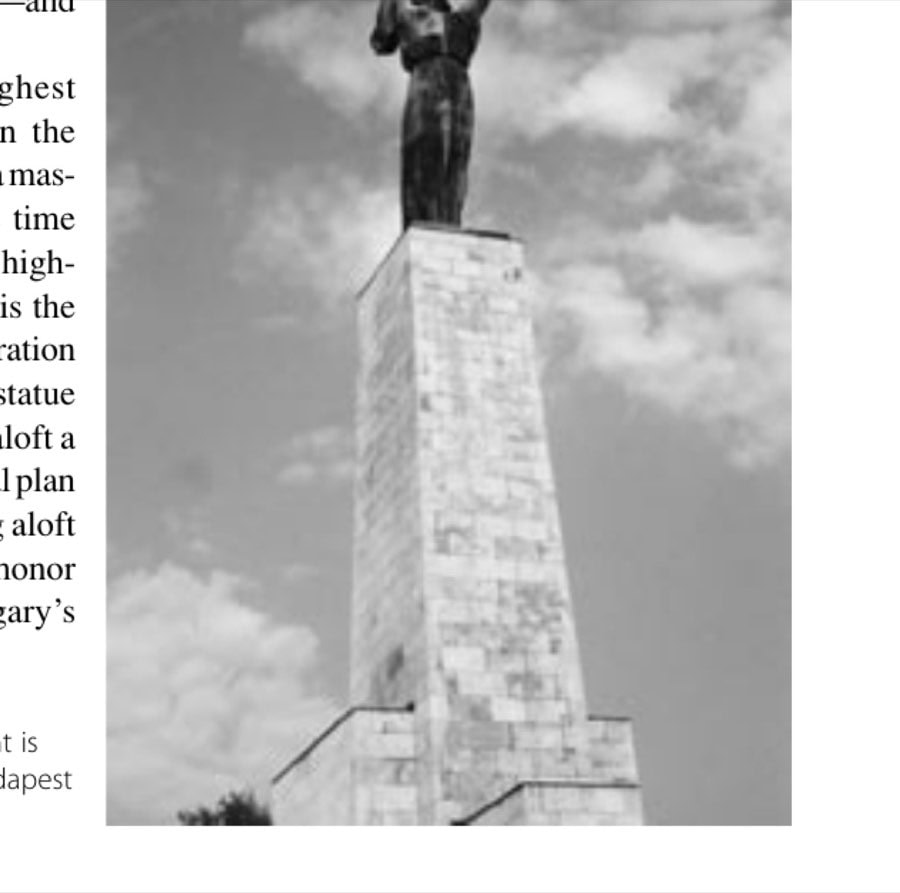
The city is very pedestrian friendly and it bristles with museums and galleries—and tour buses. Perched on the highest point above the city on the Buda side is the Citadel, a massive fortress that at one time sported 60 cannons. The highest point of the Citadel is the Szabadsag Szobor (Liberation Monument), a massive statue of a young girl holding aloft a palm branch. The original plan was for her to be holding aloft an airplane propeller to honor the aviator son of Hungary’s
▲
The Liberation Monument is the highest point in the Budapest area.
ruler, Miklos Horthy; the son died in an airplane crash in the Ukraine in 1942 at the height of World War II. But after the Soviets took over Hungary in 1944 and ousted Horthy, the design was changed. By the time the statue was completed in 1947, the palm branch was used to honor Russian soldiers who had died in the 1944-1945 siege of Budapest. The Communists added giants slaying dragons, Red Army soldiers, and peasants rejoicing at their liberation at the hands of the Soviet army. After Hungary’s liberation from the Soviets, the giant soldiers were knocked down and carted away as the city government continued to excise Communist symbols from its midst.
In early 2006, Vladimir Putin, on a visit to Budapest, acknowledged Moscow’s moral responsibility for the brutal Soviet suppression of the Hungarian uprising in 1956. One generation makes amends for the previous generation’s sins. Putin was 4 years old in 1956.
HUNGARY’S PLACE IN HISTORY Hungary is still wrestling with its history, which is rife with wars and battles. But it does some of its wrestling in the open. During last year’s marathon week, there were two exhibits at the Citadel: one in the Bunker that detailed the atrocities the Nazis performed against Hungarians who didn’t fall into lock step with their German ally during World War II and another (in the hostel on the top of the fortress’s walls) of hundreds of photographs of how children suffer during wars. On the riverside walkway up to the Bunker were displays of Hungarians welcoming the German army during World War II. The Hungarians with whom we discussed World War II and the later Communist oppression are forthright and open in their discussions of their place in history, both good and bad.
While huge, belching tour buses wind their way up to the Citadel, runners are more apt to walk or jog up the steep sets of stairs and asphalt paths built into the hillside; the stairs wind through acres of overhanging trees, and as they switchback up the hillside, they occasionally offer an unobstructed view of the Pest side of the river.
From the Citadel, you have an unobstructed view of the Buda Castle just to the north and the huge Parliament building sprawled along the Pest side of the river to the northeast. It is also easy to see the southern tip of Margaret Island.
If you happened to bring along the Budapest Marathon course map, it is possible from the Citadel vantage point to see nearly all of the racecourse, since the majority of it is run along both sides of the river. The parts that aren’t (the start and finish and the first and last several kilometers) can be seen by zeroing in on City Park to the northeast, to the right of the Parliament building.
The course is literally a tour of the Danube, running as it does on both sides of the river and through Margaret Island.
Budapest Marathon
The starting time for the race is 10:00 A.M.; the late start is to accommodate Hungarian runners who live outside the city, since most of them cannot afford a hotel room within the city limits the night before the race.
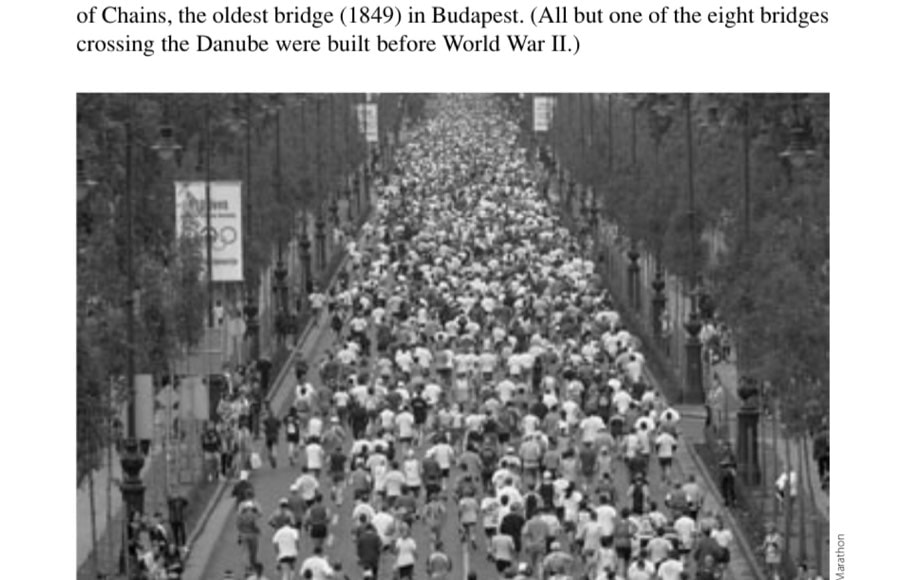
The race begins on the wide Heroes Square—yes, there are statues—which is dedicated to the original Magyar settler tribes and the Hungarian kings who subsequently ruled the country. The square is generous in its proportions and offers a good start area; as the runners speed across the square, they are funneled down by traffic tape to fill Andrassy Avenue, which runs directly toward the river. Andrassy Avenue is wide and is lined with mansions and set off with classic lampposts. A single-lane frontage street runs along both sides in front of the houses and is separated from the main street by a tree-lined pedestrian walkway. Not long after the start, the runners pass the Opera House on their right. Running under their feet is the 110-year-old subway, the oldest in Europe.
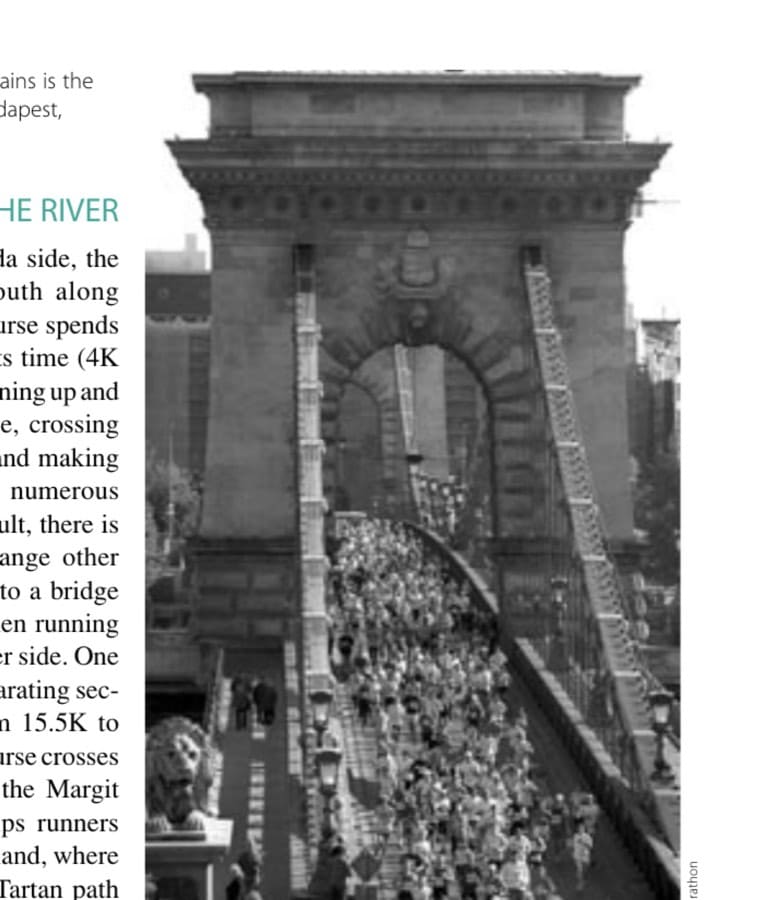
As the course uses up Andrassy Avenue, the surrounding edifices give way to a view of the Danube River valley, where across the river the magnificent Buda Castle spreads out on the hillside; also prominent is the Fisherman’s Bastion (Halaszbastya). Runners cross to the Buda side of the river by way of the Bridge of Chains, the oldest bridge (1849) in Budapest. (All but one of the eight bridges crossing the Danube were built before World War II.)
▲ The miles of the course that do not run along the Danube River run along tree-shaded boulevards.
▲
The Bridge of Chains is the oldest bridge in Budapest, dating to 1849.
Once on the Buda side, the course heads south along the river. The course spends the majority of its time (4K through 37K) running up and down the Danube, crossing it several times and making good use of the numerous bridges. As a result, there is little altitude change other than running up to a bridge to cross it and then running down off the other side. One of the most exhilarating sections comes from 15.5K to 19K when the course crosses the east side of the Margit Bridge and dumps runners onto Margaret Island, where runners use the Tartan path on the east side of the island to reach the north extreme, where they cross over to a section of Buda that features extensive Roman Empire ruins. While on Margaret Island, the course runs through wooded areas, past flower gardens, past a luxuryhotel complex, all the while with the Danube rushing past on the right and an unimpeded view of the Pest side of the city’s waterfront.
After running amidst the Roman ruins, the course comes back down the river on the west side before once again crossing the river and heading north along the east side of it, running directly under the imposing Parliament building. The course then cuts back on itself briefly, heading one street into the Pest side of the city, and runs down Main Avenue, which was originally expected to be a canal offshoot of the Danube but which became a main thoroughfare instead. The course works its way back to the City Park, where it finishes. Besides the showcase marathon, there are five other walking and running events; all six events combined boast 15,000 participants.
Budapest Marathon
A TOUR OF THE RIVER
At the finish area, there are several huge tents set up so that runners can eat sausages and fried potatoes with gravy, drink beer, socialize, and listen to music. The band at one point struck up the Hungarian version of “The Beer Barrel Polka.” The weather for the 2005 20th edition of the marathon was wet but not cold—perfect running weather. At the finish, once the runners joined their family and friends inside the tents, the wet weather outside was forgotten and the celebration escalated, with more and more runners joining the throng and the runners telling and retelling the tale of their success as they do at every marathon in every country in the world. Of course, it was all in Hungarian, but it was simultaneously presented in runner talk, which is a universal language. A sympathetic nodding of the head encouraged the hyper runner to go on with his story—and he did. Some city marathons are forced by the bureaucratic entities that run the places, and sometimes think they own them, to use parts of the city that avoid the most famous and magnificent sights the city has to offer. The
Budapest Marathon is just the opposite. The race committee goes out of its way to take runners past as many historical and architectural wonders as it’s possible to squeeze into 42 kilometers. It’s a special treat on the Budapest course to go by some of the best sights more than once, sometimes past one side (Parliament from the river side) at one part of the race and a little later the other side of the structure (Parliament from the city side). If the Buda side of the course weren’t such a climb, both the Citadel and the Castle would no doubt be on the race route.
The course, by the way, is measured by AIMS (Association of International Marathons and Road Races). Like many European marathons, it has a strict 5 1/2-hour cutoff.
WITH THE RACE DIRECTOR One of the most interesting aspects of the trip was spending a little time with Arpad Kocsis, the very personable race director. Arpad’s English is good—many Hungarians speak tolerably good English and 99.4 percent of Hungarians are literate—and he’s a delightful storyteller. He served as the race director when Hungary was under Communist control. The race began in 1984, and through the Communist disintegration in the early 1990s, the race was sponsored by the government. Once Communism ended, so did the sponsorship. As a result, there was no race in 1994 and 1995. But in 1996, Plus, a German grocery chain, came on board as the prime sponsor.
Under the Communists, Arpad had little trouble getting volunteers and spectators. The party leaders made sure the people volunteered and came out to cheer on the runners. In those days, the fields were never very large: 650 (101 foreigners) in 1984; a high under the Communist sponsorship of 1,180 (415 foreigners) in 1987; and 958 (117 foreigners) in 1993.
Since then things have changed. The race has grown: 738 (46 foreigners) in 1996; 2,444 (729 foreigners) in 1999; and 3,300 (1,300 foreigners) in 2005. But the volunteers, resenting the years they were forced to volunteer under the Communist government, are now paid volunteers. Arpad pays volunteers two to three euros per hour for their work. The race employs some 1,500 volunteers. Arpad, always the upbeat race director, predicts that for the 25th annual running, the marathon will have 5,000 entrants. Roughly every 800 meters along the course there is something to distract the runner, whether it is a water stop, an especially beautiful view of scenery, or a live band. The race does not give out age-group awards. “We gave that up,” Arpad said. “Some years ago the mayor came to help give out awards, but the award winners didn’t show up. It was a waste of everyone’s time, so we stopped doing it.”
There is modest prize money, so professional runners in the prime fall racing season do not typically race Budapest. First-place money is 150,000 Hungarian florints (equal to $750 US), although there is generous time bonus money available, but only to Hungarian runners (750,000 HUF to a sub-2:12 male or sub-2:28 female). To put that in perspective, in 2004 a Hungarian woman, Simona Staicu, won the race but did so with a 2:38, while on the men’s side, Roland Adok took second place with a 2:26.
COURSE CHANGES Because of construction and other events going on in the city, the course must be changed every two to three years, but the primary sightseeing elements remain. Arpad wants to make the
Budapest Marathon the best in the area—an area he defines as the former wall of Iron Curtain countries, although he stresses that now that Hungary is a member of the European Union, many Hungarians no longer see themselves as Eastern Europeans but rather as Central Europeans. This means that his competition for top marathon in the area may also include Vienna and Hamburg.
The Budapest Marathon currently has cooperative promotional arrangements with the marathons in Prague, Hamburg, and Rome and is working to set up similar arrangements with Vienna and Ljubljana. Europeans take their marathoning very seriously. “There was a very good 70year-old runner who ran our race,” Arpad said. “But he stopped running it when he could no longer break four hours. Very serious.”
The marathon staff is actively promoting its race to foreign visitors. The city of Budapest can accommodate 36,000 tourists, and with the softening of the borders after the Eastern European countries joined the EU, their capitals are lively and thriving. Think of Budapest as a close cousin of Prague.
For more information, visit the marathon Web site (www.Budapest Marathon.com) or e-mail Budapest.run@t-online.hu.
This article originally appeared in Marathon & Beyond, Vol. 10, No. 4 (2006).
← Browse the full M&B ArchiveMore like this
1,000+ stories from 19 years of Marathon & Beyond
The complete archive of the legendary long-distance journal — digitized and free to read.
