Camp-Town Races Five Smiles Long

Camp-Town Races Five Smiles Long

FeatureVol. 13, No. 5 (2009)200963 min read

running 100-milers such as the Kettle Moraine. It was fabulous. Imagine camping without ever having to set up camp! Your little house comes with you—including your little icebox, propane stove, sofas, closets, toilet, shower, and bunk beds in the back. You cannot believe the monetary savings over motels that such conveyances can convey over some years of traveling around in order to run around.
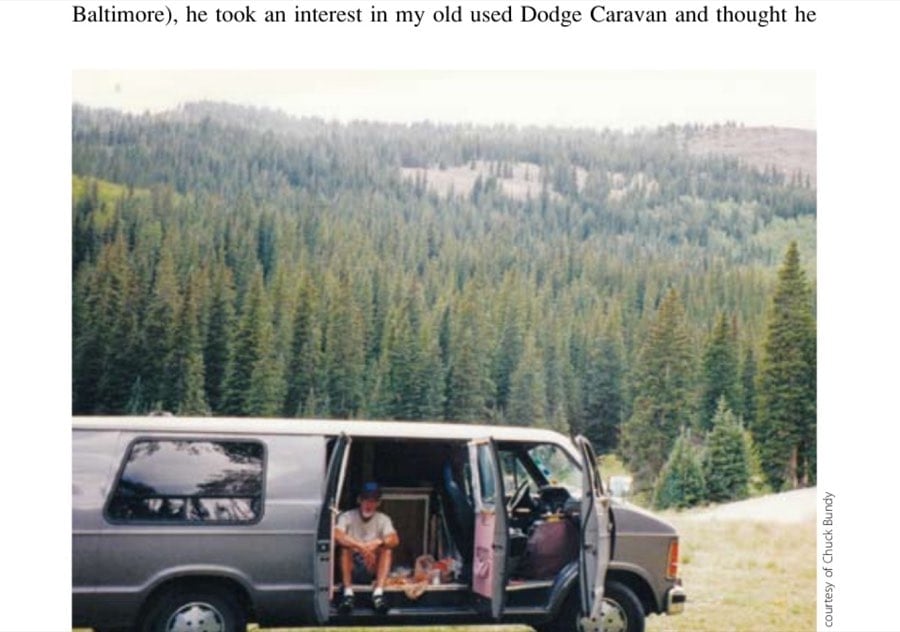
Before Hans and his mobile, there was my mentor, Chuck Bundy, and his van. It quickly dawned on me that traveling to distant venues by airplane, then car renting, and then motel staying is the /east preferred way to run long races. The best way is to camp, and the best way to do that is with your own camper. Chuck had his van (first one, then another to replace it after years of use), and it, too, was conveniently outfitted with bed, closets, icebox, space for additional sleepers, and a little portable stove. Many a night before an ultra I was privileged to spend inside that folks’ wagon.

Ina pinch, of course, almost any van for camping will do. Before Hans-Dieter shipped his Italian Fiat Hobby RV over here (yes, on a ship from Germany to Baltimore), he took an interest in my old used Dodge Caravan and thought he

Photo courtesy of Chuck Bundy

Chuck Bundy sitting in his specially outfitted Dodge Maxi-Van somewhere out west. Inside are a large bed, an icebox, several closets, and a portable camping stove—perfect for traveling around the United States and running trail races and ultras.

might like to buy it. He liked how the back seats could be removed and the trucklike space made into a living area—well, sleeping area. I refused all offers, of course, because I seriously needed that sleeping area. I still do, although now I have a newer Grand Caravan in which the back seats all fold down into the floor. Perfect for camping!

Van modification is practically a given among runners who own such things. Ultrarunning mensch Mike Dobies, an automobile engineer from the Detroit area, has very effectively reengineered his van into a kind of double-decker bedroom. He built a convenient wooden shelf halfway up the space, upon which is a comfy mattress and under which is wonderful storage area. The beauty here is that, unlike most vans where you first need to rearrange all your gear to make room for your sleeping bag, in Mike’s van nothing has to move! You simply sleep on the bed above all your gear! Genius!

Anyone who has seen the inside of John DeWalt’s van might not, however, use the word “genius” or even “engineering.” No, John’s van is a hodgepodge. A very full hodgepodge, complete with every sort of apparel, accoutrement, nonrefrigerated foodstuffs, and dietary supplements ever conceived on the face of this earth. John’s a vegetarian and former owner, in fact, of a health food store. He knows everything there is to know about healthy eating. Let the facts state the proof: John’s now in his 70s, and he still finishes the annual megatough Hardrock 100-miler in Colorado, where you must climb 12 mountains over 13,000 feet, up and down, and 11,000 feet is about the average elevation. So, who am I to argue about John’s apparently unkempt van?

Not so easy, rider!

In my wild and reckless youth, I figured that the best way to travel coast to coast was by motorcycle. (I think I was more than incidentally inspired by the movie Easy Rider.) My claim to fame as a kid was actually riding one all the way to Alaska—which, from Chicago, is a 6,000-mile ride one way. It was also my wild and stupid reckless youth: I had no tent with me! Many a night alongside the Alcan Highway, I snoozed with the moose in a bag under the stars or rain. I very quickly learned the value of shelter.

Imagine my surprise years later to witness another motorcycle camper. Yes, with my own disbelieving eyeballs I watched Tom Possert roll into the Big Cove Campground at Tennessee’s Frozen Head State Park on a Harley! First of all, that’s the place where just about the toughest ultra on earth takes place, so to do this on a motorcycle with just a little tent and zero comforts of home, you’ve got to be about the toughest human on the planet (which, for my money, Tom is). I can’t imagine—couldn’t then, and still can’t now—desiring to risk riding through storms, packing next to nothing, to get to a place where you’ll probably

have to run through storms and have no comforts once you’re done. That must be the definition of “tough.” The main point of camping is to be so close to the start/finish that you don’t have to drive afterward, but the number two point is to have as much comfort as humanly possible (spacious tent, bulky bag, foam rubber, pillows, and all kinds of clothes, sandals, and clean underwear to change into afterward inside that tent). If you travel by motorcycle, you can kiss all that comfort good-bye!

But perhaps Tom himself was inspired by more than a movie. For years I have heard Chuck tell me about some old ultrarunner (nobody seems to remember his name) who always traveled by motorcycle and always rode with his dog. He apparently rode vast distances, using just that mode and accompanied by just that mutt, to run such races as the Leadville Trail 100 in Colorado. “It was a chow,” Chuck said, “and it sat right behind the guy on the seat with his snout on the guy’s shoulder, holding himself there without being strapped down or anything else.” I would have loved to witness that, but it was before my time.

I cannot leave the topic of motorcycle camping without bragging some more. It just so happened that my first cross-country (Canada) ride took place in the summer of 1974—the very year that Gordon Ainsleigh got off his horse and ran that erstwhile 100-mile horse-race distance from Squaw Valley to Auburn, California. I later met Gordon at the Western States 100-Mile Endurance Run (in 1997) and told him about my motorcycling. In ’74, on my way back from Alaska, I happened to show up at Squaw Valley just two months after Gordy’s historic accomplishment. Little did I know!

But of course, I was really no kind of motorcycle rider compared with Gordy himself. He promptly revealed how during the ’70s he would ride a Kawasaki (I think) up Devil’s Thumb to cache water jugs near Michigan Bluff! I could not imagine this and (with jaw dropping to floor) told him so. Let me explain. Devil’s Thumb is a sheer canyon wall with a trail starting from some river and going straight-the-hell up for something like a mile. If anyone besides Gordy were to try riding a Kawasaki up the Thumb, that rider would fall over backward.

By the way, Squaw Valley is the start of probably one of the few 100-milers where you can’t camp. They want to rent or sell you time shares in all the Squaw’s condos. So, disregard the last paragraph.

A whole chapter ought to be devoted to Egor

One slight step up from motorcycle camping is back-seat-of-car camping. I know of several ultrarunners who do this. One is David Hughes of Kokomo, Indiana. David likes to brag that, unlike me, he fits comfortably sprawled lengthwise on his car’s back seat. So, he can sleep there—and does!—and this allows him some terrific accommodational flexibility. He can—and does!—park almost anywhere

the night before a big race, which means he doesn’t even need to seek out a campground.

But there are also some slight risks involved, such as the sheriff. Any car parked overnight by, say, a trailhead, side road, or Hardee’s parking lot is subject to the same window-knocking-and-flashlight-shining that many of us may have experienced as teenagers parked on lover’s lane. I myself have been awakened by just such a sheriff at just such a time on just such a lane in Walworth County, Wisconsin. No, not for “sucking face” but for trying to get some sleep before the Kettle Moraine 100. (Note to future runners there: you can park overnight in the Nordic Lot only after the race has started; not before, and not once it’s over. But there are bona fide state forest campgrounds within a few miles of Nordic.)

Other characters besides yours truly known to have camped inside cars and, yes, trucks (!) include Egor Egan and Lazarus Lake (aka Gary Cantrell). Egor, I’m told, was a pretty good ultrarunner “back in the day” who used to drive thousands of miles with his pet and camp in the back seat—which was all covered with newspapers and, some say, bear grease. According to ultra veteran Marv Skagerberg, “If I recall correctly, he covered his entire body with Vaseline against the cold and ran in shorts in all weather. His car, in which he slept, was filled with Vaseline-soaked newspapers. All in all, he looked a lot like a homeless guy with a beat-up old car.

“He also had a dog,” Marv continued, “I think a shepherd. No problem caring for the dog during a 50-miler or even a [New York City] multiday. He just turned it loose in Flushing Meadow Park and told it to forage in Queens for a few days, which it apparently did successfully, as it always returned when Egor was ready to leave.”

Gary (Laz) remembers Egor’s infamous lean when he ran. After each loop in a multiloop race, Egor would apparently run right into his car, fall down, crawl to the front of the aid-station table, and pour fluids down his throat while on his knees. “At the end of the table,” Gary says, “he would clamber to his feet and stagger back out onto the course, fully tilted and barely moving. Of course, by the end of the lap he was running like a maniac again. If I remember correctly, he got 50 miles in just over nine hours running that way.” Gary’s overall evaluation? “Egor’s greatest service to the ultra community,” he said, was “when he attended a race, just for a little while the rest of us got to feel like we were normal.”

Chuck Bundy also recalled the king of lean. “It was because he was so tall!” Chuck (perhaps kiddingly) exclaimed. “The man was huge! He had to /ean all the time to keep from hitting his head!”

DeWayne Satterfield remembers that particular nearly naked leaning, slamming, crawling, and drinking method of Egor’s and adds this about that same race in a different year: “The temps were in the upper teens. Egor blasted away from us for the first 400 meters before slowing. He was wearing shorts and a short-sleeve

shirt. As I passed him, he quipped, ‘Pray for shade; I’m going to die in the heat.’ I was bundled with two pairs of gloves and several layers of clothes.” DeWayne also recalled yet another possible hazard of back-seat camping: “After the race that day, Egor told me of once missing a race because he passed out from carbon monoxide leaking through the floorboards of his car.”

Your very own customized camper

Don Adolf is an ultrarunning veteran who, I think, got started running whenever the first humanoid did. I know him fairly well because he’s a friend of Chuck’s and is now retired from the Chicago Park District. Don’s the guy who used to have the keys to the beach houses that used to serve as warming houses during lakefront ultramarathons during the winter. And they weren’t messing around. My very first ultra was a 5OK in February during temps in the teens with a six-hour cutoff. I ran 6:09 and came back to the beach house to find the door locked and my runner’s bag tossed out in the snow.

Don has since become my hero because he travels the country going from race to race and ultra to ultra by camping inside his little red pickup truck. He doesn’t exactly have a truck only but a little camper unit that fits on top of the truck’s flatbed. He practically lives in the camper. No address, no telephone, monthly

pension checks mailed to some PO box, and. . . need there be anything more? This is paradise, no? Certainly I know other ultrarunners who’ve thought so. One told me specifically that what she wanted to do most in life was finish her career, buy a little camper, and spend her retirement “‘just like Don Adolf.”

Our aforementioned running legend and present-day multiultras race director Gary (Laz) Cantrell’s ode to Don is his own flatbed truck—would you believe a Willys Jeep from World War II?—which Gary has outfitted even less comfortably than Don has. After first completely rebuilding and restoring the thing, Gary then invented a sleeping space in the back by fashioning plastic PVC plumber’s piping into a kind of cage over which a big, heavy tarpaulin can be secured. Gary then puts a nice comfy mattress inside that space and goes to sleep—generally as seldom as possible. The first any of us normal, happy campers saw this blue monstrosity was at Barkley a few years back. We were at once appalled and amazed. Laz, however, was unfazed. To your basic Tennessee redneck man of genius, a contraption like this for camping is nothing short of perfect.

And maybe Gary’s setting a trend. At the very latest edition of Virginia’s Massanutten Mountain Trails 100, where camping is allowed and encouraged, I personally witnessed yet another pickup truck outfitted like Lazarus’s with the box and

a £ @

A The author’s (borrowed) tent set up next to another camper’s pickup truck specially outfitted with framework and tarp for sleeping—after the fashion “invented” by Gary Cantrell of Barkley fame.

the tarp under which the runner slept. Otherwise the ranch was surrounded by RVs and motor homes and quite a few tents, into one of which I myself crawled. For indeed, the mark of the true running camper is the tent.

Dim lights, no city

At any big park or national forest or the like wherever there’s just naturally a campground, you can always pay the fee and pitch a tent. Some places are so backwoods, or “primitive” as they call it, that you couldn’t drag your house bus in there if they suddenly, instantly transformed the road into an interstate highway. Some areas where trail races are run are just so remote, so Jeep-road-ish and overwhelmingly muddy, that you don’t even want to drive your car there—in which case, you will be glad you flew into the nearest airport and rented one The annual Carl Touchstone Mississippi 50M/50K/20K is just such an oftenmuddy place, happening during the spring monsoons in the DeSoto National Forest. I recall with fondness Carl himself and none other than the renowned Norm Klein helping to push my rental out of its parking place one year. In fact, that Mississlippery race is the one venue I know with this unique claim to fame: the forest rangers actually shut the race down—twice!—due to rain. So much rain came down that the creeks swelled to raging rivers with water depths well over

most runners’ heads! The rangers figured they would be saving lives by stopping the race. I myself thought it had suddenly become a triathlon.

Probably the race that most ought to be shut down (and indeed politicians have tried to do just that) is the infamous Barkley Marathons (plural because there are what amounts to five of them for the full race) at which you absolutely must camp in order to participate. The whole thing begins and ends at a small public campground inside Tennessee’s Frozen Head State Park and Natural Area. The camp only has room for fewer than 50 campers (doubled and tripled up on sites), so that’s why the event can accommodate so few participants. Of course, if you’re in your right mind, you don’t want to do this anyway.

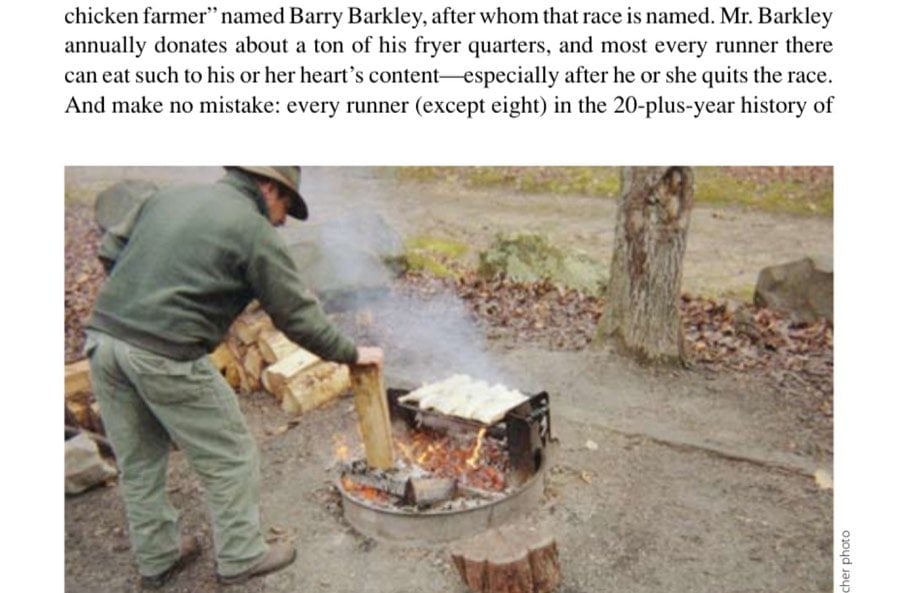
Despite whatever you may have heard or learned about this “race” (the term is used loosely), it’s the camping that makes it the most fun. It’s a relatively rustic campground (no electric hookups, for example, except for recharging laptops and cell phones in the bathhouse), so most folks sleep in their cars or vans or pitch tents. The other amazing fun part has to do with race headquarters (campsite number 12) and its ever-blazing campfire on which is cooked that other infamy: Barkley chicken. The reason for the chicken is a “scruffy, unkempt Tennessee chicken farmer” named Barry Barkley, after whom that race is named. Mr. Barkley annually donates about a ton of his fryer quarters, and most every runner there can eat such to his or her heart’s content—especially after he or she quits the race. And make no mistake: every runner (except eight) in the 20-plus-year history of

Rich Limacher photo

Carl “Rawdog” Henn tends the 2008 Barkley Marathons’ campfire. Note the full rack of infamous frozen and uncooked Barkley chicken.

the race quits running the race. It may just have the greatest DNF percentage of any footrace in history!

But, for sure, it’s got the most fun, the coolest camping, and the best chicken!

What Would a Camping Article Be Without Camping Tips?

Here are a few things about camping that you don’t want to ignore, fail to prepare for, or forget:

1. Always check your intended race’s Web site or seek info about it in magazines or elsewhere—especially if it’s touted to be a “trail” race. Note the location, environs, parks, available camping facilities, and fees.

2. Unless you’re backpacking along the trail itself (not recommended if you intend to run a race, not always possible, and not always legal!), you would be best advised to contact the campground and make reservations well in advance. Realize that campgrounds are generally fairly small and always limited in space.

3. If you’re flying and then car renting, be aware of exactly how much camping gear your airline will allow on the plane. And these days you may be charged extra no matter how little you bring.

4. Be aware of car-rental issues, like restrictions on who’s driving, where you can and cannot drive to, not running out of gas in the middle of the forest, and how much tent gear and other stuff will actually fit in the car. Don’t rent the cheapest, tiniest go-kart available and expect to drive it over Ophir Pass on the Hardrock course, for example. You may very well need a Jeep, van, SUV, or Hummer!

5. If you are planning to camp, it’s almost always better not to rely on public transportation; just drive your own Jeep, van, SUV, or Hummer. (Hey, if you own a gas hog in this day and age? Shame on ya!)

6. Know how to erect your tent before you get to the campground. You might get there after dark, and you could seriously be in trouble if it’s a brand-new tent still in the box—especially if in addition to pitch dark it is also pouring rain.

7. Bring cash, and in denominations smaller than $20 bills. That way, if you do arrive at the camp after dark or the office has closed, you

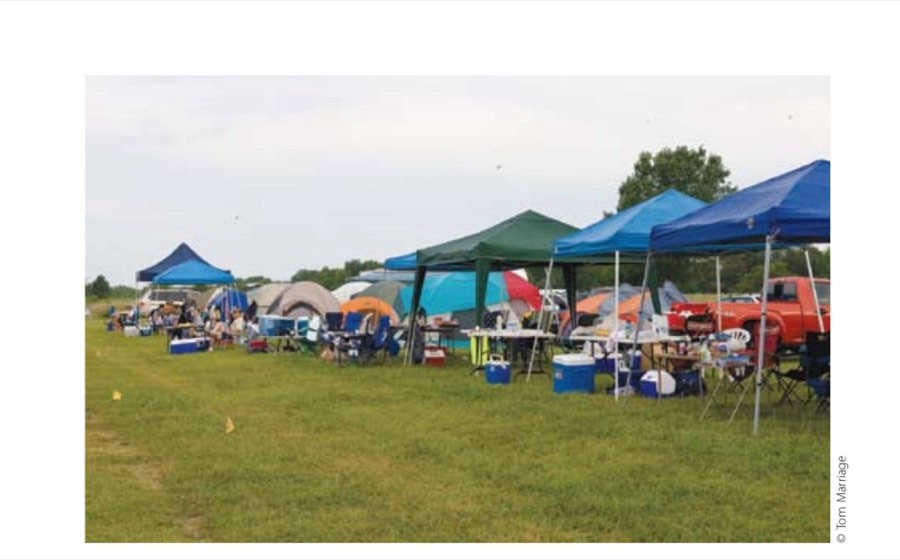
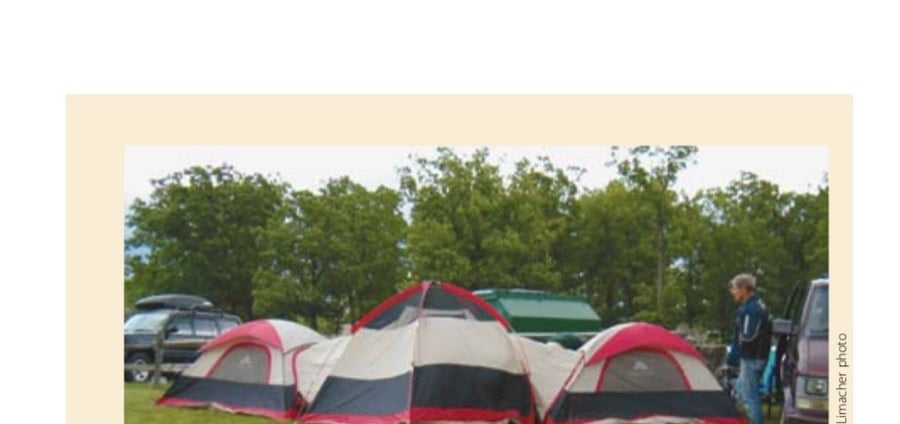
A This fairly massive temporary housing unit, complete with east and west wings, was set up on the lawn of the Skyline Ranch in Front Royal, Virginia, presumably to accommodate 2008 Massanutten Mountain Trails 100-mile runners.

can still claim a campsite (if available, or you’ve reserved one), but it will be on the honor system. Just about every park will have an unmanned drop station where you can fill out a site-claim form, put cash for your first night into an envelope, and then deposit it through the slot in the station. Then, after you wake up the next day, be sure to check in at the office to pay for all additional nights’ stays. Otherwise, you will be approached by a ranger. Your camping experience will always be much more pleasant after you pay the man.

Bring a pen or pencil! The reason is obvious (reread number seven) because sometimes at those unmanned drop stations, there’s nothing to write with.

Don’t forget to bring your personal “stuff.” Campgrounds aren’t motels, so you will not find supplied towels or little shampoo bottles. You must bring your own towels, shampoo, toothpaste and brush, shaving gear, and soap.

Don’t forget water, or empty jugs to fill with water, because you will need it at your site for stuff like cleaning up, brushing your teeth, washing all the plastic silverware you’ve stolen from McDonald’s, and filling your water bottles or CamelBak bladder before you actually start running your race.

If you need any more hints or tips than these, you really shouldn’t be camping. Check into the nearest Motel 6 instead.
Rich Limacher photo

Equalization

A short story.

a drumbeat that seemed to shake the world. My ears roared. I had no idea where I was—I barely knew who I was.

That much was normal. In the past two decades, I’ve gone through it enough times that I’m almost used to it. But then, with a suddenness that was nearly palpable, everything snapped into focus. The colors faded to the muted pastel of an ordinary ceiling, and the drum and roar receded to the murmurs of heartbeat and breath. I was lying on my back on a cot in an equalizer’s office.

I shouldn’t have awakened so quickly. Something must have gone wrong, aborting the procedure before it had truly begun. I tried to sit up, wanting to see more of the room than the ceiling, but the restraining straps stopped me with a jerk that nearly pulled a muscle.

“Now, now,” scolded a voice somewhere to my right. “You’re an old hand at this—you should know better than to move around right after you’ve been equalized.” The owner of the voice drifted into my field of vision. Short, balding, and slightly paunchy, he was wearing an equalizer’s lab smock, but he wasn’t the equalizer who’d put me to sleep however many moments before. And the portions of the office the straps allowed me to see, I now realized, were subtly different. Where earlier there’d been a bookcase, a coat rack now stood. Where there’d been a photo of a desert sunset, there was now a watercolor painting of fir trees and snowy mountains. I’d gone to sleep in Cape Town, South Africa. At a guess, I was now on the west coast of North America.

“It’s over, then?” I asked, surprised by how readily I found my voice.

“Of course. Once you get your wits back, you’re all set for another year’”—he consulted his clipboard—“on the track. First, though, you have to get reoriented.” He unfastened the straps. “You can sit up whenever you’re ready.”

I raised a hand and brought it into view, carefully curling the fingers into a fist, then relaxing them. Something was definitely wrong. The motion looked fluid and natural, with none of the jerks and twitches that should have been there as my mind fought to control a new body. I flexed the hand again, then automatically scratched an itch. The itch vanished—I’d found it first try.

\ wareness arrived as a riot of colors, swimming in patterns that pulsed to

That made me more uneasy than ever. Even though it was foolhardy to consider getting up yet, I had to find out what was going on. Carefully, I propped myself up on an elbow, then swung my feet to the floor. Out of the corner of my eye, I could see the equalizer. “You’re getting the hang of it quickly,” he said. “Whenever I work with one of you, I’m always amazed by how fast you athletes adjust.”

“That’s because we’re trained to be sensitive to our bodies,” I mumbled. “But—’” I broke off. /’m not having to concentrate, I’d almost said. But why tell him? Nothing good could come from that.

Trying to walk with a studied stride (but actually moving with inexplicable ease), I crossed to the equalizer’s full-length mirror. “Let’s see what I’ll look like this year.”

The figure staring back at me was tall and small boned, with the nearly cadaverous slimness of the professional distance runner. It was wearing a red-and-white tracksuit, and reassuringly, it wasn’t my previous body. The equalizer was right; the mind transfer had indeed been successful.

Still, something was wrong. My coordination was returning far too quickly. Already I felt as though I’d been in this body for hours. Furthermore, it looked familiar. At one level, that wasn’t surprising. Even though recent advances in equalization have made track and field a wildly popular sport—a gambler’s paradise in which most races end in sprint finishes—there are only a few hundred professional runners worldwide. It’s not uncommon to recognize a new body. Tracking down the training patterns and racing strategies of the body’s prior owners, in fact, is a much winked-at, if technically illegal, aspect of the sport. Yes, it does give you an advantage, but if everyone obtains the same advantage, then it’s not really unfair, right?

This was different. In recent equalizations, I’d been in South Africa, Australia, Japan, Kenya, and Finland. Wherever this body had been, I’d never seen it in any of those places—at least not used by anyone who knew what he was doing.

So, where have I seen it before? I wondered. Then, realizing that, knowing winks or not, it’s unwise to think such anti-egalitarian thoughts in an equalizer’s office, I tried to put the whole idea out of my mind. But it was no use. Like a dog worrying a bone, I kept coming back to it, first searching recent memories and then older ones. That thick, tightly curled hair was distinctive, but I couldn’t remember it on any of my previous competitors. I reached further back in memory and suddenly found a possibility. It was preposterous—so preposterous that I almost dismissed it. It was also easy to confirm. Feeling silly, I bent down and pulled up the right leg of my warm-up pants. And there it was, just where I remembered it, an inch-long scar, somewhat faded with the years, still present as a souvenir of a time long ago, when I’d collided with a picnic bench while playing catch at the créche.

I was dumbfounded. Oblivious to my surroundings, I stripped to my shorts and examined my body carefully. Somebody—or rather, several somebodies—

had taken good care of it since I’d last seen it. The muscles were taut. There was no excess fat. There were a few more scars, but no signs of surgery. I tested the ankle I’d sprained several times as a child and found it strong and apparently stable, although only a good workout would show for sure.

Abruptly, I remembered the equalizer. I should tell him and be reequalized, I thought, as with exaggerated care I went through the motions of dressing. Keeping this body is anti-egalitarian. I already know how to use it—I’ll have an unfair advantage. Besides, if it’s anywhere nearly as good as it once was, there’s been a big mistake. I don’t deserve it; I had too good a season last year. But I didn’t speak. Social duty be damned, | thought, I want my body.

ES Eo * That thought struck a responsive chord, and suddenly I was 14 years old again, standing before my first equalizer.

I’d been simultaneously nervous, honored, and excited. Nowadays, they routinely equalize children at that age, and there’s talk of dropping the threshold to 12. But when I was decanted, nobody under 15 had ever been equalized, and most people had to wait until they were 16. It was only as I approached my 14th birthday that the eggheads decided that the 14-year-old brain was well enough developed to handle the shock—and budding athletes such as me were the first ones to be given the opportunity. I now suspect that we might have been viewed as expendable test subjects, but with the smugness of youth I presumed we’d been chosen because we were the most deserving. For two years, I’d been the fastest in my créche, largely due to the luck of the genetic draw—the rare fortune of a runner’s mind naturally appearing in an athletic body. I was eager to prove myself against a cadre of equally good teenagers.

“Aptitude diagnostics show that you have two options,” the equalizer began. “Thanks mostly to all the training you’ve done, your body will definitely become a distance runner. Your mind, on the other hand, can either be equalized into premedical school or remain in athletics. You’re fortunate to have a choice. Which would you prefer?”

“TI go with my body,” I replied automatically.

The equalizer gaped in horror. “Young man, that’s one of the most anti-egalitarian statements I’ve ever heard. If it weren’t for your age, I’d put a reprimand in your file. As it is, I’m tempted to send you into premed just to teach you a lesson.”

Icouldn’t believe my ears. Running was all I cared about, and now I was going to lose it, just because of one stupid remark. “I—I didn’t mean it that way,” I managed to stammer. “I just meant that I wanted to go into the same career as this body. I know I can’t keep it. That’s—that’s obvious.”

The equalizer sat silently for a long time. When he spoke, his reproach was surprisingly gentle. “I think you at least wanted to keep an eye on it, didn’t you?”

I didn’t know what to say. With a single computer stroke, this man could erase my dreams. He himself might be outranked by his own equalizers and the faceless monolith of Equalization, but even a low-level equalizer is the closest thing to God a teenager ever sees. By comparison, coaches and school principals were nothing— and besides, in school there was a tendency for old transgressions to be overlooked as equalization shifted the memories, if not the faces, of teachers and coaches. Here, for the first time in my life, I was looking at a truly permanent decision.

And yet, there was something about the equalizer’s attitude, something that inspired confidence. To my dismay, I found myself nodding. “I—I’m afraid so, sir. I know it’s wrong, but I’ve put so much training into this body that, well, I’d kind of like to see what happens to it.”

“T thought so. But that can’t be. If you become a runner, it and your mind will be equalized into separate academies. There’s no guarantee that either you, or it, will ever graduate onto the professional circuit.”

I knew that, of course. However permanent your choices at First Equalization may otherwise be, you can still wash out of your chosen academy. People and bodies that don’t make the grade become factory workers and shop clerks. I sometimes envy them for having to be equalized only when they get promotions or hit those magic birthdays when it’s everyone’s turn. But generally I feel that way only when the lights are spinning as my consciousness fights for control of yet another new body. At age 14, all of that lay in the future.

“Do you still want to be a runner?” the equalizer asked.

“Yes, sir. That’s all I ever wanted, as long as I can remember.”

“You realize what will happen if you do? You’re unusually competitive. To balance that, you’Il always get an inferior body. Running won’t be as easy as it is now.”

“I know, sir. That’s OK. I believe in equalization.”

The equalizer again sat quietly, his gaze still centered on me but his attention seemingly elsewhere. I fidgeted, then tried to mask my unease by mentally tracing patterns in the weave of the carpet. I had the uncanny feeling he was reading my very soul, ferreting out secrets I was afraid to admit even to myself.

When the equalizer finally spoke again, my heart leaped, but his words were bland. “Maybe you do, Andru, maybe you do. Well, I won’t punish you this time. In the future, though, you’d better watch what you say, or someday you’ll be facing serious charges. Now get out of here and come back on Athletic Equalization Day, next month.”

Thad fled, grateful for the decision but smarting under the rebuke. / believe in equalization, I’d told myself. Or at least I want to believe. Isn’t that good enough?

ES Eo * “here, take a drink. You stood up too fast. You athletes are all the same; you think you can do anything. Come over here and sit down. Do you need help?”

I wondered how long I’d been standing before the mirror. Too long, obviously. Luckily the equalizer had misunderstood.

“Thanks,” I murmured. “I guess I did push things a little, but I think I’m OK now. Just tell me where I live, and I’Il be on my way.”

“You’re sure? Well, you athletes are a self-sufficient lot. Guess it goes with the trade. You’re in Vancouver, British Columbia. Welcome to Canada, and all that. If you like the outdoors, there’s a lot of it, not all that far to the north— whichever way that is. Downtown is all linked into a pedestrian mall with sky bridges between the buildings and all that stuff. It rains a lot around here, or so they tell me. Me, I stay indoors. Speaking of which, you live in . . .” he consulted his notes, ““Arco-block 51C.”

I nodded. Normally, I have to jot these things down, coming out of equalization, or I’ll forget them. Today my memory seemed preternaturally sharp. It was as though I’d spent all the years since First Equalization somewhere between my second and third beers, without the benefit of a good buzz, and was only now sobering up. Intellectually, I’d long known that mental acuity is part “mind,” part “brain.” That was why equalization works for doctors, lawyers, artists—and equalizers. If your mind is sharper than needed for your profession, Equalization will blunt it with a poor-grade brain. If your mind is a bit dull, Equalization will match it to an unusually efficient brain. I think it has something to do with neurotransmitters and brain architecture, although I’ve never bothered to read up on the biochemistry. I’m innately fairly bright—an advantage, even in athletics—so I’ve never had the experience of being put in an intelligence-boosting brain. I wondered if it would feel as though you were always jacked up on caffeine. Or would it simply feel like being perpetually on one beer, rather than two?

The equalizer was continuing to spout numbers. “You have apartment 3702. The door’s already keyed to your new thumbprint. Don’t try to walk—it’s over two kilometers. There’s a well-developed slide-way system, with maps every block.” He put a hand on my shoulder. “Run with the pack,” he intoned as though it were an official benediction, rather than something he’d apparently made up himself. “And remember that anyone should always be able to win. Win your share, but for the sake of Equalization, let us hope that both your victories and your losses are by the slimmest possible margins.”

It was my last chance for honesty. Jf] get caught, I thought, they’ll have no mercy. But I was already committed, so I shook the equalizer’s hand, mumbled a few platitudes, and with feigned caution picked my way through the equalization chamber and into the corridor outside.

Eo * * I didn’t go straight to my apartment. I felt too good, too much alive, to be cooped up. Besides, tomorrow would be the regional Shakedown Classic—always the day after equalization—and I wanted to try out my body. Theoretically, the best

way to do that would be to find a terminal and ask the Net where the local pros trained. But a professional track wasn’t safe; I wanted to test my speed, and the results might raise eyebrows among knowledgeable observers. So I drifted with the slide way, looking for a drop-in health club.

I found one right away, although the walkway had carried me past it before I saw the sign. I got off at the next junction, doubled back to the entrance, and found the usual assortment of ball courts and exercise machines. I’d figured that the only place to run would be in the rainy outdoors that my equalizer had apparently never seen, but a sign informed me that this place had actually managed to cram a 400meter tunnel track into the perimeter of an office building a half-dozen floors above me. The locker room, pleasantly enough, was on the same floor as the track.

I’d forgotten how cramped such places are, especially compared with professional facilities. I wasn’t claustrophobic, though, and I could tolerate an hour or so of low ceilings and narrow passageways.

I pulled off my warm-up suit and tossed it into a storage locker, thumbing the ID panel to authorize the charge. Another thumb scan opened the door to the warm-up room.

Even though it was the middle of the afternoon, the room was nearly full. As I picked my way to an open floor mat, I caught several hastily averted stares and could almost feel the ripple of excitement as people saw my red-and-white uniform. A maple leaf decorated its front side, and in case people missed that, the back of my singlet proudly proclaimed “Team Canada.” At one level, all of that was silly. Yesterday, I’d been part of Team South Africa, and next year I could easily be Brazilian. It wasn’t the regional icon per se that caught attention: it was what it said about my status as a runner. I would have gotten nearly as strong a reaction if I’d still been in my South African togs. The uniform simply announced that I was a top pro, and that always drew attention.

I was used to that response—I sometimes get it on the slide way, as well—but this time I’d rather not have been noticed. For a moment, I considered leaving, then changed my mind. No one would be likely to report me—most of them wouldn’t be able to distinguish an exceptional workout from an average one.

As I began my usual stretching routine, I was startled to discover just how stiff my muscles were. The problem was tension, I decided. I was afraid Equalization would catch its error before I had a chance to capitalize on it. Or worse, it might catch me before I’d even decided what I wanted to do. I could win tomorrow’s race easily, of that I was sure. But I wanted more. I wanted to do something really significant—something I could remember with anti-egalitarian pride no matter how they punished me. I’d get only one opportunity before Equalization would be alerted that something was amiss. It wouldn’t give up until it learned the truth.

Still fretting, I trotted onto the track. I did my first lap slowly, moving no faster than the better recreational runners. A large cluster of them soon formed around me,

enjoying the thrill of keeping pace with a professional. They’ re as anti-egalitarian as I am, I realized. They envy my speed. And Equalization allows them—no, encourages them—to do so, just as long as I’m not a member of their own class. No wonder professional sports are so popular. Why didn’t I see that before?

Then I put aside such thoughts. I was in my element, running and listening to my body, looking for aches or twinges that might reveal old injuries or present weaknesses. When I found no problems, I picked up the pace, smiling to myself as one by one my companions fell behind. I was running lightly and smoothly at just a little faster than my previous body’s natural training pace. My coordination was perfect. The ankle was strong. It had been years since I’d felt so good. Mind and body belong together, | thought, and for the first time, there was no accompanying twinge of conscience.

For the last 400 meters, I sprinted flat out. Got to find out what I can do. By the time I reached the finish, I was gasping for breath, but elated. I couldn’t believe my watch. It was the best 400 I’d ever run! In fact, it was the best that any 10,000-meter runner I knew of had ever run. If I could do that well on this—a distance that had never been my specialty or my body’s—what could I do in the upcoming race?

“Go for it,” said a voice at my elbow.

“Huh?” Startled, I turned and found the owner of the voice, a graying, bearded old man wearing a nondescript warm-up suit.

“Go for it,” the stranger repeated. “Tomorrow, at the Shakedown.”

I didn’t like the way he was almost reading my thoughts. “Go for what?” I asked.

The old man shook his head. “This isn’t a good place to talk. Let’s take a cool-down lap.”

Without waiting for a reply, he stepped onto the track and jogged down the slow lane. Fearing a trap, I hesitated, but my need for answers outweighed my apprehension. In a few strides, I caught up with him, then did my best to match his uncomfortably slow pace. “Go for what?” I asked again.

“Not just the win. Think big. Go for the record.”

“The record . . .” I repeated numbly. What did this man know? Had he been timing me? And if he had, why was he toying with me? Why wasn’t he already online to Equalization?

“Yes, yes.” He seemed impatient, talking in a low, urgent tone. “The world record. No one has set a world record since before Equalization, but you can do it. But you’ve got to do it tomorrow, before they catch you. We can’t shelter you forever.”

“What are you talking about?”

“Look, Andru—yes, I know who you are—why else did you keep that body?”

Why did I keep it? 1 wondered. Largely because it felt so natural, although even at the beginning, that probably wasn’t the only reason. But I didn’t voice those thoughts. ““What do you know about my body?” I asked instead.

“Enough. There’s no time for explanations. It’s a big risk talking to you, even here. Listen. You’re safe until the race, but not beyond. You can’t keep that body much longer, no matter what. So run that record tomorrow if you want a chance to strike a blow at Equalization.”

There was more to the last comment than I could respond to in a single breath. “Blow?” I echoed dumbly. “I’m not a revolutionary. I’m just a runner. I don’t know anything about politics.”

The old man flapped his hands like he was shooing mosquitoes. “Then I go back to my earlier question: Why did you keep that body?”

This time I knew the answer. “To run.”

“Maybe running is your politics. I’m just saying that if you want to do it, do it soon.”

“T don’t even know if I’m trained. What happens if I can’t make it?”

“Then you’re done for, and several other good people are, too. We may all be done for even if you succeed, although that’s not so certain. And at least we’ll have something to show for our efforts.”

I started to reply, but the old man cut me off. “Company coming,” he hissed. “Change the subject. Tell me about how you train.”

Daman, I thought. His comments had raised more questions than they’d answered. But he was right, so I obliged. “That depends on the body. If I find that Ihave a good finishing kick—” A moment later, several other runners caught up, and I was once again flanked by a small pack of admirers. They were still with me a few minutes later, when the old man slipped away, picked up a dilapidated sport bag, and vanished into the growing crowd of slide-way commuters.

Eo * *

Icontinued to ponder that strange conversation as I found my way to my new apartment. Absentmindedly, I thumbed the lock and stepped inside. Then I stopped to survey my new abode. Equalization is very good about such things, I thought. The furniture layout and room design looked familiar, as did the neomodern painting over the couch, but the details were subtly changed. From Equalization’s point of view, apartments are like people, \ realized. Each is different, but the differences can be adapted to cancel each other out.

My reverie was interrupted by a rustling from the bedroom. A moment later, a woman in a wrinkled red dress came into view, casually flicking strands of long black hair from sleep-blurred eyes.

“Oh, there you are,” she greeted me. “Sorry to meet you like this. I was expecting you a couple of hours ago. I got tired of waiting, so I took a nap.”

“I’m sorry. I stopped for a track workout.”

“Oh!” she exclaimed. “Should you have done that? I can’t even imagine taking a walk right after equalization. I have a hard enough time not tripping over my own two feet.” She brushed her hands across the front of her dress in a vain effort to sweep away the wrinkles. “For that matter, look at me now, and it’s been two days since my own equalization. You could have gotten hurt and ruined your whole season!”

“I know, I know,” I soothed, cursing myself for my honesty. ““That’s how we runners are—we’ve got to test the new body at the first opportunity. That’s why there’s a race tomorrow.” It was a reasonable explanation, as far as it went. Even after a normal equalization, I might have done something similar.

She accepted it and abruptly changed the subject. “What do you want for dinner? Since you’re racing tomorrow, I suppose you don’t want to eat anything with a lot of meat or fat.”

She knows athletes, 1 thought. She’s probably been with at least one before. I don’t always get a woman—it’s an incentive that Equalization doles out after a good season as a way to keep you working to win: rewarding you with sex, even as it penalizes you with a body that makes it more difficult to achieve the same reward next year. By sheer determination, I’d qualified for a companion now for three years in a row, and I’d noticed that they tended to be equalized on the same

schedule as I was—just as, apparently, this woman had been between her previous assignment and me. For the first time, I wondered whether the women really need to be reequalized each time they change assignments, or if it’s simply to break up emotional attachments—there’s nothing like being equalized halfway around the world to force you to start a new life—but it seemed impolite to ask, so I too turned my thoughts to food. “Right. Let’s have something simple. I don’t want to shake up the new body too much. How about spaghetti and a small tossed salad?” An unpleasant memory from childhood flashed before me. “Hold the onions on my salad. Raw onions give me indigestion.”

“What? How’d you learn that so soon?”

“Well, uh…” Got to watch my tongue, I thought. Almost at random, I reached for an excuse. “I said that wrong. One of my earlier bodies was allergic to raw onions. I, uh, got confused. But please, no onions.”

She nodded. “I understand. And it’s OK to be confused, even if you bodyconscious athletes aren’t supposed to show it. In my trade, you’re not supposed to get your bodies mixed up, either, but everybody’s done it.” She flashed a crooked grin that revealed anything-but-crooked teeth. “I’m blonde, right?” Without waiting for a response, she busied herself with the kitchen console and began programming dinner orders.

ES Eo * Late in silence, at first out of worry that I might make another mistake, then out of awe, as each bite triggered a flood of nearly forgotten memories. The senses are part of the body, not the mind, and apparently, the mind never completely adjusts. As I savored each bite, I realized that I hadn’t really tasted my food since my first equalization.

At last, pleasantly full, I pushed my plate away and leaned back in my chair. “Don’t let me eat any more,” I announced, “or I’ll be unfit to run tomorrow. In fact, to keep me out of mischief, why don’t you let me clean up?”

She started to protest, but I cut her off. “Yes, I know that’s your job, but tonight I feel like doing it.” I carried the plates to the kitchen. “Don’t worry,” I called back, “this doesn’t mean you’ve done anything wrong.”

“Then what does it mean?” she retorted, her voice sharp, and tinged with something that might be fear.

Ireturned from the kitchen. “I wish I knew. Somehow it just seemed right.” I shrugged. “It’s been a strange day.” I picked up the remaining dishes. “Let’s talk about something else. Tell me about yourself.”

She was startled. “What do you want to know?”

“Well, for a start, who are you?”

“I’m your consort. I thought that was obvious.”

“Yes, but what else can you tell me?”

“I… 1don’t know what you mean.”

I disposed of the last of the garbage and returned to the dining room. “What’s your name?”

She flared again into anger, this time without the fear. “I don’t have a name. It’s anti-egalitarian. At our créche, nobody got names.”

I’d heard of such créches, but they’re rare. Even the most fundamentalist disciples of Equalization appreciate the convenience of not having to address everyone as “Hey, you.”

“So, what do I call you?”

For amoment, I thought she really was going to suggest “Hey, you.” But when she spoke, it was so softly I could barely hear. “Anything you want. The last guy I was assigned to sometimes called me Dimples.”

“Which you no longer have.”

“True.” Her eyes were downcast, but her voice carried an undercurrent of scorn. “I bet you’ll think of something.” Before I could figure out what I’d done to earn that response, she drew back her shoulders, squared her chin, and defiantly met my gaze. “What’s it matter to you, anyway? Your status guarantees you a Class 9 consort. In my present body, I’m at least that.” Her anger subsided into uncertainty. Hesitantly, she rose to her feet and stepped back from the table, so that her full body was on display, the gay dress suddenly appearing ridiculous. “Or do you think I’m overrated? Tell me if you do.”

My mind reeled. Yesterday I wouldn’t have cared what my consort’s name was. Now, I was immensely disturbed that her créche had been so interested in uniformity that it hadn’t even bothered to give her one. Even more perplexing was my desire to treat her as more than what Equalization had created her to be. Still, she was lovely. And she was so obviously afraid I would give her a bad review. “No,” I said, “I wouldn’t be surprised if you’re a bit underrated.”

Eo * * The next morning, I woke early. Tension knotted at my stomach. / can’t do it, I thought. The world record is something better than 26 minutes. I’m not even sure precisely what it is. With sudden resolve, I sprang out of bed and strode to the information terminal, lodged in a corner between my consort’s dressing table and my own, suitably masculine, dresser. I sat down and leaned closer to the screen. “Library request,” I whispered, belatedly remembering my still-sleeping consort. “Suppress voice response. Visual display, track records. Ten-thousand meters, outdoor track. Priority: Team Canada.” There was a moment’s delay while the screen flashed “SEARCH IN PROGRESS.”

I’m always amazed at how easy it is to get anti-egalitarian information from the Net. Maybe it’s just a concession to reality: as long as people have access to telecommunications, it’s useless to restrict information. Maybe Equalization really doesn’t care what you know, so long as you don’t act on it. Either way, the information is plentiful, although usually logged in such a way that a standard

search wouldn’t find it by accident. I didn’t know whether “Team Canada” would prove to be a recognized priority code, but if it wasn’t, I knew a dozen others. They weren’t really codes: just commands telling the Net that you really did want a full search. As far as I could tell, they worked for anyone. They merely forced you to admit—more to yourself than to the Net—that you really did understand what you were doing. Subtle, but effective.

I sometimes think Equalization erred by not sending me into premed. Much as I love running, it doesn’t fully occupy my mind. Even in my “two-beer” state, Thad more time to think than I really wanted. One of my interests is history, and over the years I’ve learned a lot about the beginnings of Equalization.

Initially, the mind-transfer technique was used for tourism—“go live in Borneo for a year as a native tribesman’’—or for sex clubs that seem truly weird in today’s world, where relationships are already as transient as bodies. The technology grew up in a hurry, though, when a midsized Asian nation was caught trying to equalize its military into squads of super soldiers. The ensuing war was brief but vicious: the super soldiers were apparently quite good, but too few in number to hold off an alliance of deeply frightened neighbors. Equalization was born in the aftermath, when government and industry began licensing the technology in an effort to control it. Within a year, someone had the notion of organizing workers into guilds whose members were guaranteed to have equal competence, and Equalization soon grew to enjoy its present world-girdling power. But it appears to have remembered the lesson of that Asian war: to build lasting power, being able to write cultural mores and the rules of economics is far more effective than military might. If that power is bolstered by no more legal authority than is absolutely necessary, your subjects never even realize they’ve been conquered.

That, I presume, was why my screen could now light up with a page of the most anti-egalitarian data imaginable (although a discreet hit counter did tell me that only 134 other people had seen fit to visit this site in the past 12 months). And there, highlighted in red, was the record: 25:48, run 15 years before Equalization by someone named Jose Enrique Fernando Gonzales. Why did he have four names? 1 wondered irrelevantly.

A swish of fabric and the padding of footsteps behind me announced that my consort was awake and out of bed. “You’re an early bird,” she said as I hurriedly blanked the screen. As I swung toward her, she dropped her gaze to her hands, and for a moment I thought she was preparing to tell me that she was the one who’d be asking to be reassigned. That doesn’t happen often, but sometimes Equalization matches up people who just don’t fit. Personalities are harder to equalize than bodies, minds, and apartments.

Instead, she sat down at her dressing table and rummaged in a drawer until she found a nail file. “Don’t get this wrong,” she said as she scraped invisible changes into the curve of her fingernails, “but one of the things I hate about being

assigned to you guys on short equalization cycles is that I’m six months into the rotation before I figure out the best way to fix my hair, do my nails, or even what kind of clothes work best on my new body.”

“So you’re a regular on the athletic circuit? I’d wondered last night, but I was afraid it was a rude question.”

“And that stopped you?” The half smile robbed the words of offense.

I chuckled. “Ouch.”

“Yeah, well, don’t do it again.” She was working so industriously at her fingernails that I couldn’t tell if she’d meant the comment to be playful or serious. For that matter, I wasn’t sure what “it” was. Being rude? Asking questions? Not asking questions? And again, what made me care about such things, anyway?

Three fingernails later, she set the nail file aside. “You’re my second athlete,” she said. “Last year, I was with a pole vaulter.”

“The one who called you Dimples?”

“Yeah. He was a real jerk. I didn’t like that nickname, and he knew it. It made me feel like a silly little girl. | was testing you, trying to get you to prove that you athletes are all the same, but you wouldn’t rise to the bait. That’s when I knew that however many strange questions you asked, I was staying with you. The pole vaulter was nearing the end of his career—one of those guys who’s been doing the same thing for so many years that they’re starting to lose incentive—and he hadn’t saved enough money for a real retirement. He’s still at the top of the standings, but once Equalization realizes he’s merely going through the motions, he’ll be out, with nothing to do but work as a trainer in a health club and bore everyone with stories of his glory days. He knows that’s coming, and he took his frustration out on me. Nothing was ever good enough.”

“Did you report him?”

“No. I’ve known a few women who tried to curry favor with Equalization that way, but it never works. The spying goes in your file, and seems to count against you. However useful you may have made yourself to Equalization, you’ve diminished your value as a consort. You never again get a good assignment, and the last thing I want are more guys like that pole vaulter.

“Before him, I was assigned mostly to university types. Now, there’s an odd gig. The young scientists, at least the ones who’ ve earned consorts, go up the ladder fast—a new Equalization each year as they get promoted into ever-better brains. The senior professors only get equalized every five years or so. I was once the trophy of a bigwig organic chemist, who seemed to have pulled strings with Equalization to pick me for himself, and kept me for what seemed like forever.”

“What was he like?”

“Old. Brilliant. Egotistical. I think he chose me simply because he had the power to do it. He was as arrogant as a senior equalizer.”

“T’m afraid I’ve not known many of those.”

“Count your blessings. This guy loved to be seen with them, which meant that I was with them, too. They laughed at him behind his back, but he never figured it out. You’re more like the younger researchers, only better.”

“How’s that?”

“Intense. Interested in the mind as well as the body. You’d think that after being equalized a few times, most guys wouldn’t be so hung up on bodies, but they are. And you’re sweet.” Again the smile. “Strange, but sweet.”

She picked up the discarded nail file. “So, what got you up so early? Am I in for a whole year of this?”

“Nothing much,” I replied. I’d dimmed the screen so quickly when she’d first approached that I doubted she’d seen anything more than columns of meaningless numbers. “Just checking into race strategies.”

She shot me a look with none of her usual humor, and I wondered how much she suspected I was holding back. “Are you always this nervous before a race?”

“No, but this one’s different.” I groped for an explanation that was true, but not too revealing. After all that she’d shared with me, I longed to reciprocate, but the risks were just too high. Still, I’d be damned if I’d tell her an out-and-out lie. “Tt’s just so unpredictable, what with the new body and all.”

I was saved from further questioning by a chime from the terminal. “Incoming call,” announced the computer.

“Tl take it.” The viewscreen came back to life, revealing yesterday’s equalizer.

Time froze. Caught! my mind screamed. Run! Hide! Panic must have etched my face, and I could sense my consort’s sharp gaze, even as the fingernail file continued its hypnotic zip-zip-zip. But the equalizer seemed as ineffectual as ever. Was it an act, I wondered, or did Equalization select these low-level employees to be as nonthreatening as First Equalizers were intimidating? Surely, if I was about to be placed under house arrest, I’d be hearing from someone higher ranking. This man was little more than a technician.

“Ah, glad to reach you, Andru,” he said, as though nothing were amiss. “At this hour, I figured I’d just be leaving a message, but you athletes are an earlymorning lot, aren’t you? I just wanted to tell you that I’d forgotten to give you the ‘warranty’ on your body. I’m zipping you a copy—” as he spoke, an icon began blinking in the corner of my screen “—but you’ll want the thumb-scanned hard copy as well, so I’ll pop that in the mail, first thing on Monday.”

I realized I’d been holding my breath, and I let it out in a slow, gentle sigh, as naturally as possible. My heart was still beating like a triphammer, and it seemed to me that nobody could overlook the rapid twitching of my carotid. Maybe the video connection on the equalizer’s end was lousy. More likely, he really was as socially inept as he appeared. I probably could have stood on my head and started chanting in Swahili (if I could remember any from my stint in Kenya),

and he would have thought it was just one of the things “you athletes” do on the morning of a race.

His voice droned on. “…You’ll be happy to know that you’re a healthy 34year-old in prime condition. Make sure you look over the report and thumb-log the pink copy, as usual. You have the normal 10 days—well, only nine days now, sorry about that—to note any overlooked defects. Otherwise you’re responsible for returning the body in its present condition, minus normal wear and tear, whatever that means for distance runners, eh? Just between you and me, I’ve seen Equalization pass off all kinds of orthopedic problems as ‘normal.’ What they don’t like are massive changes in body weight, cholesterol, blood pressure, liver enzymes, or other things that indicate you’ve been abusing the body with food, drink, or chemicals. And they’re always harping at folks like me for not getting enough exercise—as if that’s going to be a problem for you…”

I tuned him out, and eventually he ran down like an old-fashioned wind-up toy. The “warranty” was slang for the preequalization medical report. I couldn’t believe I’d walked out the door without it—that was just another sign of how rattled I’d been. Not only is there the risk of being held responsible for someone else’s abuses of the body, but you really need to know its medical history in order to plan your training.

“Thanks,” I said, when he finally paused. “I’ll look forward to getting it. I’ve got to go now. I have a race coming up.”

“Oh, sure,” he said. “Glad to be of service.” I hit the disconnect and his face froze, blinked, and vanished.

My consort had ceased all pretense with the nail file. “So you forgot the warranty in your hurry to get to a track so you could be late for dinner . . .” The obvious questions hung in the air, but she chose not to voice them. No reproof, no judgment, nothing.

Ihave no idea what I would have said if the silence hadn’t been broken by the chime of another incoming call.

My body seemed to have an inexhaustible supply of adrenaline. A thrill of purest fear threatened to loosen my bowels, and my heart jolted from semirest right back to 180 or so beats per minute. The old man was right about one thing. Whatever I did would have to be today. I couldn’t take much more of this.

There was nothing to be gained by ignoring the call, though, so I called the screen back to life, with a 10-second delay while I fought for composure. I sensed motion beside me, then, beneath the desk, a hand stole into my lap and came to rest lightly atop the back of my own—which was pressed tensely against my thigh, as though massaging the muscles preparatory to flight. Again, the communication was wordless, but this time it added a new thrill, one that mixed oddly with the still-rising adrenaline.

Then the screen flicked on, revealing a deeply tanned young man with blond hair and startlingly blue eyes. I didn’t recognize the body, but that, of course, meant little.

“Sorry to bother you on the morning of a race,” he apologized. “I had a rough equalization and wasn’t able to call last night. My name is Aaron, and I’m your new coach.”

The heady stew of fear, adrenaline, and a woman’s touch metamorphosed into relief that left me nowhere to flee and no reason to fight. “Glad to meet you,” I burbled. I could feel the urge to chatter rise within, as my body sought to burn off the now-useless adrenaline. “But pardon me . . .” I hesitated, realizing that what I was about to say might be viewed as tactlessly anti-egalitarian. The babble reflex, though, was far stronger than my sense of propriety. “Your name,” I said. “Tt’s rather unusual. Is it Ethnic Revivalist?”

Luckily, Aaron wasn’t the type to be easily offended. “Sort of. It’s Jewish. I know my bodies no longer look Jewish, but I was raised in a Jewish créche. At First Equalization, I elected to become a Liberal. There aren’t many of us, and since we don’t insist on kosher bodies, we don’t attract much attention.”

“But you kept your name.”

“Sure. I was used to it. And all this Revivalist and Anti-Revivalist nonsense is just trash. All names have ethnic roots. Take yours, for example. It’s a phonetic form of A-N-D-R-E-W, which is common in the Christian créches.”

The adrenaline was fading, curiosity taking its place. “I didn’t know that,” I said. “That shows how much I know about religion.” Or how much I’ve cared. All I really knew was that the larger groups could form their own créches and limit equalization to their own members. For the smaller religions, that usually meant death by dispersal, while for the others it usually led to social inbreeding. No wonder I know so little about them, 1 thought. Even if they had something important to say, I’d never hear it.

Aaron was still speaking. “. . . called to tell you to take it easy today. The fans don’t expect much. Just stay calm, try to find out what you’ ve got, and don’t get hurt. Any questions?” I shook my head. “OK, there’ll be a taxi for you at the Granville Street entrance to your building at 10 a.m.” He noticed my consort, who’d quietly slid her chair into camera range as she continued surreptitiously resting her hand on mine. “Should I reserve an extra seat?”

She wasn’t about to give me a chance to say no. “I wouldn’t miss this for the world,” she said brightly. Giving my hand a final squeeze, she leaned closer and brushed my ear with her lips. “Sweet, but very strange,” she whispered, and as she drew back, the smile reflected in the screen touched both sides of her mouth equally.

Aaron chose to ignore this little exchange. “Can do,” he said blandly, the perfect Equalized Man. “I’ll see you after the race. Good luck.”

“Thanks,” I said, and switched off. 25:48, I thought. /’ve never broken 28:00, and I’ve never known anyone to go under 27:30. In the Shakedown, it’s got to be impossible.

ES Eo *

As I slowed to a walk, a familiar voice and a gray beard caught my attention. The old man had gotten a front-row seat within 50 meters of the starting line and was enthusiastically exhorting any runner who came near, playing the role of the die-hard fan. To an outsider, the words he shouted in my direction would have sounded much like those he was aiming at everyone else. “You can do it!” he called. “We know you can!”

I paused, then strode angrily to the crowd barrier in front of his seat. “Who are you?” I demanded.

He glanced apprehensively at his neighbors, then shrugged. “It’ll all come out in a few minutes, anyway,” he said. “But let’s be at least a little discreet.” He slid from his seat and sidestepped to the nearest aisle, as I shadowed him along my side of the rail. “There,” he said, when he’d found a spot suitably removed from other ears. “That’s better.” He rested his hands on the rail in an attempt at casualness, but they fluttered like wounded butterflies. He dropped them to his sides, then stuffed them in his pockets. “It’s hard to know where to begin,” he said, “especially after so many years of being careful not to say anything at all.” He pulled his hands back out of his pockets and lowered his gaze to them, as though wondering how they’d suddenly reappeared. I stole a glance at my watch to see how long I had before the race start, and when I looked back up, he was finally giving me his full attention.

“Five minutes,” I prompted, and he nodded, took a deep breath, and at last launched his tale.

“T’m part of a small group of friends,” he said. Now that he’d started, the words came rapidly, like floodwaters through a decaying dam. “We don’t have a formal organization, and if we did, I wouldn’t tell you its name. We’ve been watching you since you were 12. I’ve never seen a better natural athlete. If anyone can do it, you can.” He chuckled. “And you thought I was going to send you to premed.”

At first, that didn’t make any sense. Then, understanding struck: the old man was my childhood equalizer!

He smiled as he watched the revelation creep across my face. “I see you’ve got it figured out.”

“But why? Why you, an equalizer, of all people?”

“Perhaps because I am an equalizer.” He leaned forward, lowering his voice so that I could barely hear it, although the words came even more quickly and intensely than before. “Every day, all I see is waste. It may have begun with the goal of helping the undertalented, but Equalization destroyed the individual. And it gave us the most class-conscious society that history has ever seen. We’re all ‘equal,’ but within that framework we worry about whether we’re Class 4 or Class 5 or Class 6. Look at all the perks you and your friends have that the man or woman on the street can never touch. And those are nothing compared to what I’ve seen in Equalization.”

“T’ve noticed some of that myself. But why me, and why the race?”

“Simple. No matter how well Equalization does its job, there are always individual differences. And people being people always want to be better than their neighbors. In an equalized trade, the variations are so small they make no difference. If you go to a Class 3 dentist, you’re going to get Class 3 dental work, no matter what dentist you choose. In racing, Equalization has the opposite effect. It magnifies those small differences into the distinction between winning and losing. That allows nonathletes to believe that their own tiny distinctions can make them slightly better than everyone else. As long as no one athlete is too good, Equalization sees sports as an important safety valve. The Shakedown, though, serves an additional purpose. This early in the season, it’s easy to do spectacularly badly but hard to excel—a subliminal reminder of how equalization has minimized the tisk of random failure in everyday life.”

I nodded. “I was thinking how lucky I’d been to live close by.”

The old man snorted. “Believe me, luck had nothing to do with it. Anyway, the Shakedown was perfect for our purposes because an unexpected performance will be an even bigger surprise. As for you, you’ve long been our obvious choice. Ever since I first encountered you, I knew you had the heart of an individualist and the potential to be a great runner. And now, this is your day.” The old man waved at the track. “Go out there, Andru. Give the fans something they won’t forget. Go, and run like the wind!”

If he expected me to take those words as dismissal, he was mistaken, even though time was indeed getting short. Every time the old man opened his mouth, he raised more questions, each as disturbing as the one before. Why hadn’t someone talked to me long ago? I might have destroyed the whole plan by volunteering for reequalization. Had they been testing me to see if I’d keep the body? Or had they known the answer all along?

Perhaps because he himself had been one of the indoctrinators, the old man misread my confusion as a residue of my childhood schooling. “Do you need an example of the type of waste I’m talking about?” he asked. “Maybe you haven’t noticed how bright your consort is. In another world, she’d have been a standout. In this one, she doesn’t fit any of the standard slots. Being a consort was the best option available to her.”

I felt as though I’d been punched in the gut. “You mean she’s part of this?” I remembered her lips brushing my ear, the thrill of her whispered reassurance. Had that been scripted—calculated to help bring me to this moment?

He laughed. “Heavens, no. We’re not into taking that kind of risk. Some of my compatriots didn’t even want to tell you what this was about, but I thought you might need a nudge. No, when the computer picked her as a potential partner for you, we studied her bio, then tweaked the system a bit to make sure she was indeed assigned to you. You seemed to have some interesting things in common, though I wondered if you’d have time to spot them.”

Suddenly I was furious. “You used me!” I shouted. “And her! You’re no better than they are! In fact, you’re worse! All you wanted was someone you could manipulate into running your race for you.”

Without giving him a chance to respond, I stormed off, wishing there was something I could kick. I actually started to take a swipe at the retaining wall that held the railing, but it was brick, and I didn’t want to damage a toe. I felt betrayed. The old man might talk of individualism, but to him I was just a cog in a different kind of machine. Well, no longer. I’d do as Aaron suggested and take it easy today, and if Equalization still caught me . . . well, so far I hadn’t actually done anything anti-egalitarian with the body. That might count at least a bit in my favor.

I was still angry when the race officials began calling runners to the starting line, but I forced myself to calm down. As I lined up for the start, I looked over the other runners. A few bodies I recognized; many I didn’t. As a group, they represented almost the entire cadre of North American professionals. And today, I thought, today I could beat them all. It was an enticing idea, but I pushed it aside. Not any more.

My starting position was in the back row, toward the outside of the track. I’ve always liked starting from there because that way I don’t get trampled when everyone sprints for the lead at the first turn. And on a good day, I have the exhilaration of overtaking the others one at a time. I’d never before realized how anti-egalitarian that strategy is. I wondered if the old man noticed.

Astarting-line official interrupted my thoughts. “There will be three commands,” she said, her voice booming through the stadium loudspeakers. “““Take your marks,’ ‘Set,’ and then the gun. Is that clear?” There were a few murmured assents, but mostly nervous silence. The starting ritual was traditional. I looked again at the

other runners, then took a deep breath to settle a suddenly queasy stomach. I could still do it. Not for the old man’s conspiracy, but for myself—simply for the sake of doing something better than anyone had ever done it before.

“In that case,” the starter continued, “Runners, take your marks!” Forty bodies tensed. This is it. My heart pounded in my ears. Suddenly, only the race mattered. I knew I’d made my decision and that this time it was truly my own. I would give the race everything I had.

“Set.” The starter raised her pistol. Bang! Everyone surged, in a mad sprint to reach the inside lane by the first turn. Fighting for self-discipline, I settled for eighth place. Ten-thousand meters is a long race, and it wouldn’t do to spend too much effort on the first laps. You’ve got to find the pace and stick with it, 1 told myself.

Nevertheless, I was steadily gaining on the nearest runner. In an analytical corner of my mind, I found myself studying his running form. He’s overstriding, I thought. He’s wasting a lot of energy.

By the backstretch, I was in sixth place and closing on the leaders. /t’s going to get lonely soon if I hold this pace. I’m really going to have to watch my split times.

At the end of the first lap, I was fourth. “Sixty-seven seconds,” someone intoned as I went by. A big digital clock flashed 1:07.

I was horrified. I was already five seconds too slow. And while I was running smoothly, it was hard to imagine holding my present pace—let alone a faster one— for another 24 laps. Give it up, I rationalized. Winning the race is good enough. Or take Aaron’s advice and back off. Who cares about the record anyway? Save that for some other day. But there might never be another day.

Concentrating on running efficiently, I added more power to my stride and strove for the lead. One goal at a time, | reminded myself as I passed one, and then another runner. The leader sensed me behind him and picked up his pace, holding onto a two-meter lead. Good. Now I’ll have someone to chase.

My second split time was 2:11. Better, but still off the mark; I needed to be running slightly faster than 62 seconds per lap. I pushed harder.

By the end of lap number three, the leader was fading. As I passed him, the crowd roared and my mind failed to register the time. I wasn’t sure whether the cheer was for me or for something on the infield, where the high-jump finals were in process. A track meet is like a three-ring circus, with several events always under way at the same time. Hold onto the pace, I told myself. Jt doesn’t matter what’s going on elsewhere. You can’t do any better. This has to be good enough.

It was, barely. At lap four, I was finally on pace, having run the last two laps in 2:04. But I’d done nothing to make up what I’d lost earlier. And I was already beginning to hurt.

SAA et Late

In the sixth lap, I was buoyed up by lapping three stragglers. Two were merely being cautious. The third made me wince in sympathy. His body was that of a gangling youth and the owner was clearly unused to his new leg length, repeatedly stumbling when his feet hit the track earlier than expected. I would have liked to say something reassuring, but I could think of nothing appropriate. Besides, I needed my breath for other purposes.

By the end of 11 laps, I had lapped the entire field. As I passed the starting line, I saw momentary confusion on the faces of the race officials and realized that they couldn’t decide whether I was on my 10th or 11th circuit. “Eleven!” I tried to shout, but all I could muster was a gasp.

On the next lap, the officials had it right, but two laps later, I was beginning to get confused. The race seemed interminable, and every step was an effort. I had never before hurt so badly so early. I knew I’d lost several more seconds, but even when I finally figured out how many laps I’d run, I was unable to calculate my pace.

Concentrate, I told myself. Races are won or lost on the ability to concentrate. I studied my running form. Big toe, I thought, in a litany I always use when my form is starting to fall apart. Get a good toe-off, that’s the key.

By lap 21, I was over 800 meters ahead of my nearest competitor, but still 10 seconds off pace. I knew I’d have to make a move soon, or I’d never make up all that time. But I couldn’t push yet, or I’d falter before the finish. The spectators were deathly silent. They’re waiting for me to give out, | thought.

Picture a runner 10 seconds ahead, \ told myself, using a trick I’d learned as a child. That’s 70 meters. Now, catch him.

With two laps to go, I’d gained two seconds. Not enough. Eight-hundred meters was a long way for a final kick, but I couldn’t wait any longer. The crowd was still unnaturally silent. The tension was so thick it was almost stifling.

At the start of my last lap, I was five seconds behind. My breath was coming in wheezing gasps. My running form was degenerating. /’// never make it, 1 thought with despair.

Then suddenly, the crowd was with me. Two hundred thousand voices were urging me to the finish, and while they almost certainly didn’t know my goal, I couldn’t fail them. I felt a surge of energy such as I’d never experienced before, and I pumped my way madly through that last lap. By the time the finish was in sight, my legs felt like rubber, my lungs were on fire, and my running form was shot. But the will and the voice of the crowd carried me on. In a strangely detached state of mind, I watched myself struggle through the last 100 meters and collapse into the arms of someone at the sidelines.

That someone proved to be Aaron. I managed to nod my appreciation, but it was a full minute before I could get enough breath to ask the question that was so important. “Aaron,” I gasped, “my time—lI didn’t see—what was it?”

“T don’t know,” he said. “I was watching you, not the clock. I’ve never seen anyone run like that.” The blue eyes were shining. “It was magnificent!”

My consort had also materialized nearby, but her expression was more guarded. “So that’s what it was all about,” she said in her favorite reveal-nothing monotone.

I dragged my attention from Aaron and the overlooked clock. I wanted to lead her aside and speak to her alone and at length, to apologize for not taking her into my confidence, to make her understand why I was only beginning to realize how different she was from the run-of-the-mill consort—that it takes time to see people as individuals, because first you have to pierce the expectations created by their carefully equalized masks.

Maybe I could do that later. At the moment, I had to answer directly. “No,” I said. “Only the nerves and the secretiveness were about this. The rest, that was me trying to figure out what all of ‘this’ had to do with everything else.” I lowered my voice and ushered her to a relatively private space on the crowded track.

“For what it’s worth, I realized last night that no matter what happened, I didn’t want to go back to living the old way, when nobody would ever have called me strange—or sweet.” I paused. There was no good way to say what had to come next. I started to reach for her hand, then pulled back. Having been manipulated myself, I wouldn’t use the language of touch to do the same to her. I forced my voice to be as matter-of-fact as possible. “If you decide you want to get out of here before you get tainted with all this, ll understand. I’m sure Equalization would love to talk to you, and I doubt they’d label you as a spy.”

She didn’t speak for several seconds, an eternity that dragged by even more slowly than the worst parts of the race. Her posture now carried a hint of the hesitation I’d seen the night before, although it was mixed with something else that flashed warningly beneath the surface. But when she spoke, the charm-school gloss was firmly in control. “Is that what you want?”

I shook my head. I had a feeling that, given half a chance, she could be fascinating in a way I’d never before allowed anyone to be. “No. But I’m not sure what kind of life it would be—only that I want something more than a bed partner and a maid. Whatever that is, we’d be teaching each other.” I paused, watching the stiffness drain from her posture. “Being around me, though, is probably dangerous.”

She gave me just the barest hint of the crooked grin. “I already figured that. But it certainly isn’t dull.” She slipped her hand into the crook of my arm and moved to my side, in the process dragging me a couple of steps farther away from Aaron, who in the overall bedlam was already safely out of earshot. “Now it’s my turn,” she said. I watched her shift mental gears, like a runner stepping to the starting line, trying to block out everything but the race ahead.

In racing, we call that getting into “the zone.” She either found it, or gave up and plunged ahead, anyway. “Last night, with all the personal questions?”

I nodded.

“T wasn’t completely honest.” Her arm tensed, and her eyes drifted to the flash of color and motion that marked the still-incomplete high-jump finals. “It’s true that the people who sponsored my créche didn’t believe in names—especially not ones that would follow you from one equalization to the next. A lot of us, even the boys, become consorts, and it’s easier if you can jettison as much of your identity as possible with each new assignment. Not that I did all that good a job, last night. But there was never a formal rule against names.” Her eyes gleamed, and briefly, a tear threatened to spill. Then, she drew a deep breath and, finally, looked back in my direction. “Call me Amy,” she said. “When I was 12, some of the girls picked secret names, and that was the one I would have wanted. I never told anyone, even then. The real Amy was a music teacher. She was too good for her equalization level, but we all ignored that because . . . well, because she taught a lot more than music. Anyway, it’s a good name to live up to.” The tear finally

spilled, and she released my arm long enough to swipe at it viciously, smearing her makeup even more badly than if she’d left it alone.

“A very good name,” I said, and again was rewarded with the smile. She returned her arm to the crook of mine, squeezed lightly, and was about to speak when a scuffle in the infield attracted our attention. Three people, one of them an old man with a beard, were struggling with one of the officials. As I watched, the old man ripped the microphone from around the official’s neck and turned to face the nearest section of the stands.

“Ladies and gentlemen,” he announced, his vastly amplified voice overpowering the crowd’s babble. “Ladies and gentlemen!” The crowd quieted. “Our winner, Andru, posted a finishing time of 25 minutes and 51 seconds.”

Fingers of ice tickled through my bowels. Amy felt me tense and shot me a questioning look, but I couldn’t find the words to tell her that as fast as I’d been, I’d needed three more seconds. The mark had been within my grasp, and I’d thrown it away in those sluggish first laps.

But the old man wasn’t finished. “That’s more than a minute faster than anyone has run this distance in more than 200 years,” he shouted. “Today, Andru nearly set an all-time record. Andru—” His voice died as someone cut the power, but it was too late. The stadium had erupted into pandemonium. Fans were spilling out of the stands onto the field. Everyone was shouting. Slowly, I grasped the fact that the record had always been an artificial goal. What really mattered was that I’d run the race of my life. Gradually, the uproar took on form. It became a chant. “An-dru! An-dru! An-dru!” the crowd repeated over and over, a wave of adulation that bathed me again and again and again.

Somehow, the old man forced his way to my side. “Take a bow, Andru. You’re the first real hero the world has seen in a long time.” He chuckled. “I’m glad you’re still on our side. For a moment back there, I thought we’d lost you.”

Ilooked at him coolly, trying to see the fanatic behind the gentle exterior. “I’m not on your side,” I said eventually. ““You’d use me or anyone else if it suited your purpose. I may agree with your goals, but not with you.”

“But we made you what you are.” His voice was pleading, and suddenly I realized that he too must feel betrayed.

“No, you merely allowed me to be what I should have been all along.” My anger was fading. All I could see was my childhood equalizer, quietly reproving me for sins he shared. “You made a mistake,” I told him, “but you didn’t make it today. You should have trusted me a long time ago.”

He shrugged. “Perhaps. But what do we do now?”

It was a good question. A part of me still wanted to tell him that all I wanted was to be left alone. As I considered my answer, my attention was caught by a small boy staring wide eyed at me from the edge of the track. He was young, probably only 8 or 10, far below the age of equalization—on a field trip, I presumed,

© Holly Hight

from a nearby créche. For a full 10 seconds, I held his gaze, until an eddy in the crowd blocked him from view. When I turned back to the old man, I knew I had no choice but to forgive.

“We move ahead,” I said. “We’re committed now. But what do you think Equalization will do?”

The old man had to raise his voice to be heard over the fans, who were pressing ever closer. “For the moment, we don’t have to worry about Equalization. It won’t retaliate today—it couldn’t stand the backlash.”

I nodded my agreement. “So let’s go celebrate. Then we can plan our next race and decide what to do after that. But this time we do it together.” I glanced at Aaron, then at Amy, who’d shifted her grip from my elbow back to my hand, where returning her gentle pressure felt very natural. “All four of us.”

The old man nodded. “Sounds good. Until now, I never really let myself

believe we’d get this far, but I have worked out some ideas— ” Eo * a

M&B

This article originally appeared in Marathon & Beyond, Vol. 13, No. 5 (2009).

← Browse the full M&B Archive