

Change: The Progression We Need
“‘Y
▲
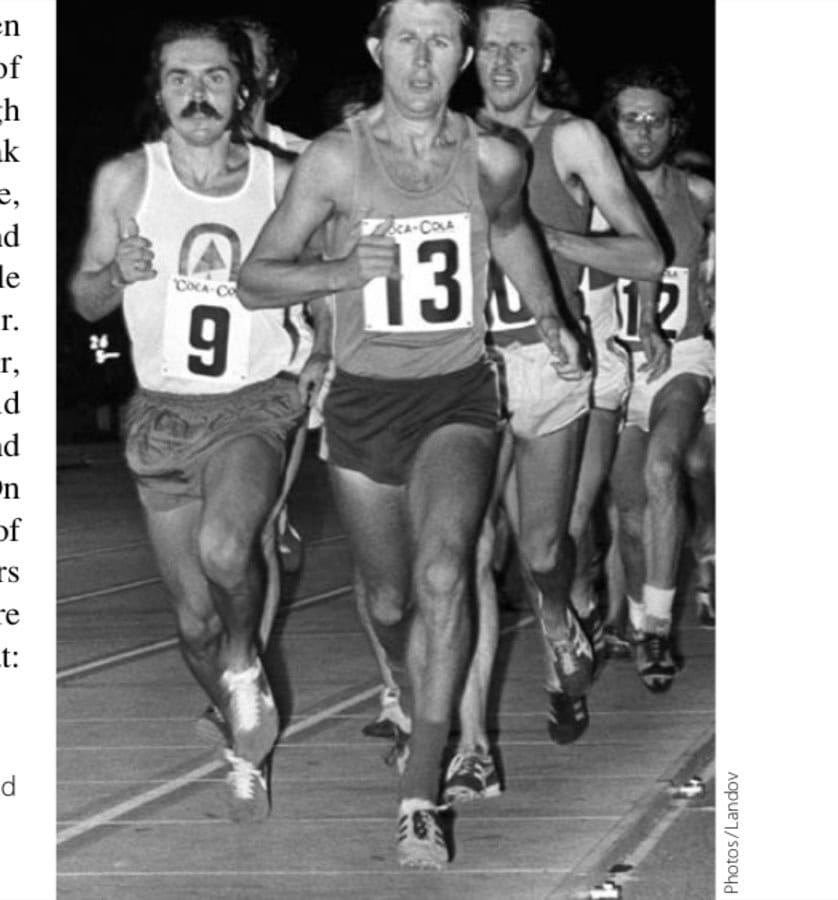
Steve Prefontaine (9), pictured here making his mark for the Oregon Track Club, showed little promise as a high school freshman.
© PA Photos / Landov
ou’re too small, Pre.’ ‘You’re not fast enough, Pre.’ ‘Give up your foolish dream, Steve.’ But they forgot something—I have to win.” At one point in his life, Steve Prefontaine actually was not fast enough. In fact, Pre may have been considered nothing out of the ordinary early in his high school career, failing to break two minutes in the half mile, five minutes in the mile, and 10 minutes in the two-mile during his freshman year. Soon thereafter, however, Pre found his rhythm and eventually became a legend in long-distance running. On the way to becoming one of the most dominant runners in U.S. history, however, Pre pulled off an incredible feat:
from age 15 to 24, he improved every year in every distance he raced. Whether or not Pre was ever fast enough, thinking about it never slowed him down. Steve Prefontaine started a running revolution in the 1970s. “He made running cool,” as Alberto Salazar claims. But he also made the idea of moving from the mile to longer distances routine. Despite the hype created in the 1960s by legend Jim Ryun in breaking the 4:00 barrier in the mile as a teen, Pre switched his mind-set to the longer distances. Pre originally wanted to be a miler after his sub-4:10 performance at Marshfield High School in 1969 but realized later that his PRs in longer events made him much more competitive. According to agegrading calculators, Pre’s two-mile was significantly stronger than his mile, and his 5K was the most impressive of the three distances.
The running career of Olympian Ryan Hall is somewhat parallel to that of Steve Prefontaine. The 26-year-old Stanford graduate recently told me that he has “joined the club” of a different group of distance runners. The humble phenom realized that, after disappointing collegiate performances in the 800 meters and 1,500 meters, maybe the role of a middle-distance runner would be more fitting for some other individual. Although Hall managed to produce All-American times in the middle distances during his high school and college careers, it was his inconsistency throughout college that frustrated the young California native. “I wanted to be a miler and was stubborn with that decision, but I was eventually dissuaded with the lack of turnover required for even the 5K.”
Hall takes to the roads Unlike Pre, Hall began concentrating on the nontrack distance events, such as the half-marathon and the marathon. Hall now has the potential to become one of the greatest long-distance runners of all time, as evidenced by the fact that he has already eclipsed the American record for the half-marathon (59:43) and by his current PR in the marathon—2:06:17—which is just over two minutes off the world record. “I believed I could get to this level when I started running at a young age, but I was patient and it didn’t happen until I was 25.”
When I asked Hall how he would sum up his running experience in one word, he responded, “resilience.” It certainly took a great amount of determination and flexibility to decide that his 4:02.62 mile in high school was simply not fast enough for potential greatness in that event. Yet, he used that weakness (if you can call it a weakness when someone sets the California state high school record in that event) to transform each of his races into a positive learning experience by remaining patient when races sometimes ended in disappointing results. As Hall, who grew up idolizing Jim Ryun and Steve Scott, told me, “I wanted the pride from excelling at a more prestigious event, such as the mile, but I wouldn’t realize my true strengths until after I had failed.”
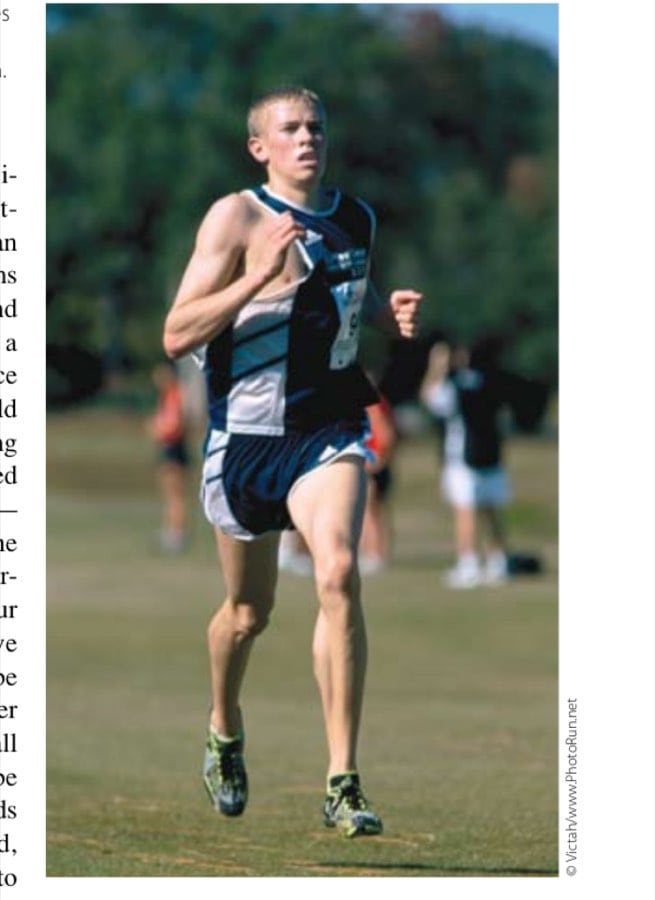
The running world is privileged to have such an outstanding role model in Ryan Hall, who teaches us lessons in patience, persistence, and humility, each of which is a part of the life of a distance runner. As Hall recently told me, “Everyone on the starting line [at the Olympics] dreamed of winning, but only one won— but this is not important—the journey was what was important. Dream big, but let your dreams inspire how you live today. Dreams should not be about the end goal but rather about day-to-day living.” Hall claims that, although it may be nice to have American records or possibly a world record, “It’s not all about me. I want to leave a legacy with my running, hoping that there will be future young Americans that will surpass my records and propel American distance running to the next caliber.” Hall hopes that these young stars will have the confidence to run with the highest-caliber runners, will be willing to fail, and will never give up until they have achieved greatness.
Every young distance runner can learn some valuable lessons from Pre and Ryan Hall. I use Pre’s improvement throughout high school and college to demonstrate that you do not have to be the fastest freshman on your team to reach All-American status in high school, and you do not have to be a national champion in high school to win an NCAA national title. Like Pre, I started my running career relatively unnoticed. My freshman high school PRs were actually fairly close to his. Yet, my high school career has been filled with near misses, which can either bring out the worst in a runner (such as frustration or quitting) or, as in my case, can bring out the best in a runner (such as the desire to work harder and improve). As an
© Victah/www.PhotoRun.net
▲
A younger Ryan Hall competes at the prestigious Foot Locker Nationals in San Diego, California.
18:00–18:30 5K runner, I failed to make the varsity A squad of my high school’s state championship cross-country team and was not included on the all-county roster as a freshman. Despite improving to a 17:00 5K, I missed second-team all-county as a sophomore. While still improving to 16:15, I missed first team all-county as a junior. Despite further improving to a 15:30 5K, I missed AllAmerican status as a senior. And, while coming close, I have never won a team state championship or an individual state championship.
Furthermore, despite working my way up through the rankings during my four competitive years of running, I am still overshadowed by of one of my teammates, who was a national age-group record holder and an All-American. Similar to Pre, I have used the constant public reminders of my not being fast enough as motivation to make a name for myself and to prove that, beginning this fall when I enter collegiate competition, I have the potential to be among the nation’s elite.
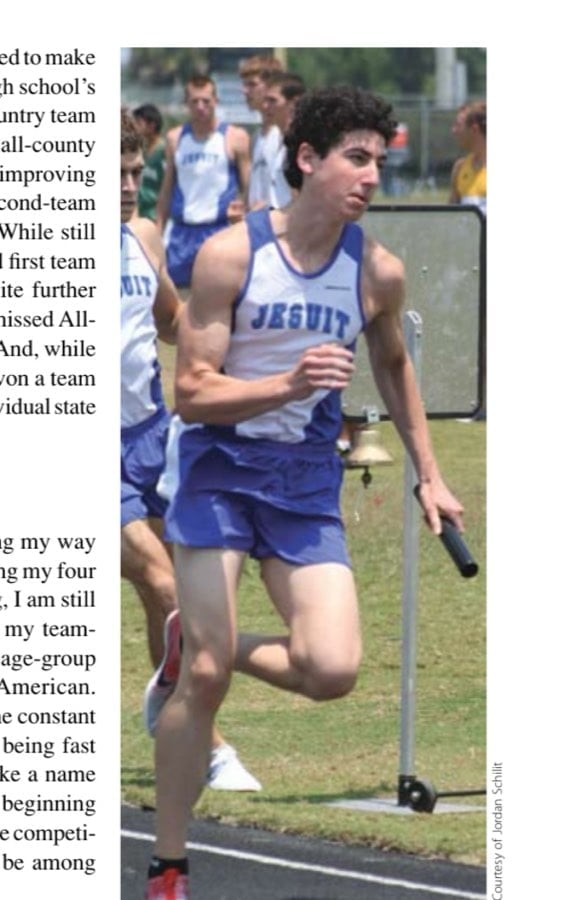
I use Hall’s ability to connect with ▲ A much stronger Jordan Schilit makes his up-and-coming runners as the motiva- mark as a senior at Jesuit High School. tion to succeed and to ultimately be a role model for them. For Hall, the transition to the marathon was not only for his own benefit but also, more importantly, for setting the stage for U.S. distance running. Certainly, that has had an impact on my training, my persistence, my goals, and, I hope, on my success. As I transition to my college years, I hope to follow in the footsteps of Steve Prefontaine and Ryan Hall by moving up in the distances and continuing to improve as my body matures. I look forward to transitioning from the 5K to the 8K in cross-country and from the 3,200 meters to the 5,000 and 10,000 meters in track.
Courtesy of Jordan Schilit
Still not out in front
I understand that I, like most successful high school runners, am currently not the fastest high school runner in the country. I also understood that like any other high school runner, I could achieve steady, yet extraordinary improvements over every year of high school. That improvement has enabled me to qualify for Nike indoor nationals and to finish within a few seconds of All-American status. Similar to when Steve Prefontaine and Ryan Hall were young, I have set my sights on the Olympic Trials and, I hope, the Olympics. That will be possible only if I continue to improve in the same way that I have over my high school career. Perhaps, ultimately, I will be the one to start a running revolution of my own, knowing that the torch will be passed to the next young distance star able to represent his country in the marathon.
This article originally appeared in Marathon & Beyond, Vol. 13, No. 5 (2009).
← Browse the full M&B ArchiveMore like this
1,000+ stories from 19 years of Marathon & Beyond
The complete archive of the legendary long-distance journal — digitized and free to read.
