

Choosing The Perfect Marathon Training Program
Let’s be honest. The friends who twisted your arm to sign up for this year’s marathon are in way better shape than you are. Their training programs— consisting of running 10 miles a day, eating only nuts and berries, and running barefoot—simply will not work for you. Everyone is different. So what is your “perfect” training program? Most of the time it comes down to trial and error before you’re able to figure out what formula of fast and slow, long and short runs works best for you. Don’t lose hope quite yet. There are some basic training guidelines that you can follow depending on your goals and existing fitness level. This article provides an in-depth look at some of the most popular marathon training programs, which will help guide you toward the perfect training plan and, ultimately, your perfect race.
The basic beginner’s marathon training program is one that guarantees to get you across the finish line. It consists of a combination of shorter runs and one long run per week, along with several rest days. The idea is that by building up your long run a mile per week or two miles every other week, you will be able to complete a marathon by the end of the 16- to 20-week program. Both individual and group-based marathon programs for beginners are available.
Joe Henderson, an instructor of running classes at the University of Oregon and author of Marathon Training, coaches adult marathon groups through the Eugene Running Company in Eugene, Oregon. Henderson has been helping average Joes across the finish line since the 1970s. His current program is group based, meaning that you come and train as a group and are held accountable by your peers.
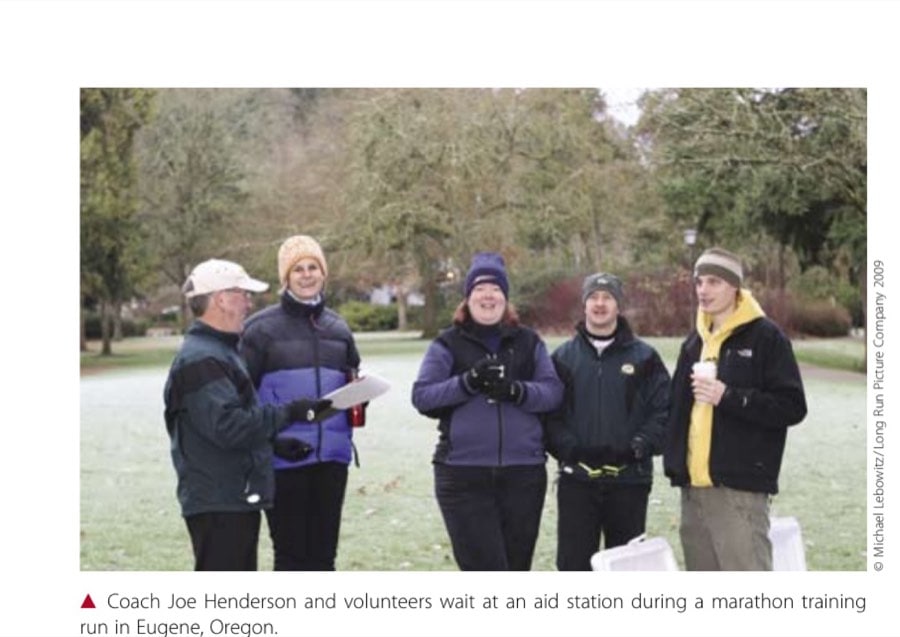
© Michael Lebowitz / Long Run Picture Company 2009
▲ Coach Joe Henderson and volunteers wait at an aid station during a marathon training run in Eugene, Oregon.
This style of training can be beneficial to those who have a hard time getting out of bed in the wee morning hours to do that lonely, long run in the dark. Eighteen weeks each summer and winter, Henderson’s group meets on Sunday mornings at 7:30 during the summer and 8:00 during the winter. Runners drop their gels and liquids into coolers and gather inside the Eugene Running Company, a local specialty running store, for a brief pep talk before heading out on their long run. Henderson and volunteers meet the runners at water stations along the course. The group-based marathon training program benefits those runners looking for accountability and training partners for a late-spring or early-fall marathon. “Running with a group gives me a reason to show up every week. Knowing there is a support group at aid stations with encouragement and hydration is refreshing when you’re out on a two-plus-hour run,” says Kristena McAlister, a 3:56 marathoner and veteran of the Henderson program.
Something for everybody Even though Henderson’s marathon program was designed for beginners, veteran marathoners have joined and improved their marathon times. “I never intended for runners to become ‘lifers’ with us, but many did,” comments Henderson. “I also never designed this as a program for improving PRs [personal records] or qualifying for Boston, but many have. This tells me the program adapts well for widely varying needs, interests, abilities, and experience levels. The best candidate
is someone who welcomes coaching and group support and might not try a marathon or get through the training without this advice and encouragement.” Henderson’s motto has always remained the same for first-time marathoners: “Train and then run the race to finish. Worry about time later.” He records times to show his runners their progress week to week, which in turn gives them a realistic pace to adopt. The information is then sent out in a weekly postrun e-mail. Even runners who would rather run by themselves can benefit from a marathon group like Henderson’s. “I am shy and prefer to run alone,” says Renee Irvin, 46, who has run eight marathons and is trying to qualify for Boston. “Group training allows us to have aid stations and allows us to talk about our running obsession. That’s the fun!”
The age range of Henderson’s trainees has been 17 to 67. Women typically make up two-thirds of the group. “I see an even larger percentage in my university running classes,” says Henderson. “This isn’t to say that females make up that big a portion of today’s marathoning population, but possibly that they’re more willing than men to join organized groups and accept coaching.” His groups’ finishing times have ranged from sub-3:00 to 7:00-plus and have had over a 99 percent finishing rate.
A beginner’s marathon training group like the Joe Henderson Marathon Team is not a good fit for everyone. Perhaps a Sunday long run does not fit well into your schedule. Henderson’s team meets only on Sundays, which is common to many marathon groups. Perhaps you do not like to train with a group of people. Henderson’s program also does not include any speed work other than occasional short races. Trainees must do speed training on their own to improve fitness. Lastly, the training program is not free; Henderson’s charges $100 per person.
Online programs If cost is a concern or if you prefer to run individually, then you may want to consider a free online training program. Many other training programs help firsttime marathoners cover the 26.2 miles. The most popular online programs are the Runner’s World SmartCoach program, Hal Higdon’s marathon program, and Jeff Galloway’s marathon training program. When you decide to follow an online program, you usually give up the group aspect of your training, unless you decide to train with friends. On the flip side, you gain more control over your training, because you can pick the program that best suits your fitness and lifestyle.
Two years ago, Runner’s World developed SmartCoach based on a system of equations developed by Jack Daniels that uses oxygen consumption, running speed, and competition length to come up with a formula to help anyone complete a marathon. Runners enter a recent race time, the distance for which they are training, how many miles a week they want to run, which day they want for a long run, and the number of weeks they want to train. The result is a personal training program. The SmartCoach incorporates a blend of long runs, tempo runs, speed work, and cross-training into a personal training program for each individual. “SmartCoach is capable of producing literally millions of different programs. Hence, it’s a great program for anyone of any age and ability,” says Amby Burfoot, developer of the framework for SmartCoach. Burfoot is executive editor of Runner’s World and winner of the 1968 Boston Marathon.
Adjustments in SmartCoach SmartCoach is the perfect solution for those who have limited amounts of time. Runners can specify for how many weeks before the competition they want to train and the day that works best for their long run. Many other online programs are already written out from start to finish, but the SmartCoach can be adjusted at any time based on current fitness. Simply enter your new fitness numbers and a new program will pop up. Another benefit is that the program is free. Unfortunately, those at Runner’s World have no way of telling the program’s success rate or the average finishing time for those who follow it. “We put out our programs, but we don’t necessarily know how people do. That’s a real failing, but it would be quite data intensive to get all the info back and analyze it and figure out what went right and wrong,” says Burfoot.
The Runner’s World SmartCoach program works well for those looking for a free, individual program that offers training for beginners and veterans alike. It adjusts based on your fitness level and time commitment and is designed to be specific to the individual. You are accountable to yourself to follow the program. For those looking for more variety in their training program, there is a nice blend of speed work and cross-training in most SmartCoach programs. Runnersworld.com is a great tool for answering all your running questions but may not be a good substitute for a live coach to alter your training program when you are injured or sick.
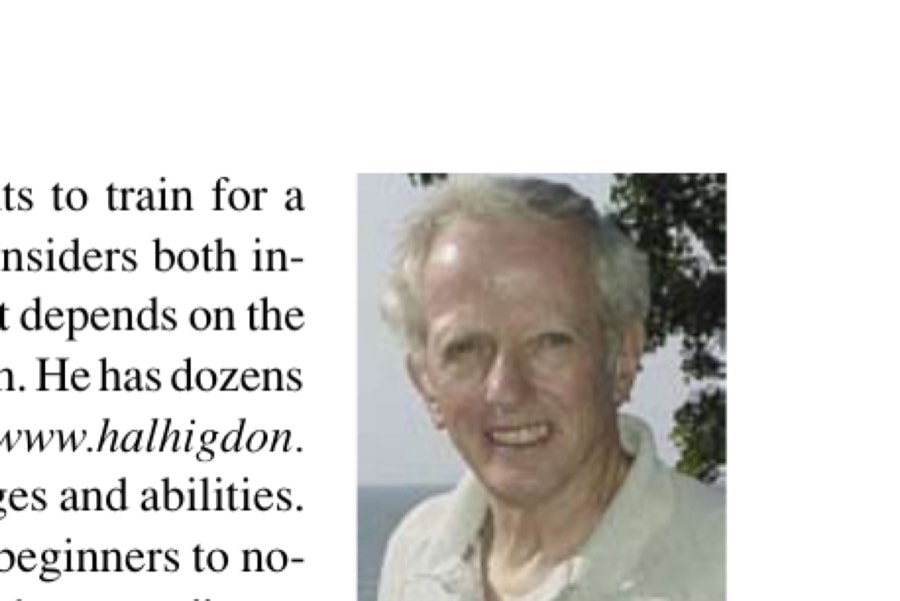
Hal Higdon’s program Hal Higdon also has a popular online marathon program for beginners. The Higdon program is great for runners who do not enjoy training in a group setting but who want a more personalized marathon coach. Higdon has been coaching runners since the 1960s and has sold almost 250,000 copies of his book Marathon: The Ultimate Training Guide. As a veteran of 111 marathons, he is no novice to the
distance. Higdon invites anyone who wants to train for a marathon to join his program, which he considers both individual and group based, but the group part depends on the trainees coming together on their own to train. He has dozens of free training programs on his Web site (www.halhigdon. com) that are geared toward people of all ages and abilities. “I have everything from free programs for beginners to noholds-barred training programs for advanced runners,” says Higdon, “[including] one recently created program featuring only three days of running a week, aimed at more experienced runners whose bodies can’t handle more frequent running. Yet they still run fast and far.” He also offers an interactive format where he sends runners daily workouts via e-mail. Marathoners can also sign up for his interactive Virtual Training Bulletin Boards (V-Board) online, where they can ask him training questions and share running experiences. One example of a V-Board activity is that before the Chicago Marathon, V-Teamers get together for a prerace pasta party.
The Higdon program has three levels of training: novice, intermediate, and advanced. The novice programs have trainees running only three to four times a week and promise to get those minimum-mileage athletes across the finish line. Intermediate runners add more miles, including two or three 20-milers toward the end of training. The advanced program is for those who are looking to improve their marathon time and includes tempo runs, hills, and 800-meter repeats. The programs are very consistent with the type of workouts you do, and the mileage gradually increases week to week.
Higdon’s program works well for those looking to train individually and get across the finish line but who do not want to run a lot of miles to do so. Veteran marathoners can benefit from the advanced programs that incorporate more pace work. Higdon does not have a good way of tracking the average age and time of
his trainees. “I have no hard data,” says Higdon. “It would be the same as the average age of everybody running the marathon today. A fairly large number of people who use my programs are young females in
the 25 to 35 age range. At least that’s my impression as to who is fueling the running boom these days.” He says that his program has an almost 99 percent finishing rate. “If runners have at least a moderate
level of fitness when they begin one of my 18-week programs and apply themselves to those programs, they are almost guaranteed to finish,” comments Higdon. Another benefit is that trainees can interact with the coach who created their program.
Jeff Galloway’s program Another popular online program is Jeff Galloway’s. Galloway, who has finished 147 marathons and has over 35 years of coaching experience, has written numerous books on running, among them Galloway Training Programs, Running: A Year Round Plan, and Marathon: You Can Do It. He offers free online programs as well as e-coaching individual plans, which cost $279 for beginners and $179 for alumni. Galloway’s ecoaching allows trainees to have direct access to him and to receive day-by-day programs for six months. Galloway Training Groups are present in 85 cities, which makes his program both individual and group based.


In Galloway’s program, trainees run three days a week (two 30-minute runs during the week and one long run on the weekend) and walk once a week. He advises beginners, “There is no pace that is too slow on long runs. The slower you run, and the more frequently you take walk breaks from the beginning, the lower your risk of injury. Yet a long run that is done at 15 minutes per mile gives the same endurance as one run at 5 minutes per mile. The slow pace allows one to recover fast. In our Galloway training programs we have an almost zero injury rate among those who follow the guidelines.” He also has speed workouts incorporated in his more advanced programs. His advice is the same to veteran marathoners as it is to beginners, but he also says, “To get faster you will need to do the mile repeats and other elements listed in our training schedules.”
Who is a good candidate for Galloway’s program? “Anyone who can run for five seconds without pain,” Galloway says. He recommends that you have been doing some running or walking for a few weeks and have done at least one three-mile run. Most of Galloway’s trainees have been running three years or less, but several hundred join his program to get faster. He has had several hundred former beginners qualify for the Boston Marathon each year. The average Gal
loway trainee is 44 years of age and finishes in a time of five hours. His program has a 99 percent finishing rate. “About the only ones who do not [finish], are those who don’t follow my advice,” says Galloway. His e-coaching is specific to the
individual, but you have to be willing to pay the fee. His free online programs are helpful for beginners and veterans.
Other options A basic beginner’s marathon training program does not suit everyone’s fitness needs. Some
people need more than just a mix of shorter runs and one long run a week to reach their marathon goals. If you are aiming for a personal best or a Boston Marathon qualifying time, you may need to incorporate speed work into your training program. The mix of short, fast runs will make your longer runs feel easier, thereby helping you to run them faster. Runner’s World’s SmartCoach, Hal Higdon, and Jeff Galloway incorporate these into your program, but they may not be specific enough to the individual. You may want to consider a training program that consists of speed workouts specific to your fitness level. You may also want to include trails and hills in your program to mimic the challenges of the course on which you will be running your marathon.
Brad Hudson’s design-your-own program The most advanced type of marathon program is a performance-based program. Performance marathon coach Brad Hudson has coached professional athletes for six years. He coached 2008 Olympian Dathan Ritzenhein (now coached by Alberto Salazar) to a personal best of 2:09:59 at the 2009 London Marathon. Hudson, who is also the author of Run Faster From the 5K to the Marathon, ran marathons at the elite level (PR of 2:13) before he began coaching. His marathon programs are individual based and at this time are tailored only toward 13 elite athletes. Beginner and veteran marathoners can still take advantage of Hudson’s performance programs through his book and his Web site, marathonperformance.com. Hudson teaches trainees how to be their own best coach by teaching them how to create their own adaptive training program. Unlike the other marathon programs, Hudson says, “I rarely write out more than one week’s workouts at a time.” He stresses writing a marathon training program in pencil and keeping it flexible in case you do not fully recover after a workout. He highlights specific workouts that are meant for specific types of athletes and that guide you to finding the best blend of progression runs, fartleks, and intervals to help you reach your goal. Hudson designs programs that allow marathoners of any age to improve their marathon time.
Runners looking to improve their best marathon time, run a fast first marathon, or choose from a variety of workouts that are specific to their needs should look into performance training. Hudson shows you how to change your workouts as your fitness level changes as well as how to choose the right workouts. He also recommends hill sprints as the secret to staying injury free. A word of caution, however: performance marathon training is not for everyone. It may not be ideal for your first marathon. Hudson advises first-time marathoners, “Stay easy, just finish,” and veteran marathoners, “Be efficient at what you are doing.” Unless you hire a personal performance coach, you will not get the benefits of one-on-one coaching. The program is very individual based, and you hold yourself accountable for creating the program and running the workouts.
In summary What is the best training program for you? Here are three basic guidelines to follow when choosing your marathon program. First, take a look at your history. Were you a runner in high school or college? If so, at what level did you perform? If you were a skilled cross-country runner, try to remember the structure of the program you followed. That will help give you a good starting base to follow for your marathon training. Are you prone to injury? If so, at what point in your training do you usually begin to break down? What are your physical limitations? Answers to these questions will give you an idea of where you should start or keep your mileage at until you become stronger. By studying your running history, you will get an idea of whether you should be following a program that consists of higher mileage, speed work, or cross-training, because you know how your body typically responds to different stimuli.
Second, how do you like to train, and how much time do you have to train? Not everyone has time for two-a-days and 90-mile weeks. You need to find a program with the right balance of long runs and short runs and that also fits into your schedule. Do you prefer to train with a group or individually? Many of the marathon training groups meet only one day a week. If that day and time does not fit into your schedule, you may need to consider virtual training groups or an individual program.
ad
Overview of training programs Joe Henderson’s Marathon Training Program Average Trainee Age: 40s Average Trainee Finishing Time: 4.5 hours Program Duration: 18 weeks Program Intensity: Beginner to moderate, emphasis on beginner Group/Individual Based: Group Cost: $100 Web site: www.joehenderson.com
Action Sports International
Also, if you are planning to follow an individual marathon-performance program, you need to have the money to hire a coach or the time to write your own program. Last, what is your goal? Is your goal simply to finish, or are you trying to set a new PR? Many people cannot improve their marathon time without a stimulus in their training program, whether that is higher mileage or speed work. Others run the risk of injury if they don’t build the proper mileage base first.
These three things will best guide you to the right marathon training program. Just remember, no matter how you train or how fast you run, each marathon you complete is a personal victory. You cannot take the marathon for granted. It can be a humbling experience, whether you’ve run one or 111. Each marathon provides new and challenging obstacles to overcome. Joe Henderson puts it best when he says, “Treat each marathon as a new experience, and run it to have a good time in ways that a watch can’t measure.” Happy running!
Runner’s World’s SmartCoach Average Trainee Age: Inclusive Average Trainee Finishing Time: Inclusive Program Duration: Varies Program Intensity: Beginner to advanced Group/Individual Based: Individual Cost: Free Web site: www.runnersworld.com
Hal Higdon’s Marathon Training Program Average Trainee Age: Inclusive Average Trainee Finishing Time: Inclusive Program Duration: 18 weeks Program Intensity: Beginner to advanced, emphasis on beginner Group/Individual Based: Individual Cost: Free Web site: www.halhigdon.com Jeff Galloway’s Marathon Training Program Average Trainee Age: 44 Average Trainee Finishing Time: Five hours Program Duration: 30 weeks (standard beginner’s program) Program Intensity: Beginner to advanced Group/Individual Based: Both Cost: Free to $279 Web site: www.jeffgalloway.com Brad Hudson’s Marathon Training Program Average Trainee Age: 28 Average Trainee Finishing Time: Men: 2:15, Women: 2:35 Program Duration: 20 weeks Program Intensity: Advanced to elite Group/Individual Based: Individual Cost: Varies Web site: www.marathonperformance.com/
This article originally appeared in Marathon & Beyond, Vol. 14, No. 1 (2010).
← Browse the full M&B ArchiveMore like this
1,000+ stories from 19 years of Marathon & Beyond
The complete archive of the legendary long-distance journal — digitized and free to read.
