

Common Spaces 1
Previously, in her “On the Road” column for this magazine [July/August, 2002], ultrarunner Ellen McCurtin observed: “Our modern world is certainly not pedestrian friendly.” I thought this was as much unremarkable as it was remarkable, having recently survived an attack by a four-legged boxer at the end of a 20-miler. Of course, it is obvious that Ellen’s observation is true for any of us who travel the roads unprotected by an envelope of steel. We obviously live in a very mobile world, but little of the mobility involves foot traffic, except for folks like us who run the roads. On a recent run, I wondered why we runners shouldn’t be able to expect more cooperation from the users of the roads we run.
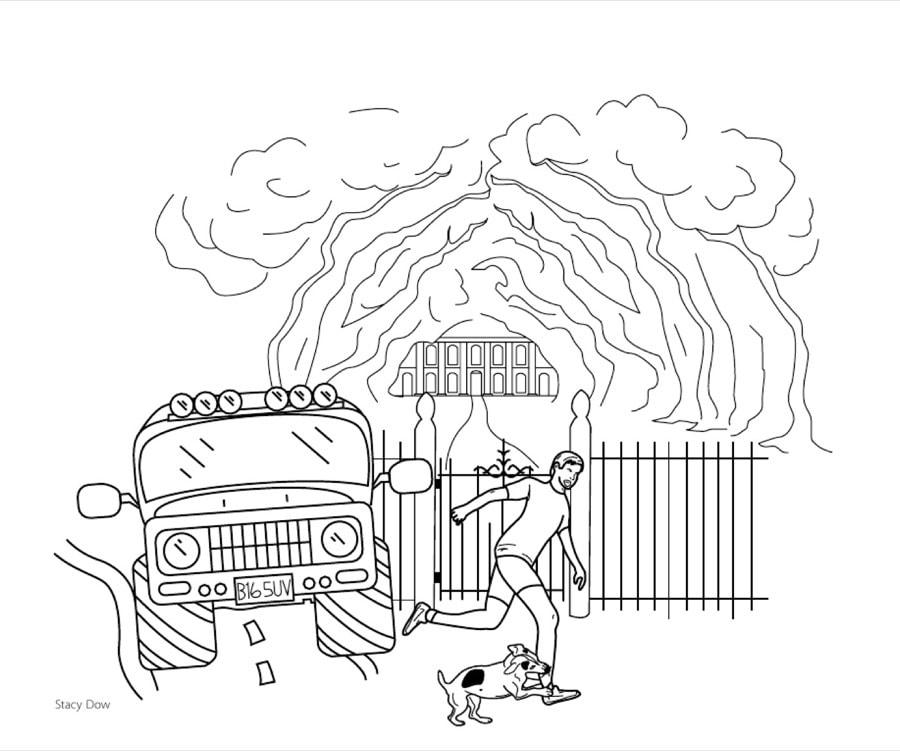
Ellen noted obstacles that runners meet along the road that limit their ability to run freely and that offer virtually unlimited dangers, ranging from gated communities to loose dogs and monster SUVs. The infringements on our sense of freedom on the open road increase daily. It would have depressed even Jack Kerouac, and he was in a car. It is frustrating to run down a lovely tree-shaded road only to meet a guardhouse next to a gate protecting what used to be an open road from the likes of us. It is equally frustrating to feel the sting of a cloud of sand thrown up from a passing SUV on its way to the local soccer field. This is a relatively recent phenomenon, isn’t it? I mean, it wasn’t always thus, was it?
WHAT DOES HISTORY SAY? The best place to contemplate such questions is on the run, where complexities seem to be transported off us with each drop of sweat and where the world becomes narrowed, focused, and simple. I tried to combine my own observations from the road with what I had read over the years. And when you work at a college, you get to read quite a bit. Usually, a good run gets me away from too much reading and gives my eyes a chance to exercise themselves on things in the real world, but now I had a chance to combine observations with book learning.
I came to the conclusion that I should not be so paranoid on behalf of my fellow runners. There is probably not a vast conspiracy to endanger runners who are using the roads. The world in general probably could not care less about us. We’re probably nothing more than a nuisance.
Stacy Dow
Historically, roadways have always been perilous. The carriages of the nobility being driven pell-mell down a winding road behind a pair of 1,500-pound horses have no doubt been responsible for many a pedestrian’s broken bones over the centuries. Then there were the highwaymen, whether the benign Robin Hoods or the just plain ratty scoundrels ready to prey on unwary travelers.
Roads were what people used to get from one place to another. But what was available when you got to where you were going? The end of the 19th century saw the growth of public spaces where people went to see and be seen. Lewis Ehrenberg’s book Steppin’ Out details the slow evolution of social venues away from the Victorian parlor to places of public entertainment in New York; his attention is especially taken with New York City nightlife.
David Nasaw drew similar parallels in his book Going Out, a tome on the growth and social importance of public spaces. His book noted the decline of such public spaces as America expanded into the 20th century. Boardwalks, Coney Island–type amusement centers, beaches, and parks lost their social centrality.
These great central gathering places, where a walker could walk, a runner could run, and a couple could stroll, were pinched off, victims of social and economic trends such as during the Great Depression, when such spaces were no longer being built; rising racial tensions in amusement parks; and the flight of the middle
class to the suburbs, where public transportation could no longer accommodate the needs of such a widespread population. A trend that further complicates the use of public spaces is the current habit of so many people of staying indoors to get their entertainment from computers, televisions, and video games.
WHERE IS THE COMMONS? Those of us who are out and about lament the demise of open roadways and what used to be referred to as “the commons.” The Commons (with a capital “C”) has a long history that has been traced by Roger Lohmann in his book of the same name. Not surprisingly, the history of the Commons runs through the great civilizations such as Greece, Rome, and Arabia; the Commons are also identifiable in the Middle Ages and the Renaissance.
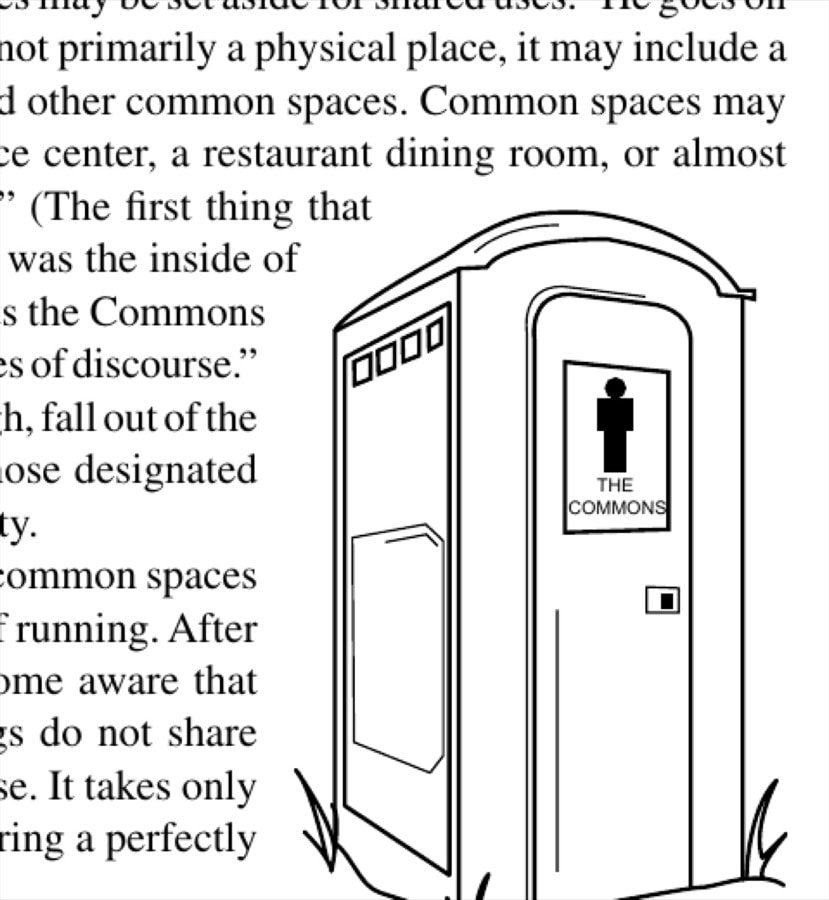
The Commons, however, claims Lohmann, “are not physical entities or places, although a variety of common places may be set aside for shared uses.” He goes on to write: “Although a commons is not primarily a physical place, it may include a place, as in the case of temples and other common spaces. Common spaces may be a committee room, a conference center, a restaurant dining room, or almost any other public or private space.” (The first thing that came to my mind, being a runner, was the inside of a porta-potty.) But Lohmann insists the Commons are not so much places but “universes of discourse.” These universes of discourse, though, fall out of the measured spaces of the state or those designated THE COMMONS for profit-seeking economic activity.
For runners, the roadways are common spaces where we carry on the discourse of running. After running for a few years, you become aware that most motorists and nearly all dogs do not share and do not approve of this discourse. It takes only one motorist or one surly dog to bring a perfectly good run to a halt. Stacy Dow
Riding in the contrived private space of their vehicles, motorists project their sense of the private space of their vehicle onto the road; it becomes de facto their personal property, not a common space after all, and territorially malevolent dogs don’t give a snit for the sociological refinements that civilized people attempt to create.
As for motorists, transcontinental runner James Shapiro remarked in Meditations From the Breakdown Lane of his 1980 cross-country journey: “For the rest of the morning I judge the motorists severely, so smooth and insulated as they whizz /QQ: whizz or whiz ? XQQ/ past in their little worlds. They just go through the desert, they don’t respect it.”
Running, on the other hand, personifies the concept of the Commons, the Commons in this case being a community of like-minded people taking action outside the realm of the state and the activity of profit economics. Running is rarely state sponsored and is largely noneconomic behavior for all but a few of us, but we pursue it anyway for the pure joy of the activity. We band with others who run for similar reasons. This shared interest creates a running Commons. We see it at the beginning of races; we feel it at the end of races.
WHERE CHARITY RACES FIT IN This Commons may in fact be one of the reasons that charity fund-raising, sharply analyzed by Roger Robinson and Jonathan Beverly in an issue of Running Times [September 2003], fits so well within the running community. As emphasized by Robinson and Beverly, running is a uniquely public act. Running is effort made visible. It is this visible effort that many are willing to sponsor through charitable contributions to biomedical research. The metaphor of racing to a finish line satisfies, even excites, our view of biomedical process and triumph, but we should note that Robinson and Beverly were generally critical of linking fund-raising to running.
It is a triumph over that which would restrict that very effort. Both charity fund-raising and running reside within the greater running Commons, areas outside of economic (profit) activity and state responsibilities where, according to Lohmann, the code of behavior is one of “fairness.”
How much would our road experiences and the experiences of others on the road be improved by a concern for fairness? Would it be possible to revive the notion of the Commons to breathe fresh air into these spaces and to shift the reason for being there—to note and be noted, to see and to be seen, as was done over a century ago in other types of common spaces, literally as well as figuratively? Is it possible that out of respect for shared space we could restrain the menace of aggressive and loosely tended dogs, the proliferation of high-profile SUVs, and private gated communities?
Lohmann observes, “Social actors throughout history have known that there is a public space outside the marketplace and the state. The public space of the Commons is predominantly not a space for buying and selling or ordering and forbidding. It is a space for talking and listening (dialogue) and for seeing and being seen (presentation).”
NO TRESPASSING Compare Lohmann’s social amicability to Shapiro’s experience as he sought out the most satisfying crossing of the Mississippi, encountering the state role of forbidding: “A friendly but intensely unyielding toll collector on the Muscatine
Bridge refused to let me cross. ‘Sorry, it’s federal regulations,’ he said. It was another in the distressingly antihuman regulatory clauses and attitudes that made pedestrians so unwelcome in America.”
Most of us runners try very hard to be seen on our roadways and streets—a good run and a life are at stake. But, of course, visual perception and acuity were not what Lohmann had in mind for “seeing and being seen.” He suggests rather a shared view of the Commons, a view that would bring fairness to our endeavor on roadways and streets and help us all see each other just a bit better. The larger and more troubling question is How do we engage nonrunners—motorists and dog owners—in this discourse?
There is some progress. Some towns close off sections of their downtown to traffic, either occasionally or permanently. Bike and walking paths are created along riverbanks. Rail-to-trail conversions are made. And the practice of the ’60s of rowdy teens throwing beer bottles at the occasional runner has diminished.
But little progress is made by urban and suburban planners who design for the automobile or public transportation but completely ignore the needs of runners and walkers and bikers. Runners and walkers who wish to promote a Commons mentality must not only be seen but must be heard. If the squeaky wheel gets the grease, the outspoken runner may get his path to civility.
Adventure Running At Its WORST! In 1989, two runners set off to become the first to run from Death Valley to Mt. Whitney and back—in mid-summer. Lottsa luck, fellers! Send $22 in US funds (shipping/handling included) to: Rich Benyo, Box 161, Forestville, CA 95436, USA Please Print
Name ___________________________________________________________________________________ Street ___________________________________________________________________________________ Town___________________________________ State/Province____________________________________ Zip/Mail code _________________________ Country ____________________________________________ Allow 6 weeks for delivery. If you wish a personal autograph, please include name of person for whom book is intended.
Edward Payson Weston and the 1861 Inauguration The Feats of the “Pedestrians” of the 19th Century Continue to Astonish Historians of Running. BY DR. EDWARD H. KOZLOFF
Competitive racewalking has always been a spectacle. At times today, with its contact-with-ground rule, the sport sometimes seems just a fraction of an inch away from running. Only a few knowledgeable spectators can appreciate the time, training, and discipline necessary to become a true racewalker. Compared with long-distance running, the numbers of races and competitors are few.
However, this was not always true. In ancient times, there were not many travel options in getting from place to place. Although most individuals rarely left the confines of the area surrounding their villages, many in the clergy did. Crusaders walked from Western Europe to the Holy Land. A few lucky enough to survive were able to walk back.
It appears that competitive walking, originally known as “pedestrianism,” began in the early 1600s. England produced many noteworthy performances such as that of Foster Powell in 1773, when he walked from London to York and back in five days, 18 hours. He averaged more than 70 miles per day for the 402-mile distance.
There was also Captain Robert Barclay, who in 1809 walked one mile in each of 1,000 continuous hours. Other feats of this nature brought widespread publicity during the late 1700s and well into the next century. Many town-to-town walking events took place, with enthusiastic crowds and betting as well.
It was natural for these contests to spread to America, and by the 1820s interest began to grow. In 1843, Thomas Elsworth, of Boston, walked 1,000 miles in 40 days. This was nearly two days faster than Barclay’s walk 34 years earlier.
The popular races of the day ranged from 10 to 50 miles, saw thousands of spectators, and in some cases gave prizes of $1,000. During this time, the average annual income of a well-paid worker was $250 per year. You can understand why many athletic individuals (and too many who were nonathletic), much like the kids of today, had dreams of million-dollar contracts and turned to thoughts of pedestrianism.
This article originally appeared in Marathon & Beyond, Vol. 8, No. 6 (2004).
← Browse the full M&B ArchiveMore like this
1,000+ stories from 19 years of Marathon & Beyond
The complete archive of the legendary long-distance journal — digitized and free to read.
