

Here is the moment when I realized I had a problem: it’s early afternoon and I’m standing in my kitchen just returned from a steamy interval workout. Now, at the outset I should say that I acknowledge how certain runners love the fast stuff; an hour at the track is like an executive spa package for them. I am not that runner. With my one-two punch of negligible athleticism and low threshold for pain, what I do at the track shouldn’t even be called a speed workout, more like hyperventijogging. Anyway, I’ve suffered through the workout and I’m in the kitchen. But am I stretching? No. Am I hydrating and checking my heart rate? No. I’m drizzling garlic-infused oil with one hand and wielding an immersion blender with the other so I can make homemade mayonnaise. This will be the foundation for a remoulade I plan to dollop or—if I’m feeling frisky—pipe over pan-roasted swordfish fillets. You get the picture: a pair of sweat-saturated Asics on my feet, a precisely emulsified scoop of homemade mayonnaise on my finger, Gatorade and eggshells on the counter. This is not the image of Alan Webb’s kitchen. But what can I say? Have you ever tasted homemade mayo or its Scrabble-worthy sibling, aioli? One spoonful and you’ll never go back to that jarred putty they sell at the supermarket. Bring out the Hellmann’s and bring out the caulk gun.
I have been running for six years, and like many new runners, I have become addicted to marathons. I am training for my twelfth right now. I have trained under Coach Guy Avery. I own worn copies of Daniels’ Running Formula and Pfitzinger and Douglas’s Advanced Marathoning. I have MarathonGuide.com at the top of my bookmarks, and I think Gmap Pedometer is a more important program than whatever it is that allows for online banking. I know that lactate threshold has nothing to do with breastfeeding. But long before I laced up my first pair of running shoes, I was building a cookbook collection, molding my own pate, seeking out duck confit for cassoulet, and tweaking my mom’s jambalaya recipe. For as long as I can remember, I have been an unrepentant foodie. In school, when the kids huddled at the back of the bus and asked if I wanted a “toke,” I assumed they meant “toque” and said, “Absolutely!” As I have grown more obsessed with running and my PRs have improved, glacially, my palate has become exponentially more demanding. On the running side, the notion of qualifying for Boston has gone from the mythological
▲
to the merely theoretical. But on the foodie side, I’m now marinating my own olives and trying to find money to join a cheese-of-the-month club. If someone mentions resistance training, I immediately think of “plats de resistance.” The cook in me grapples with the runner, and the fate of my race times (not to mention the puffiness of my soufflés) hangs in the balance.
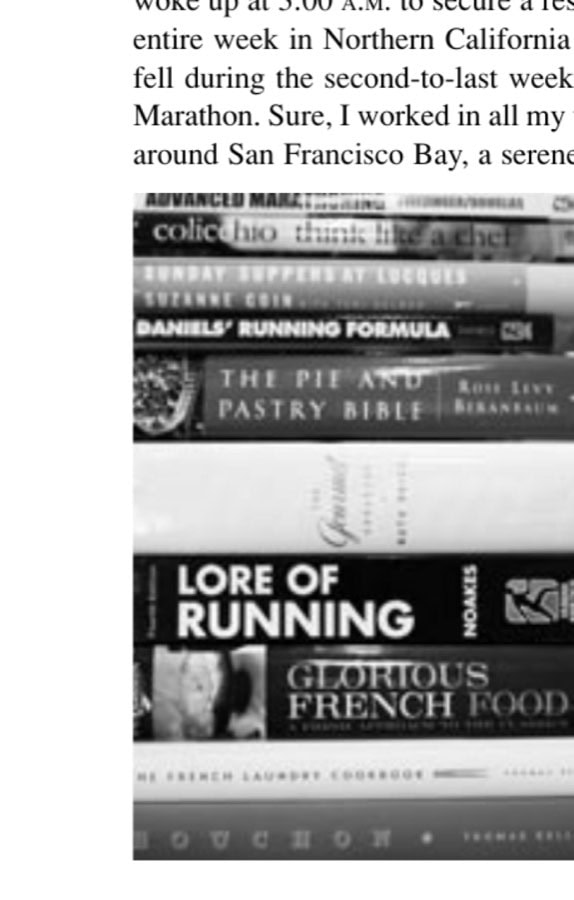
In preparation for one marathon, I banged out 20 miles on the treadmill, but I also passed the time reading Cook’s Illustrated and Saveur. I logged 40 to 50 miles per week, including hill repeats, track workouts, and tempo runs. When I wasn’t training, however, I was reading a biography of Bernard Loiseau, the deceased French chef from the Cote d’Or, perusing the forums at eGullet, or replaying episodes of “Top Chef.” I wear my Garmin Forerunner 201 everywhere, but if I had a mandoline, I would probably sleep with it. I am willing to try plyometrics if it will improve my times, but I’m also willing to try cooking sous vide if it will improve my lamb. Once I received the new Road Runner Sports and WilliamsSonoma catalogs on the same day, and my head nearly exploded.
Some people have a Jekyll and Hyde personality; I have a Keller and Meb personality. Keller is Thomas Keller of The French Laundry, the Napa Valley restaurant that perfectly illustrates my gastronomic obsession. A few years ago I woke up at 3:00 A.M. to secure a reservation at this restaurant. I then planned an entire week in Northern California to culminate with this dinner. The vacation fell during the second-to-last week of my taper for the Ocean City, Maryland, Marathon. Sure, I worked in all my training runs that week—a crowded long run around San Francisco Bay, a serene dawn jog from Monterey to Pebble Beach,
and a series of short jogs in the vineyards of the Anderson Valley and along the cliffs of the Mendocino Coast. Unfortunately, I got them out of the way in the morning and spent the rest of the day eating and tasting
wine. I felt like I had no choice. You don’t just show up at the French Laundry. You have to approach its nine-course Tasting Menu, with its assorted amuse bouches that work out to about a dozen or more
plates easily, like a marathon. You train for it with persistence and dedication. You build up to it. So for every training mile, there was a torchon of duck foie gras, and for every 800-meter repeat, a fricassee of lobster tail or degustation of rabbit. When
Do we run to eat or eat to run?
the appointed evening came, I was prepared. I had even tapered from lunch. The meal was as euphoric as finishing my first marathon. I framed the menu. As for the marathon, I was off my PR by nine minutes—one minute for each course. It doesn’t take a numerologist to see the connection.
What do you remember about the 2004 New York City Marathon? Is it Meb Keflezighi’s second-place 2:09? Is it Paula Radcliffe’s redeeming first-place finish? I was on the course that year, but I can’t even remember my time. But I remember every course at Nobu, the Japanese-Peruvian restaurant where I ate my postrace meal: Ceviche, Yellow Tail Jalapeno, Toro Tartar With Caviar, Cold Steamed Abalone, Tiradito, Broiled Black Cod With Miso, Rock Shrimp Tempura. Then came the sushi menu and, throughout, enough glistening nigiri to sate a sumo squad.
My marathon tapers have become exercises in culinary day-dreaming. As I log fewer and fewer minutes on the road, I log more and more minutes on the Internet. Instead of going through mental race preparation, I’m poring over online menus and Chowhound reviews. Instead of honing race strategy, I’m outlining a gastronomic tour of the host city with military precision. The prerace meal always causes me the most consternation. I want it to be good but, knowing my nature and weak will, not too good.
Consider last year’s Chicago Marathon. I have run Chicago twice, and I will be the first to admit it is a world-class event. But it invariably disappoints because it takes place on a Sunday, when so many fine restaurants are closed. Why, I humbly ask, do the race organizers foreclose so many postrace dinner options? That aside, I cannot tell you where the half-marathon split is in Chicago, but I can tell you exactly how many blocks it was from my hotel to an array of cafes, bistros, hot dog vendors, delis, and chocolatiers. My Boston-qualifying time, 3:15, is the number that should have been foremost on my mind. But all I could think about was 24, the astounding number of courses served with the “Tour de Force” menu at Alinea, the American temple of molecular gastronomy and site of my postrace meal.
So I face this conundrum: is it possible to make it to that fabled starting line in Hopkinton so long as I also aspire to have Michelin award my kitchen a single star? For the bistro fare I need at home—crème fraiche, lardons, macaroons—and the haute cuisine I seek out on the road aren’t going to make anyone’s list of “power foods” anytime soon. Nutrition is a fundamental part of training, I know this, and yet I must make my pie crust lighter and flakier (Hint: very cold butter).
At least once, I should adopt a more Spartan, training-friendly diet. I should sacrifice for such a worthy goal. I could try it once—train right and eat right. It would be for only 18 weeks, and it wouldn’t have to be during the holidays. Yes, I think I could do this. I think I could make a run at qualifying for Boston. I think, I think . . . I think something’s burning in the kitchen.
This article originally appeared in Marathon & Beyond, Vol. 11, No. 3 (2007).
← Browse the full M&B ArchiveMore like this
1,000+ stories from 19 years of Marathon & Beyond
The complete archive of the legendary long-distance journal — digitized and free to read.
