

D’Alessandris’S Inferno
Since my article, “Seven Habits of Highly Annoying Runners,” appeared in the May/June 2008 issue of Marathon & Beyond, I have been flooded by fan mail asking for a follow-up piece. Actually if you replace “flooded” with “received a few” and “fan mail” with “hate letters,” it might be more accurate.
Regardless, I’m back after a long vacation with a follow-up based on Dante’s The Divine Comedy. I prefer to think of this article as paying homage to Dante, not so much stealing his ideas. Really, it’s all in your perspective and how good your lawyer is.
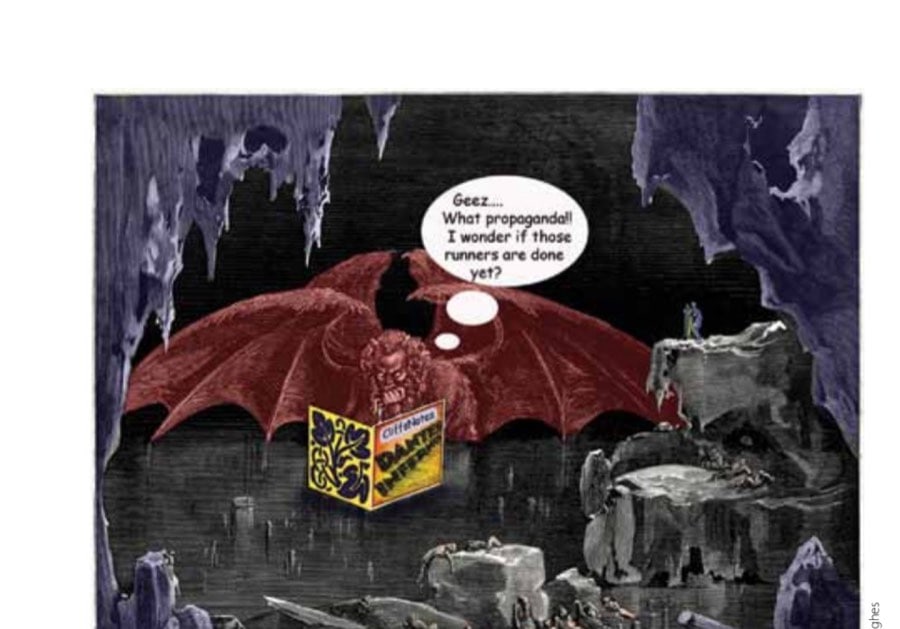
Actually, I can’t steal from Dante because I’ve never actually read The Divine Comedy. If I’m stealing from anybody, I’m stealing from the CliffsNotes summary of The Divine Comedy, as I took massive shortcuts in school and used CliffsNotes whenever possible. Even then I read the CliffsNotes only if there wasn’t a movie I could watch instead.
As a summary for those of you who didn’t take a class where Dante was required reading, here is a brief summary of the Inferno cantos of The Divine Comedy: something happens with a guy and he goes through nine stages of hell, or something like that. Look, if you want a more detailed explanation, read the CliffsNotes.
For this article relating to running, the outer circles (one through three) contain actions that most nonobsessed people would let slide. The middle circles (four through six) should bring you the scorn of your fellow runners. By the time you get to the inner circles, you are doing things that should get you a lifetime ban from running.
The outer circles Minor infractions abound in the outer circles. Nonrunners would not understand why these are even issues. Nonobsessed runners would let these slide. Obsessed runners could write a doctoral thesis on any one of these subjects.
© Michael Hughes
The first circle—the stunt runner Some people love them, some are indifferent, but enough people hate them that they secure a place in the first circle. Stunt runners, whether they dress in costume, juggle, or run backward, try to set themselves apart from the pack to attract attention away from other runners. Most are serious runners and much faster than I am, so I can’t comment on their training and dedication to the sport. But at one marathon, I heard a runner complain he had trained for six months to run his first marathon, and there was somebody dressed in a costume, as if a marathon should be easy.
Other runners love the stunt runners and enjoy their company on the course. I myself am largely indifferent, but I love the irony of a runner dressed as Superman hitting the wall at mile 22 and walking to the finish. I do have respect for somebody carrying the American flag or other patriotic flags during a race, unless it is one of those damn Taxation Without Representation flags people carry at races in Washington, DC. Here’s a piece of advice to them: if you don’t like it, move to Maryland or Virginia and stop your whining. The second circle—the preliminary T-shirt wearer I’m surprised by the number of people who wear the race T-shirt they received at the expo during the actual race. This violates a couple of basic rules of running.
First, you never should run a marathon in untested equipment, whether that is shoes, socks, shorts, or shirts. That can never lead to anything positive. The second rule it violates is what lands these folks on the list. The shirt represents (or should represent) an accomplishment greater than simply filling out a registration form and showing up at the expo. I received a long-sleeve T-shirt at the 2002 JFK 50 that I refuse to wear because I did not finish the race; this is despite the fact that this was my proudest running moment. On that November day, I made it through the first 22 miles despite having come down with the flu and sporting a temperature of 101 the night before the race.
If I’m not wearing that JFK shirt, you certainly can hold off on wearing your shirt for four more hours.
The third circle—the Boston nonqualifier I would desperately like to belong to this group. These are people who gain backdoor entry into the Boston Marathon and run without having qualified. The Boston Marathon attempts to walk a tightrope every year by offering entry bibs to charities, sponsors, and corporate bigwigs, while maintaining the overall integrity of the event. To date the organizers have done a magnificent job, helping to raise significant funds to help both the race and the local communities.
Runners who have met the strict qualifying standards can be left with a hollow feeling when the field consists of a large number of nonqualifiers. Those who take the shortcut are missing out on what it really means to run Boston. They miss the hard work and dedication that are needed to run a qualifying time and the satisfaction that goes along with accomplishing such a lofty goal.
If you want to run Boston, you should do it the right way—through hard work. That being said, if race director Dave McGillivray were to send an entry my way, I would certainly accept the offer. After all, it is Boston, and we are still in the outer circles. I’m not joking here, Dave. Call me.
The middle circles Infractions in the middle circles move from harmless items that would not bother most people too much to more serious matters. Most nonrunners would take issue with the behavior in the middle circles. Nonobsessed runners would be upset by these actions. Obsessed runners would make voodoo dolls of the offenders. Or worse yet, they would write articles.
The fourth circle—the whiners Every race has a large contingent that whines about everything. The sports drink isn’t their favorite flavor. The water is too cold. The water is too warm. They wanted a windbreaker instead of a T-shirt. They wanted an easier course.
These runners should do themselves and everybody else a favor and run an ultramarathon. Runners in the ultra culture thrive on difficult courses and are largely self-sufficient. It is not uncommon for aid stations to be three, five, or 10 miles apart. It is not uncommon to cross rivers and run up and over mountains. It is not uncommon to be attacked by a sasquatch. Ultrarunners have no problem dealing with this, learning to carry what they need, and being thankful for the amenities provided by the race director.
My two ultramarathon experiences gave me a whole new respect for running and changed my attitude for good. Run an ultra, and I can guarantee you won’t whine at a regular marathon ever again.
The fifth circle—the jerk Far worse than those in the fourth circle are the people who don’t just whine but who berate the volunteers as if they were servants. Believe it or not, the volunteer who is handing you your T-shirt has no control over the sizes that were ordered. Nor does the volunteer have control over what flavor of sports drink is used on the course. Nor do volunteers have any control over how the buses to the start are scheduled to run. These people are giving up hours of their time to help you do what you love.
ad
Say thank you to every volunteer you get a glass of water from. Always thank every volunteer you interact with at the expo. Thank every police officer on the course who is stopping traffic. Yes, the police are paid to be there, but they are also paid to put their lives on the line to keep you safe on a daily basis.
What holds true for the water-stop workers is even truer for the race director. Smaller races use volunteer race directors, so even though your T-shirt wasn’t in the size you wanted and the sports drink wasn’t your favorite flavor, take it easy on the RD. Your entry fee does not give you the right to be a jerk, and I guarantee that the RD has spent far more hours planning the race than you have spent training for it.
If you happen to run into him or her, give profuse thanks for the effort. Odds are that the RD is an obsessed runner who would much rather be out there with you running the race, not “running the race.”
© Michael Hughes
The sixth circle—the bandit Bandits are horrible people, but compared with those in the inner circles, they are practically saints. Bandits, for those of you who don’t know, are the people who choose to run a race without paying the entry fee. They use the amenities that other runners have paid for and don’t contribute to the fund. Worse than this, they can clog the early miles of a race and create a hazard for the legitimate runners.
Many runners believe that there are two types of bandits—those who are bandits at the Boston Marathon and those who are bandits everywhere else. There is no excuse to run as a bandit at a race other than the Boston Marathon. Pay your entry fee or stay off the course.
Many runners justify running the Boston Marathon as a bandit, citing the strict qualifying standards. These unofficial runners blend in with the legitimate runners and run the course, leaving just before the race ends. As you saw in the third circle, there are other ways to enter the field as a nonqualifier, most notably as part of a charity group or by being famous. If you must run Boston, do it as a charity runner or try kissing up to Dave McGillivray in a magazine article (still waiting for your call, Dave!). A bandit is a bandit, regardless of the race.
The inner circles Infractions in the inner circles are things that even nonrunners find repulsive. Nonobsessed runners are filled with anger when hearing of these violations. Obsessed runners are filled with a level of hatred usually reserved for Pauly Shore movies.
The seventh circle—the hazardous driver Whether it is during a race or just when somebody is out on a training run, the hazardous driver actually endangers peoples’ lives. Anybody who has run a marathon likely has had a close call with an anxious driver trying to cut across a side street. Anybody who trains on the road has numerous close calls each year.
As a runner, you need to be extra cautious and show extra concern toward fellow runners that you encounter when you are driving. Show them all the same courtesy, respect, and safety that you expect to receive when running. And this courtesy should apply to all people, even bicyclists.
Everyday people driving like idiots around runners are terrible. Runners driving like idiots around runners rightfully end up in the seventh circle. The eighth circle—the cheater It’s hard for me to believe that people would cheat while running a marathon; it’s even harder for me to believe that veteran runners would cheat, but I guess it’s human nature.
Cheating most likely occurs at every race. High-profile examples include Rosie Ruiz in the 1980 Boston Marathon and Jean’s Marines at the 2005 Marine Corps Marathon. It is unfortunate, but when given the opportunity to cheat and achieve a better finishing time, a certain portion of the population will do just that.
Stories of veteran marathon runners who cheat circulate through the running community, with apparently no race officials catching on to the action. In our
current litigious society there is probably very little race directors can do to call out a cheater without opening themselves to a hefty lawsuit. We can only hope that those runners end up here in the eighth circle.
The ninth circle—the vacation scammer Anytime you race in an exotic or fun location you will see them: hordes of runners wearing matching shirts, running in support of a charity. Heroes to some, villains to others, their effect cannot be understated. One large group has raised $850 million through its fund-raising efforts, centering on marathons and other endurance events.
Most charity runners have the right intentions, wanting to sacrifice of themselves to help raise money. For those of you who fall into this category, I applaud your effort, and you have done nothing to end up in the ninth circle. Quite the opposite is true, as you will see in the “runners’ heaven” segment below.
However, there are a certain number of runners who use a charity group to get their friends and coworkers to pay for their vacations. These people deserve the scorn and shame not just of the running community but of humanity as a whole.
This is charity running’s dirty little secret, and one that you can’t say out loud or you will be accused of being uncaring, hateful, and anticharity. Listen,
ad
I’m not anticharity any more than I’m proarthritis, pro-AIDS, proleukemia, or pro-CF. I just wonder why a runner from the Northeast Ohio chapter of a charity group has to run the Maui Marathon, despite the fact that there are nearly a half-dozen high-quality marathons held at roughly the same time of year that are within driving distance. Or why does a runner from San Francisco need to run the Rome Marathon for a charity when one of the world’s best marathons, Big Sur, is so close? Unless the runners are paying for their own travel expenses, there is really no good reason.
It seems to me that if these people really wanted to run a marathon and really wanted to raise as much money for charity as possible, they would choose a local marathon and save on the travel expenses. Yes, I know that this person has to raise more money for the bigger trip, but imagine the benefit of raising the additional amount and giving the money that would have been spent on that $700 plane flight straight to the charity. How many more people could be helped?
I don’t blame the charities for this; their goal is to raise as much money as possible for research purposes, and they have clearly come up with successful campaigns. I certainly don’t blame the people giving pledges, as they probably think that all of their money is going right to the charity. I put the blame squarely on runners who would never think about donating their own time or money to a charity but who jump at the chance to lie around on the beach on someone else’s dime.
Runners’ Heaven In closing, so this article is not 100 percent negative, I’ll end on a positive note. If there is a runners’ hell, then surely there is a runners’ heaven. Here are the people who should be automatically granted a pass into runners’ heaven: 1. Race directors 2. Race volunteers 3. Emergency staff (police, fire, EMS) on the course 4. Charity runners running for the right reasons 5. Meb Keflezighi (I met Meb at the San Diego International Airport once, and he was really nice. Reason enough to put him on the list.)
M&B Referral Program Did you know that we have a policy of adding an issue to your subscription when a friend subscribes to M&B because you turned him or her on to the magazine? Have your friend give us your name when he or she subscribes and we’ll tack on an extra issue to your current subscription. No limits on the number of referrals.
This article originally appeared in Marathon & Beyond, Vol. 16, No. 6 (2012).
← Browse the full M&B ArchiveMore like this
1,000+ stories from 19 years of Marathon & Beyond
The complete archive of the legendary long-distance journal — digitized and free to read.
