

Deena Kastor
Six weeks before she would run in the 2008 U.S. Olympic Team Trials-Women’s Marathon in Boston, Deena Kastor tuned up by winning the Gate River Run in Jacksonville, Florida. The USATF 15-Kilometer Championships attracted 12,008 finishers. Having won the “Gate” five previous times, Kastor also was inducted into the River Run’s Hall of Fame. Prior to her victory, the woman who is known comfortably by all runners simply as “Deena” lunched with author Hal Higdon at The Lodge & Club, where she stayed before the race in Ponte Vedra Beach.
The Lodge’s dining room overlooked the Atlantic Ocean, but the pair could barely see it because of persistent rain and fog, unusual for early March. The next day’s weather was not much better, with gusts up to 40 mph that pummeled the slender Kastor as she crossed the 180-foot-high Hart Bridge over the St. Johns River in the final mile of the race. Deena’s time was 49:36, fast for the conditions but short of her 47:15 American record for that event.
Nevertheless, Deena felt buoyed by her fitness and anticipated success in the Trials and even more success in the 2008 Olympic Games in Beijing, China, this summer, where her goal is (drum roll, maestro) the gold medal. “
And a very reasonable goal it is,” claims Higdon, a winter resident of Ponte Vedra Beach, who conducted this interview for Marathon & Beyond. He and Kastor began by discussing the documentary film The Spirit of the Marathon, in which she is featured.
KASTOR: I just got an e-mail from director Jon Dunham. He said that in Boston, they are going to have multiple showings all over town and an event at Bill Rodgers’s store on Thursday before the marathons. Jon wants to get everyone involved in The Spirit of the Marathon to come. Sounds pretty cool. During the next several months, they plan to show the film at most major marathons: Chicago, Marine Corps, New York, and Philadelphia. HIGDON: They sold out theaters all over America in January and February, including three here in Jacksonville. Runners love the film. We took some non46 l MARATHON & BEYOND l May/June 2008
runner friends with us to one showing—including a woman who worked as a scriptwriter in Hollywood—and she loved it, too. The DVD of Spirit should be out this fall.
KASTOR: That’s our Christmas gift to everybody next December. It is so exciting to hear from people who saw the film. I must have replied to thousands of e-mails from runners. Many were running their first marathon, and this gave them motivation through their training. HIGDON: One individual who posted to the bulletin boards I manage apparently saw Spirit at the same theater with you and your family. He was surprised by how cordial you were. Didn’t act like a celebrity at all. KASTOR: Simi Valley, California. We drove six hours from Mammoth Lakes to see the film, and it was so worth it. A friend of my family had a basket and was passing candy out to everybody. HIGDON: Runners love being bribed with candy, but tell me about the 2004 Olympic Games. Take us back to that golden moment when you crossed the finish line in the original Olympic stadium with tears in your eyes and shock on your face. That’s a sight that a lot of us have cherished now for nearly four years. It seems to me that you didn’t necessarily outrun everybody, but you outthunk them by being prepared for the type of weather and conditions that you had in Athens. KASTOR: First is getting as fit as you possibly can for the Olympics and then trying to run as smart as you can, and between those two things, I really believe that I was the most fit person in that race, and I should have won it. In hindsight, I accomplished my mission of earning a medal, but I really believe that if I had run a bit smarter—maybe not have been as cautious as I was, started progressing a little sooner in the race, and been a little stronger in the later stages—I probably would have come out with a gold medal. That has been my dream since then. Get that fit again and run a little smarter this time around. HIGDON: On the other hand, you could have run a bit dumber and have been sitting on the sidewalk with Paula Radcliffe. With the weather conditions as they
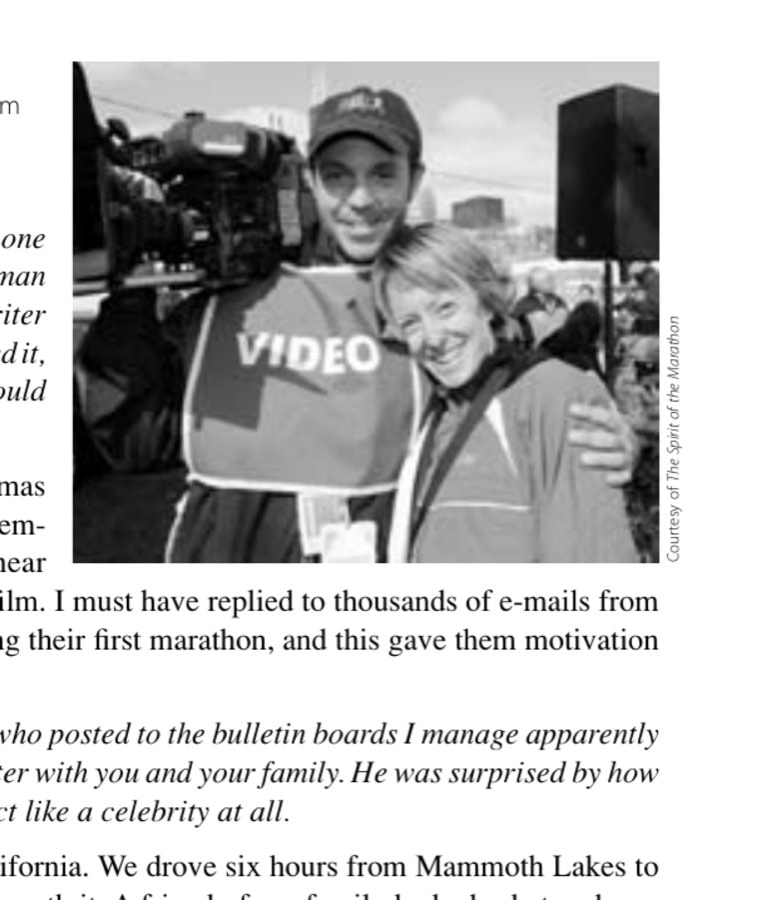
Courtesy of The Spirit of the Marathon
Deena and The Spirit of the Marathon producer Jon Dunham take a break during filming.
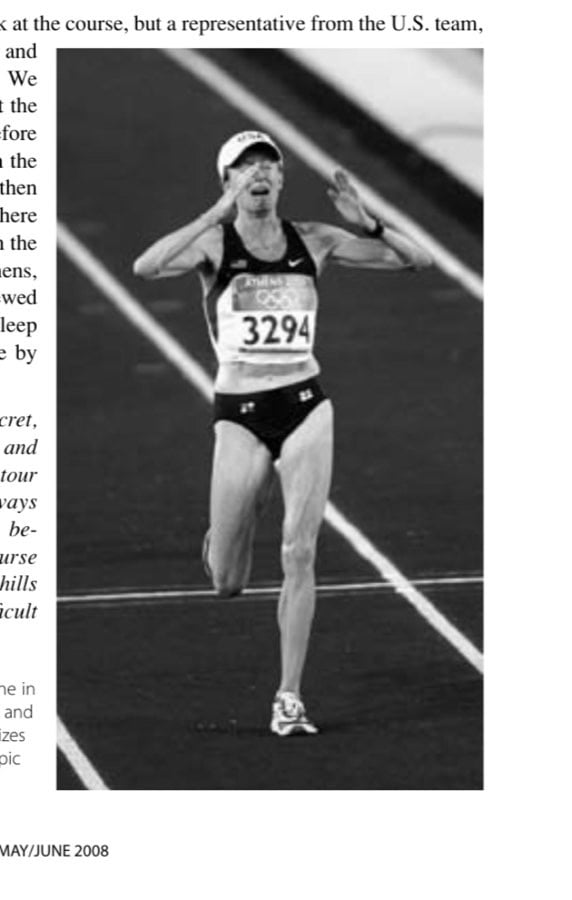
were, it was a high-risk situation. Fortunately, you had trained for a hot-weather marathon, which was my point. A lot of readers of Marathon & Beyond would like to know your secret.
KASTOR: With every race, you try to train as specifically as possible. If you are running cross-country, you want to train on some grass and hills, and if you’re getting ready for a marathon, you want to make sure you are on the roads, slapping the pavement for a good part of your weekly mileage. If running track, you want to do some sessions on the track. It’s always the specificity of training no matter what the event. HIGDON: What specific plans did you make to prepare for Athens? Had you gone over and looked at the course before? KASTOR: We did not look at the course, but a representative from the U.S. team, Randy Wilber, went over and actually videotaped it. We had a good sense of what the course was going to be. Before the Games, we flew from the United States to Athens, then from Athens to Crete, where we stayed three weeks. In the few hours we were in Athens, we got in the car and previewed the course, but I fell asleep twice! I got jolted awake by quick traffic stops. HIGDON: That’s your secret, then: being so prepared and so relaxed that the course tour puts you to sleep. I always hated driving the course before marathons. The course always seems so long, the hills so high—much more difficult
Deena crosses the finish line in Athens with tears in her eyes and shock on her face as she realizes her goal of winning an Olympic medal.
than it actually is, if you prepare properly. Tell us about those preparations. The Athens course actually was fairly flat for the first half of the race; then the hills hit you when you’re just beginning to get tired. Finally, there’s a long downhill stretch, which you can take advantage of only if you haven’t blown your legs out going up the hills. A bit like Boston, I’m going to suggest, but the original Boston Marathon course in 1897 actually was patterned on the Olympic course from Athens the year before.
KASTOR: We knew that. My preparation back in Mammoth Lakes, California, included running hills when fatigued. That was our big focus. On a 26-mile training run in Mammoth, the five miles from 20 to 25 miles were considerably hilly, then one mile downhill at the end. The terrain we trained on was very typical of what we were going to face in Athens, although at Mammoth, we couldn’t mimic the lower altitude, plus it was cooler. I train best when I’m at home and in a groove, so I sacrificed some specificity not training in hot conditions. I overdressed for a lot of my training runs to force my body to overheat. I didn’t just put on a wet suit right away. I gradually added more clothes from day to day and week to week, starting out with shorts and a long sleeve, then longer tights and a long sleeve, then changing from a thin long sleeve to a thicker long sleeve. We were being very cautious. I had to make sure I was hydrated well. It was a matter of training really smart and trying to take all the outer stresses into consideration. HIGDON: In terms of hydration, what specific routine did you follow in training and in the race itself? KASTOR: We figured I could absorb about 4 ounces of fluids every 20 minutes, or three miles in training. I increased my intake beyond that because I knew that I would need more in Athens. I wanted to get my digestive system used to taking 6 to 8 ounces instead of the 4 every 20 minutes. So every 20 minutes in practice, my husband drove up in a car next to me, and I would drink 6 to 8 ounces. It did take some getting used to. During the marathon itself, I not only drank Cytomax every five kilometers, which I drink normally, but in between I also drank a cup of water and doused my head and wrist with a sponge. I forget the exact figure of fluids I drank during the race, but it was something close to 90 ounces, which was a lot. HIGDON: A lot of runners don’t realize this, but in international competition, you can accept fluids only at the official tables, not from people along the course. If your husband handed you even a sponge, it would be cause for disqualification. And the aid stations are at precise intervals. KASTOR: Right. So every five kilometers, we had our special fluid, but then between that in equal intervals were tables with sponges, water, and Powerade, because that is an Olympic sponsor. I didn’t pass up anything.
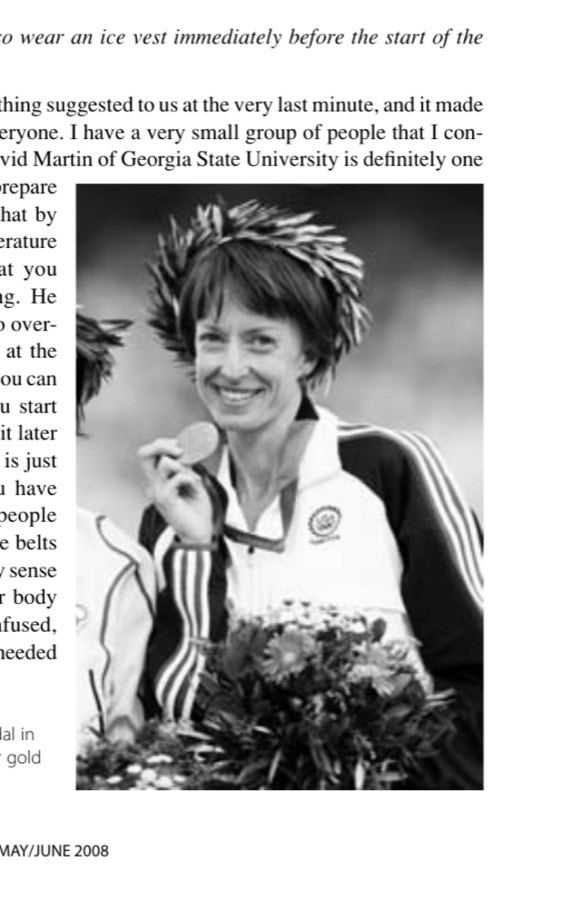
HIGDON: Had you trained with Powerade? KASTOR: No, just with Cytomax. That is definitely something that I recommend to people who are running a marathon. They should practice with the fluid that sponsors the race. HIGDON: I say the same, but I also tell runners that after 10 miles, it all tastes the same—going down and coming up. KASTOR: It is definitely a personal preference. I tried a lot of sports drinks before finding one that I enjoyed drinking, that I looked forward to hydrating during my runs, and that I could digest well. I also take two green-apple PowerGels diluted in water at 25K and 35K instead of Cytomax. That consumption intake seems to work best. HIGDON: Didn’t you also wear an ice vest immediately before the start of the race? KASTOR: That was something suggested to us at the very last minute, and it made sense. I don’t listen to everyone. I have a very small group of people that I consider on my team, and David Martin of Georgia State University is definitely one of them. He helped us prepare for Athens, and he said that by bringing your core temperature down just 2 degrees that you could reduce overheating. He said: you are still going to overheat. It was 101 degrees at the start in Marathon! But if you can delay the point when you start to overheat even a little bit later than everybody else, that is just another weapon that you have in your arsenal. Some people were warming up with ice belts on, which didn’t make any sense to me. It seems that your body would become very confused, even with whether you needed
Having won a bronze medal in Athens, Deena is shooting for gold in Beijing.
to warm up outside on such a hot day. I thought, It’s not going to take any time to warm your body up. Stretching, I could see. You want to be limber going into the race, but there was no reason to warm up for it. That was something that was introduced at the very last minute by our coaches, so we accepted the advice to stay cool inside and relax before the race.
HIGDON: I had forgotten that it was actually 101 degrees before the start in Marathon. Sitting in front of my TV set, I didn’t feel a bit uncomfortable. KASTOR: Hottest day of the Olympic Games, but I felt prepared. We had a team of people all working together, and it really made it easy to focus on getting fit, and everybody else did the rest of the work. I felt like I owed it to them to do well because everybody had invested so much time into this race. Wisconsin grad Matt Downin was training in Mammoth in 2004. He helped me recruit a number of guys to help me. Colin Steele, Joe Eckerly, and Derek Tate ran the entire summer of 2004 with me to get me ready for Athens. Collectively, I referred to them as the “Skeets.” It is amazing how deep our friendships became while training such a short time for this enormous dream. If I had a three-hour run, those three guys would alternate one hour each person. We had a blast. They got the best out of me. They got me as fit as I had ever been up until that moment. Things are so much easier when you are having an enjoyable time. Now, Mike McKeeman from Philadelphia has trained with me for the past couple of years. He helped me train for my first marathon win in Chicago, as well as for my other recent accomplishments. He currently is training with me for the Trials. HIGDON: What is the prognosis on Beijing? Everybody is worried about the pollution. KASTOR: A lot of people worried about the pollution in Greece, but it ended up not being as bad as everyone feared. In China, especially with it being a Communist country, no one is working for the month before the Games. They’re saying: we’re shutting down the factories, nobody can drive their cars, we are cleaning the air up, and everything will be fine. China has had so much negative press, and this is their chance to make a good example by pulling off the Olympic Games, and I think they will do that. At the same time, I’m not going to discredit the fact that it’s going to be very hot. HIGDON: What temperatures are they anticipating for Beijing in August? It couldn’t be much worse than Greece. KASTOR: It’s going to be similar but a little more humid than Greece. With the heat index, it might seem even warmer—not a marathon where you can expect a fast time or world record. They usually have the Olympic marathons at a time of day that is good for the media and not necessarily for the athletes. The women’s
marathon might be in the morning, so maybe they’ll give us a little bit of a break. There are so many more factors to think about in a marathon other than the pollution. You can’t train for pollution. You just want to stay away from it for as long as possible. The best advice that Dave Martin offered us during a three-day distance runners’ camp in May 2004 preparing for Athens was to make small changes. At our camp, we were deluged with advice for three days on nutrition, hydration, and anything else that might affect either our training or our race. We had a psychologist giving us tips on focusing. It was so detailed. At the end of the camp, Dave said, “A few things are going to stand out that you can change a little bit to make your preparations a little bit better, but most important is to go home and get very fit, and the fitter you are, the less any obstacle is going to affect you.” I thought that was the greatest message of all. When it comes down to it, you just need to train to be fit and healthy when you step onto the starting line of an Olympic marathon—or any marathon.
HIGDON: That makes sense for back-of-the-pack runners, too. But what about the Olympic Trials in Boston coming up in April, the day before the traditional Boston Marathon? Are you confident enough in your ability that you can cruise through that race at 90 percent, or do you really still need to go all out? KASTOR: No, I’m already really fit for that race, and I feel like I need to be if only so that I can recover rapidly and get back into training for Beijing in August. I want to be ready for what anybody has to offer in Boston. If someone goes out hard, I may need to go with them. I don’t want to discount any of the other women, because strange things happen in marathons. If I don’t have to extend myself, great—I would love for that to happen—but I don’t want to expect too much or too little out of the Trials. I just hope to be fit enough so that I can recover well and come back healthy and strong for Beijing and not miss any preparation time. HIGDON: What other preparations will you make for the Olympic Games? KASTOR: August is pretty warm in Beijing. If I were to vacation in China, I probably would not pick that time of year. I believe we are going to have a training camp similar to Athens. In 2004, we had our training camp on the island of Crete so that we could get away from all the hype and pollution. This time we might go to Korea. Our Olympic team leaders have scoped some places out, and there are nice trails to run on. HIGDON: And the infrastructure in Korea ought to be stronger, too. KASTOR: It is so nice to have people who have our best interests at heart, flying over to Asia and seeing if places are good enough for us. It’s really great to have that. I’m very appreciative.
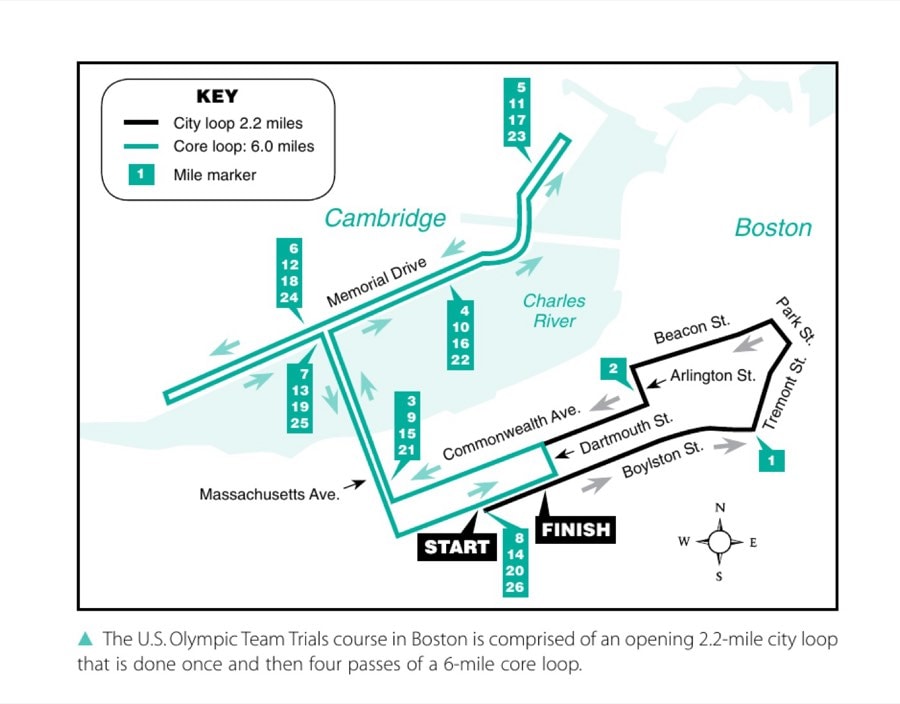
HIGDON: Our Olympic coaches are getting a little bit smarter—in fact, a lot smarter. And our runners are getting faster. The world has only begun to wake up as to what all you guys are capable of accomplishing. I was at the men’s Trials riding in a truck near the leaders. Ryan Hall gave an incredible performance: 2:09:02, and he probably gave a half minute away pumping his arm up and down. KASTOR: It’s fun to see American running doing so well right now. Not only those of us in the front of the pack, but everybody behind us. To see so many people taking part and so many people changing their lives for the better. You think that this sport is so simple, just putting one foot in front of the other, but once you start doing it, you realize just how grand it is. It infiltrates your life. HIGDON: The Trials course in Boston is different from the traditional course used for the Boston Marathon. On Sunday, the day before, you’ll be running loops around downtown, similar to the men’s Trials in Central Park last November. KASTOR: The course looks pretty good—probably not as easy as the one the men ran, but good for the runners and good for the spectators. HIGDON: And easier than if you did the traditional course with all the downhills. The four hills in Newton between miles 17 and 21 are tough, but the subtle downhill in the five miles following is what rips runners apart. If you ran the actual Boston Marathon, it probably would have added another couple of weeks to your recovery time.
Six weeks before the Women’s Olympic Marathon Trials, Deena won the Gate River Run in Jacksonville, Florida—for the sixth time.
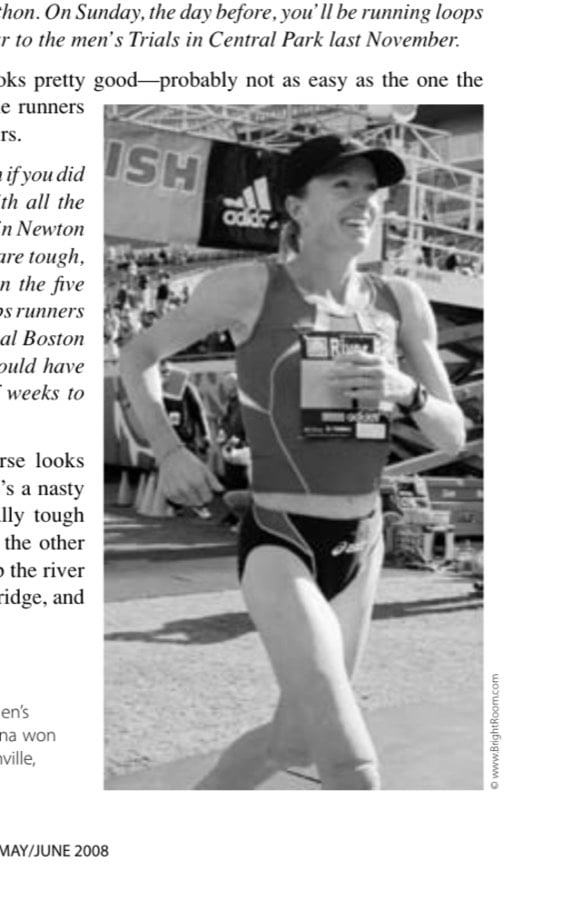
© www.BrightRoom.com
KASTOR: Yes. The course looks good, but then again if it’s a nasty day, it’s going to be really tough going over the bridge to the other side of the river, going up the river and coming back to the bridge, and
5 11 17 23
KEY City loop 2.2 miles Core loop: 6.0 miles Mile marker
Cambridge
2
e. h Av
ealt
wmon
Com
Arlington St.
uth
tmo
Dar
Tre m
3 9 15 21
t.
on S
Beac
St. t.
nS
lsto
Boy
St.
Charles River
4 10 16 22
. St
7 13 19 25
ive
l Dr
oria
mMe
Boston rk Pa
6 12 18 24
ont
1
1
Massachusetts Ave.
START
8 14 20 26
FINISH
The U.S. Olympic Team Trials course in Boston is comprised of an opening 2.2-mile city loop that is done once and then four passes of a 6-mile core loop.
going down the river and coming back, doing a shape like a T. So it doesn’t matter which way the wind is blowing; it could get you.
HIGDON: After the Olympic Games, what is your next goal? KASTOR: Ask me that question in September. You’re going to laugh when I tell you this, but one of my dreams when I’m retired is to run the Marathon du Médoc in the south of France, where you dress in costumes and go through different regions, and instead of sports drinks they have wine. That is right up my alley: combining my passions. HIGDON: Retirement? Don’t you dare use that word yet. KASTOR: You have my permission to delete that word from this interview. It is not going to happen soon. There are so many fun races to run. Médoc is only one of them. Thinking of when and if I run that race and what they offer instead of sports drinks, my husband jokes and says I’m going to have the world record for the biggest marathon spread from fastest to slowest marathon—a discrepancy of something like six hours. I love to run, and I hope to continue in this sport for the rest of my life. So no, I am definitely not retiring. After Beijing, another dream will eat away at me, and I will passionately pursue it!
This article originally appeared in Marathon & Beyond, Vol. 12, No. 3 (2008).
← Browse the full M&B ArchiveMore like this
1,000+ stories from 19 years of Marathon & Beyond
The complete archive of the legendary long-distance journal — digitized and free to read.
