

Dick Merriwell In The Swedish Stadium
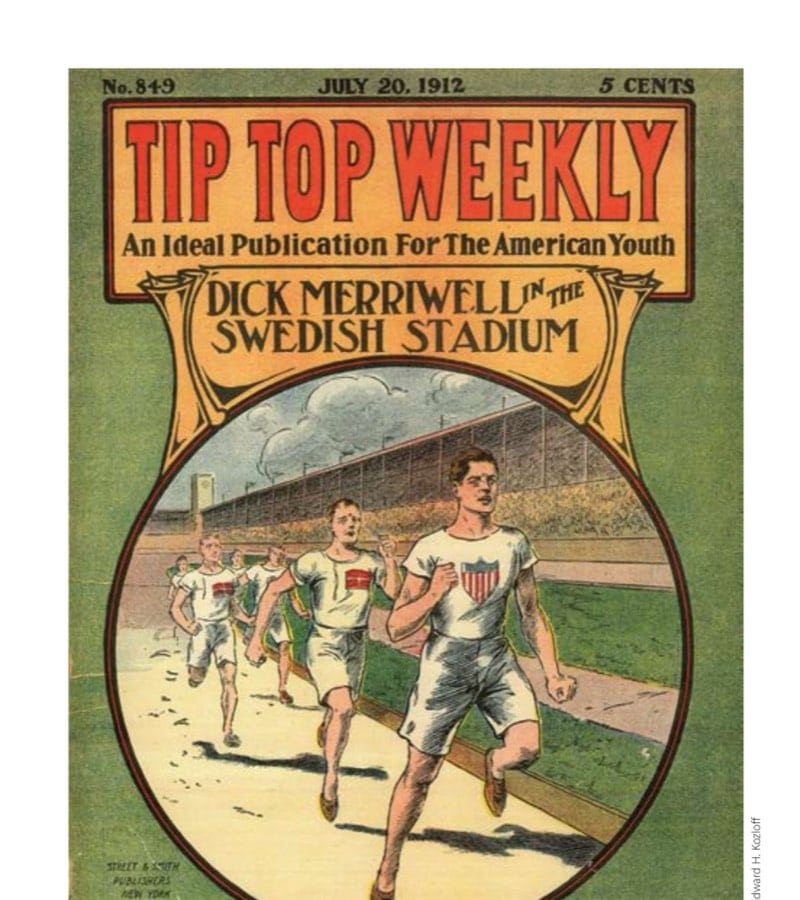
Or how brain power won an Olympic race. From a 1912 Tip Top Weekly. Part 3 of 4. Dr. Edward H. Kozloff
Editor’s note: In the previous two issues, Dr. Kozloff introduced readers to issues of Tip Top Weekly that featured track & field stories starring the Merriwell boys. Tip Top Weekly was a popular nickel weekly for boys back in the early decades of the 20th century. In the first episode, our heroes were tapped to help represent the U.S.A. in the 1912 Stockholm Olympic Games. The first episode featured their adventures on the boat trip over and also detailed the first several Olympic events. The second episode expanded a plot twist, where a foreign criminal, Carberry, attempted on several occasions to undermine the efforts of the American athletes. Carberry’s attempts to foil the success of the team from America continue in this installment.
It was unusually quiet around Stockholm after Dick Merriwell’s surprising 400meter-hurdle victory. Despite this, there was disbelief that Carberry had given up. The inspector and Merriwell had his smaller boat, and he had said that it would be taken back when he was ready.
Since Carberry had set so many traps for the American group, Merriwell and the inspector decided to return the favor. They put the craft in the water next to the American headquarters ship. Inspector Lane, with a gun and small club, and Bill Brady, the Yale catcher and Olympic shot put champ, lay concealed on the bottom. The regular ship’s watch kept guard, unaware of what was going on with the Yale men and former criminal Lefty Leyburn watching from different vantage points.
Despite this, three of Carberry’s men reached the Rhineland’s deck and overpowered one of the Yale men. They then continued around the deck overpowering the guards, eventually reaching Lefty Leyburn. Recognizing him and realizing that Carberry would want him, they threw him over the rail onto the small boat. As Leyburn landed, he fell on Inspector Lane, stunning him. Brady saw the three men coming down a rope ladder and was ready to take them on. However, the
lead man saw him and leaped from the ladder while he was still 20 feet above the craft. In doing so, he knocked Brady out of the boat. As Brady tried to get back on board, Inspector Lane was pushed into the water. Brady was forced to save him from drowning as the boat sped away. Brady yelled up to the ship, and he and the inspector were pulled to safety. Despite what was believed to be a sound plan, Carberry had again been underestimated. Now Lefty Leyburn’s life was in danger as he was taken with the boat.
Meeting the next morning, the members of the group were depressed. They thought that someone on board was giving information to Carberry. Their concern for Lefty Leyburn’s safety was also great. As they talked, Jim Phillips went to the nearby wireless cabin. He was simply amusing himself listening to messages that were being sent by different boats to each other and to shore. One message seemed strange and in code and had the same peculiarities that the previous messages from Carberry had. Suddenly, another message came through in code from Carberry. It was difficult to translate, but they were able to determine that Leyburn was safe, though injured badly with a broken leg and slight concussion. When he recovered, Carberry was going to assemble all his workers and show them what was done to a traitor.
The next day was the high jump competition. Hart, from the University of Wisconsin, was America’s best, with Jim Phillips a recent addition to the entry list. Merriwell and Inspector Lane had been trying to figure out which yacht was Carberry’s. They knew it had a wireless on it; thus, there were 17 yachts with a wireless. Of this number, 14 were accounted for, leaving three yachts to be watched carefully. Because Merriwell and the inspector were busy with this and trying to determine how to rescue Leyburn, Phillips and Hart went to the stadium alone to qualify for the high jump.
Qualifying for the high jump finals was to be a lengthy process because of the number of contestants and jumps allowed. Phillips wanted to do especially well since Barbara Morton and her mother were in the stands, and they were all going to lunch after the trials.
Despite being considered second best, Phillips was the only U.S. qualifier with a leap of 6 feet, 1 inch. The best jumper, Hart, a probable medal favorite, didn’t qualify. He developed a strange sore on his heel, which affected his jumping ability.
After qualifying, Phillips and the Mortons went to lunch and had a pleasant time. Mrs. Morton then extended an invitation for Phillips to join them on the Bourne family yacht. The Mortons had met Mrs. Bourne and her daughter on the trip from America. Mr. Bourne and their son had sailed their steam yacht from America to Stockholm.
At the wharf, a stylish launch awaited them. Phillips felt uneasy as he met the Bournes’ son, Rodney, and in their brief discussion, Rodney didn’t speak the
Courtesy of Dr. Edward H. Kozloff
way an American would converse. Additionally, with three crew members, the launch seemed overly crowded. As they approached the yacht, Rodney Bourne pointed and said, “That’s Mother on the deck.” However, Barbara Morton, looking through a telescope, shockingly said that it wasn’t Mrs. Bourne. At the same time, Phillips suddenly recognized one of the crew members as one who had tried to
disable the Olympia on the trip from America. He grabbed the fake young Bourne and held what felt like a gun to his neck, telling him to steer to the Rhineland, which was only a ship’s length away. When the crew members saw what was happening, they tried to get to Phillips, but it was too late as the launch bumped into the Rhineland’s docking area. From the deck, Inspector Lane saw what was happening and climbed down to help Phillips. They were able to hold off the crew until Mrs. Morton and Barbara could leave the launch. The fight was a struggle, with no other help coming from the Rhineland. Being outnumbered, they were just able to jump on the landing stage as the launch pulled away.
Merriwell was dazed when he heard about these events. Phillips explained that he had held a pocket flashlight to the neck of the fake Bourne, who had thought it was a gun. That had allowed them to get to the Rhineland. Merriwell and the inspector had been watching three yachts, one of which they believed was Carberry’s. They saw Phillips get on the launch and suspected that something was wrong. Now, they were sure which yacht was Carberry’s.
Inspector Lane went out on a friend’s yacht to watch the one they now knew was Carberry’s, which was called Norma. He reported back what he had seen to Merriwell. Since Carberry now knew that his yacht had been discovered, Merriwell devised a plan to attack his boat that night. They would board the boat in two groups with a contingent of athletes, most of whom had completed their Olympic activities. The smaller group would make an obvious boarding attempt. The larger group would come from behind.
As they attacked, however, they realized that the Norma’s crew was larger than they had expected, so they would have to act fast. Merriwell quickly went below deck and found the injured Lucky Leyburn. When they reached the deck, the fight was shifting in favor of Carberry’s men. Leyburn went to the waiting boat. Merriwell, being behind the fighting, was able to surprise Carberry and push him overboard to Leyburn. Then all of Merriwell’s men jumped into the boats and escaped.
Back on the Rhineland, Carberry was examined and found to have a concussion. Inspector Lane had suffered a broken arm, and it was set. Carberry was placed in a stateroom with a steward to care for his needs and to guard him, although he appeared to be helpless. All went to sleep safe in the belief that Carberry was theirs at last.
The next morning, Carberry was gone. The steward said he was awake until someone brought him a cup of coffee. It was drugged. Also, Carberry’s yacht had moved out of the harbor. Inspector Lane and Harrigan assumed that Carberry was fleeing and would no longer be a problem. Merriwell was less convinced. He worried about where Carberry’s onshore headquarters was. Merriwell kept the Yale men on alert and also spoke to Lefty Leyburn, who said that Carberry had made some special plans so that Merriwell would not win the marathon.
Back at the Games, the Americans were in the lead, but a number of foreign athletes had done surprisingly better than predicted. As the hammer throw competition progressed, one of the officials looked uneasy. Bill Brady was throwing well. After Brady’s second-to-last throw, the uneasy official personally brought his hammer back to him, something that was not usually done. As Brady went through with his last toss, the hammer went almost straight up instead of in its usual arc. A shocked Brady looked at his hand and saw that it was bleeding. He then looked at the implement. The handle was not properly set. The hammer had been made unfit for a proper throw. In the confusion that ensued, Brady’s real hammer was brought back and the doctored one disappeared. Merriwell later discovered that the official had been a substitute.
In the high jump the next day, there was still concern about how Hart had injured his foot and failed to qualify. His shoe had been examined, but nothing unusual could be found. At the last minute, Merriwell gave Jim Phillips a pair of his own jumping shoes, which were the same size. With his best jump ever at 6 feet, 3 inches, Phillips won the competition and made up for Brady’s defeat.
After the competition, Phillips was told to leave his shoes behind when he went to dress. The official who had brought Brady the faulty hammer seemed very upset with Phillips’s successful jumps. With Merriwell watching from a concealed position, the official quickly grabbed one of the shoes and cut away part of the sole, looking at it in disgust. Later, Merriwell took the shoes that Phillips was supposed to wear, cut apart the sole, and found a tiny speck of radium—an expensive material, but evidently worth it to Carberry to disable an American athlete.
Back in the Rhineland’s wireless cabin, Carberry’s presence in Stockholm was made certain. He was mad at the American high jump victory and disturbed that the expensive radium had not been recovered.
Inspector Lane, despite his broken arm, wanted to immediately search the city for Carberry. Merriwell didn’t think this was a good idea, but Bill Brady was ready to go on a search. When Inspector Lane had been playing the fake inspector, he had received clues from Carberry (who had no reason to hide it from him) where the house in Stockholm might be. If the house had a wireless antenna, that would be it.
Lane and Brady began their search and reduced the possible headquarters to one. Just before entering it, Brady stepped into a shop and made a brief phone call. The house seemed deserted, and there was no response when they rang the bell. A slight push surprisingly opened an unlocked door. As they went through the house, all was silent, and nothing seemed unusual except that there was a wireless station on the top floor.
Suddenly, five men jumped and subdued them. A message was sent to Carberry that they had been captured and would be moved that night. Inspector Lane was upset and apologetic to Brady for getting him in this situation. Brady told him to
cheer up, wait, and see what might happen. Hours passed. They were given food and water, and Brady continued to remain unexpectedly calm. Shouts and sounds of a struggle erupted from downstairs. It was Merriwell, Harrigan, Phillips, and a dozen other Americans. The inspector learned that Brady, just before they had entered the house, had telephoned their destination.
Inspector Lane was still depressed that he had rushed to find Carberry’s headquarters with the resultant danger. However, Merriwell comforted him, saying that now Carberry’s Stockholm headquarters was out of business and, additionally, many of his men had been captured along with his wireless operation.
The concern now shifted to the upcoming mile race. At least three entrants had run three seconds faster than Merriwell. The main American hope, an Indian named Little Bear, had not been running well in Stockholm and could not be counted on.
The event was actually 1,500 meters, a distance short of a mile. Merriwell hoped that the pack would stay together for three laps, since this would be best for his strategy. Preparing for the event, he ate little, traveled to the stadium in the car of the American minister, and carefully examined his clothes.
Fifteen runners lined up for the start, which was swift for the first 50, when the runners quickly settled into the pace. The English star, Smythe, took the lead, something he usually did. He liked controlling the race from the front. Merriwell settled in the middle of the pack, running on the outside so as not to be boxed in. Hallowell, a British army runner, settled into second place. For three-quarters of the race, only 20 yards separated the first from the last runner.
As they entered the last lap, little attention was paid to Merriwell, who was watching the leaders closely. Smythe’s eyes gave Merriwell a clue that he would begin his closing drive 200 yards from the finish. Fifteen yards before that point, Merriwell sprinted through the pack to the front and was in the lead by 10 yards before anyone could react. The slow, paced race had suddenly been changed, and with this, the crowd’s reaction changed the air. Merriwell could hear footsteps closing in on him but with a final burst broke the tape, winning by a six-foot margin. His strategy had worked and had allowed him to defeat the much stronger runners who had finished behind him. Dick Merriwell’s assault on the Olympic medals continues in the next issue.
This article originally appeared in Marathon & Beyond, Vol. 13, No. 3 (2009).
← Browse the full M&B ArchiveMore like this
1,000+ stories from 19 years of Marathon & Beyond
The complete archive of the legendary long-distance journal — digitized and free to read.
