

East Versus West Mountain Running
Not many things intimidate Ben Nephew. A respected road and trail racer on the New England scene with dozens of wins to his credit, Nephew is the
kind of runner who finishes near the top at the notoriously brutal Mount Washington Road Race, which includes more than 4,600 feet of elevation gain in 7.6 miles and then follows that up by winning the Mount Greylock Half-Marathon trail race the next day. Nothing to it.
But he wasn’t too far into the Teva Vail 10K at 8,000 feet in 2004 when those races seemed like child’s play. Nephew’s head was spinning. The altitude was wreaking havoc on his body. The thin air more than a mile and a half above sea level robs the body of the precious oxygen it needs to perform aerobic exercise. Legs can feel like boat anchors, solid as old iron and equally useless for running. And the lungs, normally the most reliable part of a highly trained distance runner’s arsenal, can betray flatlanders without warning, making them feel as if they’re suddenly using the cardiovascular system of a two-pack-a-day smoker trying to lug a sofa up a flight of stairs. Gifted, race-hardened runners can suddenly find themselves disoriented, gasping for air, thinking, Where is all the damn oxygen anyway? How do these people live up here? “It was sick. I was seeing stars. I definitely felt affected by the altitude,” Nephew remembers. “You can train as hard as you want, but you can’t practice the altitude. All of those guys out there are altitude trained, and it shows.”
For many people, the most compelling and attractive thing about running is its simplicity, the complete lack of any complicating factors. You succeed or fail purely on your own merits, relying on nothing but the miles you’ve put in and whatever God-given talent you might have. There are no bad bounces, boneheaded plays by teammates, missed calls by referees, or wacky decisions by coaches.
No, in running you lace up your shoes, run as hard as you can, and at the end of the race, you look up and see where you stand. Fast is fast, regardless of where you live.
WHEN THE COURSE IS THE ONLY COMPETITION
Anstr Davidson/Virginia Happy Trails Running Club
But that comforting simplicity and sameness does not necessarily pervade every corner of the sport, particularly as it is practiced at the highest levels and in the most extreme circumstances. Runners like Nephew, excellent athletes used to dominating regional competition after years of hard training and racing, can suddenly find themselves at a distinct disadvantage when they toe the line at a race on the other side of the country. This is especially true in the disciplines of long- and ultradistance mountain and trail running, activities in which the terrain and the locale play huge parts. In most of these races, the course itself is the toughest competition, arbitrarily lifting up some runners and carrying them forward, while cruelly punishing others; the other runners are more fellow travelers than bitter rivals.
Thanks to the recent success and fame enjoyed by stars such as Dean Karnazes, Scott Jurek, and others, ultradistance mountain and trail running has begun to
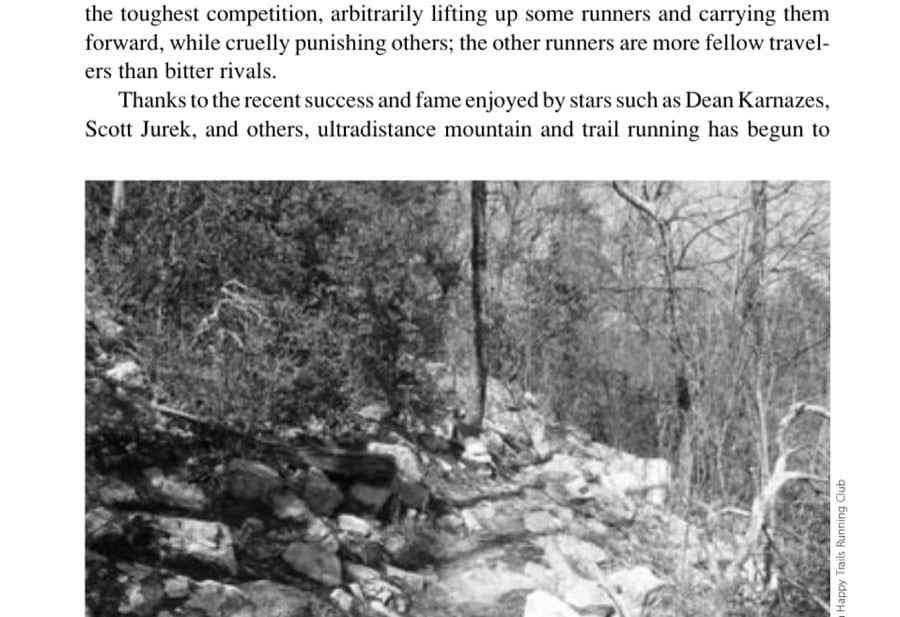
▲ Just south of Edinburg Gap, the infamous Short Mountain section of the Massanutten Mountain Trails 100 Miler.
seep into the consciousness of the American public. Nonrunners—and even many marathoners who are still considered oddballs by coworkers and friends—regard these athletes with a mix of curiosity, awe, and something bordering on pity. Outsiders also tend to lump these runners together, assuming that there can’t be much difference between some nut running 100 miles over boulders and downed trees in Massanutten, Virginia, and his equally touched counterpart pounding out 50 miles at 7,000 feet in Colorado.
While there are in fact a number of similarities in the mountain- and trail-running scenes in the eastern and western portions of the United States, the differences between the two can be striking. To begin, although many aficionados will tell you that the whole phenomenon got its start on the East Coast, there seems to be little dispute over the fact that the scene in the western part of the country is much more developed at this point. “
I think a lot of the roots of trail running and the whole thing originated in the East, but trail running seems to get more credit in the West,” said Jurek, an off-road ultrarunning legend who has won the Western States 100 Mile Endurance Run seven consecutive times and broke the tape at the Badwater Ultramarathon in his first attempt in 2005. Jurek, who makes his home near Seattle, has run and raced all over the country, including the Vermont 100 and the Bull Run Run, a 50-miler in Northern Virginia. Jurek’s perspective has helped him conclude that there are a number of reasons for the differences in the two communities. “
I think the terrain, the vast open spaces, and the network of trails [out west] have helped it evolve over time. Outdoor sports in general are more easily accessible here. Road people, when they move out here, they find the trails and they start running there instead of on the road,” Jurek said. “There are vast amounts of trail networks out here. It’s a natural evolution for folks who want to go longer.”
Indeed, most western states have hundreds of miles of natural trails snaking across the landscape. Runners looking for off-road training grounds have their pick of soft dirt or grass trails or have the option of heading to the seemingly ever-present mountains for more challenging terrain. But their counterparts back east usually have to put in some effort in order to find suitable trails for serious training. The 2,175-mile Appalachian Trail, which runs from Maine to Georgia and includes some of the more stunning vistas to be found east of the Mississippi, is not runable for large stretches. The other option for most East Coasters is a rail trail—an abandoned railroad track that has been converted to a bicycle and footpath—but almost all of those trails are paved.
THE PERSPECTIVE FROM THE SOUTHEAST “Out West, they have a great network of trails to run on. In the Southeast, people are not as conscious about working out as people are out West, so there’s not as
John Stifler / Mt. Washington Road Race
much land being donated,” said Janice Anderson, a top mountain and trail ultrarunner who lives near Atlanta. “I always feel like people out West are outside doing something. It’s not as widespread here, so it’s not as easy to find trails. I recently moved just so I could be closer to one of the parks here that has good trails.”
As a result of the lack of good off-road training grounds, a good number of runners on the eastern seaboard do much of their training on the roads out of necessity but still race often on the trails. That lack of daily experience on the trails can be a weakness come race day, many veteran trail runners say, especially when it comes to racing on highly technical courses that demand intense concentration and focus. “
Training for our races requires varied terrain. That’s tough to find in the East,” said Jurek. “It can be done, but you need altitude, too, which is tough. Also, the travel to get out here is tough. Folks tend to get out here once a year. The proximity that we have is huge.”
Anderson, who has won more than 50 ultras in her career and was the USATF Ultrarunner of the Year in 2000, echoed Nephew’s sentiments about the problems nonwestern runners face in trying to acclimate themselves to the altitude during races in Colorado, California, and other western states. “It’s a definite advantage for the western runners. I don’t have enough time to get out to a race early and acclimate myself,” Anderson said. “If I’m running a race like Western States where altitude really isn’t a factor, I can go and run tough trails to get ready.”
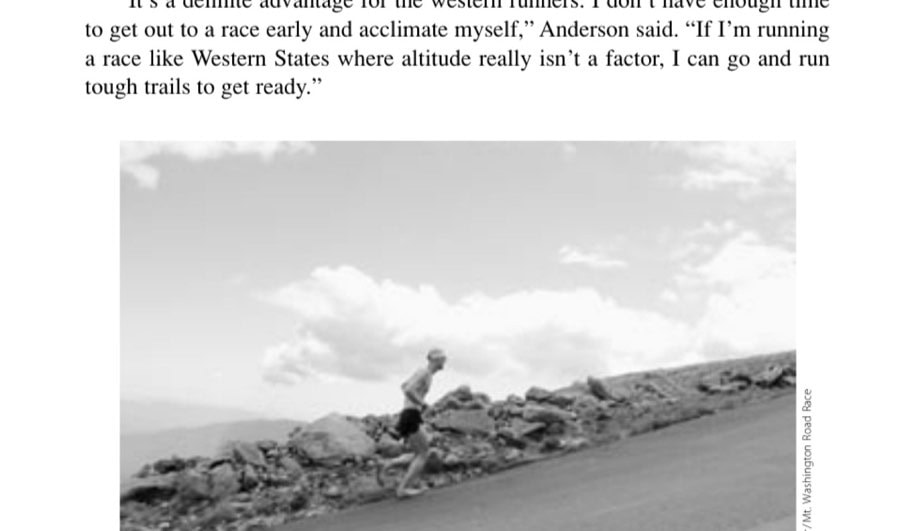
▲ Paul Low, from Massachusetts, is a multiple top-five finisher of the grueling Mt. Washington Road Race.
As Nephew points out, “You can’t practice a three-mile downhill with 1,500foot drops in elevation on the East Coast.” All of these factors have crystallized in recent years to help form an intensely competitive trail- and mountain-running scene in the western part of the country that many observers feel is perhaps the best in the world. At the very least, there can be little doubt that the level of talent in that community is at the top of the pyramid: Karnazes, Jurek, Scott Dunlap, Ian Torrence, Tim Twietmeyer, Nancy Hobbs, Erica Larson, and dozens of other top off-road specialists call the western states home.
Karnazes, for one, believes this collection of talent attracts other top runners looking for a challenge and creates a kind of self-sustaining feeder system. “I think it’s kind of a ‘center of excellence’ phenomenon. People are pushing each other to perform at higher and higher levels here in the West, and this competition breeds stronger runners,” he said. Karnazes, who lives in the San Francisco Bay area, is one of the top ultramarathoners in the world and is the author of the inescapable and incomparable Ultramarathon Man, a chronicle of his running exploits.
AT THE TOP OF THE EASTERN PYRAMID Even with the challenges of finding decent running trails on the East Coast, the last few years have seen a surge in the number of top-level trail and mountain runners emerging from that region. Among these runners are • Eric Blake, who won the 2006 Mount
Washington Road Race and with it the 2006 U.S. mountain-running championship. He lives in Connecticut. • Paul Low, a seven-time member of the USATF mountain-running team and the 2004 national mountain-running champion, lives in western Massachusetts. • Anderson, who once held five 100-mile course records at once.
Despite his stature and celebrity, Karnazes is known as a generous competitor, often helping other runners during races. That spirit of cooperation in the midst of competition is perhaps the defining trait of the trail- and mountain-running community, regardless of geography, and is something that many participants point to when asked why they prefer the dirt to the road. “
I’m struck more by the similarities we share than the differences. That same passion, commitment, and dedication of the participants seem evident in every ultra I do, regardless of the location,” Karnazes said. “Sure, we may use different gear and equipment, but essentially our spirit is the same. There seems to be two
camps: those who run ultras to win, and those who run ultras for the experience. The guys and gals who are winning most of the races are definitely racing to win, and I would estimate that’s about 10 to 20 percent of the field. In some of the more grueling races, such as the Western States 100 or Badwater Ultramarathon, a lot of the participants are defining victory as crossing the finish line. They are there for the adventure and to test their own personal limits. To me, that is the essence of ultramarathoning.”
Angie Lyons is a proud member of the latter group Karnazes describes. She will likely never win or even contend in the trail and mountain ultras she loves, but she couldn’t care less. Lyons, who resides in Tucson, Arizona, has had gallbladder disease for several years, during which time she has run the Pemberton 50K in Arizona and the Sugar & Spice 50K in Kentucky. She underwent surgery to remove her gallbladder and was laid up for quite a while.
But don’t mistake her for a charity case looking for sympathy. That would be a severe underestimation and would sell her competitive spirit short. But the community spirit of the trail and mountain scene is what keeps her coming back, day after day, pain or no. “
Out here, it’s about the mountains. The trails are steep and rocky; the elevation is high; the weather is hot. The community of trail runners in Tucson is so
ad
fun. Everyone I run with is supportive and encouraging,” she said. “Being part of a community with an organized trail-run series makes it more interesting. About twice a month, runs are put on around the area, and it’s so much fun. At the same time, it’s still competitive. There are fast people and slow people, and everyone is encouraging toward everyone else. Once they realize you want to run far, there’s no end to hearing, ‘So when’s your first 100?’”
Lyons is one of the rare runners who started her running career on trails, and she has no plans to move to the pavement any time soon. But she said that runners out West can have just as much difficulty racing in the East as easterners do when they head out West. “
I signed up to do a race in Kentucky. I wasn’t sure how to prepare for it. Ticks, mud, humidity, poison ivy. I did heat training, pretty standard stuff in Arizona, hoping that would help build stamina to get through 32 miles of humid weather,” Lyons remembers. “I realize now I should have done some training by running in the sandy washes, to simulate the slow going in the muddy section. The biggest difference in the trails was the topography! I am just not used to running up and down, up and down. In the desert, we run straight up the mountain and then run back down. So that threw me for a loop. It was an all-woman race, and I would run ahead of everyone on the hills, but they’d catch back up and then pass me on the undulating portions.”
So where does this leave the eastern and midwestern runners looking to compete with their western counterparts? How do they level the playing field? Most top mountain and trail runners say that the key is to emphasize your strengths. If you run regularly on gnarly, root-infested, and rock-strewn trails, look for similar courses if you’re going to race at altitude out West. Many trail runners train on smooth dirt trails, even out West, and experience on more technical courses will serve you well.
THE DIFFICULTY MAY HAVE BEEN OVERHYPED “People always told me how tough the trails are out there, but when I raced out West, they were not nearly as tough as what I run on here,” said Nephew. “I was like, ‘Is that it?’”
Eric Blake, the Mount Washington winner, who concentrates almost exclusively on road races and mountain races, lived and trained at altitude for two years when he was in graduate school in Colorado. For him, confidence is as much a part of succeeding in adverse conditions as any course-specific training is. “
I never felt like living at altitude was a huge advantage, but it gave me the confidence that I could run well in those races, even after I moved away,” Blake said. “That’s important for any runner. I’m definitely an aerobic runner, that’s my strength, so I play to that.”
This article originally appeared in Marathon & Beyond, Vol. 12, No. 2 (2008).
← Browse the full M&B ArchiveMore like this
1,000+ stories from 19 years of Marathon & Beyond
The complete archive of the legendary long-distance journal — digitized and free to read.
