

Editorial: Out of Lossiemouth
OUT OF LOSSIEMOUTH
Over the Christmas holidays of 1978 Runner’s World held its annual National Running Week in Palo Alto, California. National Running Week was an excessive extravaganza of running that is difficult to describe more than two decades later.
The awkward term “excessive extravaganza,” at least in this instance, is not a redundancy. It is as accurate a description as I can think of for the event.
The week opened with a mass relay event from Sausalito on the north end of the Golden Gate Bridge to halfway down the San Francisco Peninsula. Runners could run parts or all of the 15-mile run; the relay consisted of hundreds of runners from around the world. Several runners ran the 15 miles, then turned around and ran back to Sausalito, had a bowl of soup, then drove to Palo Alto to hop into the next event.
The week held 32 running programs (from “Women’s Running” to “Training Tips from the Top”) presented by 97 invited guests, including Grete Waitz, John Walker, Derek Clayton, Brendan Foster, John J. Kelley, Fred Lebow, Ron Clarke, Don Ritchie, and others. Amby Burfoot, now editor of Runner’s World, described the event this way: “As the week wore on, it became increasingly evident that National Running Week had become much more than just another whistle-stop on the running circuit. . . . Few others can match its peaks; none can match its magnitude or scope.” Indeed. The week’s highlights included the Nurmi Awards banquet, honoring the best runners of the year, which was staged like a mini-Academy Awards show. On New Year’s Eve, at the stroke of midnight a five-mile race was run in Los Altos. The winners were Alberto Salazar and Grete Waitz, who set world records of 22:13 and 25:28, respectively.
From the world of ultrarunning, Bob Anderson, RW‘s owner and publisher, brought in Frank Bozanich, Don Ritchie, and Tom Osler. Bozanich, a marine, was the American record holder at 50 miles and several other distances; Ritchie, from Scotland, was the world-record holder at 100K. (He’d pegged the record at 6:10:20, two months earlier. The year before, he’d run 100 miles in 11:30:51, also a world record. Both are still world records today, 23 years later.) Osler was one of the pioneers of modern ultrarunning. The three of them did three workouts per day, and it was usually pretty easy to find them: the host hotel had a daylong buffet, and the invited guests had carte blanche at the restaurant; when Bozanich, Ritchie, and Osler weren’t outside knocking off miles, they were inside the restaurant refilling their tanks. On a daily basis, the three of them either broke or wore out the soft ice cream machine in the restaurant (which pissed off the other 94 invited guests, who each night went icecreamless).
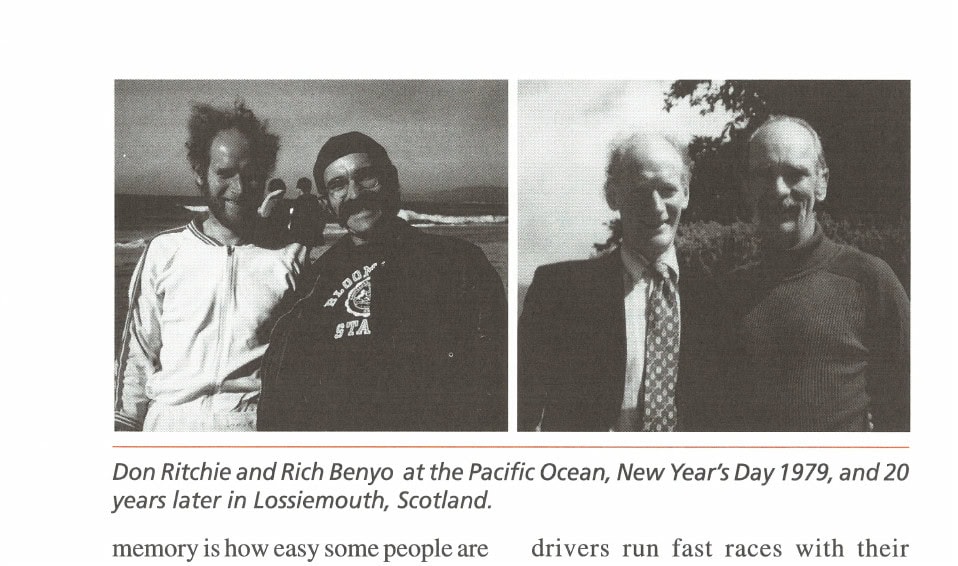
When all the hectic New Year’s Eve festivities were over, and on a few hours’ sleep, a little group of us headed out to the Pacific Ocean on New Year’s Day. Amby Burfoot was in the habit of running a race and then jumping into the frigid waters of the Atlantic Ocean on New Year’s Day. Since he was at the wrong end of the country, the least we could do was accommodate his run along the Pacific Ocean, followed by a plunge into the frigid ocean waters.
Don Ritchie, wanting to see the Pacific Ocean and also get in yet another run, came along. He’d already done a six-mile, early-morning run and now decided to do an hour run with Amby. Although Don lived in the far northeast of Scotland, where frigid waters of the North Sea are the norm, he declined the jump into the Pacific. He was very supportive of Amby doing it, though. We were kids egging on one of our own to get into some sort of silly trouble.
I remember the day as sunny but cold. The several photos that remain confirm my probably age-burnished memory that we all had a mighty good time.
I remembered Don Ritchie as the personification of the stereotypical long-distance runner: quiet spoken, unassuming, personable but not pushy, comfortable being alone, possessing a dry but deep-running sense of humor, and very focused. Marine Frank Bozanich, on the other hand, was the opposite: loud, exuding confidence, entertaining in an I’ll-show-you sort of way, very intense, but under the gruff exterior, soft as the center of a Tootsie Pop. Tom Osler? Well, Tom Osler was Tom Osler: quietly intellectual and analytical.
In 1998, spurred by the legend and myth of William Wallace in the film Braveheart, my wife and I got together with another couple and planned a vacation to Scotland. We’d never been there; the other couple had been; the female half had, in fact, grown up English, the bane of the Scots.
As we planned our two-week circuit of Scotland, it occurred to me that we might drop by to visit Don Ritchie. It had been 20 years since we’d last seen each other. I had, of course, continued to follow Don’s outrageous running career, including a litany of accomplishments way too long to list here. Here are a few highlights, though:
- In 1991, at Copthall in England, Don ran 200K (124 miles) in 16:19:16, which still stands as a world record.
- As he has aged, Don’s simply absorbed the age-group records in the ultraworld: 4:15:15 for 40 miles in the over-45 category and, in the same race (Livingston in England in 1990), 5:23:02 for 50 miles, both still world age-group records.
- In the over-50 division, he holds the world age-group records at 30 miles, 40 miles, 50 miles, and 100K.
- Don was the British 24-hour champion in 1990, 1991, 1992, and 1994.
- At the 1995 100K World Challenge in Winschoten, Holland, he was the 50-and-over champion.
And so on.
So I contacted Don and he, too, fondly remembered National Running Week, 1978. Our little band immediately scribbled in a trip to visit Don and his family in Lossiemouth as the northernmost extent of our counterclockwise trip that would begin at Edinburgh then progress to St. Andrews, Aberdeen, Lossiemouth, the Isle of Skye, Stirling (site of the William Wallace Memorial), and then Glasgow.
We were fortunate to visit Scotland during the World Cup competition and during the country’s efforts to establish self-rule after centuries of being part of England, so people in every pub we went into were either immersed in serious discussions of independence or roaring in support of the Scottish soccer team. While the English soccer fans rampaged and promoted mob rule, the Scottish fans were beloved by everyone for their openness and good humor. It was easy to get caught up in all the exuberance.
In St. Andrews, we ran on the hardpacked sand where Chariots of Fire opens. In Aberdeen, we were “kidnapped” by a local history buff who insisted she wouldn’t feel right if she didn’t show us the sights the typical tourists miss. In Elgin, we enjoyed bagpipe bands and ate “chips” made the way they used to make them at the Carbon County Fair where I grew up in eastern Pennsylvania: with skins on, covered with lots of salt, and sprinkled with vinegar.
By the time we hit Lossiemouth, we needed to slow down a little, and this was the perfect place to do that. The town lies hard against a sea that can become very angry. Don’s house, known as “The Lodge,” sits on a bluff above the moody sea. It is an intimate and warm house, at that time filled with the enthusiasm of two teenage girls, Claire and Anna, who were prevailed upon to entertain us one evening with song and guitar after we all went to the local Indian restaurant. Isobel, Don’s wife, is heavy into the teachings of Sri Sathya Sai Baba, an Indian guru, and she was pleased to share with us some of his teachings: “The desires that cling to the mind are the blemishes that tarnish man’s inner consciousness. Control the senses; do not yield to their insistent demands for satisfaction.” Also there was Don’s favorite running companion, Muffin, who Don claims is the fittest springer spaniel in the United Kingdom.
We spent a pleasant three days in Lossiemouth. As I think back fondly to the visit, the most overwhelming memory is how easy some people are to be with. I hadn’t seen Don in 20 years, and although the hairs that were left on our heads had grayed and we’d developed some wrinkles here and there, it was as though a mere week or two had passed since last we’d shared a laugh.
The couple who accompanied us couldn’t get over how such a fiercely competitive world-class runner could exist within the body of the gentle, soft-spoken guy with whom we’d spent time. In him there was not a hint of bluster or arrogance. Just a quiet confidence and a sense of humor based on the ironic nature of the world.
The depth of Don’s competitiveness comes through in his tale of the John O’Groats to Land’s End adventure published in this issue. When it comes time to race, Don is ready to give it his all. His attitude toward his sport calls to mind the famous 1970s sprint car driver Kenny Weld, who participated in a sport where a lot of drivers run fast races with their mouths but break down when the racing actually starts. On each of his sprint cars, Kenny Weld had this admonition printed: “When the green flag drops, the bullshit stops.”
Those probably aren’t words you’d hear from Don Ritchie’s mouth, but I think he understands the sentiment and personifies it every time he pins on a race number.
* * *
There are few major tragedies in marathon running.
Certainly, there are any number of minor tragedies. Hitting the “wall” on a marathon that was likely to be a PR. Losing another toenail just as beach season approaches. Being unable to surge against your most fierce age-group rival during that last race of the season. Not being picked—again—in the lottery at the New York City Marathon.
Marathon runners and ultra types aren’t rock stars, prone to self-destructive behavior or at high-risk for anything—beyond extremely low pulse rates that seem to befuddle doctors when we get our annual physical.
So it was doubly shocking after our recent trip to the Grandma’s Marathon to receive news that Christine White of Metamora, Illinois, had died in a small plane crash in Santa Fe County, New Mexico.
No need to scratch your head trying to recall Christine’s feats as a marathoner—and she’d have found it ironic if you were to confuse her with Christine Clark, America’s only female Olympic marathoner in 2000.
Christine White was the mother of four. Her boys ran cross-country in high school. Her youngest son was a freshman in college. She’d spent much of her adult life raising her brood, and now that they were leaving the nest, she found, at the age of 51, the time to pursue her dream to write.
She went back to college and majored in creative nonfiction writing. She wrote about a variety of subjects, from skiing to her beloved Santa Fe. She also wrote a story about high school cross-country runners and what they say when they speak of their sport (see pages 99–112 in this issue). She was a friend of Lorraine Moller, a world-class marathoner from New Zealand, who has the distinction of being the only woman to have completed the first four Olympic marathons for women. Lorraine is a friend of M&B’s, and she turned us on to Christine’s story.
We admit to having a weakness for cross-country running and racing, just as Christine did. It’s pure, it’s simple, it’s elemental, it’s primordial—and it’s a breeding ground for world-class marathoners. In 1975, after taking third place at the World Cross-Country Championships, Bill Rodgers set an American marathon record of 2:09:55 at Boston. The various cross-country championship rosters read like a Who’s Who of marathoning: Grete Waitz, Steve Jones, Carlos Lopes, Craig Virgin, Ed Eyestone, and so on.
We held onto Christine’s story for months, slotting it into this issue because the issue corresponds with the annual U.S. cross-country season.
We did what little editing was needed, dwelled on how best to handle a few exact quotes (and decided our readers are adults and have heard such words before), solicited a handful of Christine’s cross-country photographs (she was also good with a camera), and then went into the galley proof and page proof stages. The proofs were sent to Christine for her approval, but they didn’t come back.
When publisher Jan Seeley phoned after her return from Grandma’s to see how Christine was doing with the proofs, her sister-in-law, Diane Peterson, answered the phone. She related to Jan that Christine and her husband Mike had died in a small plane crash the week before on their approach to Santa Fe. Mike was an accomplished pilot, and everything seemed to be going smoothly—until the plane spiraled out of the sky, hit the ground, and burst into flames. The FAA reports it may take a year to determine the cause of the accident. In the meantime, Christine’s family has pulled together to survive the crash.
It’s not difficult to discern by reading between the lines of her story how proud Christine was of her children. And it’s not difficult to gauge her obvious talent in writing about the world around her.
On several occasions, as she and I exchanged e-mails, she was apologetic about not being a serious competitor herself. But in the end, she was wrong. She might not have been a serious athlete, but she was certainly a serious competitor, sweating and struggling for just the right word, much as her boys had struggled, during a well-fought race, to catch and pass that one runner in front of them in order to come home victorious, spent, and elated, another race well run. We hope you enjoy reading Christine’s story in this issue and lament that we can’t look forward to presenting any more of her beautiful writing.—Rich Benyo
This article originally appeared in Marathon & Beyond, Vol. 5, No. 5 (2001).
← Browse the full M&B ArchiveMore like this
1,000+ stories from 19 years of Marathon & Beyond
The complete archive of the legendary long-distance journal — digitized and free to read.
