

Isaiah Douglas lives for running. He has competed in 20 marathons, including 10 Bostons, and hundreds of shorter events. Six days a week, usually during the evening hours, he runs around a small man-made lake in Savannah, Georgia, with a tireless gait and ready smile.
Eighteen years ago, Douglas had little to smile about. Without a job, he didn’t have money to buy food. Running was the furthest thing from his mind, something he had a natural talent for but had grown to hate through the wind sprints he had done as a member of his high school football team. In the half-dozen or so years since he had graduated from high school, Douglas hadn’t done any running, and he didn’t rue the loss one bit. Out of those difficult times running emerged as Douglas’s unlikely savior, his meal ticket, both literally and figuratively.
Douglas, 44, is a native of Tallahassee, Florida. He is married and has one daughter, age 15. His occupation is heavy equipment operator. In his spare time, Douglas moves a different type of heavy equipment. At 6-foot-2, 195 pounds, he is a giant in the marathon world, where men nearly a foot shorter and nearly 100 pounds lighter dominate the sport. Douglas is not an elite marathoner, but he is better than most. He has run eight sub-three-hour marathons and has a personal best of 2:46. “
I’m a little bit of a role model for the big guy,” Douglas says. “People say they don’t see how a big guy like me can run like I do. I look at smaller runners . . . I’m sure it would help being 15 to 20 pounds lighter. I enjoy it, though.”
Enjoyment is not a word Douglas would have used in connection with running during his early years. He played soccer, softball, and football while growing up, recalling that he did well in all of them. By the time he got to high school, Douglas concentrated solely on football, encouraged by other athletes to focus on just one sport. “There was something about football,” says Douglas, who was a tight end and describs himself as a pretty good player. “It was my love.”
GOOD SPEED DOESN’T MEAN YOU LIKE TO RUN
Iaiah Douglas
Douglas displayed good speed on the gridiron, and that caught the attention of the track coaches during Douglas’s freshman year when, without any training, he ran a 4:49 mile in physical education class. Proving it was no fluke, he ran a 4:51 a short time later. When the coaches begged him to come out for track, Douglas ran in the opposite direction. “
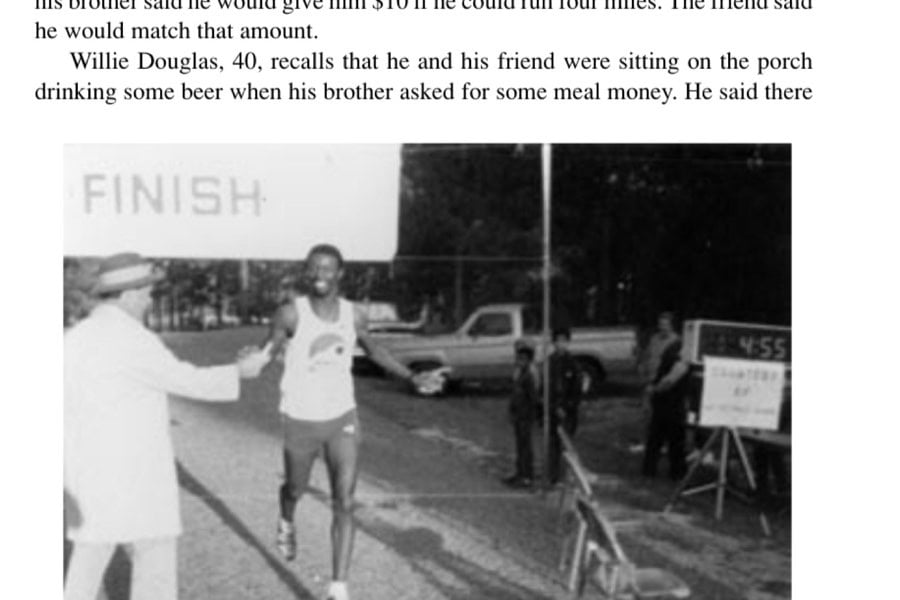
I hated running,” Douglas recalls. “Doing wind sprints in football turned me against running. If you had told me at that time I would be running marathons one day, I would have thought you were crazy.”
Douglas graduated from high school and moved to Savannah to attend Savannah State University. When college didn’t work out, he went into retail sales. Douglas was working for Wal-Mart in 1986 when he was laid off. Living with his younger brother, Willie, Douglas relied on him for financial help while he remained unemployed.
One day, however, Willie came home with a friend and commented, “You haven’t got a job yet!” When Douglas asked him for $20 to get something to eat, his brother said he would give him $10 if he could run four miles. The friend said he would match that amount.
Willie Douglas, 40, recalls that he and his friend were sitting on the porch drinking some beer when his brother asked for some meal money. He said there
▲ Caption to come.
was some food in the house that Isaiah could have eaten, but he had a hankering for Burger King. Willie suggested the run as a joke, recalling that Isaiah had enjoyed running on the treadmill at the gym one time. “He wouldn’t get off it,” Willie says.
Nevertheless, Willie doubted that his brother could run four miles after years of inactivity and with no training. Isaiah was hardly more confident. He hadn’t eaten a full meal in two days and hadn’t run since high school. “
I said, ‘Man, I can’t run no four miles,’” Douglas says. When he considered his hunger, Douglas had second thoughts. Weak from not eating, out of shape from lack of exercise, and forced to do something he hated, Douglas headed to downtown Forsyth Park for a run that would change his life.
When he arrived at the park, Douglas looked for ways to cut the course. There would be no shortcuts, however. Douglas says his brother knew he might try not to run the full distance and stationed his friend at the other end of the one-milesquare park.
Douglas started out at a slow pace and discovered that it wasn’t as difficult as he had thought. He continued to circle the park, and over the final mile, he picked up the pace. “I wanted to show him [his brother],” Douglas says. “I could have gone another two to three miles. I forgot I was hungry.”
Douglas’s memory returned long enough to enjoy a postrun meal of a chicken sandwich and large order of french fries at Burger King. He had surprised himself as well as his brother. “He sure fooled me,” Willie says. “I didn’t think he could do it. He was determined.”
IF FOUR IS GOOD, FOUR MORE IS BETTER The next day, Douglas, on his own volition, again ran four miles. That began a daily routine that led him to his first race the next month, an 8K, which he completed in 28 minutes.
It’s as though Douglas’s inner runner had been waiting all those years to come out, bursting forth with unbridled energy. Once released, it stretched its legs like a young colt and headed off for the new horizon at a full gallop.
Following his inaugural race, Douglas ran a 5K in 17:40, finishing in the top 10. “I went out too hard,” he says. Later in the year, Douglas held back on the reins and won a 5K in 17:18. After the race, a fellow participant told him he could get his times down to the 15s if he started doing speed work. Douglas heeded the advice and incorporated twice-weekly speed sessions into his workouts. The payoff was faster times and consistent one-two finishes in local 5K and 10K races.
Like many novice runners, Douglas eyed the challenge of racing greater distances. He said he thought of doing a half-marathon. The final push came from
comments he heard from some people following a local race he had won. “They said maybe I was just a 5K or 10K runner,” Douglas says. Determined to prove them wrong, Douglas ran his first half-marathon in January 1987. He finished in 1:20. “That was a pretty good time,” Douglas says. “I didn’t know what to expect. I had just started speed work.”
Despite his excellent half-marathon time, Douglas went back to the shorter races. He said he felt more comfortable running the shorter distances. Furthermore, half-marathons were harder to find, and Douglas felt he couldn’t win a race at that distance.
Douglas continued to excel in the local, shorter races. During the next several years, he recorded personal bests of 4:30 in the mile and 15:48 in the 5K. Eventually, he went back to the half-marathon, running a 1:14. There was no turning back now. Like countless others before him, Douglas was ready to take the next step up in the natural progression of the runner, the ultimate test—the marathon.
In high school, Douglas recalled, he had watched the Boston Marathon on television. He saw runners struggling up Heartbreak Hill and wondered why anyone would do that. Douglas was about to find out. Douglas set his sights on the 1991 Savannah Marathon, which featured a flat out-and-back course that meandered through the streets of downtown Savannah and the outlying areas. His training consisted of long runs up to 20 miles and speed work. Douglas ran the first 20 miles in under two hours and was confident he could break three hours. He doubted the stories he heard of runners hitting The Wall during the latter stages of the marathon. “I thought they didn’t know what they were talking about,” Douglas says. He soon discovered otherwise.
WHAT’S THAT YOU SAY ABOUT A WALL? Around the 21-mile mark, Douglas suddenly encountered The Wall, whose very existence he had questioned just moments before. His confident stride was reduced to a shuffle and walk as his body and mind united in rebellion.
Recalls Douglas, “Everything just left me. I had no energy, no will. Mentally, I felt I could go no farther.” Douglas forced himself to walk and run. He received a welcome energy boost from something he detested—pineapple. Someone offered him a piece of the fruit along the course. “I never thought pineapple could taste so good,” Douglas says. Douglas finally crossed the finish line, more disappointed than sore and feeling really drained. He had acquired a taste for pineapple and an aversion to running marathons. Douglas vowed never to run that distance again.
His resolve wavered, and three weeks later he decided he might do another marathon. Douglas gained further confidence in his quest for marathon redemption when he ran a half-marathon in 1:15 roughly three months after his marathon.
Once again, Douglas eyed the Savannah Marathon. Upon the advice of a friend, he altered his training, doing four 10-milers at a fast clip, eight to 10 long runs, and climaxing with a 23-miler and speed work. Never too far away was the memory of his first marathon, which Douglas turned into a positive. “
My failure gave me the incentive to improve,” Douglas explains. And improve he did, completing the race in 2:52. Douglas says he was determined to go out slower. He kept up a steady pace throughout the race and never hit The Wall. “
I felt great,” Douglas says. “I broke three hours and qualified for Boston.” The Boston Marathon was about to join pineapple on Douglas’s secondchance list. Maintaining the same training, Douglas prepared for the 1993 Boston Marathon. Noting that he didn’t do much hill training, Douglas says he didn’t know what to expect. He zoomed through the first half in 1:19. He paid for that fast start by hitting The Wall at 15. “I was more physically drained,” Douglas says. The last 11 miles mirrored the final miles of the 1992 Savannah Marathon for Douglas, who ran
HK ad
and walked to the finish line. Despite his travails over the last 11 miles, Douglas finished in a respectable time of 3:16. It would be nearly four hours after the start of the race, however, before Douglas could reflect on his performance. He leaned against a pole for 20 to 25 minutes after crossing the finish line. “I didn’t know what state I was in,” Douglas says. “I blacked out.”
THEN HE CAME TO HIS SENSES When he finally regained his senses and realized where he was, Douglas experienced the runner’s high. He said he was happy that he had completed a marathon, especially one as rich in tradition as Boston. This was the start of an annual rite of spring for someone who had once considered the Boston Marathon the pursuit of crazy individuals.
Later that year, Douglas ran the Kiawah Island Marathon in 2:58. Describing his time as pretty good, Douglas notes that the weather was real cold. “I’m not a cold-weather runner,” Douglas says. Douglas prepared for the 1994 Boston Marathon by increasing his weekly mileage from 70 to 90 and his number of speed workouts from one to two. He also upped the distance he ran during those speed sessions from 400 to 800 meters.
The changes paid off with a 2:54 time at Boston. Douglas ran the first half in 1:28 and followed that with a 1:26 second half. Around mile 14 or 15, Douglas said, he felt that he was just starting the race. “I felt good all the way to the finish line,” Douglas says. “That’s the year I got hooked on the Boston Marathon.”
Douglas planned on running Boston in 1995, but that changed following the death of his father. He ran Jacksonville that December, recording a 3:01 in 80degree weather. Next up was a Boston Marathon Douglas didn’t want to miss—the 100th anniversary of the fabled race.
He found himself behind 10,000 runners and says he didn’t start racing until mile 17. He recorded negative splits the rest of the way and finished in 2:56. Douglas says he felt good the whole way and didn’t want to quit. With a better start, he predicted he could have broken 2:40. For Douglas, the race offered the ultimate runner’s high from a number of standpoints. “
I felt that nothing would take the place of being in the 100th-anniversary race,” Douglas says. “It was being a part of history. My father never had a chance to see me race, but I felt he was watching me. It was a very emotional day.”
So emotional, in fact, that Douglas questioned whether he wanted to return to Boston. He says he didn’t feel like he could accomplish anything more, that he had closed the book on Boston. By the following January, however, Douglas reopened the book after remembering that he had to submit his application. He ran the next six Boston Marathons, breaking three hours each year.
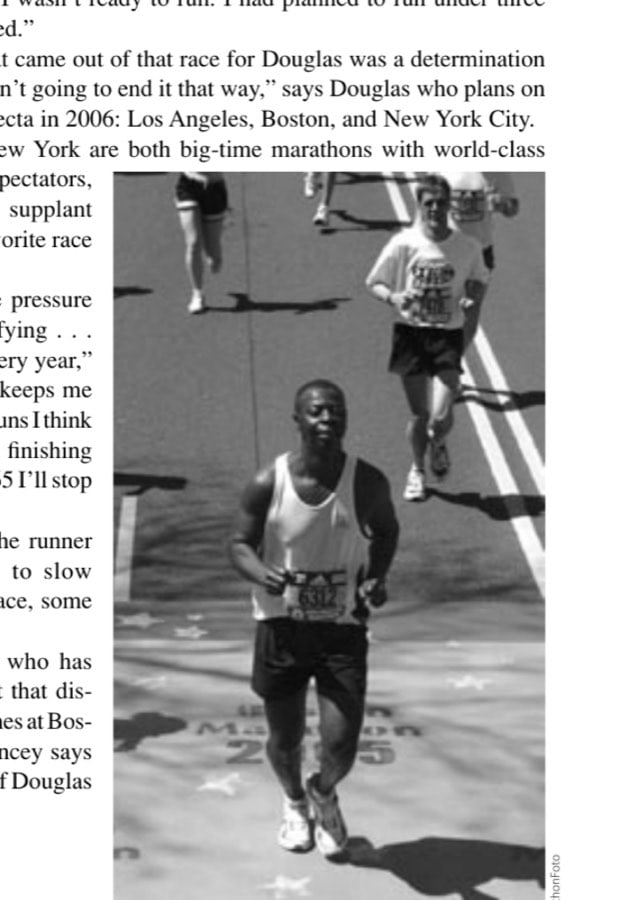
Douglas skipped Boston in 2003 to attend a performance by his daughter that he says he couldn’t miss. As it turns out, he didn’t miss Boston entirely. “I had to watch the race on TV,” Douglas says. “I was hooked.”
THE WORST THAT BOSTON CAN DISH OUT
▲
MarathonFoto
Douglas’s return to Boston the following year was less than memorable. He got stuck in Boston traffic and arrived as the race began. Stuck behind 18,000 runners, he slogged his way through a sea of discarded paper cups and battled hot weather on his way to a 3:51 finish, his slowest marathon time.
Explains Douglas, “I wasn’t ready to run. I had planned to run under three hours. I was disappointed.” The one positive that came out of that race for Douglas was a determination to make amends. “I wasn’t going to end it that way,” says Douglas who plans on running a marathon trifecta in 2006: Los Angeles, Boston, and New York City.
Los Angeles and New York are both big-time marathons with world-class fields and thousands of spectators, but they’re unlikely to supplant Boston as Douglas’s favorite race at that distance. “The spectators, the pressure of running it and qualifying . . . it makes me go back every year,” Douglas says. “Boston keeps me motivated. During long runs I think about competing in and finishing that race. Maybe at age 65 I’ll stop running it.”
Jerry Mincey was the runner who advised Douglas to slow down at the start of a race, some 20 years ago. A 2:53 marathoner who has completed nine races at that distance, including three times at Boston, the 58-year-old Mincey says he was finishing ahead of Douglas
Caption to come.
when they first met. After he suggested to him not go out so hard, Mincey says, Douglas started winning races. All it took was a few words from a seasoned runner, much like the baseball coach who told Sandy Koufax not to throw so hard. “
Isaiah had speed and I could see it,” Mincey says. “He has a real strong kick at the end. I told him it was more important how he finished a race than leading during the early part. He took that advice and started finishing first in races. He’ll place in the top five in local races unless there are some real fast runners from out of town.”
Douglas has deceptive speed, according to Mincey, noting that he doesn’t appear to be moving that fast. Douglas further disguises his talent with a running style that Mincey says is not especially smooth but quite effective. “It works for him,” Mincey says. Mincey finished ahead of Douglas at the 1993 Boston Marathon. The following year, the two men reversed their finishing order. “He loves that Boston Marathon,” Mincey says. “He strives to run Boston every year and puts the miles in to accomplish that goal. As he gets older and finishes behind an increasing number of younger competitors, Douglas is coming to the realization that winning isn’t everything. Saying that getting beaten by so many runners brings him back down, Douglas is reflecting more on the rewards of running that go beyond a trophy or medal.
NO NEED FOR A DOCTOR’S SERVICES “I’m a man blessed by God to be able to run injury free for so many years, being able to run 26 miles without stopping,” Douglas says. “I see a lot of people with health problems who can’t run. I haven’t gone to a doctor since I started running. I’m feeling good about myself.”
Douglas has another reason for running: genetics. He noted that members of his family are large and prone to putting on weight. “As much as I like to eat,” Douglas says, “I’d weigh 250 pounds if I didn’t run.”
Still, Douglas realizes that his running owes a debt of gratitude to eating. “I tell my brother I’m glad he didn’t give me money for food,” Douglas says. “The only reason I ran was because I wanted to eat. I can’t think of any other way I would have started running.”
Willie Douglas has watched his brother evolve from a reluctant runner to a Boston Marathon regular who shows few signs of slowing down. “He never ceases to amaze me,” Willie says. “I kind of pumped him up to get started, but I give him all the credit. I know I couldn’t do it. His mama and daddy would be proud of him.”
This article originally appeared in Marathon & Beyond, Vol. 10, No. 1 (2006).
← Browse the full M&B ArchiveMore like this
1,000+ stories from 19 years of Marathon & Beyond
The complete archive of the legendary long-distance journal — digitized and free to read.
