

Eulogy For a Runner
“W
e are gathered here today to honor the memory of ______________ _____________.” These words will be spoken, inevitably, over each of us. This despite the fact that most of us think that we, personally, are exempt. Runners—that independent, compulsive lot—are especially prone to this line of thinking. We are lulled to sleep by the vigorous exercise schedule to which we adhere, too tired to contemplate tomorrow, much less our final rest. We block such thoughts, blank them out, push them away, and think we are invincible. After all, we push and punish our bodies almost every day, stressing our muscles, bones, and our hearts to the limit. Our bodies are tough and well loved. How could they desert us? How could we die? If on a bad day a runner’s mind should drift to thoughts of his mortality, he would visualize going out like Johnny Kelley, the Boston marathoner . . . finish his last road race at 90, pick up his age-group trophy, get his affairs in order, lace on a pair of New Balance (purchased at half price), and shuffle off into eternity with eyes locked firmly on that final finish line.
Unfortunately, that ain’t the way it works. Runners do die and even occasionally die suddenly. Proper diet, regular exercise, and no smoking notwithstanding, runners fall over dead just like all other creatures. And occasionally, heaven forbid, runners actually die while running or, worse yet, while participating in a race! Oh, that makes for huge news, a super media event, creating public controversy about exercise. Is running bad for you? Will it kill you? How many running-related deaths per 10,000 runners were there in the United States last year? Should we pass laws limiting the number of miles citizens may run? Should all runners be required to carry defibrillators so a passerby could resuscitate? Cast your vote at our Web site.
Locally, when a runner dies prematurely, whether in the act of running or not, the hand-wringing starts in full force: “I knew all along running was bad for you!” “He exercised too much, and his heart got so big it just blowed up.” “All that runnin’ and what did it get for him but an early grave.” Likely, these comments come from the same folks who say, with a knowing look, “I’m gonna start running when I see a runner with a smile on his face. Har, har.” They miss the point.
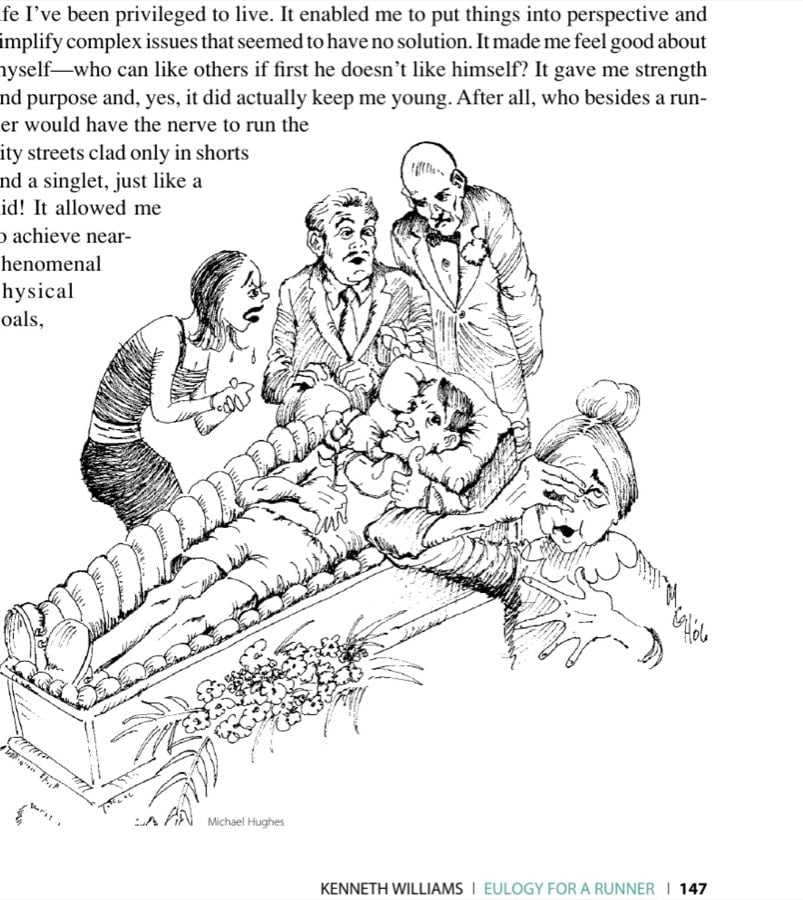
So, as I was saying, runners die just like everyone else. This bothers me. Not the dying, but the hand-wringing, the unsolicited comments, and the casting of blame. Now, don’t get me wrong, I don’t want to die, but if I could pipe in at my own graveside memorial and toss a few from the subsurface peanut gallery, I would have a few things to say to my mourners, provided the weather is good enough to allow my friends to attend the services!
First, running didn’t kill me. To the contrary, it enlivened me! It opened my eyes to the beauty around me. It allowed me to see not the puddles in the road but the magnificent clouds reflected off the water in the puddle. It gave me hope for a brighter tomorrow, for a new age-group PR. It made me appreciate the wonderful life I’ve been privileged to live. It enabled me to put things into perspective and simplify complex issues that seemed to have no solution. It made me feel good about myself—who can like others if first he doesn’t like himself? It gave me strength and purpose and, yes, it did actually keep me young. After all, who besides a runner would have the nerve to run the city streets clad only in shorts and a singlet, just like a kid! It allowed me to achieve nearphenomenal physical goals,
Michael Hughes
accomplishments that would have boggled my father’s mind and been inconceivable to my grandfather. And, yes, it increased my spirituality. After all, what long-distance runner could endure the last few miles of a marathon without calling, loudly and with utmost sincerity, for God to grant strength and relief from the cramping muscles and blistered feet; for God to spare the humiliation of becoming a babbling, crying, walking DNF; for God to allow the finish line, that elusive goal, to be crossed upright and conscious.
Did I spend too much time running, to the detriment of my family, my business, my nonrunning friends? Did I fiddle while Rome burned, missing dance recitals and soccer games and other important family and business events? They may disagree, but I don’t think so. Running created me as the person I am. It shaped me, sharpened me, and molded me so that I could take my relationships to a higher level, one with more respect and love for all. It made our time together better—quality time, it’s now called. It gave me a nimbler, clearer mind. It helped with decisions and allowed me space, many times, to sort out right from wrong. It enabled me to blast right through middle-age crisis without so much as a Harley, and it kept me out of trouble—not all the time, but much of the time.
Was I obsessed with running? Well, I prefer to call it “dedicated.” I’m passionate about the people I love and the things I do, including running. I’m like many runners. My body has two switches: off and on. When I’m on, I’m wide open. I work hard and play hard. I love totally. When I set out to achieve a goal, I do so to attain the goal, not just to come close. If there are 1,800 steps in a mile, then there must be 47,000 steps in a marathon. All that’s necessary to do is take a step at a time. It’s logical to me.
Back to the funeral. I likely succumbed to a hidden medical problem, one that escaped detection by caring, board-certified doctors using million-dollar, state-of-the-art medical equipment. Runners are hypochondriacs, and our prying, sensitive, alert, and inquisitive minds do not allow any abnormality or anomaly of the body to go unchecked. I am like that, so be assured that the problem was hidden. I suppose I could have quietly retired to my bed to avoid excess risk, but runners are not about that. Runners know the costs of being fit and are willing to exchange them for the benefits.
So, don’t blame running for something that occurs naturally and to everyone. Don’t for a moment allow the fact of my passing to give you an excuse for not keeping yourself in good physical condition, for vigorous, shirt-soaking exercise. My parting physical fitness message to you is this: get moving.
I’m out of here, caught the westbound early, well before I accomplished all I wanted, but running wasn’t the problem. I didn’t run to live longer; I ran to live better, and I did.
This article originally appeared in Marathon & Beyond, Vol. 10, No. 5 (2006).
← Browse the full M&B ArchiveMore like this
1,000+ stories from 19 years of Marathon & Beyond
The complete archive of the legendary long-distance journal — digitized and free to read.
