

Factors Affecting Finishing An Ultramarathon
Nevertheless, if we can glean some handy information about what differentiates an ultra finisher from a DNF (did not finish), we can surely improve our chances of finishing, improve our times, and generally feel better during the event.
I’m going to translate the findings of nine ultrarunning research papers that have important implications for us in terms of training and racing. All nine papers were released in 2010. We will look at how the data can help us improve our ultrarunning. And please bear with me here—I know you’re not interested in hearing about regression analysis, multivariate analysis of variance, paired ttests, and standard deviations, so I’m not going to bore you with them. I’m just going to give you the straight facts and my interpretation so you’ll have plenty of take-home messages to implement into your training schedules and ultraracing preparation and tactics.
Here are the questions we will look at: 1. What factors determine our ability to complete ultramarathons? That is, what are the differences between finishers and nonfinishers in ultras? 2. What factors are associated with faster times in ultras, and what are the
performance-limiting factors? 3. What are the performance trends in ultraraces? Why are these important questions for ultramarathoners? The answer is easy. If we can determine the factors that weed out the nonfinishers from the finishers in an ultra, we can come up with countermeasures to increase our chances of finishing. Here is an example. If, say, doing high mileage appears to correlate well with completing an ultra, we can boost runners’ mileage to a higher level in order to improve their chances of finishing.
What factors determine our ability to complete ultramarathons? Martin Hoffman, MD, who works out of the University of California Davis Medical Center, has done a large number of studies on ultramarathoners. His recent paper in the International Journal of Sports Medicine (Hoffman, Lebus, et al. 2010) examined the body-composition characteristics of 72 of the starters (17 women, 55 men) in the 2008 Rio del Lago Endurance Run at Granite Bay, California.
The researchers compared body characteristics such as body mass index and percent body fat with finish times and found an interesting result—the percent body fat in the finishers was lower than in nonfinishers. This would certainly make sense because extra fat pounds must be carried over the entire distance, and in this case it is noncontributing: fat is dead weight.
Hoffman’s study also found that despite wide variations in body mass index and percent body fat, the faster men had lower body fat than the slower men.
© Joe McCladdie
▲
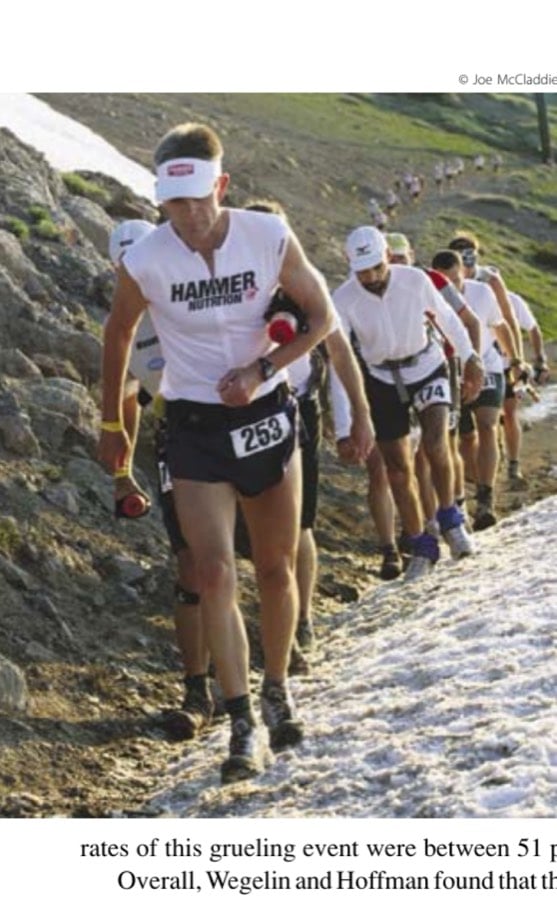
Martin Hoffman, MD (shown here heading up the Western States 100 Escarpment) and Jacob Wegelin, PhD, examined 22 years of data from this race for their research.
Strangely, this correlation was not found with women. The percent body fat range for the top three men was 6-14 percent and for the top three women was 14-27 percent. Jacob Wegelin and Hoffman (2011) looked at factors affecting
the probability of ultrarunners completing the Western States 100-mile Endurance Run. They looked at finishers and DNFs in this event from 1986 through 2007. Compiling these data was no mean feat—they looked
at data from 8,282 starters and 5,276 finishers. The completion rates of this grueling event were between 51 percent and 80 percent. Overall, Wegelin and Hoffman found that the most notable factors that increase a runner’s likelihood of dropping out of this ultra event were increasing age, being a female over 38 years of age, and having previously dropped out of the race.
Age clearly plays a significant role in finishing ultras. Male and female runners between 18 and 38 years old had the highest completion rate, and from 38 to 50 years old, both sexes had a decreased probability of finishing. Men were 46 percent more likely to finish at age 38 than at age 50 and six times more likely to finish at age 50 than at 72. Fifty-year-old men were 70 percent more likely to finish than 50-year-old women. Ah, the ravages of aging!
Wegelin and Hoffman concluded that starters in ultrarunning events since 1986, and those who have finished every event since then, had a 28 percent higher chance of finishing than runners who have dropped out of the race since 1986. No surprises here; it is self-evident that people who always finish are more likely to finish. Perhaps Greg Crowther had it right when he told me, “Since some people never drop out, a personal commitment to always finishing (unless pulled) might be the difference between those who sometimes drop out and those who don’t . . . But that’s fairly speculative.”
The matter of food and fluid
© Joe McCladdie
Nutritional factors have also recently been shown to affect our ability to complete an ultramarathon. A study by Kristin Stuempfle et al. (2010) of Gettysburg College to assess whether food and fluid intake influences the ability of runners to finish a 160K race was most revealing and of great practical importance to ultrarunners.
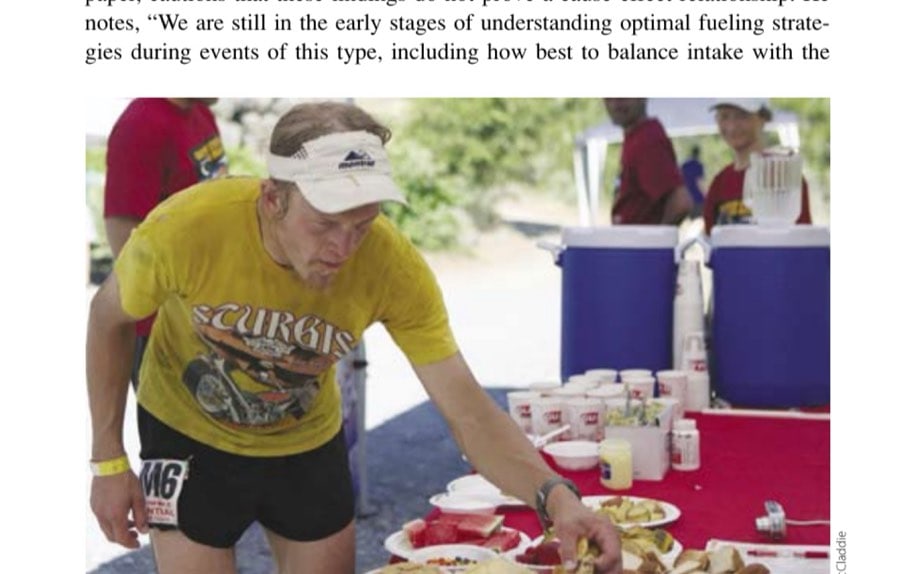
Stuempfle looked at the food and fluid intake of 12 male and four female runners in the Western States 100-Mile Endurance Run and found that the finishers had significantly greater caloric intake compared with the DNFs. Check these figures out: The finishers each ingested a whopping average of 8,228 calories during the event, while the nonfinishers each took in only 3,106 calories. However, Crowther points out, “The numbers are skewed by the fact that the nonfinishers weren’t out there for as long and thus wouldn’t be expected to eat as much.”
Perhaps a better way of looking at food and fluid intake is how much each ultrarunner consumed per kilogram of body weight. These figures are telling: an average of 4.6 calories/kg/hour for the finishers versus an average of 2.5 calories/ kg/hour for nonfinishers, a significant difference. But Hoffman, coauthor of this paper, cautions that these findings do not prove a cause-effect relationship. He notes, “We are still in the early stages of understanding optimal fueling strategies during events of this type, including how best to balance intake with the
▲ Research has shown that Western States finishers ingest significantly more calories during the race than nonfinishers do.
Summary: Take-home messages Percent body fat in finishers is lower than in nonfinishers. Low body fat usually comes with lots of consistent training. So watch your diet for low-nutrient-density, high-calorie foods such as pastries, pies, cakes, and candy.
Your likelihood of dropping out of ultras increases if: • you are past age 38 • you are a female over age 38 • you have previously dropped out of an ultrarace Your likelihood of completing ultras increases if: •
you are a male or female aged 18 to 38 years • you are a new starter to ultrarunning since 1986 • you have finished every event you have entered since then Train yourself to keep eating, especially during your lengthier training
efforts, and find out what foods settle well in your gut. During ultras, finishers average a significantly higher sodium intake than nonfinishers. Make sure your sports drinks have plenty of sodium if you
are a heavy sweater. Sodium levels in sports drinks should be 45-55 mg/16 ounces of liquid. The sodium concentration in your electrolyte replacement drinks ranges from 232-845 mg/deciliter (about .4 of 1 pint).
capacity to process nutrition without developing gastrointestinal symptoms that are so common.” You would think that fluid intake would also play a major part in completing an ultrarace. Surprisingly, in Stuempfle’s study, fluid intake did not differ significantly between finishers (11.0 ml/kg/hour) and nonfinishers (8.6 ml/kg/hour) when calculated as a ratio to body weight. Hoffman summarizes, “What was important from the fluid intake part of this study was that the rate of fluid intake and the percent weight loss (3 percent) was the same between groups. I think this suggests that overall, both groups appeared to have managed fluid appropriately, as a weight loss of ~3 percent should be the goal, and that fluid intake did not discriminate between who would finish or not. We do not want to promote overdrinking, as that is the main cause of hyponatremia, from which people have died.”
Sodium intake also may play an important role in completing ultramarathons. Tamara Hew-Butler et al. (2010) of Oakland University, Rochester, Michigan,
looked at the sodium levels in finishers and nonfinishers in the Western States Endurance Run to see whether there was any correlation with their probability of finishing. She noted that during the race, the finishers averaged a significantly higher sodium intake than nonfinishers. The finishers had a positive sodium balance during the race without changes in blood-sodium concentration.
Why is sodium so important to ultrarunners? Sodium is the major electrolyte we lose in our sweat and therefore one of the two major ingredients in sports drinks. It helps us retain water and makes us thirsty, so our water stores are better conserved and we drink more fluid. It also shuttles water across the walls of the small intestine for absorption into the bloodstream. Low sodium levels can lead to muscle cramps and weakness and would in all likelihood contribute to the high rate of DNFs in ultraraces.
Runners who sweat heavily can lose as much as 4,800 mg of sodium per hour in extreme heat and humidity, although a sodium loss of 1,100-1,900 mg/hour is considered normal. Abnormally low concentrations of sodium in the blood are considered dangerous, especially in ultra trail runs and Ironman triathlons. Sodium is best replaced by consuming sports drinks that contain sodium and by eating salty foods occasionally. Dr. Hoffman also makes the point, “While the need for sodium intake during endurance events is still under debate among exercise scientists, excessive fluid intake seems to be a primary cause for the development of low blood-sodium concentrations. When athletes can monitor their weight during endurance events, the proper response to a weight gain is a decrease in fluid intake and a decrease in sodium intake as well if they have been taking sodium.”
What factors are associated with faster times in ultras, and what are the performance-limiting factors? Hoffman et al. (2010) did a study to see whether body composition affects ultrarunning performance. Bearing in mind Hoffman’s earlier study that found faster men had lower body fat than slower men in the Rio del Lago ultramarathon, we would expect to see the same trend. Indeed, Ganong and Hoffman (Hoffman, Lebus, et al. 2010) concluded that the top-five fastest participants had lower percent body fat, on average, than the rest of the finishers. These data are best presented in a simple chart for comparison. Average overall % body fat Men = 17% Women = 21%
Average % body fat for five fastest Men = 11% Women = 20%
Therefore, it seems that leanness is an important biological attribute of top ultrarunners. The same nutritional advice applies here regarding avoiding lownutrient-density, high-calorie foods.
More fun facts about ultrarunners who participated in Western States and the Vermont 100 • Their average number of years running ultras is 7.6. • The runners tend to be longer in the tooth than most ultra competitors. The average age of these runners is 44. • Twenty percent were women. • Ultrarunners are well educated: 43.1 percent have bachelor’s degrees, and 37.9 percent have master’s or doctoral degrees. • Ultrarunners are a healthy lot! Their average number of days off work or school in the previous year is only 2.8 days. • But ultrarunners get injured frequently: 52.2 percent reported a running injury in the previous year that was severe enough to interfere with training.
Knechtle et al. (2010) from the University of Zurich, Switzerland, did a revealing study that examined the most important performance parameters for ultrarunners. They looked at biological variables such as body composition plus training and racing activity such as average weekly training volume and personalbest marathon time in relation to the total ultrarace times for 66 male Caucasian ultrarunners in a 100K run. They concluded that the two most important factors that determine race times are higher weekly training volume and personal best time in the marathon—more important, even, than low body fat.
Knechtle, Knechtle, and Rosemann (2010) also found similar results in a study of 25 male mountain ultramarathoners who competed in a seven-day mountain ultramarathon. The fastest mountain runners had the fastest marathon times and trained at faster speeds than the slower performers.
Wegelin and Hoffman (2011) studied factors that correlated well with finish time among finishers of the Western States 100-Mile Endurance Run. Their results were an extension of the factors from their concurrent study on what factors differentiate finishers from DNFs: advancing age adversely affects finish times; women tend to run slower times than men; and increasing temperatures cause slower times in both male and female ultrarunners, although females appear to be less reactive to heat than men.
Wegelin and Hoffman also add the caveats that there are great individual differences between ultrarunners and that many of them defy the statistics. It is
▲
Wegelin and Hoffman’s research shows that your likelihood of dropping out of an ultra increases if you are a female over age 38.
© Joe McCladdie
possible to have high-performing ultrarunners, for example, who have higher body fat than the research says is optimal or to have fast ultrarunners who are well into their 40s. Hoffman and Fogard (two papers—2010) gathered a comprehensive and impressive pile of information from 500 of the 701 competitors in the 2009 Western States 100-Mile Endurance Run and Vermont 100-Miler to put together a revealing profile of ultrarunners. They looked at sex, age, education, days of work lost in the previous year due to illness or injury, vitamin use, number of years running ultras, highest running distance in one week within the three months before the event, and specific injury data. They also looked at these runners’
performancelimiting factors in these races. Their results give us a better idea of what makes ultrarunners tick—interesting reading indeed. Did you know that 75.6 percent of ultrarunners take vitamins or supplements?
What about the training habits of these competitors? The average highest running distance in one week within three months before the race was 131K. Nonfinishers averaged 22K less than the finishers. And what factors adversely affected their race performance? The main reason that DNFs gave for dropping out was nausea and vomiting (23 percent). Finishers reported that blisters, muscle pain, exhaustion, and nausea/vomiting affected their performance.
An alarming trend also emerged from this study. Just over 60 percent of finishers used nonsteroidal anti-inflammatory drugs, compared with 46.4 percent of nonfinishers. Nonsteroidal anti-inflammatory drugs (NSAIDs) relieve muscle soreness and pain by blocking
the production of prostaglandins, a compound that activates the inflammatory response in damaged muscle. Currently, we think it is necessary for inflammatory cells to invade the injured muscle to control the tissue damage, so the muscle tissue can then be repaired. This needs to take place for the muscle to bounce back stronger and more resistant to future encounters with muscle soreness. Clearly, ultrarunners are taking NSAIDs before and during their race in an attempt to preempt the development of muscle soreness during the ultra. But the ultrarunner needs to take note: The side effects of this habit can be extremely dangerous.
There is strong evidence that long-term use of NSAIDs can cause gastrointestinal bleeding, stomach upset, ulcers, kidney problems, impaired blood clotting, and possible death with long-term (> 90 days) use. There is solid evidence that NSAIDs can reduce blood flow to the kidneys during endurance events. Considering that there has not been a lot of research into the use of NSAIDs during ultra events, you would be well advised not to pop them like candy before your ultra, no matter how tempting this might be. Pain is an indicator that we are stretching our body beyond its physical tolerance, so perhaps we should listen to it more closely, rather than masking its symptoms.
What are the performance trends in ultraraces? We will finish by looking at how ultrarunning has evolved in the past decade or two. Dr. Hoffman (2010a) has written an excellent piece summarizing what has transpired with ultra events in terms of finish times, finish rates, and ages of the fastest runners. Here are some of his fascinating observations based on his staggering statistical compilation of data from 32,352 ultra finishes by 9,815 unique runners between 1992 and 2008: •
Finish rates have consistently averaged 60 percent between 1992 and 2008. • In this time period, the average finish rate for trail ultras is 59 percent, and the average finish rate for road ultras is 47 percent. •
Annual finish rates increased and then plateaued by the early 1990s. • Twenty percent of the finishers in ultra races in this time period are women. • Average times for the fastest runners have not changed over the past two
decades for any age group, for either sex. • Average annual finish times have not changed significantly over the 17-year span of this study for men and women finishers under 30 years of age. • Males in the 40-49 year age group and women in the 30-39 year age group have the fastest average times.
• Average times for age groups over 30 years in males have slowed, and likewise for women in the 50-59 age group. • Women’s times, on average, are 3 percent slower than men’s times. • When all times for men and for women are averaged, they have slowed by
70 minutes per decade for men and by 40 minutes per decade for women across the 17-year span of this study. • The average age of ultramarathoners has increased at the rate of one to three years per decade for men and women, paralleling the increase in the
average age of all finishers. • The average experience level for men from the early 1990s to 2008 is 4.4 years, and the average for women is 3.6 years. Here, then, are the latest observations from the research on ultrarunners. Consider what changes you can make to your nutrition, training, and racing habits to reduce your chances of dropping out. It’s a numbers game—if you make the changes that are positively associated with increasing your chances of finishing and of running a faster time, the odds of your ultra being successful are greatly increased.
The author wishes to thank Martin Hoffman, MD, and Greg Crowther, PhD, for their invaluable assistance with this article.
References Hew-Butler, T., K. Stuempfle, L. B. Weschler, I. R. Rogers, and M. D. Hoffman. 2010. Sodium balance in finishers and non-finishers competing in a 161 km mountain footrace. Abstract presented at ACSM Annual Conference, Baltimore, Maryland. Hoffman, M. D. 2010. Performance trends in 161-km ultramarathons. International Journal
of Sports Medicine 31(1):31-37. Hoffman, M. D., and K. Fogard. 2010a. Demographic characteristics of 161-km ultramarathoners. Research in Sports Medicine (in press at time of writing). ———2010b. Factors related to successful completion of a 161-km ultramarathon. International
Journal of Sports Physiology Performance (in press at time of writing). Hoffman, M. D., D. K. Lebus, A. C. Ganong, G. A. Casazza, and M. Van Loan. 2010. Body composition of 161-km ultramarathoners. International Journal of Sports Medicine 31(2):106-109. Knechtle, B., P. Knechtle, and T. Rosemann. 2010. Race performance in male mountain ultra
marathoners: anthropometry or training? Perceptual and Motor Skills 110(3):721-735. Knechtle, B., A. Wirth, P. Knechtle, and T. Rosemann. 2010. Training volume and personal best time in marathon, not anthropometric parameters, are associated with performance in male
100-km ultrarunners. Journal of Strength and Conditioning Research 24(3):604-609. Stuempfle, K., M. D. Hoffman, L. B. Weschler, I. R. Rogers, and T. Hew-Butler. 2010. Food and fluid intake in finishers and non-finishers in a 160-km mountain footrace. Abstract presented at ACSM Annual Conference, Baltimore, Maryland. Wegelin, J. A., and M. D. Hoffman. 2011. Variables associated with odds of finishing and finish
time in a 161-km ultramarathon. European Journal of Applied Physiology 111(1):145-153. (Published online 11 September 2010.)
This article originally appeared in Marathon & Beyond, Vol. 15, No. 4 (2011).
← Browse the full M&B ArchiveMore like this
1,000+ stories from 19 years of Marathon & Beyond
The complete archive of the legendary long-distance journal — digitized and free to read.
