

Finishing Off A Great Year
Part 2 of 3 Editor’s note: Frank Bozanich was one of the premier ultrarunners of the late 1970s and early ’80s. In this three-part series, Frank recounts his running and racing successes and several failures during an 18-month period from January 1979 to June 1980. At the end of part 1, he had just completed his first Western States 100, back when the race was much more simple than it is today.
The week following Western States, I covered a mere 17 miles, which included a 35:20 10K race in San Diego on Sunday, July 15. Considering the effort I had put into the WS100 the previous weekend, I was pleased with the result. I had no real expectations and ran the race for training. Mentally it was a real boost to be that strong and quick after hammering the body as I had. I feel it was a testament to my overall body strength and training routine. I felt that my mileage and hard work allowed me to recover faster than others could.
On July 29 I competed in a 20K race from Carlsbad to Leucadia over a rolling course. I finished seventh overall in 1:10:15, which was pleasing to me and gave me the proof that I was pretty well recovered from WS. I trained hard for the next few weeks and then traveled to San Francisco, where I competed in the Mayor’s Cup Marathon on August 26. The course started on Treasure Island and climbed over the Bay Bridge into the city, where it wound through the varied neighborhoods, including Chinatown, before crossing the Golden Gate Bridge into Marin County. We turned around at the end of the bridge, recrossing the bridge before entering the Presidio. It was a beautiful course and a great way to see San Francisco. I finished seventh in a time of 2:33.
National AAU 50-Kilometer, Brattleboro, Vermont, September 16, 1979 After training for a couple of weeks more, Jan and I traveled to Brattleboro, Vermont, for the 50K national championships. It was a great vacation for us and a terrific way to relax before the race. We met up with Bob Mason, whom I had met a couple of years before at the race at Lake Waramaug. The two wives had a great time sightseeing and shopping while Bob and I pondered our upcoming races. The night before the race, we four joined Stan Saplin, a New York sportswriter, for dinner. Stan was asking questions about my running and wanted to know when my next race was. I casually mentioned that I was going to run the Michigan 50-mile the next weekend, as was Bob. This created something of a problem, as I had somehow failed to inform Jan of that plan. Apparently Bob had also failed to inform his wife. Jan promptly stated that I was not going to the race, and Bob’s wife chimed in that Bob was also not going. Bob and I quickly turned our faces away from each other and deep-sixed the conversation about Michigan. Stan wisely changed the subject, and we finished the dinner without further comments on Michigan. Later that night I explained to Jan that Bob worked with the race director of the Michigan race and I was to be the featured runner, so it all worked itself out.
The Brattleboro race was held on September 16, won by John Cederholm over Fritz Mueller in a time of 2:56:43 to 2:59:09. I was happy to finish in ninth place with a time of 3:03:39. Jan was my handler, and as these things go, she got lost on the segment of the course that was in the open with no shade during the hottest part of the day. Other handlers on the course kept asking me if I needed anything, and I meekly refused because I thought Jan would be right along, but Murphy’s Law was very much in play. I began suffering toward the end of the seven-mile loop when Jan finally showed up, feeling really bad about getting lost. I could not get mad at her as she was doing her best in an unfamiliar area, and I was thankful to get some fluids. The race was sponsored by Famolare, a women’s shoe company. This sponsorship made for a great trip for Jan, as they stocked her up on several pairs of shoes, which she gladly showed off after we got home.
The day after the race, Famolare had a rental car that needed to get back to Boston, so Jan and I gladly offered to return it to Logan Airport for them. They said that we could use it in Boston until we left, which really made it fun. Driving in Boston, I discovered, was far more difficult than the race and more dangerous than driving in Okinawa on the day that driving went from driving on the right side to the left side. We visited friends in Boston that we had met in Brattleboro and thoroughly enjoyed ourselves for a couple of days.
I was home for a couple of days before getting on another plane heading to Michigan. I met Bob in Green Bay, Wisconsin, where we boarded a commuter
flight to Hancock, Michigan. We then drove to Copper Harbor, Michigan, to prepare for the 50-miler.
Michigan 50, September 23, 1979 The day before the Michigan 50 we drove the course, which basically followed the shore of Lake Superior for what seemed like forever before turning back inland and then heading back into Copper Harbor along the main road. I remember that we had to stop every so often so that Bob could drop off his pharmaceuticals in mailboxes along the way. This saved him from having to carry the lot with him. You must remember these were the days before all the fancy fanny packs and runner backpacks. The funny thing was that during the race I remembered where Bob’s drops were, but unfortunately for him I was too far ahead to remind him where they were, so he missed a couple of them. I remember thinking as I was running that it would be fun to watch the expressions on the owners of the mailboxes when they checked for the mail, only to find a stash of pills and whatnot in their box.
The race was on September 23 and started at a fort outside Copper Harbor. It traveled through town and continued out along the highway bordering Lake Superior. I went out in my usual quick start, feeling strong, and soon was running alone, with only my handler close by in a car. She would stop every so often and give me my drink, which consisted of defizzed Coke and water. I ran alone for the entire race and had to mentally force myself to maintain the pace that I had established. We eventually came to the town of Phoenix, which had a population of six, and we didn’t see a single person cheering us on.
The course was fairly level up to this point, with a few rolling hills that followed the shoreline. In Phoenix we turned back inland, and the course eventually joined up with the main road back to Copper Harbor. I was running strong and feeling good, but then over the last 10 to 15 miles the course began to rise and ran through a tunnel of overhanging branches. It was really beautiful because of the fall colors, and the scenery took my mind off the increasing pain. I finally reached the last mile, which was a good downhill into the finish. I pushed as hard as I could over the last mile, as I knew I had a great time going for me. I finished in a personal best of 5:05:35. It was one of the most difficult races I had done to that point, as I ran alone from the start and was constantly focused on the effort to push my body to its limits. It was a very satisfying performance and worth all the effort.
Three weeks later, on October 13, I toed the starting line of the National 50-Mile Championships in Seattle, Washington. The course was a double out-and-back on the Burke-Gilman Bike Path, which parallels Lake Washington. My good friend John Coffey came up from Portland to be my handler. I knew that it was going
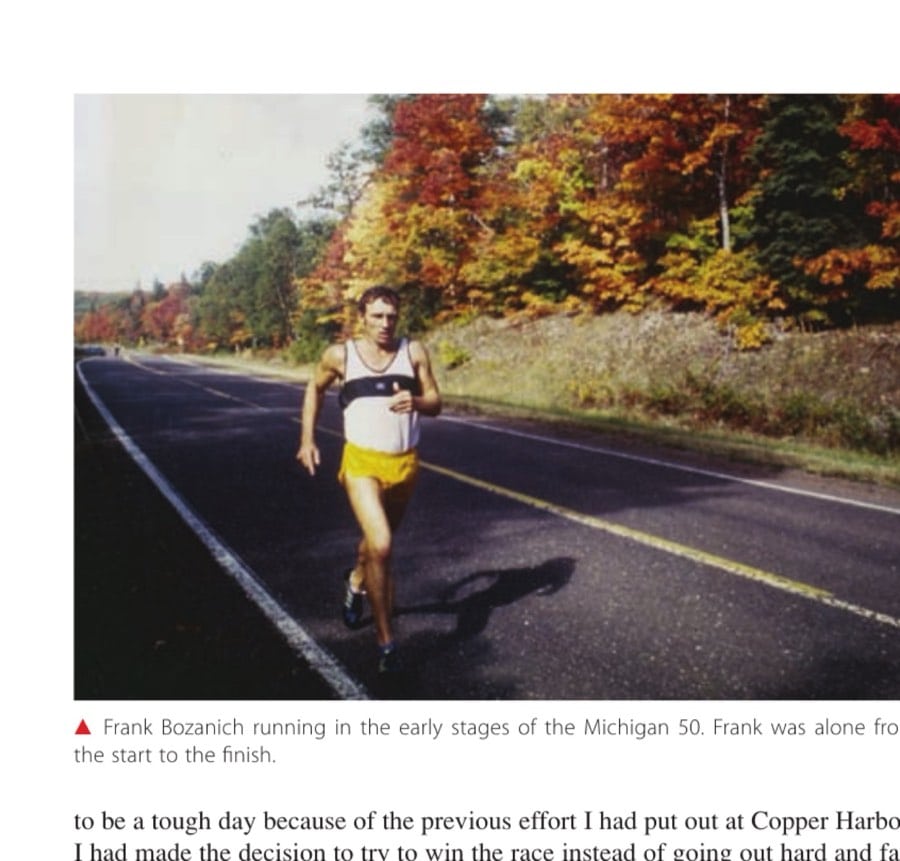
Photo courtesy of Frank Bozanich
▲ Frank Bozanich running in the early stages of the Michigan 50. Frank was alone from the start to the finish.
to be a tough day because of the previous effort I had put out at Copper Harbor; I had made the decision to try to win the race instead of going out hard and fast for a fast time. I had tried going for records in previous National Championships with disastrous results. I have often said that when you go for a record, one of two things will result: either you will break the record or you won’t, and more often than not, you will break yourself and not the record.
The weather, dry and cool, could not have been better. I started off in a typical style of getting out quickly and getting clear of the other runners but staying under control, marshaling my reserves of energy. I felt comfortable and decided to continue with my effort.
John was able to provide my drink and keep me posted on where the other runners were on the course. At about 35 miles I began to feel the leftover strain from Copper Harbor and started to labor. I have had the same difficulties in other races at about this distance and knew it was a matter of working through it. A couple of the other runners went by me, but I tried to hang on, and John did a great job of keeping up my spirits.
Because it was an out-and-back, I was able to keep track of those who passed me. One of the runners who had done so was Warren Finke of Portland. I just kept the legs moving, and shortly after 40 miles I started to feel better and began
Photo courtesy of Frank Bozanich
▲
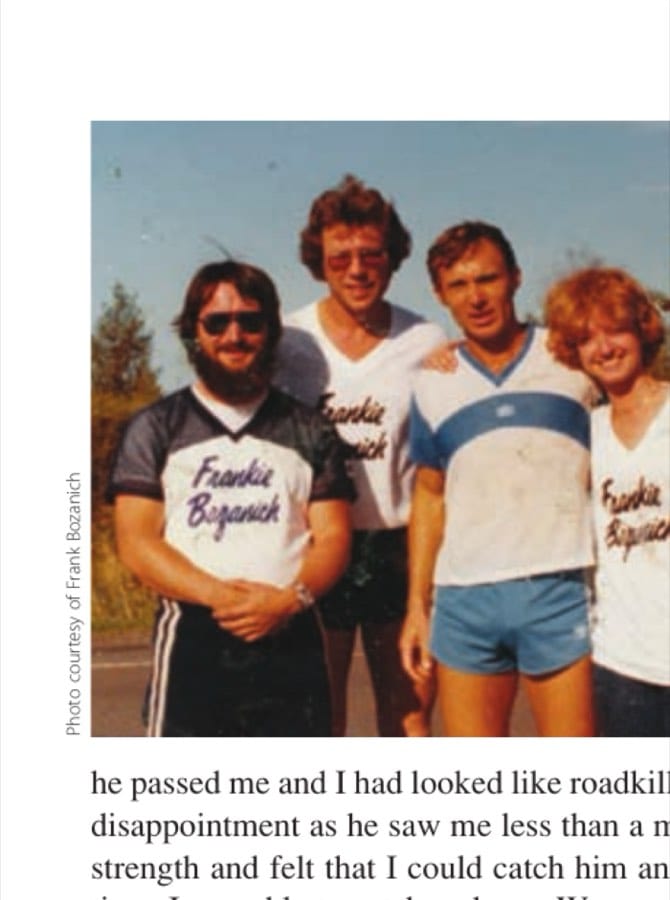
Frank with some of his Minnesota fans after the race. They were some of the few fans to watch the event and were a welcome sight and motivator for Frank.
moving back up with the leaders. We had the final turn around mile 47, and as we approached it I could see Warren making the turn for home. Warren thought that he had dropped me for good about 10 miles earlier when
he passed me and I had looked like roadkill. The look on Warren’s face was utter disappointment as he saw me less than a minute behind him. I drew some inner strength and felt that I could catch him and beat him, but I just had to bide my
time. I was able to catch and pass Warren with about two miles to go and ended up beating him by three minutes to win in a time of 5:32. It may not have been one of my faster races, but it was one of my best wins as it came three weeks after
a tough race and I was able to dig deep down inside to pull it off.
Carson City Half-Marathon, October 27, 1979 On October 27 I ran the Carson City, Nevada, Half-Marathon in a time of 1 hour, 15 minutes. I was pleased with that time because I ran the race as a training run—
in addition, the race was held at 5,500 feet altitude. After the race I flew back to Seattle and drove to Anacortes, Washington. I had grown up in Anacortes and lived the first 20 years of my life there. I had run track races while in high school,
but that had been the extent of my running back then. A road race was scheduled for October 28; the course was 3.6 miles. It would be an opportunity to finally run a race in my hometown. The race was called the
Mount Erie Run and ran on roads from the elementary school I had attended to the top of Mount Erie. I had driven to the top of the mountain several times but had never made the trip on foot. By the end of the race, I was able to produce a tie
for first place with a 20-year-old. I felt happy with my performance, considering that I had raced a half-marathon the day before. The final two miles were pretty tough, as they went up the side of the mountain after the initial flat 1.6 miles.
The course climbed 1,500 feet in those two miles. To cap off the day, I ran back to the start.
On November 24 I ran the Seattle Marathon as another training run. John Coffey came up for the race, and it ended up being one of those races you remember not so much for the race or the time you turned in, but rather for the weather you encountered. Undoubtedly it was one of the worst days for weather I had ever had the pleasure of running. The course was a double out-and-back, which meant that we encountered the fierce head winds not once, but twice.
The course made me remember doing a training run in Okinawa with my training partner, Jim Kramer, a fellow Marine, during the heavy part of a typhoon. Jim and I had decided challenge was too great to turn down and would make a good story later in life. Everyone else went to the package store to stock up on booze to make it through the long time they would be in their quarters. By the time we finished, we were running in calf-deep water from the rains, and the winds were approaching 70 knots.
In Seattle, the weather was miserable before the race, during the race, and after the race. It rained heavily, the temperature hovered at 35 degrees, and there was a 35- to 40-mph wind out of the north. Of course the race was run in a north-tosouth and then south-to-north direction.
I ran in my customary shorts and singlet, and John did the same. Halfway through, John was freezing and decided to call it a day. It then took him nearly an
ad
Photo courtesy of Frank Bozanich
▲
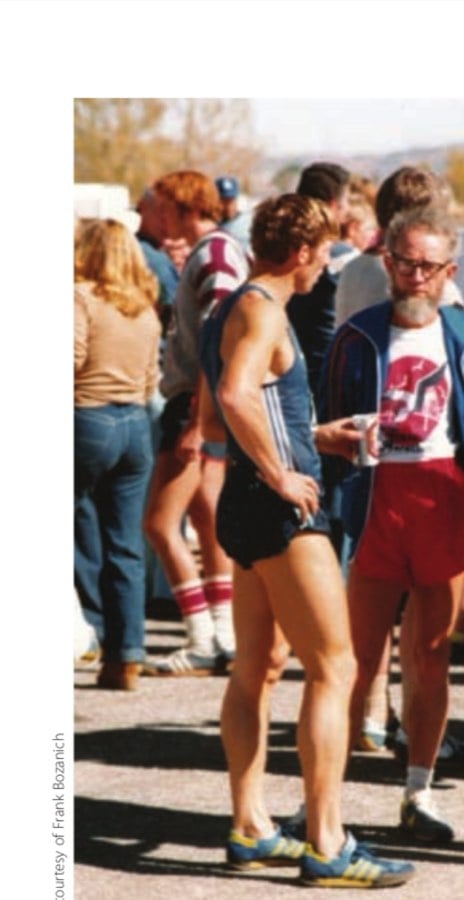
Frank visiting with Ross Smith after the Carson City HalfMarathon. Ross was one of the original veteran runners in the 1970s.
hour to dig through the pile of drop bags in the tent. I continued on to finish with a time of 2:39 and was very happy with the time—and happier still that the damned race was over. Because of the foul weather there was
no awards ceremony; everyone simply got dressed and ran for home. I found my drop bag, went to the car, turned on the heater, and just sat there with it on full blast before I was warm enough to drive home. The weather was
so horrible that even today, when John and I get together, we still talk about that race. A week after the marathon I ran the TESC 20K in Olympia, Washington. The course was a combination of roads and trails and was very hilly. Once again I ended up in a
tie for first. This was yet another of those cold, wet, and windy days, where the trails were nothing but mud, and we were all glad when it was over. On December 15 I participated in the Striders 50-Mile in Santa Monica,
California. This was a return to the site of my first 50-mile race, and I was hoping for but not really expecting good results. The race was conducted on a dirt track that was soft. The race did not go well, and I dropped out at 30 miles with
sore and tired legs. Although the year ended on a low with the last race, I was completely satisfied, as I had set an American Record at 100K, won the 100K National Championship, and also won the 50-Mile National Championship. I
also won four of the five 50-mile races I had entered, with two of them under 5 hours and 20 minutes. I also ran strong in my first trail 100 miler, not bad for a road runner and sea level runner at altitude. I was now mentally ready to start
the next decade of running ultras. The third and final installment will appear in our next issue.
This article originally appeared in Marathon & Beyond, Vol. 15, No. 3 (2011).
← Browse the full M&B ArchiveMore like this
1,000+ stories from 19 years of Marathon & Beyond
The complete archive of the legendary long-distance journal — digitized and free to read.
