

For the Long Run
I’ve been running regularly for the past eight years, though I consider myself a lifelong runner. I started when I was 11, when my dad and I ran the Skunk Alley Run near Missoula, Montana. I remember so well his encouragement as I ran, and back then, it was just fun. I wasn’t thinking about competition; it was an adventure, even this two-mile race. To me, it took forever and seemed a vast distance, every step uncharted territory.
I was used to watching my dad run, as he did every morning, six miles or so. We had this long stretch of road from our house, so that I could see him getting smaller as he ran north, toward the Mission Mountains. I remember thinking how incredible it was, that he could run that far, that he could be that fit. Six miles may as well have been 6,000.
Then I entered that two-mile race and I realized, with a little encouragement, that I could do what he did. That was incredible. It hadn’t occurred to me before that I could do it, too. I was lucky to have started with encouragement and a sense of adventure, with an emphasis on loving it first. My initial introduction to running had nothing to do with competing.
As I got older, that changed. It was less about play and more about discovering my potential. I enjoyed that at first; it was a form of exploring. Running is as much a creative pursuit as anything else. For me, it started off as fun, and over the years, it has gone back and forth: sometimes it’s fun, sometimes it’s tedious, sometimes it’s a test of how badly I want that time, to win that race, or to simply get out there at all.
My dad has been running for 34 years. He has run through blazing Oregon summers and Montana ice storms, in rain and wind, five to six miles a day, no hill training, no speed work, no long run each week, just that enduring, immutable desire to get out there on the road. He’s now 74 and he’s still doing it, still loving it. That’s what I want to do. I want to love it forever.
The arrogance of youth That hasn’t always been the case. In high school, the pressure was on. I understood that had to be the way it was, that to win or to place well, I had to be diligent about
my workouts, about my nutrition, about how I cared for nagging aches and pains. At 15, I wasn’t all that careful. I didn’t pay close enough attention to that stuff. I got hurt and thought I could pop a bunch of aspirin and keep running. What wound up happening instead was that I didn’t run regularly again for almost 15 years.
When I did pick it up again, I was working 60 hours a week in front of a computer and was 30 pounds overweight. I looked at myself in the mirror one day and bought a gym membership the next. I ran about a tenth of a mile on the treadmill, called it good, and wondered if I had wasted my money on the membership.
A week later, I tried it again, and this time I went two-tenths of a mile. I did that for a few weeks, adding a little at a time, and at some point, I deduced that I hadn’t wasted my money. Before I knew it, I could run two miles, then three, then four, then five. I was reminded that running could turn into a passion.
And that five miles was a long way. I had stood on the south rim of Crater Lake, gazing across to the north, and had stared at 4.7 miles worth of open space. I’d imagined a tiny figure on the surface of the lake, running, nearly invisible in her smallness as she covered the vastness of that width. This time, perspective was everything; I was in awe of what I could do.
I ran until I was about six months pregnant and then had to stop for more than three months. When I picked it up again, I was 50 pounds overweight. My first
ad
run was one lap around the track, and it took me over three minutes. It may as well have been a marathon. But little by little, I got into shape. I’m proud to say that I managed to push a BOB running stroller more than 13 miles when all was said and done, not quickly, but 13 miles nonetheless, on a 1.5-mile loop. I had done the right thing in toughening up my tolerance to boredom running on this loop.
All tribulations aside, I learned a lot about myself during my fight to get back into shape. I learned the importance of persistence, of heading off injuries before they begin, of getting enough sleep (which isn’t easy with a newborn), and of the kind of excitement that carried me through all of those times of doubt, when it felt like I would never lose the weight, would never get faster or fitter, when it seemed that all the running in the world wouldn’t help.
My dream carried me forward, and my dream was to run well. My son, Rune, was 8 months old by the time I finally worked up my nerve to enter a race. It was a small, local 5K trail race, my first since high school. And I won! I couldn’t believe it.
My husband, Blaine, had brought the video camera and had captured my excitement as I chattered about how it felt, how hard it was (there was a monster hill), and how I hadn’t expected this.
As a result of winning . . . Winning will usually do one of two things. It will either make you complacent, or it will make you hungrier. In my case, I was hungry. I wanted to do more. I wanted to run faster, farther, harder. When I look back at my old training log, I realize just how hard I pushed myself after that race. I didn’t run lots of miles, but the ones I did run were full of fire, too fast, too far, too hard. I was frequently injured and suffered one frustration after another over everything from IT band pain to patellar tendinitis.
What I hadn’t learned in high school, I was forced to learn now: the value of rest, of taking easy days after hard ones, and of getting enough sleep. As I got faster, my expectations got higher. I put more pressure on myself than ever before. My head was full of dreams. We all remember those Olympic track dreams we had when we were seven years old, the ones where you’re coming down the final stretch after a grueling race (though in the fantasy, you’re fresh as a daisy), your rival (or whichever famous runner happens to be making the headlines) at your elbow. You see her shadow at the base of your feet, and you’re trying desperately to outrun it. Just find that extra gear, you tell yourself. And there you have it, simple as that, and you go, you charge the line, and she is breathing down your neck, at your elbow, blazing a path right behind you, but despite her being so close, you are uncatchable.
I thought a lot about this, and in every context—on the track, on the road, on the trail, in the next 5K, in the next half-marathon, maybe even the next marathon. It was possible. Anything was possible. I hadn’t thought quite like that since I was a kid, yet here it was, this incredible confidence, this insurmountable belief in myself.
And never has that confidence showed itself quite like it did in 2008 when I entered the Timberline Half-Marathon, a trail race skirting Timothy Lake near Mount Hood. I took off like a shot, like I had in the 5K; I was new enough at this that I assumed I could carry a 5K pace through a half-marathon—what’s 10 extra miles?
I started regretting this decision about 3.1 miles into the race. It didn’t help that, because it was a trail race (and there are lots of trails around Timothy Lake), I got lost, leading 10 or 15 other runners down a dead-end route. Panicked, I backtracked (apologizing on my way past the knot of confused athletes), speeding up, nearly sprinting back up the trail, desperate to put some distance between me and the people chasing me.
I glanced at my watch: I was only 30 minutes into my race with an estimated hour to go (trail races are usually slower than road races) and a 5K pace I knew I couldn’t hold. I tried to drift, to distract myself by getting a good beat in my head from a song I’d recently heard. Then I inhaled something and couldn’t stop choking.
Not the best running form I ran, doubled over, thinking about how I must look. Ever try a six-minute mile while touching your toes? I stumbled, turning my ankle, but I jumped back up, determined. I would go on to turn my ankle two more times before finishing, bedraggled, with something stuck in my windpipe, first overall: I had managed to beat all the guys.
Along with that accomplishment, I would later cough up the spider I’d inhaled in the first five miles of the race. Not only had I won, but I had done it in the most skin-crawling way. From Timberline came big dreams, but even big dreams have to be tempered. I remember how excited I was the day I found out I had qualified for the elite wave at Bloomsday, a well-known 12K race held in Spokane every May.
It can draw nearly 50,000 athletes and is often compared to the Boston Marathon due to its popularity. It’s known for its scenic course and is one of the few premier 12K races in America, since 5Ks and 10Ks are much more popular here. It also draws an international field, offering more than $75,000 in prize money.
I was absolutely elated, on cloud nine, though I wondered what I was doing here. Then I remembered: I had worked hard for it. Fighting through injury,
▲ Courtesy of Holly Hight
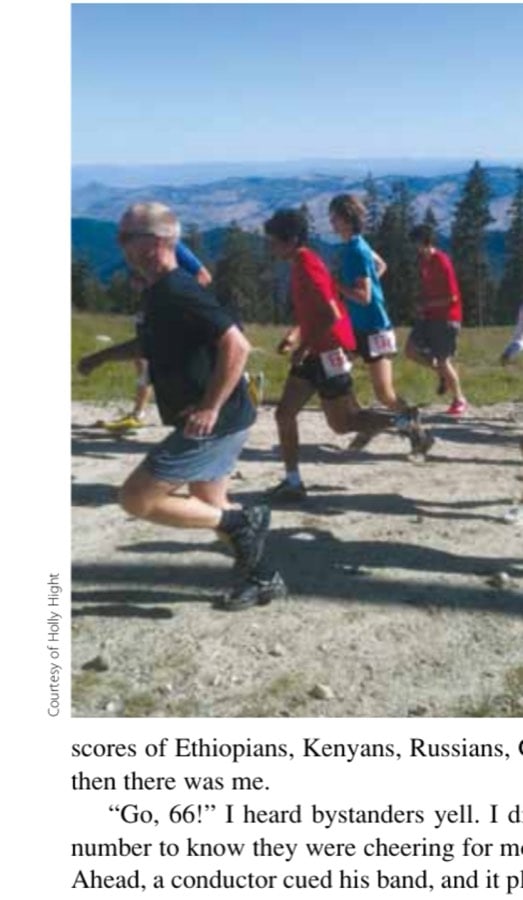
Getting back into racing.
burnout, and other setbacks, I had made the elite wave, a goal for over a year. The morning of the race, the “elites” had their own indoor changing area, bathrooms, and warm-up space. People in black suits
and white gloves opened the door for us. I felt like a royal. And then the gun went off. Seeing 5:15s on TV during the Olympics is not quite the same as watching it from behind. In my case, everybody just got smaller.
Ahead of me were scores of Ethiopians, Kenyans, Russians, Germans, and faster Americans—and then there was me. “Go, 66!” I heard bystanders yell. I didn’t have to remember that was my number to know they were cheering for me because I was the only one in sight.
Ahead, a conductor cued his band, and it played as I ran by. This happened more than once. Hordes of people waved and clapped. I was a brief celebrity, caught somewhere between the elites and everyone else, a race of 45,000-plus finishers,
yet alone, something fleetingly remarkable. For a short time, I pretended I was in the lead.
The hill can kill confidence In the brightness of the day, Doomsday Hill, the hardest climb on a notoriously hilly course, looked even worse than I’d remembered. My coach and I had driven the course the night before, and in the gloom, it had looked surmountable. Now, as I approached mile five, it might as well have been K2. I would love to say I pulled it together, charged the hill, and ran one of the great races of my life. Instead, it continued being one of the worst. There were reasons: injuries, burnout, and more.
But people continued to cheer. “Come on, 66!” In other races, I had heard the familiar refrain: “Go get ’em!” This time, there was no one to chase. But that didn’t matter; the enthusiasm of the crowd carried me.
Suddenly I wasn’t alone. A man blew by as though I was standing still, a Tanzanian named John Yuda. Despite the fact that the elite men’s race had begun 15 minutes after the elite women’s race, I couldn’t hold him off. There was no more pretending. His entourage included a carload of cameramen, who were clicking away as they rode ahead of him. I found out later that he had averaged 4:38 per mile.
I finished almost 13 minutes behind Lineth Chepkurui of Kenya, the eventual winner, and nearly three minutes behind the woman ahead of me. If you’ve never known what it’s like to finish last, it’s both lonely and freeing. You lose all illusions of grandeur, and finally, you’re left with yourself and the best you can do.
I ran that race by myself. I felt a conflict of emotions, including disappointment over the fact that I couldn’t keep pace with anyone else in this field. But I also felt the awakening of something else: the desire to be realistic in my dreams and to enjoy where I was at.
Like winning, losing will usually inspire either complacency or hunger. The hunger flared, but I also knew that to be the best runner I could be, I needed to approach my goals incrementally instead of comparing myself to others and setting an unrealistic bar.
I had also gotten into the nasty habit of focusing too much on racing and on those four little numbers on my watch. I had forgotten that running can be a creative process, that there’s beauty in improvising and in leaving the watch at home.
But if there’s a tug of war that goes on inside any runner, it’s the bid to compete versus the desire just to love it for its own sake. My best runs have taken me by surprise. They’ve been the impromptu, in-the-dark kinds of runs I wasn’t planning, the bet by a friend to a duel in the rain, the twilight run after I set down my book, not quite ready for bed or for the shower, when there’s nothing else to do but muse. What better way to muse than on a run? Especially just as the sun is setting—or coming up.
No guilt I go back and forth on the competing part. I go through cycles when the race seems exciting and others when just getting out on the road is the best part. At first, I felt guilty. I thought that my lack of desire to compete was a sign that I’d lost my motivation to run, but I realize it’s just coming up for air. When I was finally ready to go, I tackled the biggest goal of my running life: the marathon, specifically the 2010 Eugene Marathon. Here was a fairly flat, fast
▲
Courtesy of Holly Hight
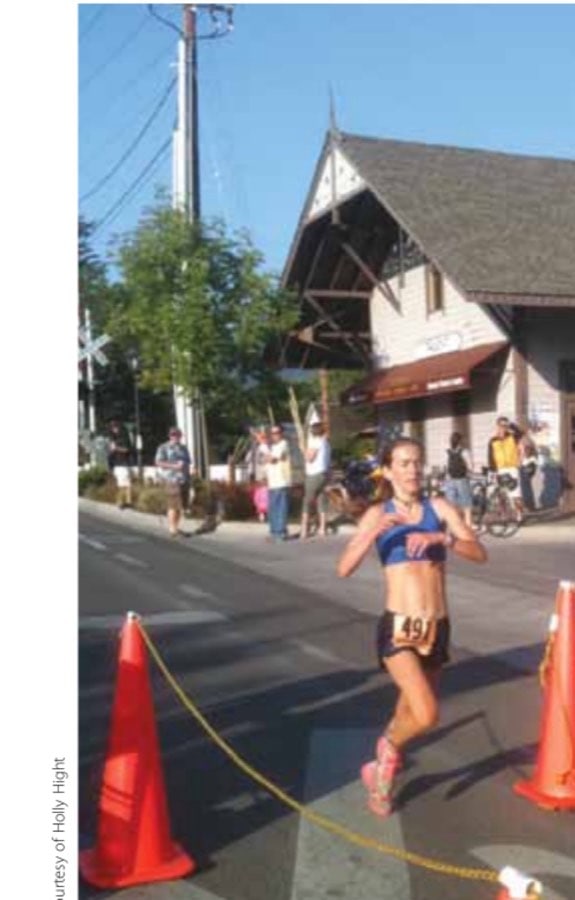
course, finishing around the track in Hayward Field, with hundreds of spectators along the way and in the stands, all cheering, all clapping—talk about a rush! But first came the 16 weeks of training. I had come off a long layoff that had
me running only about 15 miles a week. I found a coach, two other teammates, and a training plan, with the long-range goal for the three of us to make the Olympic Marathon Trials. Again came speed work and longer runs than I had ever done. Early on Tues
day mornings, I wound down a bike path to a middle-school track flanked by evergreens. I did everything from 200s to mile repeats as kids came on school buses and I darted around pink, green, and blue backpacks in lane one. Much as
I had dreaded these workouts, I had also missed them and was ready to be going hard again. On the flip side were the long runs. These came on Sundays as I arose before dawn to drive to the north side of Portland where I would run 18 to 22 miles on
the Leif Erickson Trail, packages of GU in one pocket and toilet paper in the other. Sometimes I would join a friend or teammate who was also running the Eugene Marathon. At other times, I did these runs alone, and that’s
when my imagination ran wild. These were the times the trail was full of bandits or mountain lions or packs of dogs that had joined forces after escaping from every nearby yard. I was startled by the cackle of every
bird, every movement in the grass. In the distance was the dull drone of the freeway, reminding
At my peak.
me that I was, in fact, in a city. But in these early hours, I felt as though I was the only human being on the planet. Despite getting spooked, I enjoyed these long runs and looked forward to my ultimate test in the marathon. My training routine felt comfortable, and the predictability of it appealed to me. No more running willy-nilly; I was on a mission. This first marathon would be a range finder, but I also wanted to go under three hours.
I held my breath as the weeks went by, nervous each time I went out about incipient injury (I’ve always been injury prone), but nothing happened except the usual aches and pains. Race morning yielded worse-than-usual nerves. (I hadn’t been able to sleep for two nights prior.)
But I was ready to go when the cannon (yes, cannon) went off. Talk about symbolism. This was my biggest race to date, and my longest.
IT band problems A teammate and I ran together, and the miles clicked off easily until, at mile eight, I felt a tightening in my IT band. The tightening worsened until, periodically, spikes of pain set my knee on fire. Music and crowds took my mind off it, and I also thought about the time I paced the Portland Marathon. What an experience! As a pacer, I ran with people who were trying to qualify for Boston. My job was to keep them motivated, excite them (even at mile 22), keep their minds off of their pain and their doubts. Their moods were up and down, cycling through periods of doubt and depression while, at other times, their excitement and confidence seemed to soar. I kept thinking: eye on the prize. But what of all those in-betweens, those moments of anticipation when it isn’t in the bag yet? If there was no chase, no chance for failure, it wouldn’t be as exciting. And without failure, there would be no real chance to reflect or to do things better. It’s what feeds our drive. It’s also what makes us better athletes. I told myself those same things as I clicked off the final, painful miles. When I looked at my watch, I realized that achieving my goal was a long shot. Somehow, though, it didn’t matter. I was doing what I wanted, what I’d trained hard, to do. I finished but missed my goal by six minutes. Funny that it wasn’t disappointing in the least. I was happy to be done and to have completed my first marathon. I didn’t run another step for nearly two months. When I did, I had made a crucial decision: I wouldn’t be training for the
Olympic Marathon Trials. I wanted to love running first. Which takes me back to that race near Missoula, Montana, when I was 11 years old. I’m grateful I’m a runner. I feel very lucky just to be able to do it. There are days I forget all about what race I’ve got coming up and I relish the dash from the parking lot, realizing I’m not out of breath in the least.
The Way We Were A now-grizzled high school cross-country team looks back at the formative years.
Editor’s note: Several years ago we received a link to a posting by San Francisco attorney Michael Bernick, who was looking back at long-distance running the decade before the running revolution struck. What caught our eye about the piece was its vivid recreation of the baby boomers engaging in high school
cross-country while also going to the other extreme and occasionally running one of the relatively few marathons available in those days. Dr. Bill Roberts, the medical director of the Twin Cities Marathon, has for years been researching the effects on runners under 18 who take on the challenge of the marathon; his findings: nothing wrong with a teen running a marathon. We contacted Michael, and he was able to in turn contact some of his high school teammates to solicit from them their memories of that 50-year-old era. What follows is the running boom before the “running boom” hit.
Who We Were When running became life: Southern California’s 1960s long-distance subculture. BY MICHAEL BERNICK
Before distance running entered the mainstream culture in the 1970s, before marathons and road races attracted thousands of runners, before Nike and Reebok, there was a distance-running subculture in Southern California. You wouldn’t have known it existed from reading the Los Angeles Times or watching local television or listening to the radio. But a vibrant distance-running community emerged in the 1960s. This community was linked by a network of all-comers’ races, weekly road races, and newly established marathons. Most important, new attitudes were emerging among these runners: about long-distance running as a lifestyle as well as about workout regimens, diet, lifelong training, and the inclusion of women.
My older brother, Jim, then a senior at Fairfax High, introduced me to longdistance running in the summer of 1967, a few months before I was to start my freshman year. My first run was from our house in the Fairfax district to the top of Mount Olympus in the Hollywood Hills. Though I ran only the first two miles and walked the rest, I was hooked.
Fairfax did not have a long tradition of long-distance and track athletes making their mark. According to Gabe Grosz’s history of Fairfax track, the school lost every track meet between 1962 and 1965. But all that changed in the fall of 1967 with the arrival of a new coach, John Kampmann.
Like other successful high school coaches, Kampmann brought commitment and passion to the sport that were contagious. Running was not done part time or occasionally; it was a daily, year-round regimen. Running was one part physical and a larger part mental. Running was linked to diet, sleep, and focus.
Long-distance training under Coach Kampmann was a mix of approaches: speed-play techniques from Finland, repetitions on the track, and long slow distance (LSD). We ran in the Hollywood Hills, on the trails of Griffith Park, at the La Brea Tar Pits near Fairfax. We ran on the area’s golf courses, throughout Brentwood and UCLA, at the Santa Monica beach. On weekends we ran through the canyons north of Sunset. We would start at Burton Way and La Cienega and each week choose a different canyon: Franklin Canyon, Coldwater Canyon, Benedict Canyon, Beverly Glen Drive—12, 14, 16 miles. Often on Sundays, we would do a canyon run in the morning and come back at night with a three- or four-mile run at the Los Angeles Country Club.
By the next year, Fairfax was among the top cross-country and track teams in the city. In the spring of 1968, Mike Wittlin set a city record with a two-mile time of 9:17. The following year, Dan Schechter won the city mile championship with a time of 4:16. In dual meets, the half-mile squad, led by Gary Shapiro, regularly ran in the 1:50s. Fairfax lost only one dual meet in 1969. During the next two years, Fairfax won 14 straight dual meets.
Beyond competing as a team, we were part of the region’s distance community. We traveled throughout the region on weekends to compete in road races in Montebello, Pacific Palisades, Diamond Bar, Toms Peak, and the Los Angeles Police Academy. We ran the Culver City Marathon in 1967 and 1968 and the Palos Verdes Marathon in 1969 and 1970. We traveled in a van to San Diego to run the Mission Bay Marathon in January 1970. During the summer, we competed in the all-comers’ meets at Venice High, Pierce College, and Los Angeles Community College.
The region’s distance community was not large. Each road race might have 100 runners, and even the marathon races rarely had more than 200 or 300. The runners, though, traveled to the same races, met at the same handful of stores that sold running shoes, and read the same books and articles on running, particularly the running bible, Track & Field News. Through these interactions, the running subculture grew.
Mainstream athletic culture in the 1960s in Southern California focused on a few sports, primarily baseball, football, and basketball, in which a small number of athletes actually competed. Most high school athletes and nonathletes did not
Bernick, Bernick, Kantor, Gurnick, Flesch, and Wittlin l THE WAY WE WERE l 75
continue active exercise after graduation. But in distance running, everyone trained and competed. A main part of the sport involved “PRs” (personal records), pushing yourself to improve your own time. Coach Kampmann gave as much attention to each runner’s PR, from the slowest to the fastest runner, as to the team score.
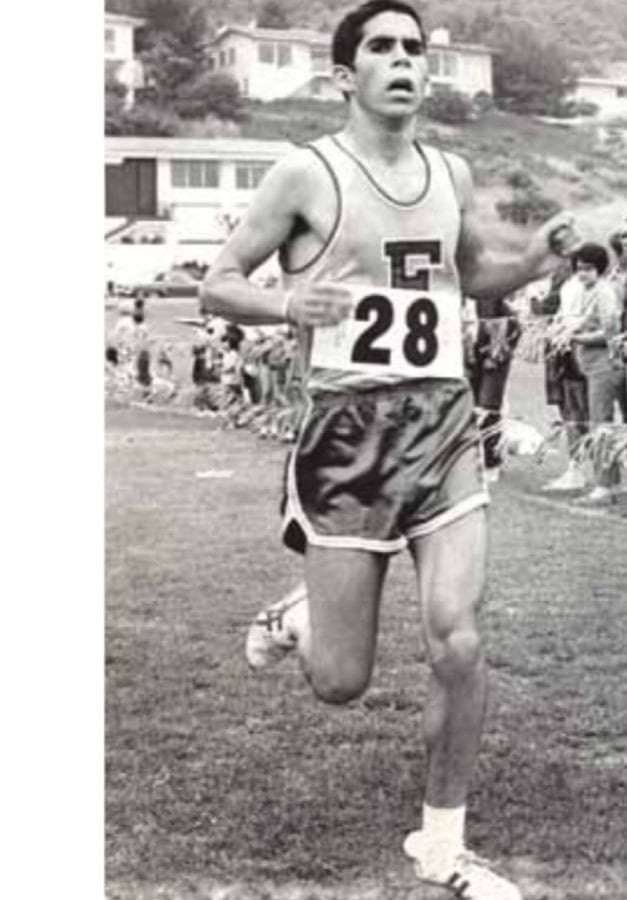
Running did not stop in high school. It is a lifelong pursuit. At the road races, you would see runners of all ages and from a wide range of occupations. Further, the groundwork was being laid for the establishment of women’s high school and college teams and for the full participation of women in all distance races.
Most of us from that running era at Fairfax have continued to find value in the distance-running culture and continue to run daily. My own running career would have its ups and downs over the years. On a Saturday morning in May 1970, I ran my second Palos Verdes Marathon, finishing in 2:42—among the top 20 high school marathon times in the United States that year. Later that year, I went east to Harvard, where I joined the cross-country and track teams. My participation, though, ended after two mediocre years. A few years later, I competed again as a graduate student at Oxford University in England (where graduate students could compete on university teams) but stopped after an undistinguished year. In both cases, running had lost its cultural ties: the sense of purpose, the broader lifestyle,
the camaraderie. Since returning to California in 1976, I’ve continued to train, almost exclusively long slow distance, increasing my weekly miles over the past 10 years. Today, living and working in
the San Francisco area, I run twice a day, around 50 to 55 miles per week, often in the scenic Presidio area. Similarly, if you look around the streets of Southern California, you’ll see others from the 1960s Fairfax
teams who continue distance running: Gary Shapiro, Eli Kantor, Jeff Rothman, Bobby Sherman, Mike Wittlin, Irwin Merein, Roy Cohen, Tom Flesch, Dale Lowenstein, Sam Kiwas. But the full legacy of those Fairfax years stretches far beyond our teams.
▲
Michael Bernick finished the 1970 Palos Verdes Marathon in 2:42:32.
Long-distance running has soared in popularity and today attracts tens of thousands of runners, both men and women, to major races. Thanks to the coaching and life philosophy of John Kampmann and other Southern California running advocates of the 1960s, for many of us, reminiscing about high school sports isn’t an exercise in remembering things long gone. Rather, it is reflecting on the birth of ongoing life-affirming habits. * * * When Rich contacted me, I welcomed the opportunity to write in more detail about our long-distance/marathon subculture of the 1960s in Southern California. I just couldn’t remember much more. So I turned to former cross-country teammates at Fairfax High who also were marathon runners. Fairfax High in the 1960s under Coach John Kampmann developed one of the top distance programs in the region, winning the Los Angeles city championship in 1970.
Several teammates responded with the thoughtful essays that follow that capture the time in greater detail than my original essay. These essays also capture the intensity of the running experience and the influence of these experiences over the past nearly 50 years.
For all of us, long-distance running was the defining activity of our youth. While questions have been raised recently on marathon running at an early age, these essays confirm the highly positive long-term effects on physical health and goal-setting and most of all on self-confidence. Eli Kantor’s essay details his transformation from a poor athlete into a confident runner and how this transition influenced him in high school and for years after. All of the essays connect to the lifetime professional and personal values of the high school long-distance running experience.
Additionally, in reading these essays, the detail of memory stands out. Most of us can hardly remember events of a few years past. Yet we recall in great detail the long-distance running races of nearly 50 years ago: the names of the runners, the specific times recorded, the dirt tracks at UCLA and Pierce College, the heat of the competition. Note Keith Gurnick’s essay and his ability to reconstruct and bring to life several races from 1971 and Tom Flesch’s ability to recall times, schools, and races when Fairfax won the city championship in 1970. My brother, Charles, focuses on the distance road-race culture in Southern California, a variety of races and locations.
All of us continued to run for decades after high school, and except when injuries intervened, all of us continue to run today. As Keith notes, most of us still have the mimeographed weekly handouts that Coach Kampmann passed out with their motivational sayings.
Finally, a word on Mike Wittlin, whose essay comes at the end. Mike was one of the leading high school runners in the 1960s in Southern California, setting a city record in 1968 with a two-mile time of 9:17. Mike is able to recall well his
Bernick, Bernick, Kantor, Gurnick, Flesch, and Wittlin l THE WAY WE WERE l 77
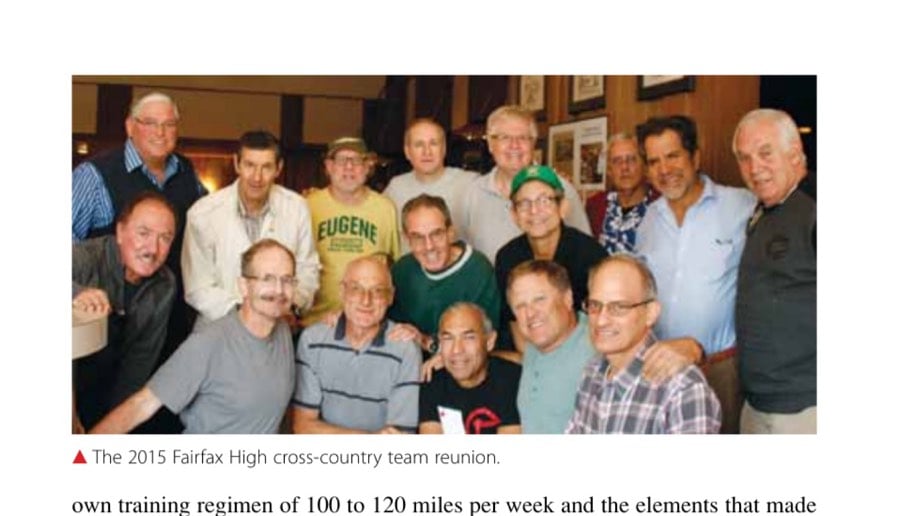
▲ The 2015 Fairfax High cross-country team reunion.
own training regimen of 100 to 120 miles per week and the elements that made Southern California a long-distance center in the 1960s. Before contacting him for this issue of Marathon & Beyond, I hadn’t spoken with him in more than 30 years. But as fellow long-distance runners, we were able to pick up the conversation without missing a beat.
Simpler Times Filled with energy and high spirits, Southern California was the place to be. BY CHARLES BERNICK
Those of us who began as distance runners in the late 1960s and early ’70s have witnessed significant change in the running scene over the subsequent four decades. Dirt tracks are almost extinct in major cities, replaced by all-weather surfaces. The variety and specificity of running shoes has exploded. More and more runners have “online” coaches to help them prepare for their next half-marathon. But at the risk of seeming like a fossil trapped in a time warp, I must confess that there is something I miss among all these progressive developments: the way the road race used to be.
When you picture a contemporary road race, what comes to mind are thousands (or tens of thousands) of entrants; entry fees of $50 or more (and don’t even think about putting off registering until race day); T-shirts with a list of sponsors; chip timing; and entertainment before, after, and along the way. Yet let me take you back to the way road racing was in Southern California in the year 1969.
As a 14-year-old, with high school looming in six months, I decided to follow in the footsteps of my two older brothers and begin training as a distance runner. At that time, I entered a lively road racing circuit. With a race available
within a 40-mile radius almost every weekend, there was no shortage of choice. These races were almost exclusively “sponsored” by the local running club, local department of parks and recreation, service organizations, or the Southern Pacific AAU (SPAAU). The SPAAU races were generally considered championships and ranged from 15 to 30 kilometers.
Entering a race could be a spur-of-the-moment decision. All you would need to do is arrive 30 minutes before the start and register—usually for less than $5. A field of 75 to 100 runners was typical, with a consistent smattering of local collegiate runners, high schoolers, individuals who had taken up running at some point after college, and some older individuals. It was common to see the same runners week to week—leading runners such as Bob Deines, Mike Mahler, Ron Kurrie, and my brother Jim, along with 62-year-old Monty Montgomery and octogenarian Fred Grace.
Particularly striking were the variety and inventiveness of the races. While currently most races are a standard 5K or 10K, road races of the ’60s and ’70s embraced a wide range of distances, from the four-mile Long Beach Ocean Runs to the seven-mile race around the Los Angeles Police Academy and the 25-mile race in Griffith Park. (It still baffles us as to why they didn’t just make it a standard marathon.) In addition, not all races were simply following a route from start to finish. Who can forget the Devil-Take-the-Hindmost run, where a certain number of the trailing runners were eliminated on each lap of a repeated loop, leaving only the last few runners to race to the finish. Then there was the Toms Peak run where runners had the option of following a groomed trail or creating their own path to the top of the mountain.
At the finish of each race, water was usually available. Awards were not given in age groups, as they are commonly now, but were based both on the absolute
▲
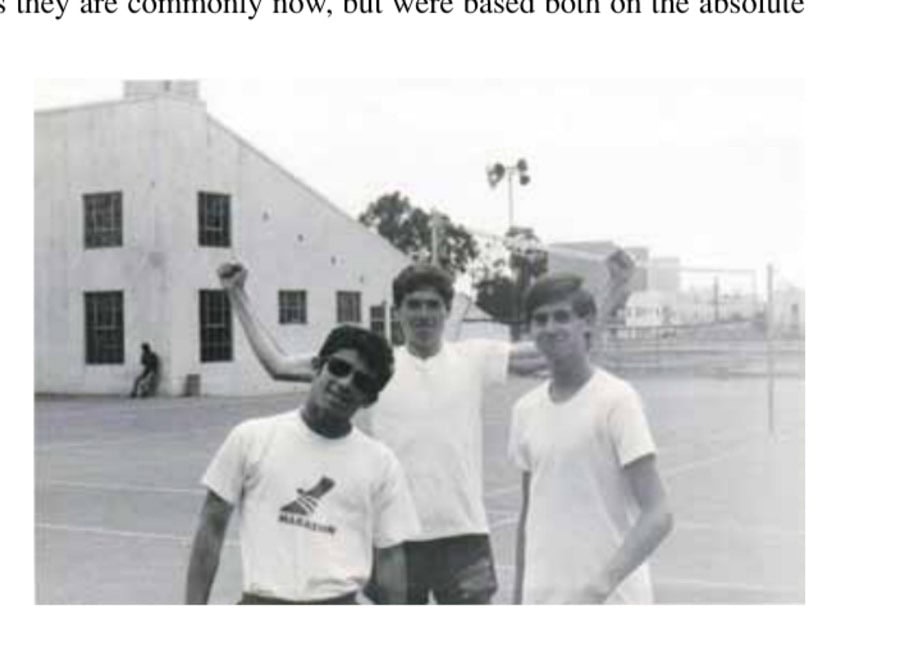
Fairfax High, fall 1969: (left to right) Charles Bernick, Tom Flesch, and Keith Gurnick.
Bernick, Bernick, Kantor, Gurnick, Flesch, and Wittlin l THE WAY WE WERE l 79
finish place and a handicap method. In the absence of Internet postings, runners could pick up the printed results of the prior week’s race. No other sport comes to mind that can match the inclusiveness of road races, where top athletes toe the starting line with middle-schoolers and grandmothers. They have contributed to the growth of distance running and clearly have evolved to become a popular way to participate in our very special sport.
The Soul Brigade Finding the leader within. BY ELI M. KANTOR
I was never a good athlete. When it came time for choosing teams in elementary school, I was always the last to be chosen. In baseball, I was always shunted into right field. In football, I was always the center. In basketball, they never passed the ball to me. I was skinny, short, and uncoordinated. When I was in the 10th grade in Fairfax High School in 1966, I was standing on the corner of Third and Fairfax in Los Angeles at the bus stop one morning trying to hitchhike or take the bus to school. I saw my 10th-grade English teacher, Ms. Kenzora, drive by and pull over to pick me up on the other side of Third Street. I sprinted across the street to her car. She said, “You run fast; you should be on the track team.” Those words changed my life. I went out for the cross-country team and discovered that even if you didn’t have natural ability, you could succeed through hard work, guts, and determination. I poured my heart and soul into running and gradually improved. Next semester, we had a new coach: John Kampmann. To him running was more than just a sport; it was a way of life. He would lecture us about the philosophy of running, various methods of training, and warming up and warming down. He appointed me to be in charge of the “660 workout group,” thereby transforming me into a leader. I called our group
the Soul Brigade. When I ran for team captain, my primary opponent was Sam Kiwas. In his speech to the team, he said this: “If you elect Eli, he will turn the team into a social club.” Consequently, I was elected overwhelmingly. I started the “soul bowl” regular bowling nights and regular team trips to the local smorgasbord. I took a group of social misfits and transformed them into a team. I persuaded the cheerleaders to come to our cross-country meets, and that developed respect for our team throughout the school.
As team captain, one of my jobs was to lead the warm-up exercises. No longer would I hide in the back and merely go through the motions. Now, as if by magic, I could actually touch my toes and do the push-ups all the way to the ground, while counting out the exercises. Since cross-country involved running up and down
▲
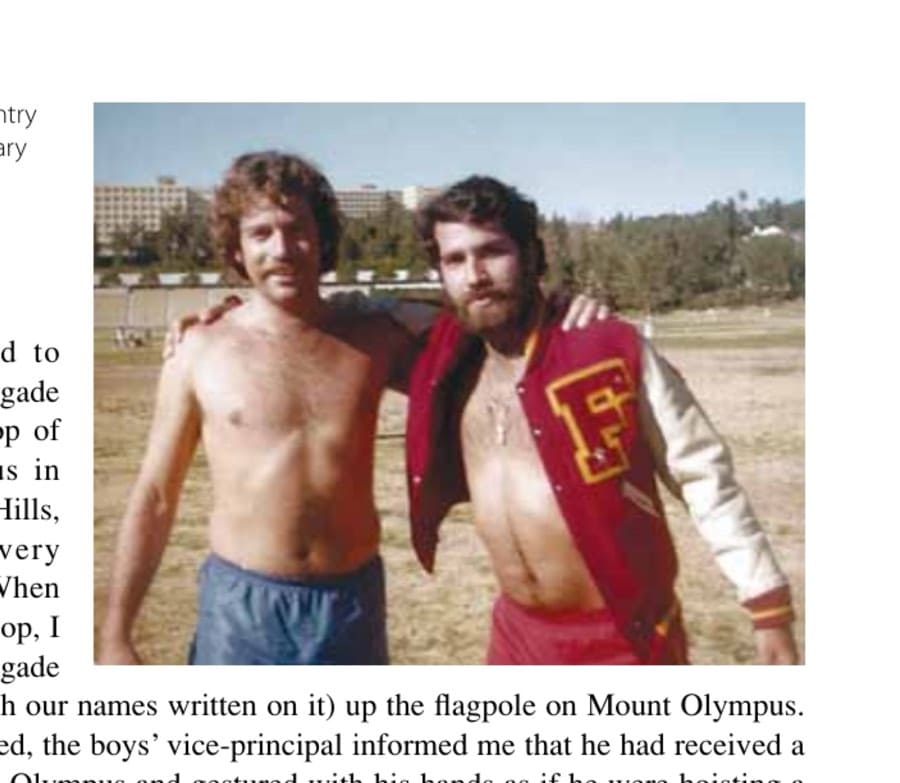
UCLA cross-country course, fall 1970: Cary Klein (left) and Eli Kantor.
hills, I decided to have the Soul Brigade run up to the top of Mount Olympus in the Hollywood Hills, which was a very steep incline. When we reached the top, I ran our Soul Brigade flag (a towel with our names written on it) up the flagpole on Mount Olympus. When we returned, the boys’ vice-principal informed me that he had received a call from Mount Olympus and gestured with his hands as if he were hoisting a flag up a pole. I played dumb and he just smiled.
We also ran to the fountain on the corner of Wilshire and Santa Monica, where we would take a dip. We would run on golf courses until we got chased out. During the summer, we would run on the beach. In those days, the late ’60s, people would just stare at us as we ran by as though we were crazy. Maybe we were.
During that time, our football team was pathetic, losing almost every single game. But our cross-country team went to the city finals. However, the Fairfax High School student newspaper ignored us and focused only on the football team. I devised a plan to remedy that situation. I ran for Commissioner of Athletics and won. I had Jeff “Wolfman” Rothman run for Boys League president. He won as well. Now we had a voice in student government. We created the Boys League Newspaper as an alternative to the official student newspaper, the Colonial Courier. Our newspaper featured stories about the track and cross-country teams. We then created the Boys League radio station, which broadcast at lunch hour. We would hold lunchtime sports rallies where the Soul Brigade would perform our cheers and dance moves to inspire the student body to support our team. We had the print shop produce little cards with slogans that the students could wear and asked the art classes to make banners supporting the team.
One day when I was a senior, the boys’ vice-principal pulled me aside and told me that I should be careful how I behaved both on and off the campus because the younger students looked up to me and that I was a role model to them. After that I tried to be aware of my conduct. I recently discovered that one of my younger teammates had named his son Eli, after me.
Bernick, Bernick, Kantor, Gurnick, Flesch, and Wittlin l THE WAY WE WERE l 81
Coach Kampmann transformed us into disciplined athletes, team players, and, more importantly, into leaders. I don’t believe that I would be a successful attorney today if not for the track and cross-country teams. My teammates have become doctors, lawyers, CPAs, teachers, and successful businessmen, applying the lessons that we learned on the track and trails at Fairfax High.
Keying on John Silva Every hero needs a nemesis. BY KEITH GURNICK
I graduated from Fairfax High School in June 1972. My introduction to distance running began four years earlier when Mr. Richard Green, my eighth-grade physical education teacher at Bancroft Junior High School, asked me if I would like to train with him and a couple of other runners in the early mornings before school and outside of school. Mr. Green was a tall and lanky man, a former 4:04 miler at Kansas in the heyday of the “four-minute-mile barrier,” and he thought I might make a good runner after he watched and timed me in what they used to call a 660 time trial. I think I ran a blistering 1:38. The 660 was a standard junior high school running distance for testing speed and distance; it required an entire four laps around a concrete track.
I began working out, or training as we called it, one or two days a week, sometimes by myself around my neighborhood streets and sometimes on the track at Fairfax High School but mostly at the La Brea Tar Pits, running on the very thick and wet grass. I was mostly in awe of other runners who were also working out at that time, including Howard Snider and Randy Dodge. These two guys were like machines: arms pumping in perfect rhythm, and they never seemed to get tired. I could run neither as far nor as fast as either of these two talented distance runners; they were one grade ahead of me and treated me like I was worthless.
I knew before I graduated from junior high school that I wanted to run track and cross-country at Fairfax High School, but I had no idea just how hard my competition would work. The summer before the 10th grade, I trained some, but not enough, in preparation for the 10th-grade cross-country team, as I thought it would be easy to do well because of my early start in running. Little did I know what was to come.
I had quite a surprise during those first few very hot and smoggy weeks of September 1970 when I went up against the likes of Tom Flesch, Charles Bernick, and others. I thought at the time they lacked any talent and athleticism, but they certainly made up for this in raw guts, motivation, and dedication. Under the coaching of John Kampmann, our freshman team placed third in the City Final Cross-Country Championship during his first season coaching us.
Our first track season was shortened due to the February 1971 Sylmar earthquake. I ran the Class C-1320 (three-fourths of a mile), and I enjoyed being on the track team and running my event very much. Reflecting on the C-1320, I remember it as being the perfect distance race. Go out hard at a good pace the first lap, just maintain and run hard the second lap, and kick it in the last lap. Of course, it didn’t always go exactly like that, and as I learned, there is much more to racing strategy if you are actually racing to win as opposed to just running to improve your best times.
My arch nemesis that 10th-grade track season would prove to be a very good runner from Sylmar High School named John Silva. His Pierce College crosscountry time was better than mine during the preceding cross-country season, and he was also running the C-1320 each week. We could see the race results each week, and thus we could see what we were up against. But my eyes were not set on beating John Silva, because I wasn’t even the best C-1320 runner on my own team. Each week I was competing against the likes of #1 Charles Bernick and #2 Arnold Ross, and I was the #3 runner—not very impressive, being the #3 guy.
Our 1971 track meet against Sylmar High School (at Fairfax’s track) turned out to be the last dual meet before league prelims due to the Sylmar earthquake. Prior to this meet, I was very frustrated because I was getting beat by two of my own teammates. I came up with a race plan to try to fix this. The night before the race, I envisioned keeping as close as possible to Charlie Bernick, and if I was able to, I would run as fast as I could the last 180 yards to try to beat him. I did not think about anyone else in the race but Charlie Bernick. I went over my race plan while lying in bed the night before the meet, and I did not sleep very well that night.
▲
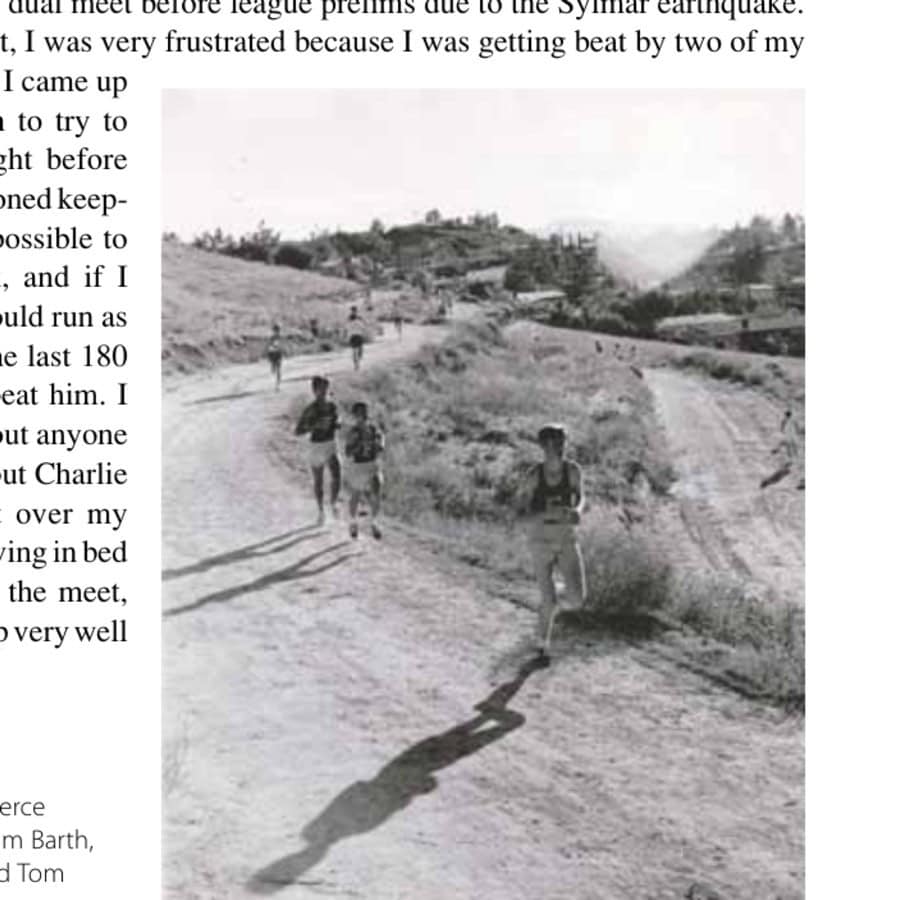
League Finals, Pierce College 1969: William Barth, Charles Bernick, and Tom Flesch.
Bernick, Bernick, Kantor, Gurnick, Flesch, and Wittlin l THE WAY WE WERE l 83
The next day we all did our warm-ups together, wearing our nice, warm, red Fairfax sweats. I remember warming up with Charlie and Arnold. Round and round the track we ran on the grass infield, being careful not to run into the bleachers or trip on a water drainage grate. We probably ran two miles at a “shag” pace before doing some wind sprints just before the race. When it became time to race, I was focused on my secret mission, which was not necessarily to win the race but to beat Charlie. As luck would have it, I ran my race as I had rehearsed it while trying to fall asleep in my bed the night before, and just before the final turn I passed Charles Bernick and went on to take second place in the race, about 25 yards behind John Silva.
I made it through league prelims and my goal for league finals was no longer to be the best C-1320 runner on my team but to win the championship. To me this meant I had to beat John Silva, whose personal best was at least 15 seconds faster than my best. But I employed the same prerace strategy: I was going to focus on John Silva, stay directly behind him, and sprint past him in the final 180 yards. I envisioned a 2-foot-long rope tied to his running shorts and my running shorts, and I was not going to let him get more than two feet ahead of me at any time during the race.
At the start of the race, John Silva was on my radar, and I guess I was on his as well. He knew I took second in our dual meet, but he also knew his best times were much better than mine. He went out at a blistering pace, finishing the first lap in 64 seconds. I came by at 70 seconds, and he was so far ahead that not only could I not see him, but my race plan was shot and I felt I had no chance to even get a trophy. But something strange happened during the race.
For the second lap, I kept my same pace and did the same for most of the third, and magically everyone just kind of came back to me, including John Silva. The next thing I remember, at the last turn John Silva was the only runner in front of me, and I ran as fast as I could and passed him and won the league championship. My father filmed the race in 16-mm Kodachrome, and I still have it today. This race was the highlight of my young running career. Having met my goal of winning the league championship, I was mentally ill-prepared to perform or advance past the city prelims, and when I was eliminated the next week, as a consolation I ran my first marathon, the Palos Verdes Peninsula Marathon, finishing in 3:19:11. I felt every second of the last six miles when I hit the Wall. It was not easy running a marathon coming off four weeks of interval speed work doing eight to 10 440-yard repeats at 58 to 60 seconds with only a 110 recovery.
Over my high school running years, I was plagued with various annoying soft-tissue injuries like shin splints and tendinitis that seemed to always crop up at the worst of times, such as when I was peaking near the end of each season for a big race. In the 11th grade I got eliminated in city quarterfinals in the mile
ad
where I ran a sluggish 4:39.6. I again ran the Palos Verdes Marathon a week or so later, running the first 15 miles in 96 minutes (6:24 pace) and then running the last 11 miles in 96 minutes (too embarrassingly slow a pace to calculate). I guess you might say I went out too fast and died! My goal that day was to beat the Fairfax High School marathon record that was held
by Michael Bernick. Obviously I didn’t. Over the years I have been fortunate to run with a running partner, my cousin Arnold Ross, whom I introduced to distance running just before the 10th grade. Since then, we have run many 10Ks and marathons together, although, due to my age, sore knees, and neck problems, I stopped running marathons after 2007 and I do not run much anymore. Running with Arnold for many, many years was a major part of our lives together. We are both very competitive, even in our 60s. In August 2006 we ran in four all-comers’ meets in the valley. In the last meet, I ran 5:53 in the 1,500 meters (not too shabby). My goals were to break six minutes and beat him and not have a heart attack or drop dead. I accomplished all four that day.
For me, running and a running philosophy were not just an exercise-athletic activity, and as I got older not just a way to good health and self-esteem, but rather a recipe for how to live my life. The principles taught by our coach, John
Bernick, Bernick, Kantor, Gurnick, Flesch, and Wittlin l THE WAY WE WERE l 85
Kampmann, went well beyond the track and cross-country arenas. He instilled camaraderie, perseverance, dedication, and a strong work ethic. I remember he would say and teach us, “You get out of it what you put into it,” or “Your reach should exceed your grasp.” These sayings apply to almost everything in life. He rewarded achievements with a slap on the back and personal attention, and he motivated each of us with his weekly paper handouts, printed on a mimeograph machine, many of which I saved and read again whenever I feel I need a motivational pick-me-up.
Running The longer, the better. BY TOM FLESCH
A few of my friends told me to try to make the cross-country team in high school. I seemed to have endurance while running a couple of laps in junior high and was not too winded. A small group of us started running in the summer, once a week. They wanted to run five miles, a distance I thought was way too much.
When I joined cross-country in high school, I was terrified to learn that my coach, John Kampmann, wanted us to run not only every day but on weekends and holidays also. We ran five to 10 miles each day. In those days, there were no joggers. The only people who ran were on the cross-country or track team. So when we ran in the streets, we got quite a few stares.
It turned out that I loved to run and even more that I became a very good runner. I loved to run long distances and found that the more I ran and the longer the distance, the more endurance I developed.
In 1970, Fairfax High School won its first and only city championship in crosscountry. John Kampmann was the coach, and our team beat Granada Hills High School by three points. However, what was impressive was that Granada Hills had three runners finish in the top 10 in the race and we did not have one runner in the top 10. Although running is an individual sport, cross-country is based on the best five runners finishing at the top. Your score is the finishing place of all five. Coach Kampmann taught us to run together, to stay as a pack, and to never lose contact with runners ahead of us. He instilled a sense of esprit de corps that bonded us to work together. Fairfax had a score of 76, besting Granada Hills’s 79. I was a junior and I was the fifth man on the team.
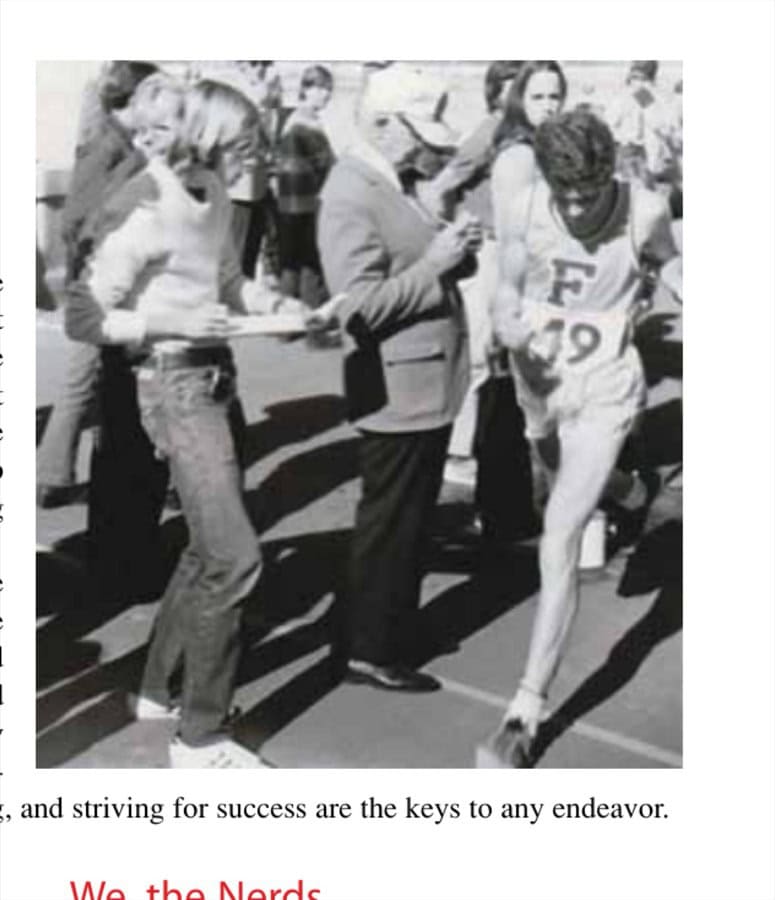
Winning the city championship was the culmination of Coach Kampmann’s years of developing dedicated runners to run to win. We ran every day, weekends and holidays and on vacation. Before my final year of high school, Kampmann challenged us to run 1,000 miles for the summer. Along with a Fairfax alumnus, Gabe Grosz, I achieved that goal, and I made it to the state championships with a 9:27 two-mile as a senior. I also ran 2:45 in the Mission Bay Marathon. I finished
▲
Tom Flesch finishes the 1972 Mission Bay Marathon in 2:45:40.
38th overall and was the third high school student in that race. There were only 600 runners in that marathon, but that time still finishes in the top 100 of almost any big marathon today. The lessons and the dedication of the culture of running that we had in those days carried forward in every way to my life today. Endurance, dedication, pacing, and striving for success are the keys to any endeavor.
We, the Nerds Be patient and inherit the earth. BY MICHAEL WITTLIN
As I write this, I’m 64 years old. I was involved in distance running from 1963 through 2002 as a spectator, participant, and coach—and finally, as a casual jogger and fitness runner. My participation started out as a mildly interested spectator by watching runners such as Jim Beatty of North Carolina, Jim Grelle of the Multnomah Athletic Club in Oregon, and Bruce Kidd of the Toronto Olympic Club on TV in the early 1960s. It grew to become a passion as I watched great runners like gold medalists Billy Mills, Bob Schul, and Peter Snell run at the Tokyo Olympics in 1964.
Finally, it became an obsession during my high school and postcollege days up until the age of 31, as many of my weeks during most of those years involved running between 100 and 120 miles per week. Most of my friends were competitive runners, my weekly schedule was built around my running schedule, and there was nothing more important to me than “getting my miles in.” Running became like an appendage to my body, and when I injured my back in 2002 and was no longer able to run, I found that there was nothing that could really replace it.
Bernick, Bernick, Kantor, Gurnick, Flesch, and Wittlin l THE WAY WE WERE l 87
We can mention surfing as a counterpoint to running. On the surface, they seem to have been very different. The surfers were the big, athletic, good-looking guys with the cool cars who had beautiful girlfriends, hung out at the beach, and could do something magical like riding a surfboard on huge, pounding waves. Runners . . . we were often the short, thin guys who came to our sport because we couldn’t make it in the more glamorous sports (football and basketball). We took the bus (only a few of us had cars), hung out at the library, and found magic to be in short supply. However, upon closer inspection, there were some definite similarities:
1. Both were activities that involved a relatively small number of people and that were viewed by most as difficult to participate in. 2. Many people viewed surfers and runners as kind of “edgy” or weird. “Surely
they must have better, more constructive ways to spend their time.” 3. Both activities gave participants a sense of belonging, of sharing a common experience with others. Furthermore, that sense of shared experience
endured over time. I recently attended a 45-year reunion of runners, some of whom I had never met and others whom I had not seen in years. Within a few minutes, we were able to converse as though we were continuing a
conversation from the day before. A runner from California could meet a runner from Calcutta and in short order find common ground, even if they didn’t share a common language. It must be similar with surfers.
4. Finally, the sense of accomplishment that many of us felt from having endured miles and years of running, of having been able to do something that most could not, or at least, did not do, contributed to an inner confi
dence. A friend’s dad once told me, “Part of the secret to happiness is to find something that you love, work very hard at it, and do it to the best of your ability.” I know old surfers who have espoused that view, much as
old runners do. And as success can build upon success, many people with a history in both pursuits have gone on to achieve great things in other areas. You need look no further than yourself. Southern California was a great place to run in the 1950s, ’60s, and ’70s. First, it was and is home to many fine universities, which developed some fine runners.
UCLA had sub-four-minute milers such as Bob Day and international competitors such as Geoff Pyne. Their meets were originally held on a dirt track near what is today Pauley Pavilion. Later in the 1970s, UCLA had one of the first tracks with an artificial surface. USC had Ole Oleson, who was an NCAA champion at three miles. Even small schools such as Occidental had runners like Bob Deines, who competed in marathons on a national level, and Bill Schabarum, who ran a 4:03 mile on a dirt track.
Second, there were some very fine running clubs, which turned out some excellent runners. Some of those were the Santa Monica Track Club (SMTC) under Mahaly Igloi and later Joe Douglas, the Southern California Striders, and the San Fernando Valley Track Club with Laszlo Tabori, the third man to break four minutes for the mile after Roger Bannister and John Landy.
Because of its great weather, which promoted year-round training, Southern California was often the destination for world-class runners who came to train for a few days, weeks, or even months. I remember running down San Vicente Boulevard (a very popular training place for runners from the SMTC and indeed from all over) in 1984; I was passed by Joan Benoit, who a few months later won the Los Angeles Olympic Marathon.
There were also a number of opportunities to compete at both indoor and outdoor meets as well as a number of high-quality all-comers’ meets at some of the local high schools and community colleges, such as Pierce Junior College in the San Fernando Valley. In the mid-’60s I saw Richard Romo of the Southern California Striders run a sub-4:00-mile at Pierce as well as John Bork of the Striders run a sub-1:50 half mile. Finally, the large number of high schools in Southern California produced some fierce competition and some great performances, such as a sub-4:00 mile by Tim Danielson of Chula Vista and an 8:41 two-mile by Eric Reynolds of Camarillo.
ad
Bernick, Bernick, Kantor, Gurnick, Flesch, and Wittlin l THE WAY WE WERE l 89
▲
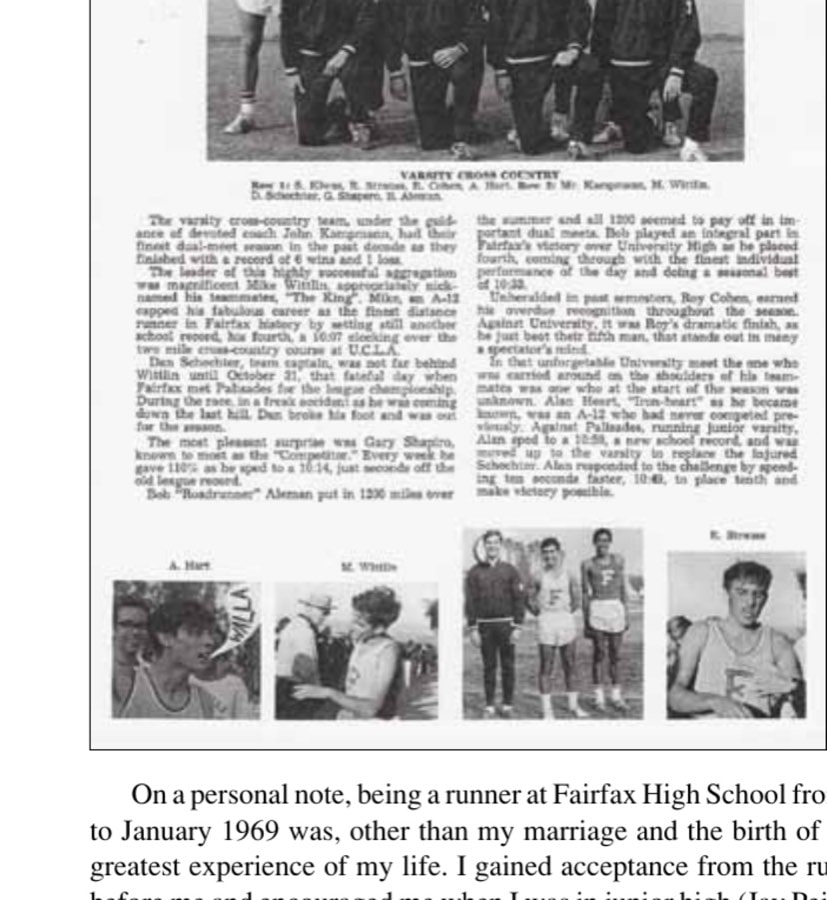
Fairfax varsity cross-country team photo, fall 1968.
On a personal note, being a runner at Fairfax High School from February 1966 to January 1969 was, other than my marriage and the birth of my children, the greatest experience of my life. I gained acceptance from the runners who came before me and encouraged me when I was in junior high (Jay Peitzer, Steve Gleitman, Roger Brandwein, Len Maripol, and Glenn Erso). They became like family to me, and I looked up to them. I shared tough workouts and ran epic races (at least in my mind) with people like Gabe Grosz, Roy Cohen, Dan Schechter, Jim and Michael Bernick, Gary Maeder, Bruce Andelson, Harold Goldstein, Gary Shapiro, and many others. There isn’t a day that goes by that I don’t think of at least some of them. Finally, I got to be coached by John Kampmann. I think my own teaching career was shaped by him because I wanted to live up to the example that he set in the positive way that he dealt with us.
This article originally appeared in Marathon & Beyond, Vol. 19, No. 5 (2015).
← Browse the full M&B ArchiveMore like this
1,000+ stories from 19 years of Marathon & Beyond
The complete archive of the legendary long-distance journal — digitized and free to read.
