

From Austinto Boston
On a map, the distance from Austin, Texas, to Boston, Massachusetts, is 1,969 miles. But as any marathoner knows, the distance is actually only 26.2 miles as long as you can run that distance fast enough to qualify for the Boston Marathon. If you’re not naturally that fast, then you have to add in the training miles. In my case, I ran 6,379 miles between finishing the Austin Motorola Marathon on February 17, 2002, and qualifying for Boston in the Hartford Marathon on October 14, 2006.
Truth be told, I didn’t actually run all of those miles—I walked 552 of them. Sometimes I walked because I was simply exhausted, and sometimes I was taking planned walk breaks, as Jeff Galloway recommends. This is the story of how I decided which miles to run and which to walk during my quest to qualify for Boston.
The story began in August 2001. My son Geoff and I were at a musical gathering at Zilker Park in Austin, celebrating Lance Armstrong’s third victory in the Tour de France. We looked at each other and said, “If Lance can do that after testicular cancer, we should be able to run a marathon.” We trained separately for six months, Geoff at college in Massachusetts, and I with the Austin Fit group. On February 17, 2002, we ran the Austin Motorola Marathon together. Geoff was gracious enough to slow down when I needed him to, and we crossed the finish line together, hands clasped and arms raised. It was a great thrill, especially because we had done it together!
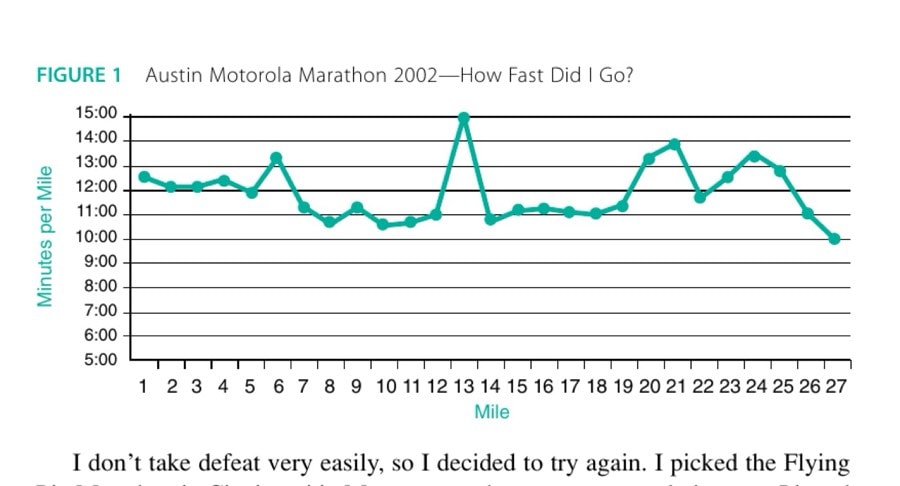
But, I am embarrassed to admit, it was also a disappointment. Despite everyone’s advice to the contrary, I had set a time goal for my first marathon, and I had missed it. I had figured I ought to be able to finish in five hours, but I fell short by 11 minutes. Although I had just accomplished something that less than 1 percent of the U.S. population ever accomplishes, I still felt defeated by the race. The pace chart in figure 1 shows what happened. The blue line shows the number of minutes for each mile. The spikes at miles six and 13 were for calls of nature. And at mile 20, I hit “The Wall,” that notorious barrier when so many runners seem to run out of gas, and I walked for much of the last 6.2 miles.
Minutes per Mile
Figure 1
Austin Motorola Marathon 2002—How Fast Did I Go?
15:00 14:00 13:00 12:00 11:00 10:00 9:00 8:00 7:00 6:00 5:00
1 2 3 4 5 6 7 8 9 10 11 12 13 14 15 16 17 18 19 20 21 22 23 24 25 26 27 Mile
I don’t take defeat very easily, so I decided to try again. I picked the Flying Pig Marathon in Cincinnati in May as a good next target, mostly because I loved the name. I kept training the way I had been, and my wife and I drove up to
Cincinnati for the race. I wore a heart rate monitor during the Flying Pig. Although not perfect, the heart rate is a fairly good indicator of how hard the body is working, so monitoring the heart rate during a run can help manage energy. When I’m running, my heart
rate generally ranges between 140 and 170 beats per minute. There’s a critical point at about 155 BPM, which is my anaerobic threshold. Roughly speaking, after crossing the anaerobic threshold, the body starts burning energy differently,
in a way that is not sustainable for a long period of time. At the Flying Pig, I had joined a pace group aimed at five hours and was feeling really good until mile 17, when I started to feel like I was working much
harder to maintain the same speed. I checked my heart rate monitor and noticed that I had crossed my anaerobic threshold. I stayed above the threshold through mile 20, but at that point I was completely exhausted and walked much of the
rest of the way. The two charts in figure 2 show the relationship among heart rate, anaerobic threshold, and pace during the Flying Pig. The blue line in figure 2a is my average heart rate, and the flat line shows my anaerobic threshold. Note the values
for miles 17 through 20—my heart rate crossed the anaerobic threshold (to about 165 BPM, well above 155) and stayed there until I wore out and started walking at mile 21. The blue line in figure 2b shows my time per mile. Note that I was
able to maintain my target pace (about 11:35) through mile 20, but then I slowed down substantially because I was walking so much. So in that critical stretch from mile 17 to 20, I was able to maintain my target pace, but only by burning energy
in a way that could not be sustained. In other words, running in the anaerobic zone for almost an hour was the cause, and the slower pace from mile 21 to 26.2 was the effect.
Average Heart Rate
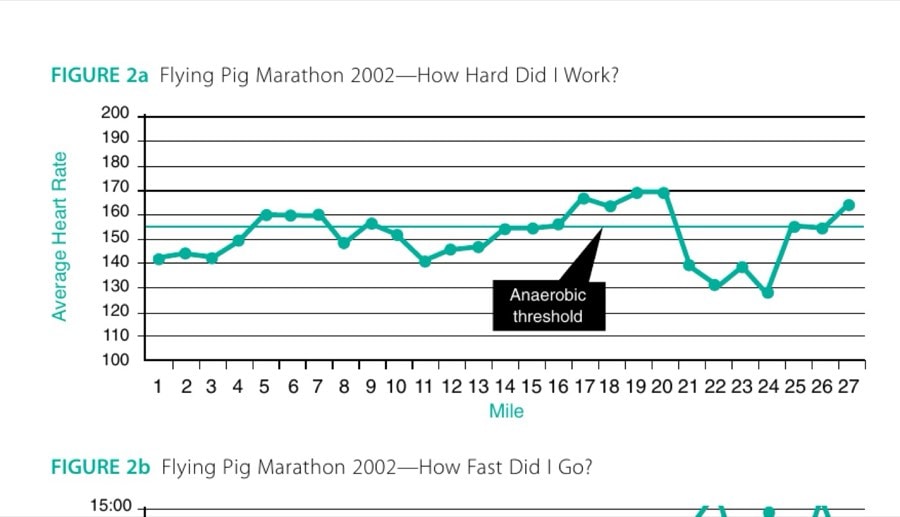
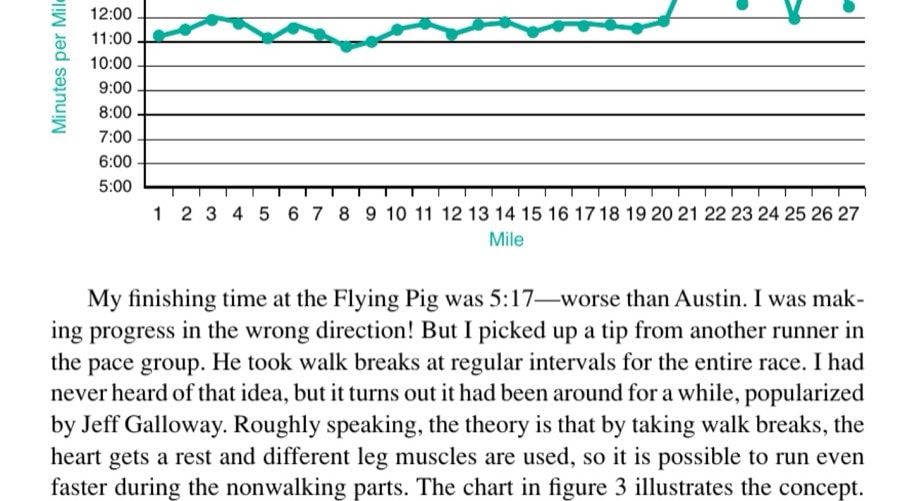
Figure 2a Flying Pig Marathon 2002—How Hard Did I Work? 200 190 180 170 160 150 140 130 120 110 100
Anaerobic threshold
1 2 3 4 5 6 7 8 9 10 11 12 13 14 15 16 17 18 19 20 21 22 23 24 25 26 27 Mile
Minutes per Mile
Figure 2b Flying Pig Marathon 2002—How Fast Did I Go? 15:00 14:00 13:00 12:00 11:00 10:00 9:00 8:00 7:00 6:00 5:00
1 2 3 4 5 6 7 8 9 10 11 12 13 14 15 16 17 18 19 20 21 22 23 24 25 26 27 Mile
My finishing time at the Flying Pig was 5:17—worse than Austin. I was making progress in the wrong direction! But I picked up a tip from another runner in the pace group. He took walk breaks at regular intervals for the entire race. I had
never heard of that idea, but it turns out it had been around for a while, popularized by Jeff Galloway. Roughly speaking, the theory is that by taking walk breaks, the heart gets a rest and different leg muscles are used, so it is possible to run even
faster during the nonwalking parts. The chart in figure 3 illustrates the concept. With two one-minute walk breaks in a mile and a running pace of 8:30 the rest of the time, it takes about 35 seconds less to finish a mile than with a constant
running pace of 10:00. In my professional life, I’m a consultant for Borland Software Corporation. When talking about software measurements, I always advise my clients to focus on the important decisions they make and to look for objective data to support
the decision making. In my running life, I was now faced with an important decision: should I incorporate walk breaks? I decided to gather some objective data. The chart in figure 4 shows my average pace and heart rate over several months
Minutes per Mile
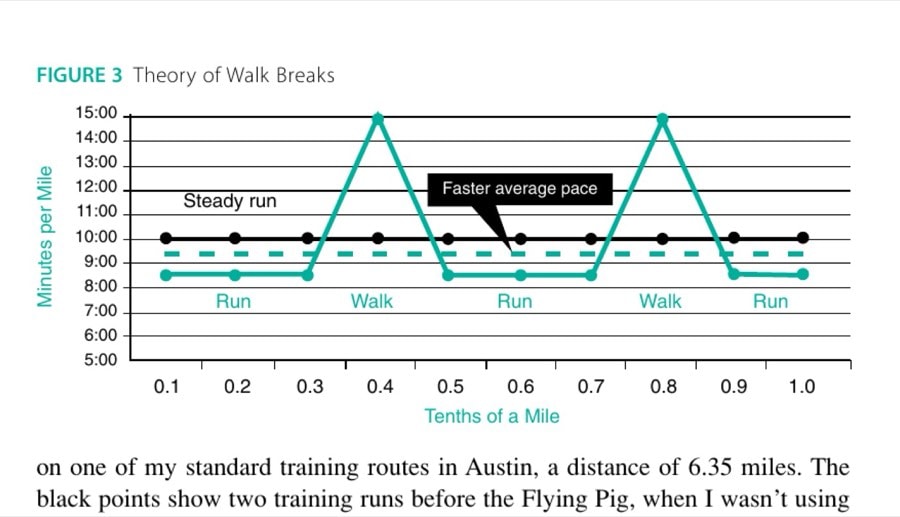
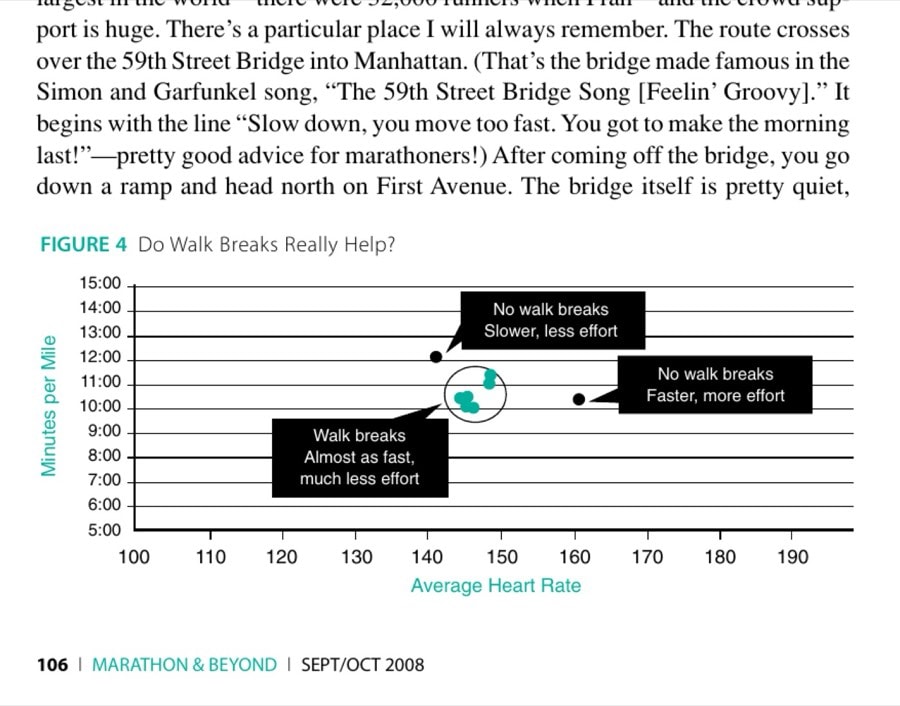
Figure 3 Theory of Walk Breaks 15:00 14:00 13:00 12:00 11:00 10:00 9:00 8:00 7:00 6:00 5:00
Faster average pace
Steady run
Run
0.1
0.2
Walk
0.3
Run
0.4
0.5
Walk
0.6
0.7
0.8
Run
0.9
1.0
Tenths of a Mile
on one of my standard training routes in Austin, a distance of 6.35 miles. The black points show two training runs before the Flying Pig, when I wasn’t using walk breaks. One run was at a slow pace with a low heart rate; the other was at
a faster pace but a higher heart rate. The blue points show several training runs after the Flying Pig, when I used walk breaks. They generally have both a faster speed and a lower heart rate. The data was convincing: I concluded somewhat
to my surprise that there might be something to this weird notion of walk breaks after all. So I decided to try it in New York in November. The New York City Marathon was one of my most memorable. It’s one of the
largest in the world—there were 32,000 runners when I ran—and the crowd support is huge. There’s a particular place I will always remember. The route crosses over the 59th Street Bridge into Manhattan. (That’s the bridge made famous in the
Simon and Garfunkel song, “The 59th Street Bridge Song [Feelin’ Groovy].” It begins with the line “Slow down, you move too fast. You got to make the morning last!”—pretty good advice for marathoners!) After coming off the bridge, you go
down a ramp and head north on First Avenue. The bridge itself is pretty quiet,
Minutes per Mile
Figure 4 Do Walk Breaks Really Help? 15:00 14:00 13:00 12:00 11:00 10:00 9:00 8:00 7:00 6:00 5:00
100
No walk breaks Slower, less effort No walk breaks Faster, more effort Walk breaks Almost as fast, much less effort
110
120
130
140
150
160
Average Heart Rate
170
180
190
but after the turn, the sound of the crowd is amazing, reverberating off all of the tall buildings, and it hits all at once! In planning for New York, I needed to decide when to walk and when to run. Galloway generally talks about walk breaks as a ratio of walk time to run time (for example, one minute of walking for every seven minutes of running). However, I have found it easier to analyze by thinking in terms of the average amount of walking per mile, because then I can look at the effect of the walk breaks on my pace per mile. For New York, I had initially decided to walk for two and a half minutes every mile, but I cut that back to two
minutes per mile in the second half. My pace varied a bit through the race, but not badly. I didn’t hit “The Wall” at mile 20 and even called my wife on my cell phone to tell her! Then I kept going into Central Park. I knew if I could just keep going for another couple of miles, I would have a new personal record. And I did keep going and got the PR: 4:44! By consistently taking walk breaks, I had knocked more than a half hour off my time in Cincinnati! I had done better than my plan—for the first time, I felt that I had beaten the race, rather than the other way around.
Frankly, if I hadn’t felt that I had beaten the race, New York might have been my last marathon. So I’m grateful to my running friend at the Flying Pig for giving me the idea I needed. My first key lesson was that planned walk breaks can have a strong psychological and physiological effect, significantly reducing the average pace per mile.
Now flushed with success, I started lining up future marathons and began to think that perhaps I might even be able to run in Boston. Men in my age group (55–59) have to run a 3:45 marathon to qualify for Boston. I began to wonder whether I might be able to qualify.
In 2003, I ran four marathons: Disney World, Austin Motorola, San Diego Rock ’n’ Roll, and San Antonio. Each race was a little faster, and I gradually cut my finishing time by another half hour. To measure my progress, I created a little chart (figure 5) that shows Boston qualifying times for my age (the upper black line) and the finishing times of my marathons (the blue dots). By extrapolating my finishing times, I figured I could hit the 3:45 mark sometime in 2004. Of course, by extrapolating further ahead, I would break a world record (the lower black line) in late 2006 or early 2007, which didn’t seem very likely. So I knew there had to be a limit to the extrapolation. I just didn’t know where it was.
To help me understand the trade-offs between running and walking, I created a chart to plot walk time against pace while running (figure 6). The horizontal axis shows the average amount of time spent walking during each mile. The vertical axis shows the average pace while running, given as the time it would take to run a mile if I ran the entire mile at that pace. The chart shows each of my first seven marathons. For example, when I ran the New York City Marathon, I walked a total of 54 minutes (an average of 2:04 per mile) and ran at an average pace of 10:12.
5:00
Marathon Finishing Time
4:45 4:30 4:15 4:00
Austin Motorola 02
5:15
3:45 3:30 3:15 3:00
San Antonio 03
5:30
San Diego 03
5:45
New York 02 Disney World 03
6:00
Austin Motorola 03
Flying Pig 02
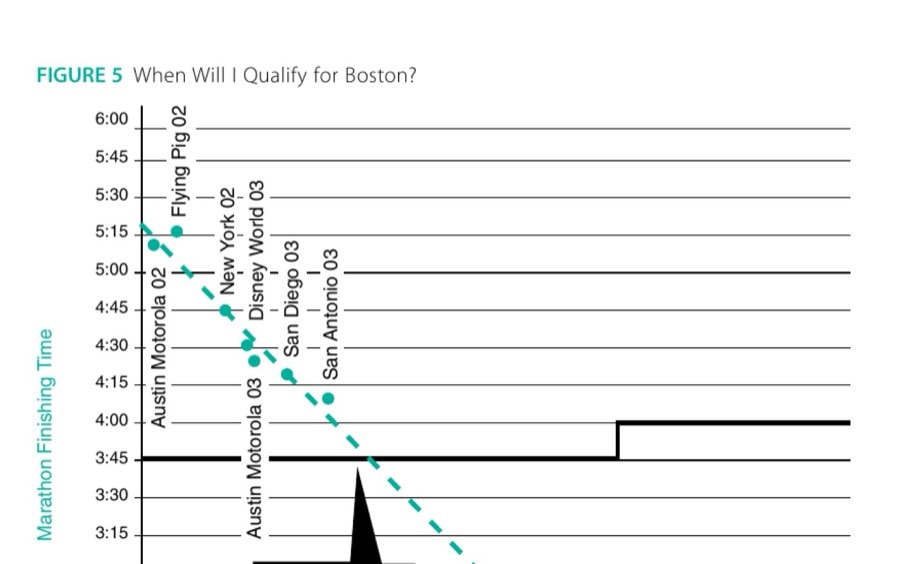
Figure 5 When Will I Qualify for Boston?
Qualifying time 55–59 age bracket
2:45 2:30
World record
2:15
Jan-09
Jan-08
Jan-07
Jan-06
Jan-05
Jan-04
Jan-03
Jan-02
2:00
Compare this with the Flying Pig, where I had almost the same total walk time (54.5 minutes, an average of 2:05 per mile), but my running pace was only 11:37. I walked almost exactly the same amount in both races. The difference was that in New York, I spread the walking out over the whole race, which allowed me to keep my heart rate under control. This, in turn, allowed me to run faster when I wasn’t walking, which cut a half hour off my finishing time. My best marathon in 2003 was San Antonio—I walked about 2:18 per mile and ran at a pace of 8:31, with a finishing time of 4:09. My next goal was to break four hours. Based on my experience in 2003, I decided that my best shot at a sub-four marathon would be to walk two
minutes per mile and hope to be able to run at a pace of 8:16. So this was my race plan for the Austin Motorola Marathon in February 2004. Unfortunately, the two-minute walk breaks didn’t give me enough rest, my running pace started to slow down in mile 16, and I hit “
The Wall” at mile 21. I finished in 4:08, which was a PR but not the sub-four I was aiming for. So my conclusion was that I needed to stick with two and a half minutes of walking per mile.
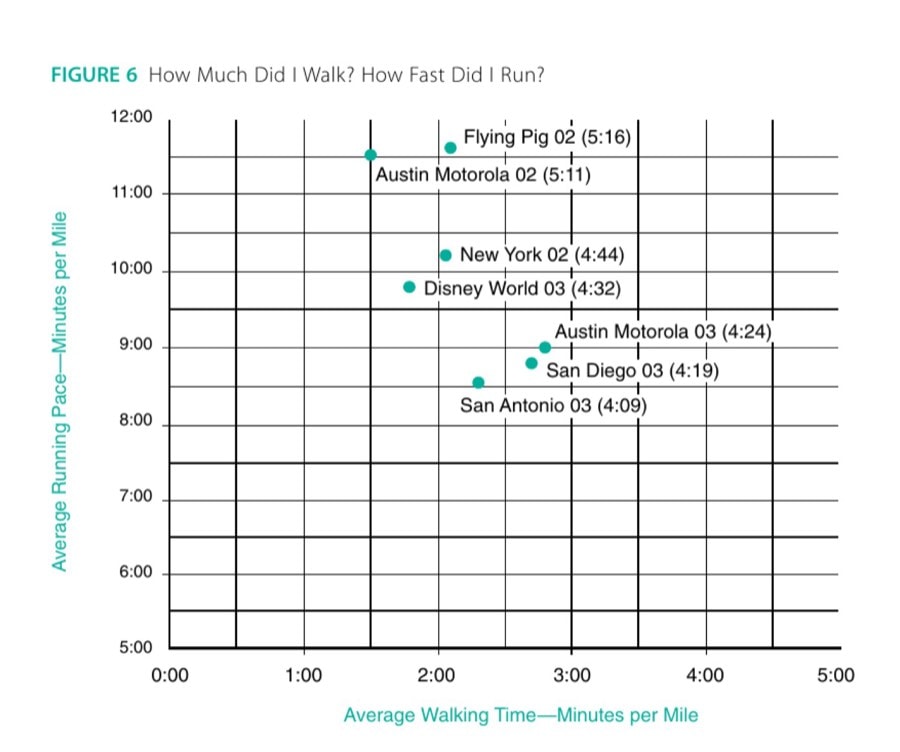
Figure 6 How Much Did I Walk? How Fast Did I Run? 12:00
Flying Pig 02 (5:16) Austin Motorola 02 (5:11)
Average Running Pace —Minutes per Mile
11:00
New York 02 (4:44)
10:00
Disney World 03 (4:32) Austin Motorola 03 (4:24)
9:00
San Diego 03 (4:19) San Antonio 03 (4:09)
8:00
7:00
6:00
5:00
0:00
1:00
2:00
3:00
4:00
5:00
Average Walking Time —Minutes per Mile
Fortunately, I got another training tip at Austin when I went to a running clinic by Jeff Galloway. He looked at my running form and told me that I had too much vertical lift for each forward stride. Essentially, I was wasting energy going up
that I could use instead for going forward. He told me that I could correct that by increasing my stride rate—the number of times my feet hit the ground during a minute. For those who know cycling, that would be like Lance Armstrong using
a higher cadence than had previously been typical for racers. Here was another decision point, so I needed to gather some more objective data. I bought a pedometer to count the number of steps and matched that up with
the times from my watch. The chart in figure 7 shows the data for a series of short training runs in early 2004. The horizontal axis shows the revolutions per minute, where one revolution is two steps, and the vertical axis shows the running pace.
The trend line shows a very clear correlation—shorter, quicker steps gave me a faster overall pace. So here was a way to increase my running pace! If that would allow me to maintain a running pace of 8:00, then I could stick with the 2:30 walk breaks and
still break the four-hour barrier. I put the walk breaks and stride pace together in my race plan for Olympia, Washington, in May 2004:
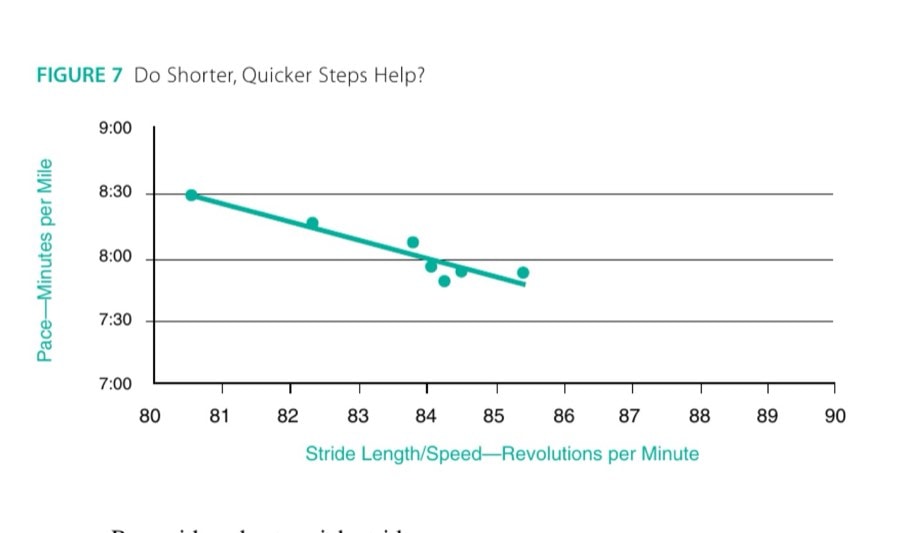
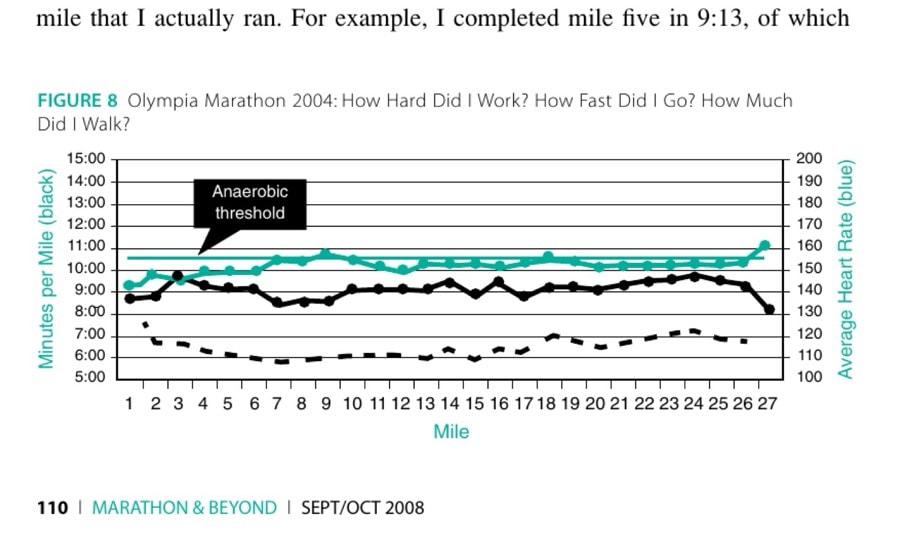
Figure 7 Do Shorter, Quicker Steps Help?
Pace—Minutes per Mile
9:00
8:30
8:00
7:30
7:00
80
81
82
83
84
85
86
87
88
89
90
Stride Length/Speed—Revolutions per Minute
• Run with a short, quick stride • Walk for a minute and a half at the start of each mile • Walk for a minute at the halfway point of each mile • Walk briskly when walking I was able to stick to the plan for the entire race and finished in 3:59. I had
broken the four-hour barrier! The chart in figure 8 shows my pace and heart rate during the Olympia Marathon. (The chart shows both lines on the same diagram. The labels on the left correspond to pace; the labels on the right correspond to heart rate.) Note
that my pace was relatively constant, and my heart rate was consistently below my anaerobic threshold. The dashed black line shows the amount of time in each mile that I actually ran. For example, I completed mile five in 9:13, of which
15:00 14:00 13:00 12:00 11:00 10:00 9:00 8:00 7:00 6:00 5:00
200 190 180 170 160 150 140 130 120 110 100
Anaerobic threshold
1 2 3 4 5 6 7 8 9 10 11 12 13 14 15 16 17 18 19 20 21 22 23 24 25 26 27
Mile
Average Heart Rate (blue)
Minutes per Mile (black)
Figure 8 Olympia Marathon 2004: How Hard Did I Work? How Fast Did I Go? How Much Did I Walk?
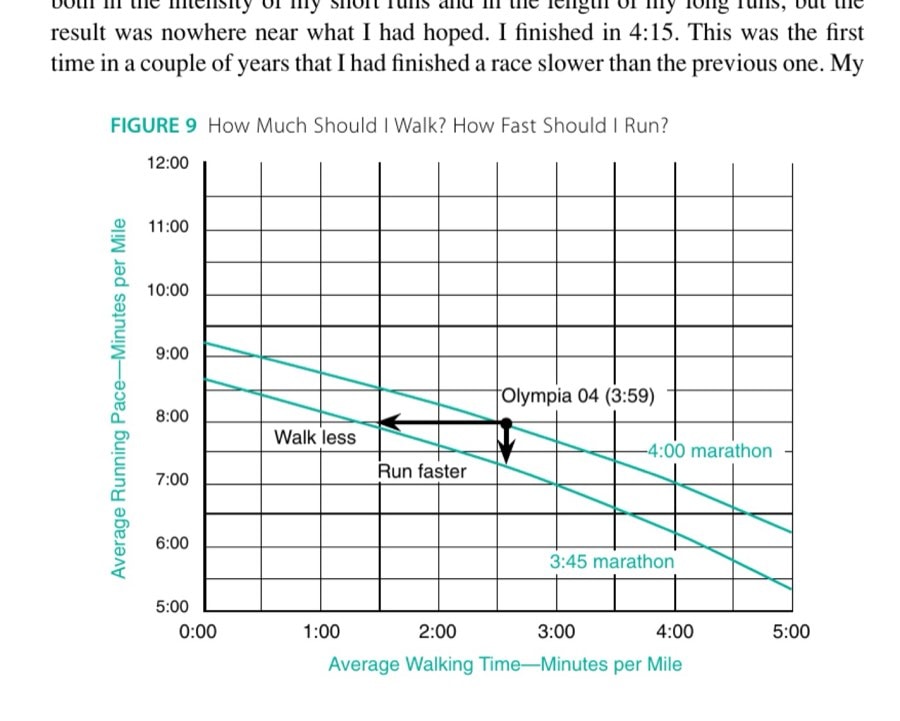
three minutes were spent in walk breaks. So I actually ran only 6 minutes, 13 seconds of mile five. Having finally broken the four-hour barrier, I figured I had a shot at breaking 3:45 (and therefore qualifying for Boston) in my next race, the Twin Cities Marathon in September 2004. And if I didn’t make it then, I was convinced that I would hit it during 2005, in time to run Boston in 2006. So the question was: how should I improve on the Olympia time? A walk/run chart can serve as a guide for questions like this. Note that there are many points on the chart that correspond to the same marathon finishing time. For example, in order to finish a marathon in 3:45, I could walk one minute per mile and run at an 8:08 pace, or I could walk two
minutes per mile and run at a 7:36 pace. The two curves on figure 9 show the combinations that correspond to a 3:45 marathon and a 4:00 marathon. Note that the point for the Olympia Marathon (finishing time 3:59) is just inside the 4:00 line. So in order to qualify for Boston by running a 3:45, I had to find a way to move from the 4:00 curve to the 3:45 curve. There were basically two ways to do that: I could keep the walk breaks the same and run faster, or I could run at the same speed and walk less. Of course, there’s a broad range in between, but those were the two basic ways.
I decided to try the run-faster strategy for the Twin Cities. I trained much harder, both in the intensity of my short runs and in the length of my long runs, but the result was nowhere near what I had hoped. I finished in 4:15. This was the first time in a couple of years that I had finished a race slower than the previous one. My Figure 9 How Much Should I Walk? How Fast Should I Run?
Average Running Pace —Minutes per Mile
12:00
11:00
10:00
9:00
Olympia 04 (3:59)
8:00
Walk less
4:00 marathon
Run faster
7:00
6:00
3:45 marathon
5:00
0:00
1:00
2:00
3:00
4:00
5:00
Average Walking Time—Minutes per Mile
analysis was that I had overtrained—in retrospect, my muscles had felt tired even before I started the race. So I resolved to fix that problem and try again. I would limit my long runs to two of about 20 miles each during the six weeks preceding the target marathon.
But in looking at a walk/run chart, I began to wonder whether I could ever run the running parts fast enough. Perhaps I needed to switch tactics and work on reducing the walk breaks rather than speeding up the running. So I decided to switch to the walk-less strategy, aiming for one-minute walk breaks while running at an 8:08 pace, about the same pace I had run in Olympia.
I picked the Chicago Marathon in October 2005 as my primary target for 3:45, hoping to warm up with a 3:55 at the Stockholm Marathon in June. Unfortunately, at Stockholm I hit “The Wall” on the bridge at kilometer 35, finishing in 4:13, which didn’t give me much confidence for Chicago. However, my training went well, so I decided to aim at least for 3:55 in Chicago. But I did even worse than Stockholm, finishing in 4:16.
It was time for some careful analysis. It had been almost 18 months since my sub-four at Olympia, and I hadn’t come close to duplicating that. The chart in figure 10 shows my five marathons in 2004–2005. The data still indicated that I ran my best races when I took walk breaks of at least two minutes, but I couldn’t seem to get the running speed up to the pace I needed to hit my target of 3:45. The key to figuring out the answer involved taking my anaerobic threshold into account. I had previously determined that my heart rate crosses into the anaerobic zone when I run at a pace of about 8:00, as shown by the flat black line on the chart. As shown by the black dot on the 3:45 line, running a 3:45 marathon with two-minute walk breaks would require me to run at a pace of 7:36, almost half a minute faster than my anaerobic threshold. Since my walk breaks would take up about 50 minutes of the 3:45 total marathon time, I would be running well into the anaerobic zone for almost three hours, which I couldn’t possibly maintain. My conclusion was that I needed to run more slowly and drop the walk breaks completely!
I sought some advice from Steve Sisson, a running coach in Austin, and he agreed with my conclusion. He put together a training plan aimed at running the Austin Freestyle Marathon in February 2006 with no walk breaks. We knew I had a psychological dependency on the walk breaks, and I had to go cold turkey if at all possible. My first real test was the 3M Half-Marathon in January, which I ran with no walk breaks at all and finished in 1:49, my fastest half-marathon ever! So we figured we were on track. This confirmed the second half of my lesson about walk breaks: walk breaks help only when my running pace is significantly slower than my anaerobic threshold.
My target for the Austin Marathon was 3:55 as a milestone on the way to a 3:45 at Grandma’s Marathon in June. However, the conditions in Austin on February
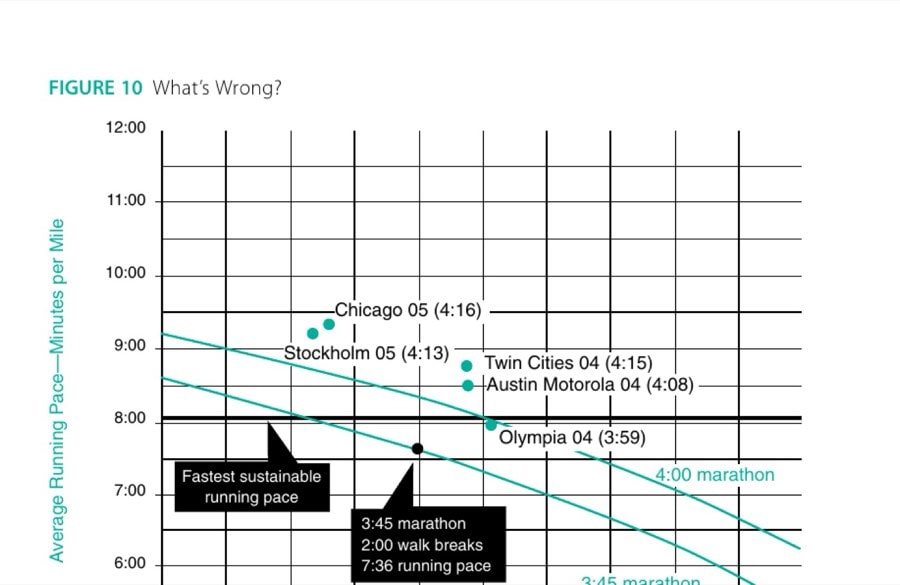
Figure 10 What’s Wrong? 12:00
Average Running Pace—Minutes per Mile
11:00
10:00
Chicago 05 (4:16) 9:00
Stockholm 05 (4:13)
Twin Cities 04 (4:15) Austin Motorola 04 (4:08)
8:00
7:00
Olympia 04 (3:59) 4:00 marathon
Fastest sustainable running pace 3:45 marathon 2:00 walk breaks 7:36 running pace
6:00
3:45 marathon
5:00
0:00
1:00
2:00
3:00
4:00
5:00
Average Walking Time—Minutes per Mile
19 were miserable—30 degrees and a slight drizzle for the entire race. I had never run a race when it was so cold, and I waffled about how to prepare, what clothes to wear, how to hydrate, and so on. Despite the conditions, I was able to keep on
a nine-minute pace for most of the race without any walk breaks, but around mile 22 the cold weather got to me. I started shivering, and my hands and feet started to get numb. I was able to walk to the finish and barely kept it under four and a
half hours, but it wasn’t the confidence builder I had hoped for. Nonetheless, Steve and I chalked it up to the lousy conditions and put a plan in place aiming for a 3:45 at Grandma’s Marathon in June. The training was
more intense, including not only tempo runs but also various kinds of interval workouts at paces much faster than my target pace of 8:35. As a training run, I ran the Vancouver Marathon in early May but treated it as a long run at an easy
pace rather than an all-out marathon. I finished the entire race without any walk breaks, and my final time was 4:04, my best in two years. So that was good for the confidence, but 20 minutes would be a lot to knock off at Grandma’s.
As luck would have it, the conditions at Grandma’s Marathon were as bad as Austin had been, just in the opposite direction. It was 65 degrees and humid at the start and almost 80 degrees at the finish. Nonetheless, I decided to start off
at the target 8:35 pace to see how well I could do. I kept to the 8:35 pace for the
first 10 miles, but the heat took its toll, and I was really exhausted by the halfway point. I had to give up on the 3:45 target and just hung in there to finish, with a final time of 4:36, my worst time in three and a half years!
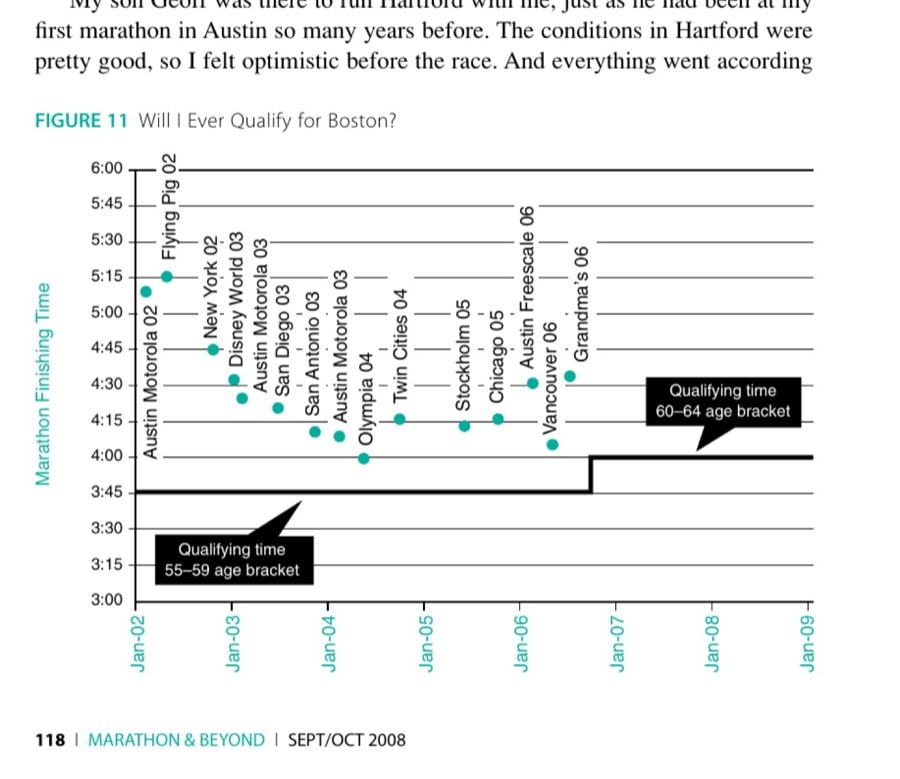
Taking another look at the target-times chart (figure 11), it was clear that nothing had worked for two years, and the odds of my ever running a 3:45 were pretty low. So I decided to switch from plan A (“get faster”) to plan B (“get older”),
aiming for a sub-four-hour marathon that would qualify me for Boston in 2008, when I would be 60. I also decided to take it a little easier on the training, figuring I needed a break after several pretty intense years.
I picked the Hartford Marathon in October as my first attempt under plan B. I put together a lighter training plan, with slightly shorter short runs, fewer hard workouts, and fewer extralong runs. I also took the time to do some careful
planning about hydration and nutrition. Through a bit of reading, analysis, and experimentation, and with some extra advice from Steve Sisson, I decided that I needed 6 ounces of water per mile and a pack of gel every two miles. Both
numbers were significantly higher than I had previously used. I tried them on a 10-mile run in Austin the week before the marathon, and I felt much better than usual, so I figured the hydration and nutrition plan would be a help.
My son Geoff was there to run Hartford with me, just as he had been at my first marathon in Austin so many years before. The conditions in Hartford were pretty good, so I felt optimistic before the race. And everything went according
4:30 4:15 4:00
Grandma’s 06
Austin Freescale 06 Vancouver 06
4:45
Chicago 05
5:00
Stockholm 05
5:15
Austin Motorola 02
Marathon Finishing Time
5:30
Twin Cities 04
5:45
San Antonio 03 Austin Motorola 03 Olympia 04
6:00
New York 02 Disney World 03 Austin Motorola 03 San Diego 03
Flying Pig 02
Figure 11 Will I Ever Qualify for Boston?
Qualifying time 60–64 age bracket
3:45 3:30 Qualifying time 55–59 age bracket
3:15
Jan-09
Jan-08
Jan-07
Jan-06
Jan-05
Jan-04
Jan-03
Jan-02
3:00
15:00 14:00 13:00 12:00 11:00 10:00 9:00 8:00 7:00 6:00 5:00
200 190 180 170 160 150 140 130 120 110 100
Anaerobic threshold
Average Heart Rate (blue)
Minutes per Mile (black)
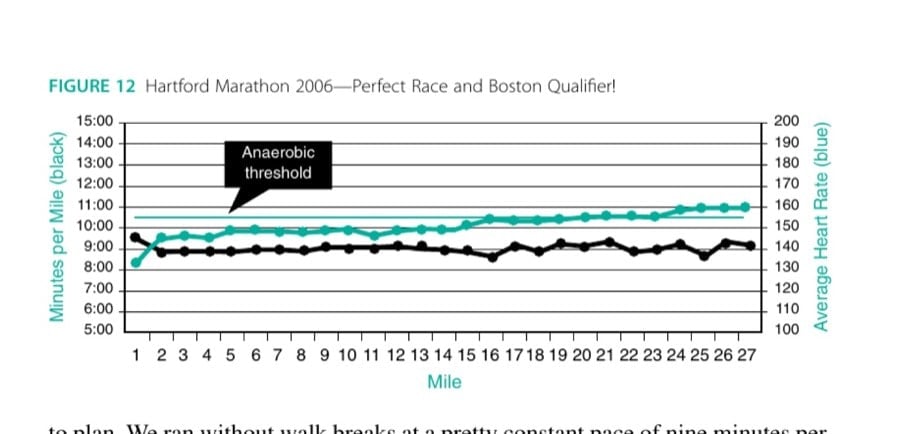
Figure 12 Hartford Marathon 2006—Perfect Race and Boston Qualifier!
1 2 3 4 5 6 7 8 9 10 11 12 13 14 15 16 17 18 19 20 21 22 23 24 25 26 27
Mile
to plan. We ran without walk breaks at a pretty constant pace of nine minutes per mile, finishing in 3:56:48, my best marathon ever and good enough for Boston in 2008! The pace chart in figure 12 shows a very smooth race. My pace was smooth
and steady until I hit the sections that were slightly hilly late in the race. My heart rate was well below my anaerobic threshold for over half the race and didn’t get significantly above the threshold until the last few miles, when I could sustain it
until the race was over. So I finally did qualify for Boston, and I did it by running, not walking. In retrospect, I wish I had stopped using walk breaks earlier. They worked fine for a while, up to the Olympia Marathon, where I first ran a sub-four. And since I
was on a roll, it didn’t seem right to switch strategies, so I was right to keep using them in the Twin Cities. But after that, when I was 15 minutes slower, I should have done the anaerobic threshold analysis, and I might have reached the
correct conclusion a year earlier. It might also have helped if I had listened to the conventional wisdom, which says that walk breaks lose their value sometime around four hours. But even if I had quit the walk breaks earlier, I don’t know
whether I ever would have run a 3:45 marathon. Perhaps I have the wrong genes. Or perhaps I would have had to do something else differently. I’ll never know. But after I finished the 2008 Boston Marathon, completing the quest I had
started six and a half years earlier, it really didn’t matter.
M&B Referral Program Did you know that we have a policy of adding an issue to your subscription when a friend subscribes to M&B because you turned him or her on to the magazine? Have your friend give us your name when he or she subscribes and we’ll tack on an extra issue to your current subscription. No limits on the number of referrals.
This article originally appeared in Marathon & Beyond, Vol. 12, No. 5 (2008).
← Browse the full M&B ArchiveMore like this
1,000+ stories from 19 years of Marathon & Beyond
The complete archive of the legendary long-distance journal — digitized and free to read.
