

From Cowsto Cow Pies
Safari Club International provided the incentive for a western adventure. My wife, Deb, applied for a grant of tuition to attend a week at its Wilderness Training Camp near Granite Peak in Wyoming, home of the setting for some of the scenes in A River Runs Through It. When her application was accepted and the date was set, I did the usual: I searched databases for a marathon in the area.
The plan was for Deb to fly out to Jackson Hole for the beginning of her class on Tuesday. I would drive out and pick her up at the end of class on the following Tuesday. I had to look up the location, but as luck would have it, there was a marathon in Ashton, Idaho. Ashton was just the other side of the hill from Granite Peak. Great price, too: $25. I persuaded Deb to run the half-marathon and sent in two entry blanks. Can you believe a marathon for $25?
Deb and I travel by campgrounds. We travel a lot and seldom stay at motels. So Deb flew into Jackson on Tuesday, and on Thursday I headed west, the Mazda Navajo packed with camping gear. I had to do a few things for work before leaving, but they went quickly when I started to think of going to the Rockies.
My first night was at Wyalusing State Park, on the banks of the Mississippi and Wisconsin rivers. A camp here would provide a couple of hours less to drive the next day and a couple of long walks to keep active.
My mom’s place was the first goal. She is in Yankton, South Dakota. Mom had a deck project that needed my help, and staying in Yankton would break up another long drive. An evening of excitement with Mom’s friends, playing cards, was followed by a 5K in the morning. This was my speed training for the week—Yankton’s Riverboat Days celebration.
SECURE AT THE FORT I drove across Nebraska on highways 12 and 20, the back roads, to Fort Robinson State Park. This one is a real sleeper: little known, it plays the unknown to the bigger Black Hills area just to the north. The campground here is nine bucks. The fort was a big part of the American West and preserves the old structures as lodging and museum.
Part of my problem with driving and camping on the way to races is the damage to my legs from a long drive; my current plan is to drive a little less each day to avoid problems, while getting a little more exercise. I awake on Sunday near the Wyoming border, with two full days to drive across the state. Very little traffic and a cool morning make for a pleasant drive to Casper. I circle back on the four lane; a gravel road goes to Riverton, and I’m determined to find it.
Now how can you resist a road named Poison Spider? Gravel! Washboard! Desolate! Wow! I remember a time in Colorado when I drove a road like this, parked at our campsite as the car sank—flat tire! The road sure brings back memories of flats in remote places. Of course, not to disappoint, I get about 40 miles from Casper and the road gets rougher. A short investigation reveals a very flat tire and not just on the bottom. I had one visitor when the tire was almost changed. Desolate! Good to know someone used this road.
After a stop in Riverton for new tires, I headed up the Wind River. Scenery here is great and the wind was terrific. No wonder it’s called the Wind River. At DuBois, I got a commercial campsite. It was a good one, a river ran through it, and my site was right on the riverbank.
Monday morning, plenty of time, my goal is just to make it to any camp around Jackson by evening. Daylight Donuts in DuBois was the first stop; had to wait for it to open at 6:00. With breakfast and coffee ready for the drive, I headed toward Moran Junction. This is one of the great drives in Wyoming—lots of wildlife. I had to slow for a few horses wandering down the middle of the road.
Since there was little traffic, I was going slower than the speed limit, stopping every so often to take pictures. The Tetons were hazy in the distance. The radio reported the haze came from the fires in Yellowstone. The east entrance was burning; a helicopter reported a thousand trees were down and across the road from Lake Junction to the east entrance of the park. The smoke was drifting south, obscuring the scenery. I pulled into Moose, where breakfast is offered outdoors, with a nice view. It’s overpriced, but I felt satisfied in stopping. The Tetons are magnificent, even with a shroud of smoke.
A RIDE FOR A BUCK In Jackson, I restocked the cooler, gassed up, and found a trail to hike. Cache Creek went out of town from a small parking area. I had lots of company for the first four miles as the trail climbed gently into the mountains along a creek bed. A biker told me about the trail up the mountain, Game Creek Trail, and back toward Snow King Resort at Jackson. She said I could ride the ski lift down the hill for a buck. That sounded interesting. This was my training for the marathon. The hike ended up being about five hours long. What would Lydiard think?
I camped along the Hoback River that night. It wasn’t a great camp—too close to the highway. But I was only a few miles from Granite Peak and Safari Interna98 l MARATHON & BEYOND l JAN/FEB 2005
Courtesy of Steve Wearne
tional, where I hooked up with Deb and where she was able to get me coffee and a cinnamon roll the next morning. My day was starting off on the right foot! We decided to stretch our legs a bit and hike to the top of the ski lift just so we could ride back down. It was a nice hike, all switchbacks to the top—a lot like a hike we had in Banff, Canada, a few years back. The ride down on the ski lift is like zooming in with a camera: Jackson gets bigger as you draw near. You get a bird’s-eye view of the town. The traffic comes down a road where cars do a traffic-light shuffle, two light changes to go a block. Off to the east one block is where the locals, those in the know, go around the downtown—very little traffic, quickly skirting the downtown congestion, actually making progress. Something to keep in mind. We get a few souvenirs of Jackson: Grand Teton bookmark for me, map of the Targhee Forest for Deb.
Shortly after noon we were driving through Wilson on our way to Idaho. Our plan was to meet a friend, Mike, who is a ranger at Yellowstone, do some hikes that he had told us about, and then run the marathon on Saturday.
Picking Driggs, Idaho, from the map, we planned on going east into the mountains, where we hoped to find a camp and hike into the mountains. It worked out great! We found the campground, then drove out of the camp and a quarter of a mile down the road, where we set up at a free site. The policy is that if you find a fire
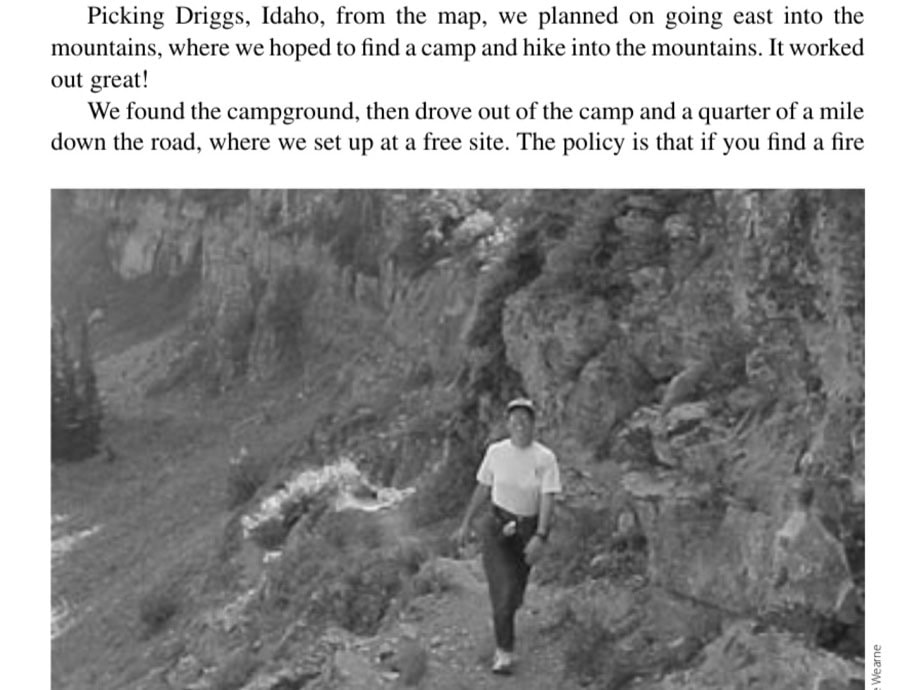
Deb climbing the Devil’s Stairs.
ring in this area, you can camp for free, even though it’s not a formal campground. After a short hike back to the camp to fill up with water, we were at the trailhead. Having no idea where to go we picked out an interesting name—Devil’s Stairs—on
the western side of the Alaska Basin. We followed another trail along a creek that gradually climbed the mountain until the trail divided; we took the trail to the right. Going up the side of the moun
tain like a stairway, we saw where it got its name. The view improved quickly. This was a great hike of about eight miles. The view from the top was spectacular. We got back to camp before dark; the camp was at 7,200 feet. It would be good conditioning, as the race begins at 6,200 feet.
ONWARD TO MEET MIKE
Courtesy of Steve Wearne
Wednesday morning was cool, with a beautiful clear sky. Our plan for the day was to drive into Yellowstone from the west, getting to Canyon Village by 4:00 or 5:00, where we would meet Mike, who was scheduled to work until 4:30. We drove north to Ashton, gassed up, and headed out of town on the scenic drive that the marathon would use on Saturday. It was, indeed, scenic. We scouted out some campsites along the way, then drove to West Yellowstone, restocked the cooler at a grocery store, and entered Yellowstone.
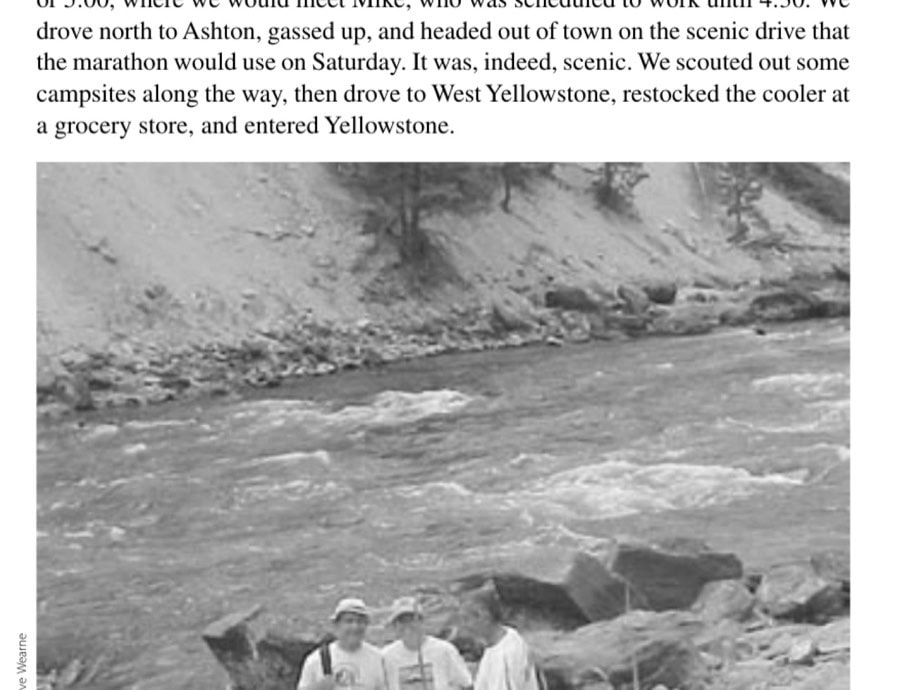
Turnaround at Yellowstone River on the Seven-Mile trail.
The west entrance was much as we had remembered it from a year before— burned! The fire of ’88 had done in many of the trees, but more were growing back. About 12 feet tall, they were beginning to once again get established. Mike had sent us his personal directions for driving the loop around Yellowstone. We toured the Firehole River, following his instructions. The drive was nice. With the trees burned off from annual fires, you can see a lot more of Yellowstone. We had a picnic and a short walk in the river, arriving at the canyon just before 5:00.
Thursday morning we packed up for one of the hikes Mike had chosen. He wanted to do a couple he had not done in his two years working at Yellowstone. The Seven Mile Hole was Thursday’s hike. As the name implies, it is a hike to the bottom of the Yellowstone Canyon, five miles each way. This was very scenic. You pass through some areas of geothermal activity—a stinky, gassy downhill! Hot springs pour from the earth. We had our noon picnic at the river, took pictures, and then headed back to the top. Strange how the return route can seem like a completely different area even though you just hiked it in the other direction. I sure didn’t remember so much reverse climbing to get into the canyon.
We stayed at the employee lodging again on Thursday night, getting ready for the next hike and discussing plans. The main goal was the Bechler region for Friday. This is the southwest corner of Yellowstone. It is considered the wet area of the park. Ashton was the first goal, as its gas was a dime per gallon cheaper than West Yellowstone and we needed to get our race packets for Saturday’s race. We stopped along the way at Pole Bridge campground to check it out. Pole Bridge was only two miles from the start of the marathon, so we set up our tents and continued on to Ashton.
In Ashton, we had no idea of what we were looking for, but a banner was in front of the community center. Inside was the packet pickup. We stood in line, as there was only one person working the expo. Fortunately, Deb was first in line, and I was last. The crowd was that big. We had our packets and a little more information and were out the door in five minutes.
Our plan to camp at Pole Bridge seemed increasingly good to us. First of all, the campsite was free. Second, we wouldn’t have to take a bus to the start. We could merely drive a few miles, and there we were.
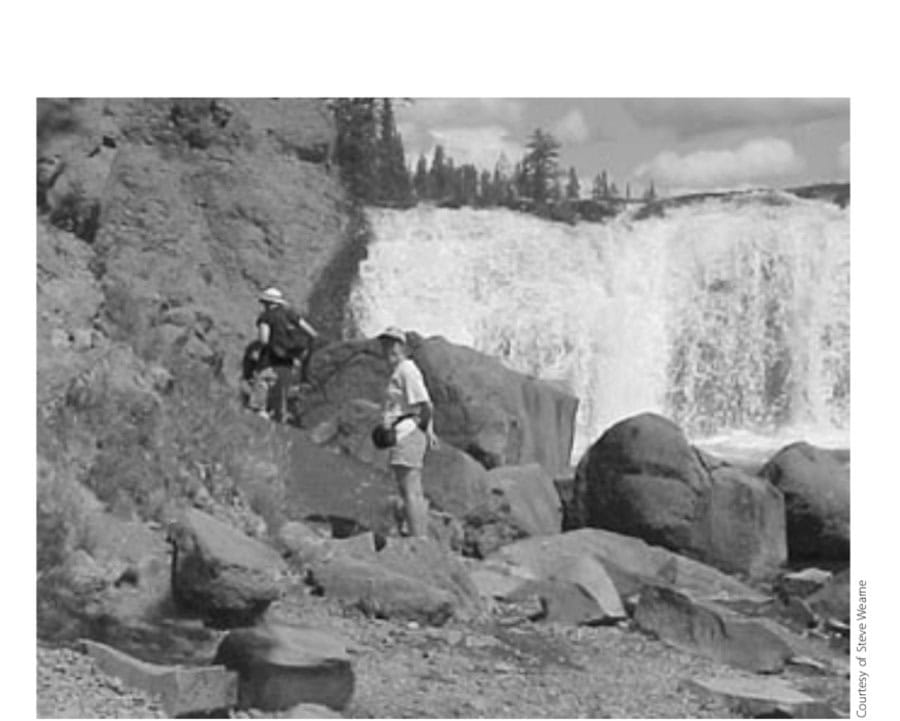
A FANTASTIC FALLS Bechler Meadows was at the end of a long gravel road through the Targhee Forest and into the southwest corner of Yellowstone. We left one vehicle at Bechler Ranger Station and drove over to Cave Falls to start our hike. Cave Falls was fantastic! We had our noon picnic, then went down to the falls and started a hike through the meadows. At a fork in the trail, we made the fateful decision to go across the river. End of carboload! It was already after 3:00. We misjudged our hiking speed and
Courtesy of Steve Wearne
Deb and Mike at Cave Falls.
misjudged the trail going out on a long loop trail. When the lightning started, we were still more than three miles from our car. The storm was quite severe, but we continued to make our way toward the ranger station while watching the swaying trees, ready to jump out of the way should one come down.
It was nearly 8:00 when we arrived back at the ranger station. That was real close to sunset. Just after we left the station on our way to get the other car, we encountered a tree across the road. Another car was stopped on the other side of the tree. We all discussed how we might move the tree, going so far as to consider exchanging cars so we could each proceed on our way. With some teamwork, a length of rope, and muscle from another carload of people who arrived, we managed to drag the tree out of the road. By then it was dark.
When we finally got to camp, it was 10:00 P.M.—a very, very dark night. I made a double rice dish. We had a few crackers and cheese for an appetizer (real gourmet dining), and hit the sack at 11:00. We figured we had done 10 miles of hiking that day, not exactly the classic marathon taper.
Bright and early the next morning, we were at the start. We parked the car and arrived before the buses. There were two buses full of runners and two port-apotties. Race director Dave apologized for the shortage of port-a-potties, delayed the race long enough for everyone to use the facilities, and gave last-minute in102 l MARATHON & BEYOND l JAN/FEB 2005
structions. Look out for cow pies. Be careful crossing cattle guards. A bear had been sighted along the trail; be careful. We’ll try to chase the cows off the course before you reach them. We looked at each other and smiled. Just like the New York City Marathon. Not.
A hundred yards after the start, we came to the first cattle guard. It forced us to slow to little more than a walk, but it went smoothly enough. I fell into line with four runners in front of me. My goal was to attempt to try to hold seven-minute miles and to not beat myself up so much that I would be useless in the New York City Marathon. The rain from the night before had really settled the dust. The 10 miles of gravel had a thin crust of damp dirt. Most of this part of the route was on washboard road, which made it a bit hard to run. It required a constant search for a smooth path, moving from side to side in an attempt to gain the best route possible. A few miles down the road, one of the runners left the rest of us behind, so I was suddenly following two women and one guy by about 100 yards, not gaining or losing too much. After mile five, a runner passed me. A little later, I passed one of the women, and at the pavement I still trailed four runners. In this part of the race, you could see the Teton Mountains in the distance. They were spectacular in the early-morning light.
FOGGED-IN SCENERY After 10 miles on gravel, the route changed to a good paved road, Mesa Falls Scenic Byway. My time at 10 miles was 71 minutes, right on pace. The start had been at 6,200 feet, and miles 10 to 16 were downhill. We passed the lower falls by going into a turnout for the scenic overlook. Fog filled the valley. It was nice to be diverted to the overlook, but someone should have chased the fog away, as there was no indication that a river was below.
At 13 miles, we passed the start for the half-marathon. Deb spotted me just before the trail plunged over the side of the road. She was a half hour from her start time and had just gotten off the bus from Ashton. I yelled at her about how nice it was to be on paved road—just before descending the ditch at the side of the road, which dropped to a railroad bed that followed the Warm River. Now this was scenic! We’ve had cows, cow pies, cattle guards, foggy falls, Grand Tetons in the distance, warm river flowing at our feet, forest all around, and all downhill. How could it get any better than this?
Well, it didn’t! Scenery was still great as we ran on the rail bed through a valley with the river on the left. We passed through a campground and crossed the river; then just before mile 17 we began the climb out of the river valley. This is where I did some walking. Nine-minute miles were now in order. Four uphill miles before we leveled off to rolling hills for the last six miles into town. I kind of knew this part was coming but had tried to block it from my mind.
One of the water stops on the climb out of the valley seemed to be a family event—the course and volunteers kept that small-town feel going. At the top of the hills, you run along flat plains that just stretch out as far as you can see. My pace slowed, and people passed me. I consoled myself that they were half-marathoners, but they weren’t!
If you’re from a small town, you know what I mean by a local atmosphere where everyone seems just a little more friendly than in large urban areas. People can’t hide behind steering wheels, blasting horns at you, thinking you will never know who they are. Locals know each other by the car they drive, and no hiding is allowed. The attitude carries over into everything they do.
We ran through town, down the main street, and the crowds—both of them—offered us encouragement and directions.
AH! THE FINISH, AT LAST! The finish line was on a road next to a park. It was a good setup, plenty of refreshments, a local artist, and food nearby. I thought the finish should be on the grass, in the shade, under a tree, but it was still a good finish and left the shade for me to lie around in. The showers were hidden a little, but the football coach told me where to go. Another small-town thing you notice: everyone knows where the showers are. Why would you have to give directions? Deb finished and we had a good time waiting for awards, getting free huckleberry shakes at the drugstore (What a great deal!) and visiting with other runners. Deb and I both won door prizes, as did about half the people at the awards ceremony. This race was a real bargain: T-shirts with a collar, low entry fee, good bennies! The finish medals were locally made from wood, and numbering them was a great idea, as each medal was then unique. By this time, I understood the early start: the day was getting warm, really warm. I wouldn’t want to be out there any later in the day.
After the awards, we recovered by driving back on the race route, picnicking at the halfway parking lot, hiking to the railroad trail, and going as far as a tunnel. More scenery! When we stopped at the Mesa Falls overlook, the fog was gone and we were able to see what a beautiful scene I had missed earlier.
On the drive to West Yellowstone, we put together a plan for the rest of the trip. Just as well camp in Montana as go back into Yellowstone—our passes were still good— then do some hikes and go out the northeast entrance.
Our Sunday route took us to Norris Basin, home of a slew of geysers, fumaroles, and hot springs. About two-thirds of the trail here is closed because of heat and increased thermal activity. The ground is overheated. A year earlier, we had been here with Mike, and I jokingly told him to start one of the geysers for me. A few seconds later, the Whirligig Geyser started up. I said thanks, somewhat in awe of his authority. Next stop was Grizzly Lake Trail.
My father left me a book by the Sierra Club detailing the hikes in Yellowstone, and I had remembered to bring it along. It described the Grizzly Lake Trail as a new find, in 1973, about two miles of trail, and you couldn’t see the lake until you descended into the valley, as it was hidden by tall trees. Well, the fire of ’88 changed all that. It was now a hike mostly in the open. The water was as clear as Lake Superior. We had a picnic and hiked back to the car, running into only two other hiking groups on the entire hike.
We went to Mammoth Hot Springs, which was crowded with tourists. I was looking for a trail up a mountain, while Deb was trying to avoid any form of climbing. After a short hike at Mammoth, we found an ice cream shop—not that it was lost—and in the hot wind, we had to eat fast before our cones melted.
I was determined to find that next hike, but Deb wouldn’t let me do Specimen Ridge. Instead, we hiked a shortcut up to the ridge; of course, since it was a shortcut, it was literally straight uphill. Specimen Ridge featured some petrified logs along the way; Deb wanted to turn around at that point. “Hah,” I say. Heading to the top of the hill where the wind was blowing so hard we felt we could spread our arms and soar, we found the view was great, but we would need feathers to fly. Downhill was even more of a challenge.
MORE SCENERY, AND STILL MORE After camping in the northeast corner of Yellowstone, we were on the road early Monday. The scenery was great going into Cooke City, Montana. The Chief Joseph Highway is one of the most scenic you could find anywhere, rivaling the Beartooth, which goes north. We had driven the Beartooth the year before. Now we traveled slowly down the mountain valleys going toward Dead Indian Pass, site of a part of the shameful way Indians were treated in the past. The mammoth motor homes were more common in this area, competing with horse trailers; we avoided getting behind them whenever possible and made Cody before noon.
We shopped Sierra Trading Post’s outlet store. Then we refilled at a gas station, at Daylight Donuts, and at a grocery store. With no real destination—what a great feeling—we headed for the Big Horn Mountains, one of our favorite places.
On the way to Greybull, we picked a route into the mountain, deciding on Ten Sleep. First we went to the town and then to the campsite. The town provided a nice site for a picnic and a break from driving. In the mountains, the road changed to gravel. Improved gravel. Five miles of that and we were at the campsite and trailhead. We packed a light lunch and water and took trail 65 toward Mirror Lake.
The lake was in the bottom of a valley where it was well protected from wind, giving it that flat, mirrored look. Two tents occupied sites across the lake from each other. The lake served as the turnaround point on what turned out to be a beautiful hike, going through mountain meadows and woods at a little over 9,000
Courtesy of Steve Wearne
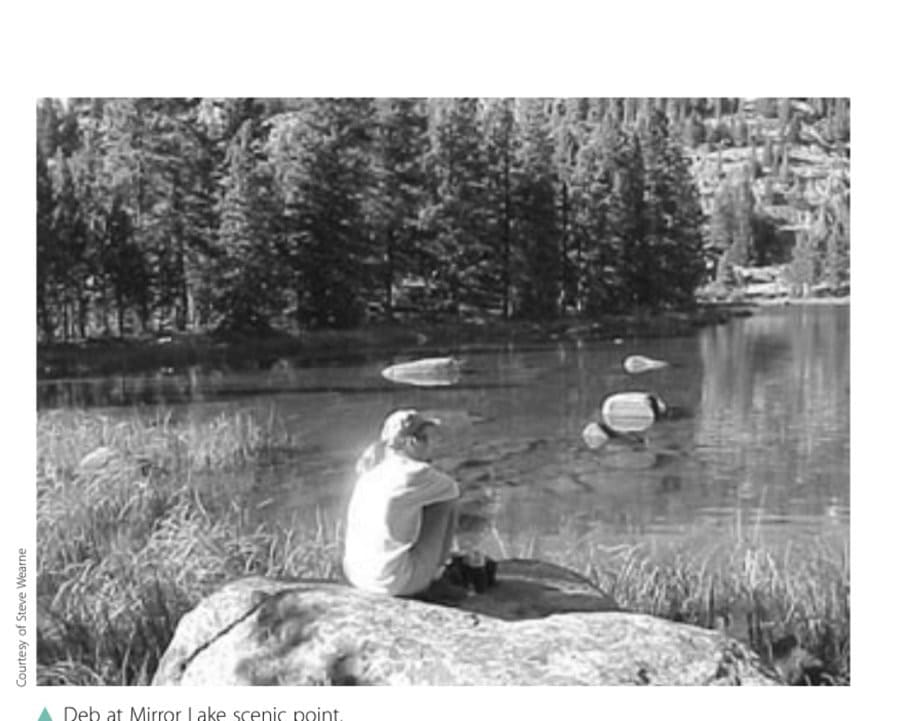
Deb at Mirror Lake scenic point.
feet. We drove down the mountain about a mile from the campground and found a fire ring a hundred feet off the side of the road where we set up camp for the night. We had picked the camp because we spotted deer grazing in the meadow
next to it; as we set up camp, the deer didn’t seem to mind our joining them. Tuesday was another clear day with cool temperatures when we started. Of course, they usually are at 9,000 feet. Highway 16 winds through the mountains;
we were headed for the Black Hills. Crazy Woman Road goes down out of the Big Horns to the valley near Buffalo. Down is an understatement. The Navajo was in low gear, four-wheel drive, and still required some braking.
There are campsites along the road, but they are too close to the road. The valley walls rise steeply on both sides and the valley features a small stream flowing through it. This shortcut took us an extra half hour of driving for 15 miles of
road, but it was well worth it. Next stop, Black Hills. Spearfish Canyon is something of a must see. We drove to the second picnic area and set up next to the stream where there were no picnic tables but where the shade and water made up for it. We waded into the water,
which was icy cold. We decided to spend the night in Sheridan Lake Campground even though there was a charge to do so; we wanted to do the Needles and Pigtail highways, and the campground was close to the starting point. Also, we could swim at Sylvan Lake.
WHAT? MORE SCENERY? Sylvan Lake is at the trailhead for Harney Peak, highest point between the Rockies and the Appalachians. The Needles Highway is very scenic but can be quite slow going at times, as a lot of people on it are driving while scenery watching and there aren’t a lot of places to pull off.
The Pigtail Highway was designed to give the driver a view of Mount Rushmore while going through tunnels. Each tunnel lines up with the faces, so you gradually get a close look at them as if they were a picture framed by rock. This is one of the top 10 scenic drives not located in Wyoming.
By the time the end of the trip was in sight, we began to feel a bit let down, not wanting it to end. That was our mood as we left Rapid City after noon and drove home to Rio, Wisconsin, arriving about 1:00 A.M.
Of course, to top off our adventure, we were entered in the 5K race at Sauk City. It’s called the Cow Chip Classic. It has become an annual event for us since we met there 16 years ago. This went together thematically with the race the week before where we were forced to dodge cow pies on the marathon road. Now we got to throw them as part of the fun after the 5K race! We decided to forgo the cow-pie tossing and merely run the race. We both took first in our age group. What a swell way to finish off a marathon adventure and sightseeing extravaganza.
This article originally appeared in Marathon & Beyond, Vol. 9, No. 1 (2005).
← Browse the full M&B ArchiveMore like this
1,000+ stories from 19 years of Marathon & Beyond
The complete archive of the legendary long-distance journal — digitized and free to read.
