

Fuel For The Finish Line
RABBIT LAKE, ALASKA, 1993
I awoke at sunrise in a cozy sleeping bag in the Alaskan wilderness. It was 10 degrees above zero, and I was 65 miles and 24 hours into a 100-mile snowshoe race on Alaska’s Iditarod Trail. It was February, the dead of winter, and I was hungry.
This was a problem. I had only enough powdered Unipro Endura Optimizer to fill my CamelBak with a 1,200-calorie liquid meal. This is the liquid food that I used for years as my racing fuel. It provides carbs, protein, and everything else needed to sustain a person without the hassle of chewing. One CamelBak full of this special potion would, I hoped, be enough to get me 35 miles down the trail to the finish line. But after stopping to sleep for six hours in a tent at the second of only two checkpoints along the racecourse, I needed some breakfast, something I could sink my teeth into.
The checkpoint volunteers could not help me; the Iditasport race rules prohibit them from providing any supplies during the race except water, hot chocolate, and Tang. A lightbulb going on in my head, I headed for the back of the checkpoint tent, where the trash was kept. Surely some of the 50 mountain bikers, skiers, and snowshoers who had gone through this checkpoint during the night had left something to eat!
Breakfast that beautiful, crisp, cold Alaskan morning was my fellow competitors’ throwaways: three bites of a PB&J sandwich, half a brownie, about a dozen yogurt-covered raisins, and half an energy bar covered in pocket fuzz.
Renewed by other people’s unwanted calories, I hit the trail and finished the race in good form. Lesson #1: Scrounge if you have to, but always eat what you need when your life depends on it. There’s usually something edible to be found, whether in the back row of a 24-hour minimart, your friend’s kitchen, or the nearest dumpster.
BERKELEY, CALIFORNIA, 1992 On all fours, I crawled up the half-dozen steps from my garage into my house. Vision darkened to gray black, and with a loud ringing in my head, I groped for the doorknob into my kitchen. Next, I found myself opening the refrigerator door and grasping the bottle of liquid food I had left there five hours before. Grabbing a banana and some tortilla chips, I started pounding down the calories. A flood of sustenance coursing through my veins, my vision returned and the ringing disappeared. I had gotten into this state of hypoglycemic shock and total glycogen debt for a good reason. I had put myself there intentionally.
For years, this was a weekly ritual: 85 miles on my road bike through the San Francisco East Bay hills on just two bottles of water and a PowerBar. Nothing more allowed. Why? To train my body to live on less, to dig deep and really explore every possible internal fuel source.
It works. In many a race, I’ve been able to compete and cover hundreds of miles on foot or bike while consuming only 200 calories an hour or fewer. Some would say it’s physiologically impossible, but my body knows differently.
Lesson #2: You can learn to live on less in competition if you’ve done it in training. Internal metabolic efficiency is trainable and attainable. (Just don’t do it all the time, or you’ll break yourself down or even hurt yourself.)
DEATH VALLEY, CALIFORNIA, 1990 My support crew pulled up next to me as I climbed out of Death Valley on my road bike and asked if I needed anything. Their jaws dropped as I handed them my empty CamelBak, fully drained of 1,200 calories of liquid food in 75 minutes. “I’ll take another refill,” I said.
We had started the race just three hours before in Badwater, the lowest point in the Western Hemisphere at 282 feet below sea level. Our finish line would be 135 miles and three mountain passes away on Mount Whitney, the highest point in the Lower 48. The event was the Mount Whitney Summit Classic. It was September.
Early in the race, a half-dozen racers had broken away and built a five-minute gap on the rest of us in the pack. Watching them pull away, I decided to bridge up to them and join in the action. As soon as I got there, though, the breakaway splintered and I was left holding the bag, so to speak. I was off the front alone with 100 racers chasing me and 100 miles to go.
There was only one thing to do—hammer—and that had a price: calories, and lots of them. Without a support crew to refill my CamelBak, not to mention a case of Endura Optimizer in the truck, I couldn’t have done it. Ten hours after the start, I crossed the finish line in first place. But it wasn’t the course record I had set that amazed me, it was the 10,000 calories of liquid carbs and protein that I had managed to consume in 10 hours.
Lesson #3: High-intensity, high-performance output requires high-caloric intake. Pound the fuel if you want to pound the pavement. Of course, you can do this only if you have unlimited access to food. (And yes, you can definitely eat too much!)
PENTICTON, BRITISH COLUMBIA, CANADA, 1991 As I sat staring at the back of a green plastic door, my bowels let loose in a torrent of what is euphemistically known as Hershey squirts. As I sat there in a porta-potty doing my necessary business, fellow racers ran by, enjoying the beautiful views of the Okanagan Valley in Ironman Canada, eight hours into the race.
There were still over 20 miles to run, and I was having the runs for the fourth time in six miles. Things had been going so well: a good swim, fast transitions, five hours to cover the 112-mile bike course, and now the marathon run was all I had left.
Unfortunately, the run part of the race also meant switching from my favorite liquid food in my CamelBak to consuming whatever the race organizers had to offer at the 26 checkpoints along the run course. That meant Gatorade and fruit, both full of sugar and citric acid. They weren’t going down, or should I say through, too well.
There was only one thing to do: switch to water and chocolate chip cookies, the only other fare they were offering. I switched to a well-hydrated cookie diet, my bowels got back to normal, and my pace picked up. I shaved 40 minutes off my run split from the year before and broke 11 hours, my goal for my second Ironman. And the view was much better on the racecourse than inside those green plastic toilets!
Lesson #4: Eat what works. If you’re getting sick, switch to water and something simple and palatable while you get your body back under control.
BOSTON, MASSACHUSETTS, 1996 Sitting on cardboard in a huge muddy tent filled with a few thousand runners, I was enjoying a sushi breakfast with a half-dozen Japanese runners. It was an hour before the start of the 100th-anniversary Boston Marathon. It was an excellent breakfast in the company of fellow athletes whom I had just met, and it beat the hell out of the doughnuts and coffee that everybody else was eating. Caffeine and a sugar bomb do not a breakfast make. But sushi, well, that’s a meal! This meal was unplanned, but it was a godsend. And it helped set the mood, and energy stores, for the day.
Although I hadn’t brought breakfast, I had brought some food for the race, having learned the hard way not to depend on what race organizers provide. In the company of 40,000 official runners and probably 20,000 bandits, I had a lot of fun that day. It started with the great breakfast and continued with a beautiful, crowd-lined route. I also carried a tiny butt pack with a camera, PowerBar, and two packets of GU, a quick-energy gel. That food, along with the water provided along the way, was all I needed to have a smooth race with no energy problems. Lesson #5: Be your own chef. Eat a decent breakfast and bring your own food for the race or workout so that you won’t be at anyone’s mercy.
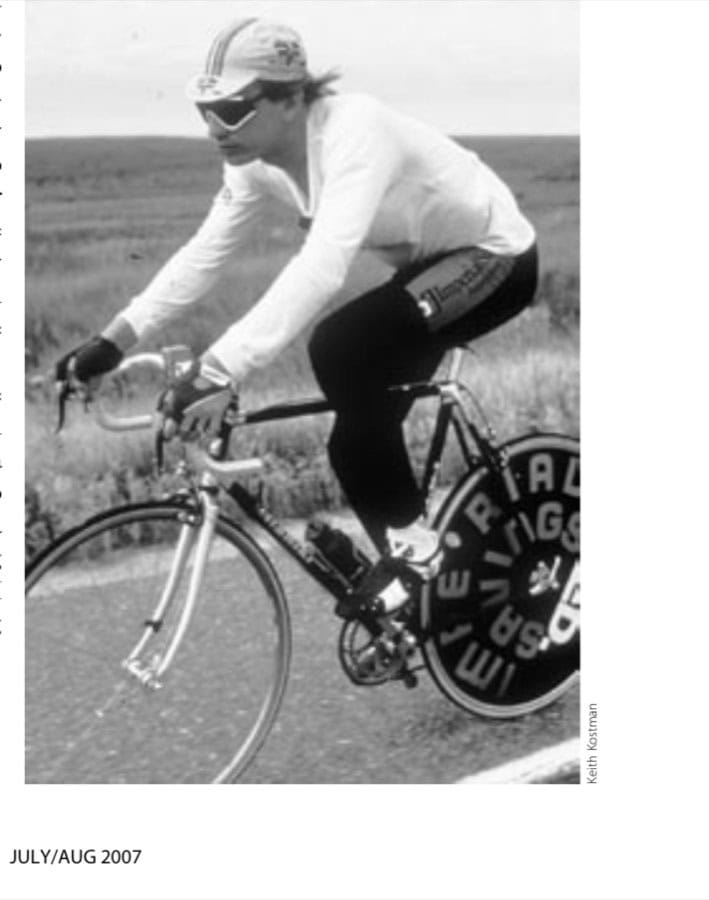
SOMEWHERE IN MISSOURI, 1987
▲
Chris Kostman: Race Across America 1987.
Keith Kostman
“We hear you’ve been riding great. Do you want anything special?” my crew asked over a loudspeaker mounted on the roof of my support van. “Well, since you asked, I’d like a vanilla shake from McDonald’s!” I replied.
It was day six of the Race Across America, and I was rolling through muggy Missouri, expecting to reach the Mississippi River by midnight. My crew was rotating every four to six hours from the motor home to the spy car to the pace van. I interacted only with those in the pace van behind me, who took care of all my needs.
Not knowing that the previous crew rotation had already given me a milk shake, each new trio was happy to give me a special treat. I was taking advantage of them and I knew it, but everything seemed OK.
It wasn’t. Shortly after dark, I started falling asleep and I began experiencing my only hallucinations during the nonstop 3,127-mile bicycle race. When you’ve been on a sugar buzz all day, there is only one place to go: down. And down I went, hard. After five great nights that had gone surprisingly well, considering that I was sleeping only three hours a night, I fell apart.
I didn’t reach the Mississippi until 10:00 A.M. the next day. I had lost 10 hours to hallucinations, extra sleep breaks, and an eastward pace that could only be called barely rolling. It was entirely my fault, and it would take me the remaining 1,000 miles of riding hard, and most important of eating properly, to make up what I had lost.
Lesson #6: Don’t be a self-indulgent idiot. Eat right. Avoid sugar. Wait until the finish line for the party!
EAGLESONG LODGE, ALASKA, 1995 It was midnight, and I had just limped off the Iditarod Trail into the living room of this remote lodge. It was serving as a special, bonus checkpoint halfway through the 100-mile snowshoe race in which I was competing for the second time. What made it special was that it was a building rather than a tent and that it was also a business; you could pay to eat a meal or even sleep indoors for the night. Regular Iditasport checkpoints are just tents in the woods that offer nothing but water and a smile.
I had been racing for almost 14 hours, and I was fried. My tight legs had slowed my pace over the last six hours, making me really feel the minus-20-degree temperature and also putting me into caloric debt. I had taken hours longer than planned between checkpoints, and thus between refueling stops, so I really needed to put something substantial in my stomach.
The trail beckoned, but that warm lodge and its friendly proprietors got the best of me. The next thing I knew, I was slurping down a big bowl of moose chili. The only problem was that I’m a vegetarian. I hadn’t eaten meat in five years, so while the hot, heavy food really felt good, I was hoping it wouldn’t make me sick.
And as the effects of this wonderful, warm, lovely meal spread throughout my frozen limbs and warmed me to the core, I tried not to think of the big, brave, Alaskan moose that had to die to make it possible. Rejuvenated and refueled, I finished the race in good form. In fact, that moose stew had such staying power that I only had to regularly sip my Endura Optimizer during the remaining 50 miles to the finish line in Skwentna.
Lesson #7: Do what you have to do to eat right. If the fuel’s not in your stomach, it’s not going to power your muscles or your brain.
LE FONTANIL, FRANCE, 1993 For 48 hours, I had eaten nothing but my usual chocolate-flavored racing fuel, Endura Optimizer. And who can call that eating, anyway, when the food is liquid and drunk from a bottle? It was fueling me fine, but I was sick of it.
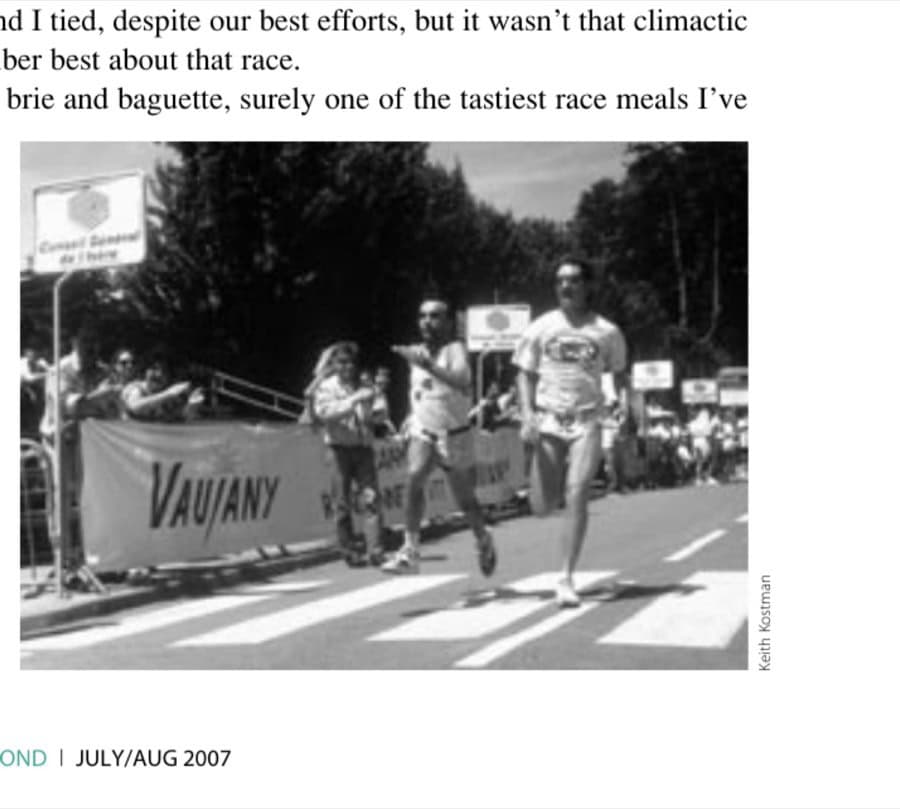
Behind me was 7.2 miles of swimming and 336 miles of cycling, and now I was 55 miles into the 78.6-mile triple-marathon run. They don’t call it the World Challenge of Endurance for nothing. At this point, my pace was slow. I just wanted to finish in one piece and have a good time. I was running in the company of my support crew and a variety of the locals who had taken me under their wing as I raced around and through their little village over and over. I was the only American racer who spoke French as well as the only racer with fingernails painted five different colors. I think they found me entertaining.
At one point, one of my French crewmembers, Damien, rode up next to me on a mountain bike with a brie-covered baguette in his hand. He intended it as his snack. I ate it. And from that point on, I had not one more sip of my high-octane racing brew; I was a brie-and-baguette man through and through. And it didn’t hurt a thing. So close to the finish, with my casual pace producing a low heart rate, and especially with no prize money on the line, I could afford to indulge. And I loved it. I f
inished the race in a sprint for 17th place with German triathlete Gunther Teichmann in the middle of a human funnel with a few thousand spectators going wild. Gunther and I tied, despite our best efforts, but it wasn’t that climactic ending that I remember best about that race.
It was Damien’s brie and baguette, surely one of the tastiest race meals I’ve ever had. Lesson #8: Have fun. Live a little! The heart of the endurance athlete is in the stomach, after all.
Keith Kostman
▲
1993 Triple Ironman: Chris Kostman, right, sprints for 17th place against German entrant Guenter Teichmann. They tied.
This article originally appeared in Marathon & Beyond, Vol. 11, No. 4 (2007).
← Browse the full M&B ArchiveMore like this
1,000+ stories from 19 years of Marathon & Beyond
The complete archive of the legendary long-distance journal — digitized and free to read.
