

Fun And Folly In the Yukon
“W
e have seen bear tracks on the trail, but if you do come across one, make some noise and take some pictures.” Nervous laughter spreads across the prerace audience. The following midday I stand on the start line. I have come to Whitehorse, nestled on the banks of the Yukon River near where the White Horse Rapids were during the days of the Klondike Gold Rush in 1896, the same year the modern Olympics were first held. The river was called the White Horse because the fierce rapids looked like the flowing mane of a galloping horse. The city of Whitehorse is the capital of the Yukon Territories in northwest Canada and is surrounded by true wilderness.
I am here to enter this toughest of races, the Yukon Arctic Ultra, 100-plus miles of self-sufficiency in Arctic conditions. The race finishes at Braeburn, a stopoff point on the famous Yukon Quest dog-sled trail race, which course we will be following. Colin Searle
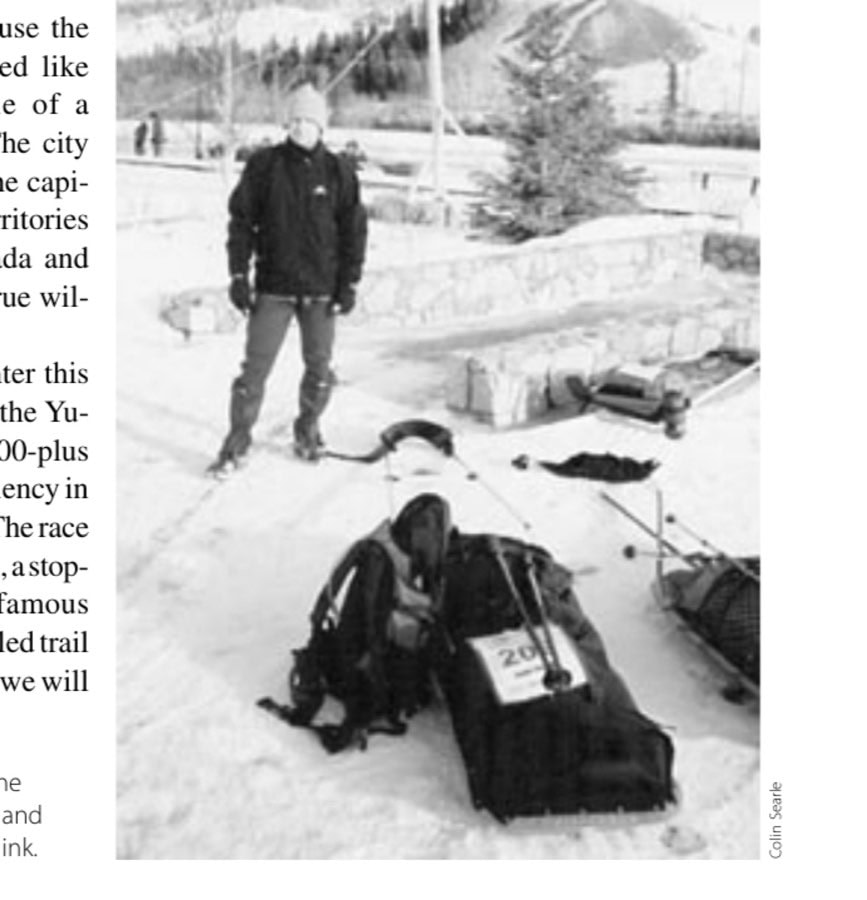
The calm before the storm. I am prepared and ready to go, or so I think.
The race organizer has picked the month of February, which is slam bang in the middle of the harshest period out here, when temperatures can drop to minus-50 degrees Fahrenheit! Around my waist, I have strapped a harness, which is connected to a sled with poles. The sled has been packed and repacked about 50 times. It contains everything I need for this race—or so I think. The temperature is very mild: only 25 degrees Fahrenheit, which means I have to be very careful when racing, especially regarding sweat. In fact, not monitoring their sweat is to prove disastrous for a number of experienced racers when the temperatures later plummet, leaving their bodies struggling with hypothermia.
The race has only two checkpoints. The first is at 20 miles, and the other at about 60 miles. I cruise through the first 20 miles, which is entirely on a frozen river. The waves of the rapid current have frozen into bizarre shapes, and cracks in the surface lead down into darkness, giving me the creeps.
Bagpipe Paul has been walking behind me for quite some time, but gradually I lose him and move through the stark countryside alone. I have had the feeling for about two hours that dusk is upon us, but the light remains. A steep slippery slope leads up to the checkpoint.
A PIT STOP WORTH TAKING I grab some stew and hot chocolate before laying out my sleeping system, a minus-40-degree-rated sleeping bag inside a bivy sack (a waterproof outer shell). I then light my stove. Both these items are checked to race organizer Robert’s satisfaction, a relief to me, as he can pull you out of the race if he feels your equipment is not up to scratch.
There is a mandatory four-hour wait here before commencing, which is quite tough, as it is too early in the race to sleep. I have reached this point in six hours. I am competing against 17 people, with another 20 athletes going in the slightly crazy 300-mile race. The organizers also offer a marathon-length leg in case you want to get just a taste of the cold.
I have learned of this event from a great Web site called Eventrate.com, which focuses on endurance racing all over the globe and holds forums that offer a wealth of information on all aspects of these races. The previous year, I had competed in the Jordan Desert Cup, my only other ultrarace: 105 miles across the baking sand. From having survived that, it seemed obvious that my next challenge should be the complete opposite.
Training for both these races has consisted of loading up my rucksack and heading off onto trails around the countryside. Eventually I can travel on foot for eight hours, splitting each hour up into a 40-minute run followed by a 20-minute walk. My aim is to be used to being on my feet for long periods of time. Toward
the end of my preparation for this race, I would tie a bungee cord around my waist and connect it to a door handle. I would then step onto a treadmill set on maximum climb, in turn pulling the cord tight. Thirty- to 60-minute sessions of power walking strengthened my calves and lower back. My kids found it hilarious, but I feel this is quite a fair imitation of sled pulling as far as my muscles are concerned. My experience of the extreme cold is nil, so it is all new to me.
I am due to leave at 9:43 P.M., but as Paul is leaving only 10 minutes later, I decide to wait. With head torches on, I lead the way back onto the river; after 10 miles of following reflectors on sticks, we find a sign that directs us off the Yukon onto a wooded trail. Immediately we start to climb, which is to become a recurring theme. We haven’t been climbing long when Paul asks me how I feel. I get the feeling he is struggling.
We are soon overtaken by Martin, a strong guy I had met in the Jordan Desert, and I am asked what my plans are. When I state that I will try to hit the next checkpoint without stopping, Paul explains that he won’t be able to make it, but he is fine about my going on, as I expected.
I head on up the trail alone, my head torch picking up snowmobile tracks and footprints. I have been traveling for hours when suddenly I notice very large deep tracks in the snow. I keep looking at them, trying to convince myself that they are nothing; but they look very much like bear tracks, especially as there are large clawlike marks at the front.
A CHANGE IN SLEEP PLANS I feel nervous, though I have no choice but to keep moving along the trail. At 5:00 A.M., I come in contact with Martin again. “Are you still aiming for the checkpoint at Dog Grave Lake before sleeping?” he asks. When I confirm that I am, he advises me that I may find getting some kip there difficult, as it is a tented area and can get rather noisy. He thinks I might find it easier to sleep just off the trail. I never fancied this idea before, but now I think this is a possibility.
As Martin storms off at his usual quick pace, I make a snap decision to follow his advice. As soon as this has been decided, the wind comes out of my sail, and at 5:45 I am laying out my sleeping kit. I prize my feet out of my trainers, which are inside waterproof overshoes, and climb into my bag, pulling the zip closed over my head, my own little cocoon.
I shut my eyes and am amused by the twisted hallucinations that I view, something I am used to from my previous race, before falling quickly to sleep. One and a half hours later I awake, shivering. When I look outside, an early-morning light surrounds me. I try to put on my trainers, but they are frozen into my overshoes. After wrestling with them for a couple of minutes, I manage to free them and then have a real struggle trying to squeeze my swollen feet into rigid shoes. My
fingers hurt; I shiver some more. I stomp around in the snow trying to warm up, all the time my skin feels tight from the cold. I pack my sled and am on my way again, pleased to be moving. I suck on the hose connected to my hydration system, and the mouthpiece is frozen. I stick it in my mouth for a while and am soon back in action. The trail starts to lead down; suddenly I realize I am heading toward the dreaded overflow I have heard and read about. It is a condition where a river, lake, or swamp is not totally frozen and water is able to “overflow” onto the ice. We have been warned that it is a dangerous situation. Obviously, getting wet out here is not an option.
The snow trail just stops at dark, frozen water. I am confused. I can’t see a way through. The bushes and trees are thick around here; many lie tangled in the swamp. I cross a narrow piece of ice but find myself following a tangled circle before arriving back at the same point. I look across a wide area of cracked ice and realize I need to cross but am scared of breaking through the surface.
I retrace my steps back up the trail and see that the tracks of a previous racer lead through some undergrowth. I follow, getting scratched by branches, but to my relief this newly broken pathway skirts around the swamp to rejoin the trail without crossing water.
And so the grind continues. I climb up steep hills, dragging my faithful little friend behind me, then back down into valleys. I curse myself for putting my body through this again. I talk to my body regularly, full-on conversations, pleading with it to get me to the finish. I will be very appreciative.
MAKING DEALS WITH MYSELF I converse with my inner self to give me the willpower. I swear regularly. I speak aloud to my girlfriend, explaining to her how unimaginably hard this is. I promise myself this will definitely be the last race of this type ever!
It’s the lack of checkpoints in this race that makes it so hard: you spend large amounts of time on your own, with no breaks to look forward to. The scenery is probably spectacular—mountain ranges, snow, trees, blue skies—but to me it seems a harsh, barren place in my current state of mind.
Apart from tracks, there has been no sign of life. I haul the sled up, up, and up—there seems no downs. I am in pain and very tired, but I clamber on. The hours ever so slowly ease by. This is a simple life: eat, drink, put one foot in front of the other, don’t cry, keep moving. There are no choices; there is only one way, and that is forward.
Somewhere along the line, I have seen a sign stating 10 miles to the checkpoint. I have calculated what time I should be reaching it, but it is taking longer. Sod Robert and his mileage calculations. It is bugging someone else, who has
written in the snow: “What the f— is going on?” This makes me smile, but I can’t believe that somebody has the spare energy to mess about like this. I pass more frustrated statements. Just keep moving, I tell myself; I have no choice.
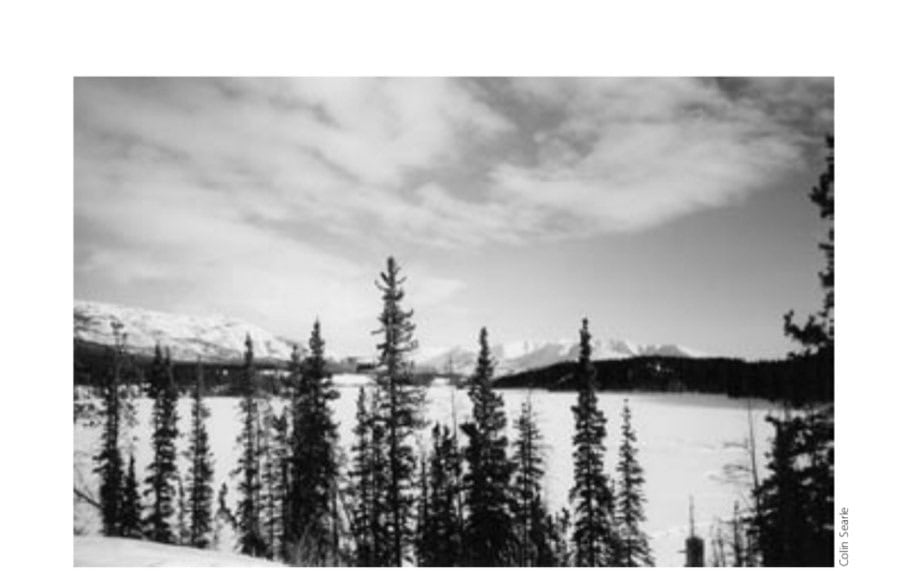
At last, after yet another hard incline, I spy a tent; it is 2:30 P.M. I walk over to the checkpoint, park my sled, and look across at the fantastic view. I have continually spied a huge frozen lake through the trees, and now the camp sits above the tree line overlooking Dog Grave Lake, with large mountains filling the horizon.
I help myself to lots of stew, bread, and some hot chocolate, noticing that the hot water has lots of sticks bubbling around in the pot—lake water, I guess. It is then time to look at my feet, so I retire to the warm tent. I find that both my small toes are very swollen, full of liquid, and sporting blisters. I put small slits in them. I fill my water containers with hot water and get all my gear together.
As I am checking my sled, I overhear some of the race marshals discussing tonight’s weather forecast—apparently there is going to be a big drop in temperature. A feeling of dread settles over me. I really do feel quite scared and even think of staying behind to wait for a couple of racers to travel with, even though they won’t be leaving for hours. I dismiss this immediately, as I have come to this event first to test myself with sleep deprivation and second to travel through the night on my own.
Colin Searle
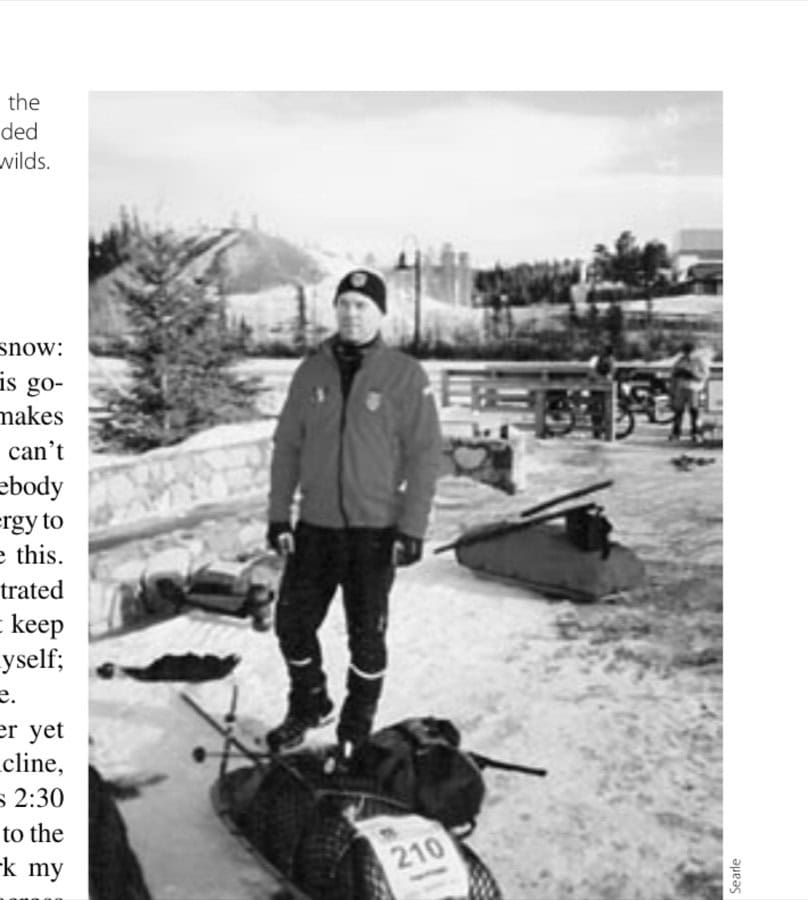
A racer with all the paraphrenalia needed for a jaunt in the wilds.
I leave at 4:00 P.M. with trepidation and the good wishes of the race helpers. I have found the Canadian people very caring and open.
MAKING UP SOME DISTANCE The trail heads up, of course, and so it is more of the same. The stop has refreshed my legs, so surprisingly I feel a lot better. I move swiftly, hoping to cover as much ground as possible while I still have light. There is a bright blue sky, and so the light remains until 6:30, of which I am appreciative.
As darkness falls, I put on my head torch containing a new battery, which I have installed at the previous stop. As I switch it on, I am disappointed with the weak beam. I know I have another battery in my backpack, but it is starting to get very cold and I know I will have problems changing over in the dark. I decide to travel in the dark, turning on the light now and again to check that I am still on the trail.
Soon my water tube freezes solid, so now I have no liquid. Problems are beginning to mount. This is where things start to get weird. Sleep deprivation kicks in. I am stumbling along in the dark, just about making out the snow-covered trail as it winds its way through the trees. The sky is a deep black pierced by the brightness of a thousand stars. The sled occasionally makes a low growling noise when sliding over icy ground. “I’m being followed,” I mutter to myself.
It’s so cold now that frost is all over me. This is dangerous. I have it planned, though. When I stop, I will immediately light my stove and boil some water. I will have a hot drink, then pour the hot water over my rigid overshoes so I can unbuckle them and free my trainers. I will then repeat this procedure when I awake. At 9:30, I decide to stop for one hour. Progress is slow. I need liquid, and I can change my battery over gaslight.
I whip the stove out quickly as I stop, but I can’t build up any pressure. I have taken my hands out of their heavy-duty mittens and am exposing them in only thin gloves. I am rushing. I get snow in the lighter, I find my matches, they light, and on a couple of occasions the stove ignites, but I can’t keep up the pressure. I am desperately aware of the clock ticking as far as frostbite is concerned and have to abandon all plans and jump into my sleeping bag with my clothes and shoes on. I hope I haven’t done any damage to my fingers. I am aware that things are getting desperate but am so tired that I immediately fall asleep. I am awakened once or twice by Ski-Doos shooting just past my head, as I am lying right next to the trail.
Suddenly I awake shivering. The time is about 11:00 P.M. I have had about one hour’s sleep. I am so cold. It is very dark.
ad page
I jump out of my damp sleeping bag, chuck everything onto my sled, buckle up, and head off, moving quickly. I am amazed at how one hour’s sleep can allow you to continue racing. The next thing I know, I am up high on an exposed area. To my left, the terrain drops away rapidly to a valley. There is no wind, thank god.
MY KINGDOM FOR SOME BATTERIES I desperately need light, and my head is freezing. I take out one of my hands to assess the cold. I figure I might have a minute or so with no wind and so decide to slip on my balaclava and change my batteries. No problem with the headgear, but as I can’t see what I’m doing with the batteries, it is all done by feel.
I should have bought another headlamp or torch, but I was feeling guilty about the amount of money I was spending on this race. I manage to change over batteries, but to my horror as I turn on the torch, there is a glimmer of light that just fades away! I don’t believe it. I had used Duracell the previous night with no problem, but these supposedly highly rated equivalents have badly let me down.
If my brain had been working instead of being in a stupor, I could have put the Duracells back in, but this revelation wasn’t going to permeate my soup-thick thoughts until a few hours later. So I return to turning on the weak beam very rarely to occasionally catch a reflector to at least confirm I am still on the trail.
I have been heading downhill for a while when I suddenly anchor up. I realize my feet are just about to head into darkness. I switch on the pitiful beam. Oh no! Frozen water. I look across the river, but the beam goes nowhere. I don’t know what way I am meant to go. I skirt round the edge, but there is no sign of an alternative route, and to be honest, I can’t really see anything. “Shit! I’ve got to cross,” I mutter to myself.
I start to walk out onto the ice, tapping with my sticks as I go. Mostly the ice feels solid, but then I come across some that feels soft. I am now out in the middle. I backtrack a bit, then head in another direction. The ice groans, I groan, my sled drags noisily behind me. I feel like I am going to fall through at any moment. I just head straight for the opposite bank, waiting morbidly for the ice to give.
And then I am up onto solid ground, snow underfoot, heart racing. This was now feeling really dangerous. I had been foolish. What if it had gone wrong? I had just left my outcome to fate. This was not right.
I head back up into woodland, and I notice that there is a light green rainbow shape forming in the sky. It rises from a silhouetted mountain range to the left, curving up into the pitch-black sky before falling down to the right-hand side of the horizon. “Aurora borealis,” I hear myself muttering. If there was one thing I desperately wanted to see out here, it was the northern lights. I feel privileged,
but the show hasn’t started yet. As I travel through the night, the uniform shape in the sky gradually breaks up. I see huge spires of emerald light shoot up as high as my field of vision before twisting and turning around each other in some strange ethereal dance. Clouds of light break away from each other before slowly merging again, and so the display continues.
MORE BAD ICE TO CROSS This all adds to the weirdness of the occasion. I come across another frozen river. By now I have remembered I still have energy left on last night’s batteries, so I flick on the torch and can see the ice clearly. The water beneath looks muddy. There are dark shapes down there—branches poking up.
This time I unclip my sled so that if the ice gives I won’t be dragged down. Again the out-of-control feeling, standing out in the middle, 20 yards from safety, hoping that everything holds, including my nerve. I can hear a voice inside me screaming. I ignore it and rush for the bank.
I intend to keep going until the finish, but at 2:30 A.M. I am shot to pieces again. This time I take all the equipment from the sled and lie down in it with my sleeping kit. I zip the bivy sack up around my head when suddenly the silence is pierced by the unmistakable howl of a wolf, very close by, within a hundred yards. I listen, and after a minute or so I hear someone approaching, then moving past; it’s another racer passing. Then I’m once again in silence.
An hour later, I awake shivering. I’m up quickly. Go, go, go. I have overtaken a few people tonight. I see them sleeping by the trail, and now I overtake a racer who has stopped to make a hot drink—the guy who passed me earlier as I tried to sleep? Maybe. I say hello and go past and never see him again.
I am starting to hear things regularly now. There are people in the woods around me, mostly men with one woman. They are shouting and messing about. I know this is just my imagination and tell myself off for being silly. There is hardly going to be anyone else out here apart from racers, as the temperature is now down to minus 30.
My head seems to be covered in ice. My eyelashes keep sticking open as they freeze to my hat, and ice is forming in the corner of my eyes! My fingers hurt now despite the heavy-duty mittens I am using with liner gloves. It is going to be a major nuisance, but in the end I decide to get two chemical hand warmers out, only to find they are frozen.
It takes a half hour for them to start working enough to raise the temperature in the mittens by a couple of degrees, which proves to be crucial, as I end up with mild frostbite, leaving a numbness in my right thumb. Eventually the incredible dreamlike night is over.
Colin Searle
Dog Grave Lake, as viewed from camp.
The lightness floods over the landscape, bringing a pure white sky. “A winter wonderland,” I contemplate, as the snow falls around me. I wind my way through the wooded trail. I notice pinkness in the snow after urinating. I am so dehydrated that blood is beginning to show itself—hardly surprising, as I haven’t been able to drink for over 12 hours.
WHERE’S THE LAKE? I run now, attempting to finish the race. Somewhere in the night, I calculated I would finish about 10:30; but despite my being nowhere near the time, I swear at Robert again. Where is the bloody lake? I know that I need to cross Braeburn Lake near the finish, but every time I come to a bend, I peer round only to see the trail disappearing into the distance. I run to the next bend, peer around; same outcome. This is driving me insane. Finally I head down a steep slope onto a large frozen lake.
After a few minutes, I realize the visibility is becoming poor. I look to my right and see that all the features are fading fast as whiteout descends upon me. I rush on, desperate to finish before this dangerous condition envelops me. I was warned that once across the lake, some evil climbs and descents await me, and I am not disappointed. But soon I am back on the flat and know that I must be close to the finish.
An English racer, Andrew, stands talking to someone ahead of me. He congratulates me, so I ask where the finish is. “It’s here,” he replies. I look to my left and see the Yukon Arctic banner. I walk over to a wooden building, park my sled, and wander into a warm room where people sell hot food and drinks. There are some other racers sitting around talking. My time is recorded: 10:29 A.M. Sorry, Robert; your calculations aren’t so bad. A strange but typical end to this type of race. It has taken me 46 and a half hours to complete, and my brain is swimming with experiences.
In the bar later that night, someone comments: “There seemed to be some very large prints out on the trail, but I wasn’t sure whether I was hallucinating.” I agree, saying they looked like bear tracks but covering myself by mentioning hallucinations. There’s some nodding of heads, but we’re all aware of sounding too dramatic. After all, what do we know?
FOOTNOTE I really learned a lot from this race. It wasn’t just about fitness and mental strength. In these conditions things are very much more difficult than normal. Just getting something out of your rucksack turns into a major test. “Self-admin,” as I heard it called, is of utmost importance. By “self-admin,” I mean the act of looking after yourself. It really is your main concern. I got a lot of things wrong and have learned my lessons: don’t cut corners, as it could cost you your fingers—or worse.
Bagpipe Paul came up with an interesting theory afterward. It is as if there is a hidden strength in all of us that is called upon only in survival situations. In everyday life, our body and mind moan at us, and generally we give in and rest; so when you start something like this event, we are all in this mode. Then, after many hours of complaining, it is as if the survival instinct comes to the fore, weighs up the situation, and then gives you the tools to get yourself out of there. I had to agree with him, as I have been thinking along similar lines for a while. I am certain it is in all of us but, of course, rarely used. Maybe this is why these sorts of experiences can be addictive. You are tapping into a deeper side of yourself that is just not used in our safe, controlled life. It is nice having the comforts of modern life, but we could be suppressing an important side of our makeup. For more information about the Yukon Arctic Ultra, visit www.arcticultra.de/
This article originally appeared in Marathon & Beyond, Vol. 9, No. 1 (2005).
← Browse the full M&B ArchiveMore like this
1,000+ stories from 19 years of Marathon & Beyond
The complete archive of the legendary long-distance journal — digitized and free to read.
