

Give Itthat Good Old Collegetry
Part I of this classroom-to-course story appeared in our last issue.
PART 2 OF 2
The month of February continued with the odyssey of training and learning more about sports physiology. At the beginning of the second month of class, Mick began a long session on the makeup and structure of the human muscle. Particular attention was given to the gastrocnemius muscle in the upper leg. This section jogged my memory of high school and college lectures from biology and life-sciences classes. Here are some of the more interesting things that Mick told us.
MUSCLE ADAPTATIONS During training, certain adaptations occur in our muscles and other areas of the body. These adaptations include 1. training muscle types to be more aerobic; 2. an increased amount of myoglobin (a muscle protein that stores oxygen);
3. an increased number of capillaries in the muscles to promote a greater supply of oxygen and other necessary elements; 4. more mitochondria, the power generators of cell function, in the muscle cells;
5. an increased ability of the muscle cells to store glycogen, the fuel that drives our body functions and activities; 6. an increased ability to oxidize lipids (fats), which are an excellent source of fuel but take longer to be broken down into usable energy; training gives
an athlete the ability to burn more fat than sedentary people can; 7. the fact that training also increases muscle fiber size.
ENERGY SYSTEMS The three energy systems or energy pathways are (1) the immediate, which supports activity that lasts for short durations of one to 30 seconds, as in a 100-meter dash; (2) the glycolytic, which supports activity lasting for 30 seconds to three minutes, as in a 400-meter race; and (3) the aerobic or oxidative, which supports activities lasting more than three minutes, such as a marathon.
With the immediate system, the supply of fast-burn energy is expended within a few seconds, but little strain is placed on the muscles, in that the recovery is quick. With the glycolytic system, the fast burn of energy causes rapid buildup of acid in the muscles (that burning feeling near the end of a 400-meter race).
With the oxidative system, the production of glycogen and the expenditure of energy are kept at equilibrium, enabling the body to engage in physical activity over long periods of time. All three of the energy pathways would be used in the course of a race longer than a sprint, and the body can switch from one system to another as needed.
MUSCLE CONTRACTION The second and third energy systems take time to kick in. As the first energy system peters out, chemical signals trigger the initiation of the second system, and so forth. In this discussion, we learned about the chemical process that drives muscle contraction. We learned about adenosine triphosphate (ATP), the chemical formula that makes fuel for the muscles possible. During this discussion, we learned an interesting term: MPG—maximizing and preserving glycogen. We also learned a good definition: fatigue is defined as the inability to maintain desired muscle contraction. Muscle fatigue in a 100-meter dash is not felt, but in a 400-meter run, fatigue is felt as a sudden occurrence as acid buildup happens rapidly. This is because in the glycolytic energy system, energy output is fast and inefficient and produces a lot of waste product. A marathon runner experiences fatigue as a gradual buildup. The primary cause of fatigue with the oxidative system is glycogen depletion. Once glycogen is depleted, it cannot be repleted until the body stops activity and rests. When marathoners run out of glycogen, they bonk (read that as hitting The Wall)! Another useful thing I learned in these discussions on muscle structure and muscle contraction is the real cause of muscle soreness. I had been told and had read in numerous articles that muscle soreness is caused by the buildup of lactic acid. This, we were told, is a myth. Lactic acid actually can be converted back into ATP energy fuel and is not found in the muscles in large amounts after physical activity. The real cause of muscle soreness (or DOMS—delayed onset of muscle soreness) is microtears of the muscle fiber. It
is essential to have rest after a hard workout or a race because the body needs time to repair the microtears.
RUNNING PSYCHOLOGY This section was taught by Doctor Alan L. Smith, who teaches sports psychology at Purdue and is himself a marathoner. A lot of what he presented was already familiar to me from my own study of psychology and reading in the psychology of training and racing.7 Doctor Smith told us that there are four key areas in the psychology of training and racing. They are (1) becoming self-aware, (2) developing key mental skills, (3) incorporating these mental skills into our training and competition, and (4) designing physical workouts to foster mental skills and mental toughness. Doctor Smith talked a lot about the use of positive imagery in training and racing to help our performance. While we are training, we need to train our minds to perform as much as we need to train the physical body.
SPORTS NUTRITION For the marathoner, nutrition equals taking in large amounts of glycogen, meaning carbohydrates; we joked that the marathoner’s diet could be referred to as the “anti-Atkins Diet.” There are two main areas of interest when it comes to nutrition: the precompetition phase and the postcompetition phase. Mick emphasized that during the time before your target race, you need to give careful attention to food intake for months leading up to the race, not just during the final week and days. If an athlete keeps the carbohydrate level high during the long training regimen, the results of that training will improve.
We talked about the glycemic index of a food type. This is the ability of a food type to raise a person’s blood sugar level compared with a standard—-the standard being the activity in the body caused by white bread. High-glycemic foods are good for a quick rise in glycogen, will produce an immediate burst of energy, and are burned quickly. Low-glycemic foods produce a rise in glycogen at a slower rate but are not burned up as quickly. This means that before a race, the marathoner should select foods that have a low-glycemic level so that the glycogen fuel is not burned (that is, synthesized) too fast. During the race, highglycemic nutrition sources are okay.
We also talked about the potential benefits of the traditional technique of carbohydrate loading. It used to be that marathoners would practice a regimen of purging the body of most of its stores of carbohydrates about a week before the target marathon with a carbohydrate fast and a long run. The purging was followed about three days before the race with a gorging of carbohydrates. This regimen is scientifically proven to produce a rise in carbohydrate levels, causing the body to supercompensate. We agreed that this kind of regimen is too
strenuous for the average athlete and presents a big possibility of getting injured or fatigued at a time when we want to be fresh before our race. Mick told us that for us, carboloading meant a renewed focus on a high-carbohydrate diet and a taper of our training. Another part of this unit was a discussion about how much we should take in during the race. This is a question that is answered by the dynamics of the individual runner, the pace used while running the race, and the racing conditions. This discussion on nutrition was concluded with an explanation of the fact that a high-carbohydrate diet after the race is helpful in the recovery process.
At the end of February, the class began a fund-raising project to go along with our marathon training. At the beginning of the semester, Mick showed us an article by Rick Reilly from Sports Illustrated about a high school cross-country runner
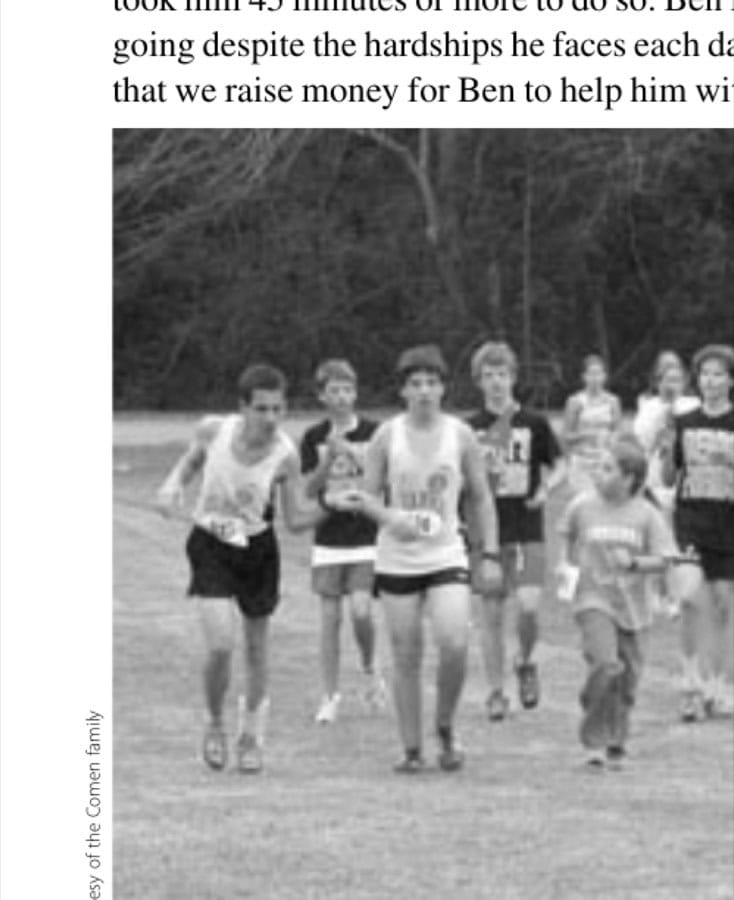
named Ben Comen,8 a boy from Anderson, South Carolina, who was born with cerebral palsy. Despite this challenge, Ben wanted to run cross-country with his twin brother, Alex. Despite the difficulty of forcing his uncooperative muscles to run, Ben still
finished the local 5K cross-country courses with grit and determination, even if it took him 45 minutes or more to do so. Ben is a remarkable young man who keeps going despite the hardships he faces each day. This story inspired Mick to suggest
that we raise money for Ben to help him with his plans to become a doctor.9 Mick also suggested that our class “battle cry” be “B.C.!” in honor of Ben and his determination. So, whenever we were tired and discouraged,
we would shout “B.C.!” If Ben can keep going, so can we! Our fund-raising efforts garnered over $5,000 for the Ben Comen Scholarship Fund. It was a good feeling to not only be in training and be learning new things
in sports physiology but to Ben (left) in the finishing stretch of one of his high school cross-country races.
Courtesy of the Comen family
THE CLASS FUND-RAISER
also help someone realize his dream. It was also great that the Comen family came to Louisville to cheer us on at our race.
THE THIRD MONTH The rhythm of the class was broken in the third month by spring break. During March, however, Mick continued providing us information concerning sports physiology and training.
Hydration In this unit, we were told that dehydration is the runner’s most common problem during a race. Since thirst is a poor indicator of our body’s hydration needs, runners often involuntarily cause their own dehydration by not replacing fluids soon enough and at a rate sufficient to compensate for fluid loss. When we are dehydrated, less blood flows through our system, which means a diminished coolant effect in the body. All of these factors combine to cause a reduction in the quality of athletic performance.
Advice was given for how we can stay hydrated during a race. We were given information on the American College of Sports Medicine’s position on hydration. 1. Hydrate well, at least 24 hours before athletic activity (clear to pale urine
is the sign that you are hydrated). 2. Tank up from five hours to two hours before the start of the race. 3. Drink early and at regular intervals during the race. 4. Drink at a rate sufficient to replace fluid loss through sweat or the maxi
mum that can be tolerated. 5. Fluid should be cooler than ambient temperature. 6. It is helpful if the fluid is palatably flavored. 7. Carbohydrates and electrolytes should be included in events lasting over
one or two hours. At the end of this unit, Mick also discussed the phenomenon of hyponatremia or water intoxication. This is a condition of low blood sodium caused by perspiration during prolonged athletic activity and replacing fluids without any sodium (that is, no sports drinks). The condition of low blood sodium causes poor nerve signaling. Symptoms include cramps, dizziness, seizures, confusion, and nausea. Even a slight reduction of blood sodium can cause mild symptoms. Severe effects can cause cardiac trauma, leading to death. [For more on hyponatremia, see the January/February 2003 issue of M&B.] Despite the potential for sodium depletion, dehydration is still the greater risk to distance runners. We were advised to
replace the loss of sodium by drinking the sports drink offered in the race and to “drink heavily but don’t gorge.”
Overtraining Syndrome This is a subject that Mick has spent a lot of time researching. Overtraining syndrome (OTS) is not the same thing as an overuse injury; rather it is a prolonged condition of depression and fatigue. It is a chronic, debilitating fatigue that by definition is associated with performance incompetence, tiredness, and extreme fatigue. A common nickname for OTS is staleness. There are 80 clinical symptoms of OTS, which include a feeling of heavy legs, depression, negative mood changes, lethargy, and increased incidences of infection (such as a wound or sickness that won’t heal or resolve).
OTS is different from overreaching, which is a situation of hard training where an athlete has some OTS symptoms that subside after two to three days of rest. In training, we were told, the athlete wishes to overreach—that is, to cause the body to make the desired adaptations—but we don’t want too much of a good thing. OTS requires months of rest in order to recover. People at risk of suffering from OTS are those who are overzealous and running high mileage in their training. Common sense is the best safeguard for OTS. Exercise and the Immune System This discussion asks whether you can run yourself sick. Does exercise make us less or more likely to contract upper respiratory tract infections (URTI)? Basically, a person who exercises is healthier than the average sedentary person; however, there seems to be a threshold where a higher degree of training can mean an increased risk of URTI. Why is this so? It is not completely known why; researchers, however, suggest that there is an open window created by higher levels of training, opening the athlete to infections. It has been found that the cells in saliva and mucous secretions that protect us from infection are at reduced levels after intense endurance exercise.
The irony was that I became sick the day of this lecture. The coincidence of my fast-paced hill workout in the rain may have had something to do with it; either way, it gave weight to Mick’s lecture. The application of this information is asking ourselves whether we should run when we’re sick. The answer to this is based on the degree of the sickness and the degree of the exercise in which we engage. Cross-Training After talking periodically throughout the semester about training, Mick also talked to us about cross-training. Cross-training is defined as an alternative mode of training to enhance sports-specific training. In other words, to improve our running performance, we can do more than just run. Cross-training can prevent OTS,
reduce boredom or monotony, enhance performance, reduce the risk of injury, and help with injury rehabilitation. Cross-training includes cycling, cross-country skiing, swimming, and strength training. A well-rounded training plan includes some kind of cross-training.
Running Injuries Some time was given to some common running-related injuries. Mick talked to us about plantar fasciitis, iliotibial band syndrome, and shin splints. A common theme in this discussion was that different injuries occur from some of the same causes. The common causes are poor flexibility, inadequate shoe support, and training errors. Common treatments that help with different injuries include icing the sore area, stretching properly, replacing old shoes, and reducing training. Ergogenic-Aid Paper As was mentioned at the beginning, we were required to write a research paper concerning the benefits of an ergogenic aid. An ergogenic aid is something that facilitates or improves athletic performance. An ergogenic aid can be a substance, a device, or a technique. For my paper, I chose to study the process of carbohydrate loading. We were required to consult academic journals such as the Journal of Applied Physiology or the International Journal of Sports Medicine. I discovered in this research that a carbohydrate-loading regimen is beneficial to endurance performance, but only temporarily. The beneficial effects will wear off after a period of a few days. Carbohydrate loading is also more beneficial for men than for women. Additionally, a high-carbohydrate diet is useful for postrace recovery.
THE FOURTH MONTH The last month of the class was less intense than the previous months. We discussed less about physiology and more about race-preparation strategies. At the end of the first week of this month, the bulk of the academic requirements had been met, the paper and lab reports were turned in, and the last exam was taken. The tone of this month was more lighthearted, and excitement was building as the race approached. Our lab work this month consisted of retaking the physical tests that we had taken early in the course.
We weren’t able to retake the lactate-threshold test because the lab did not get the necessary testing materials on time. My 5K time trial went poorly again . because I was again recovering from a cold. My VO2max test, on the other hand, went great. I tested higher than I had at the beginning of the semester: 52.3 ml/ kg/min, or 4 ml more than before.
Two classes were devoted to guest speakers, and during one class we watched the movie Pre, the story of Steve Prefontaine. Some of us wondered whether a
subliminal message was being given before our big race by showing us a movie in which the character dies at the end.
Prerace Strategies We are now in the time of the taper, so it is time to supercompensate. We have been breaking our muscles down; now it’s time to heal up. The emphasis now is rest, a refocus on a high-carb diet, and hydration. We were advised to not eat anything new, to eat often, but to not gorge so as to avoid gastric intestinal distress. The Crowning Touch During our last class before the race, we were cautioned to not get caught up in the excitement of the race, because, we were told, the “marathon eats heroes.” During this lecture, Mick offered names and strategies for the different stages of the race: Miles One to Three (“Time to Relax”) It is important to pace correctly. Don’t go out too fast. If the pace feels right, you’re probably going too fast. If the pace feels a little slow, you’re probably still going too fast. Miles Three to Eight (“The Honeymoon”) Enjoy the scenery. Talk to fellow runners. Talk to the crowd. Miles Eight to 16 (“Time to Focus”) Keep the pace even. It is tempting to pick up the pace during this phase, so be careful. Miles 16 to 20 (“Hey, This Is Challenging After All”) The effort begins to feel harder. The strategy is still this: even pacing. Miles 20 to 21 (“The Wall”) You have a choice: you can bump The Wall, hit The Wall, or slam into it! Miles 21 to 23 (“The Grind”) Effort is increased. You have now reached the “halfway” point. Miles 23 to 26 (“NAPS = Not A Pretty Sight”) If you’ve done well, you can still keep an even pace. It’s time to focus and work—and forget the watch! Mile 26 to 26.2 (“Home Stretch”) It’s the Kentucky Derby Festival—use the whip!
Mick also talked to us about “Plan B” (i.e., “I’ve messed up. Now what?”). Here he talked about the benefits of programmed walking. It may be necessary to walk to put off muscle stiffness, but the difficulty is deciding when to do that. One strategy is to walk at every water station. We were reminded that when we
walk, we are still covering ground. If we wait to walk and problems set in, then the need to walk is increased. Walking earlier in a controlled or programmed way can reduce a meltdown and avoid some 15-minute miles.
THE KENTUCKY DERBY FESTIVAL MARATHON
The author taking his “final exam” in the 2004 Kentucky Derby Festival Marathon.
www.brightroom.com
All of the preparations were completed, and it was finally time to take our last “exam.” Despite my experience at running a few marathons, much of this race offered some new experiences for me. For instance, I usually had traveled to the race city during the morning of the race, and I had never before attended a prerace dinner.
On April 23, Mick and I journeyed to Louisville and got situated. We arrived early, and after stopping at the expo and registration, we drove over portions of the race route. By early evening, we went back to the expo for the pasta dinner. At the expo, members of the class began to arrive and gather. Our excitement began to grow as we talked and laughed together. Even the band at the expo got into the act. The band members found out that we were a group of students from Purdue and played the Purdue fight song, “Hail Purdue!”
The next morning, we gathered in the hotel lobby and waited for the time we could walk down to the pickup points for the bus ride to the starting line. The weather on race day was hazy and humid, with temperatures in the high 50s. When we got to the start area, we were able to meet the Comen family, who had come to cheer us on. It was great to meet the young man for whom we were raising money.
I almost missed the start of the race because of a particularly long port-a-potty line. I finished with nature’s call within minutes of the start and hurried to the gear-check area. Because of the size of the
crowd, I was standing on the curb when the gun when off, and I started farther back than I would have liked. But I was off feeling pretty good and was cheered on by the Flynn and Comen families. Since I started back in the pack, I passed a lot of my classmates—with the calls of “B.C.!” to each other. Within a few miles, I had caught up with a lot of the guys with whom I had trained. It was tempting to slow down and run with them, but I wanted to keep a 7:30 pace and the group was running about eightminute miles. I was feeling relaxed, so I stuck to the faster pace.
The race route is roughly T-shaped and begins south of downtown Louisville in Iroquois Park. The race begins by circling through the park and takes on a series of hills until mile seven. The route then goes north, passing Churchill Downs, to the edge of the downtown area, where at mile 11.5, the half- and full marathons split, with the marathon route heading east. Shortly after the split, the route enters Cherokee Park and another series of hills. When the route clears the park, it turns north to the riverfront and then west to mile 24, when it turns south for a half mile and then back east to the finish.
The first half of the race was a lot of fun. The race route wound its way through a shady residential area and the park. The route was lined with supportive crowds, and there was an air of celebration. The park offered some steep hills, but the scenery was pleasantly wooded. When I left the park and the first set of hills, I was only a little off the pace I wanted. The way north to the city was even better than the first part of the race because the crowd had increased and the straight, wide road we were on was slightly downhill. Whatever time I had lost in the hills, I easily gained back. At this stage, the race offered a nice amenity that I had never experienced before—water bottles at the aid stations. Several of the other aid stations also offered us water in 8-ounce bottles.
WHERE DID EVERYBODY GO? When we arrived at the split point, a banner and signs directed the half-marathon runners to the left and the full runners to the right. What happened after the split was as astonishing as it was depressing: Almost immediately after we turned right to follow the marathon route, the crowd disappeared. The effect was so sudden that if it weren’t for the few runners ahead of me, I might have stopped to check whether I was still on the course. For the rest of the race, we pretty much were on our own. A few people were scattered along the way, but there was not to be a crowd again until some 300 yards from the finish line.
Soon after the turn for the second half, the second set of hills began. The hills in and around Cherokee Park were longer and higher than the first set of hills. It was somewhere in these hills that I realized that my time goal was not going to happen. The strength in my legs and my energy level were beginning to slip
away. I was bumping heavily into The Wall. It was time for some programmed walking to save whatever energy was left. By the time I got to the riverfront, I was in survival mode. I was passed at this stage by Paul and Chris, but I caught up to Anderson, who was struggling more than I was. For several miles I ran, walked, and alternated places with Anderson, who was regaining some of his strength. At one point Anderson asked me: “So, what’s the plan now?” My answer: “Survival!” Eventually Anderson pulled ahead of me.
At mile 25, I heard someone call, “Go, Mr. David.” The welcome cheer came from Ben Comen, who was stationed with his father to cheer the class members to the finish. At the 26-mile point, the crowd emerged again to cheer us home. After the cheerful finish line volunteers, I was greeted by another disappointment: most of the food was gone, consumed by the hordes of half-marathon finishers. At least plenty of water was left.
To make matters even more depressing, a dark cloud blew in over the city, and I was chilled by a cold wind. It had been sunny and hot in Cherokee Park. Go figure! After finishing, I stumbled to the gear-check area, put on my sweats, and ate the energy bar I had stashed away for the occasion.
Now that I was feeling better, I made my way back to the finish area to cheer in the rest of my classmates. I consoled a classmate who had to drop out because of a knee injury. I also got to see Ben Comen run the last 100 yards with a class member. This was an inspiring sight.10 Since I had already found the remaining food (there was another food tent down a side street) and the gear-check area, I helped some of the other finishers get there. After the last member of the class came in, I walked back to the hotel and arranged for my ride home.
I finished my race in 3:50:09—an 8:46 pace. I finished 143rd overall out of 625, 116th of 414 males, and 40th of 78 males in the 40-44 age group. Though I didn’t get the time I wanted, the statistics weren’t too bad. Of my class group, I was the third finisher in the class, fifth overall; Paul and another grad student finished first and second from our group. One even qualified for Boston. The finishing times ranged from 3:20 to 5:30. It is interesting that the statistics for our class were not unlike a race’s finishing statistics. After the first class back in January, five students dropped out, mostly because of scheduling conflicts. Because of injuries during the semester, some ran the half- instead of the full marathon. One was sick with stomach flu and didn’t run, and one did not finish.
CONCLUSION The marathon was held the Saturday before the last week of classes. Since our class requirements were fulfilled, Mick devoted Tuesday’s class to a celebration of our accomplishments. Mick made a certificate for each class member who finished the marathon, certifying that we were official marathon runners. Mick also gave each
NOTES 7. An excellent book in this area is Running Within, by Jerry Lynch and Warren Scott. 8. Rick Reilly, “Worth the Wait,” Sports Illustrated, October 20, 2003. 9. Ben also has plans to complete a marathon some day. 10. With Mick’s help, Ben was given special permission to run the last mile with several of the class members. It turned out to not be feasible for him to get back to the 25-mile mark after he ran the first time, so he waited instead at a turn in the course just before the finish.
Courtesy of the Comen family
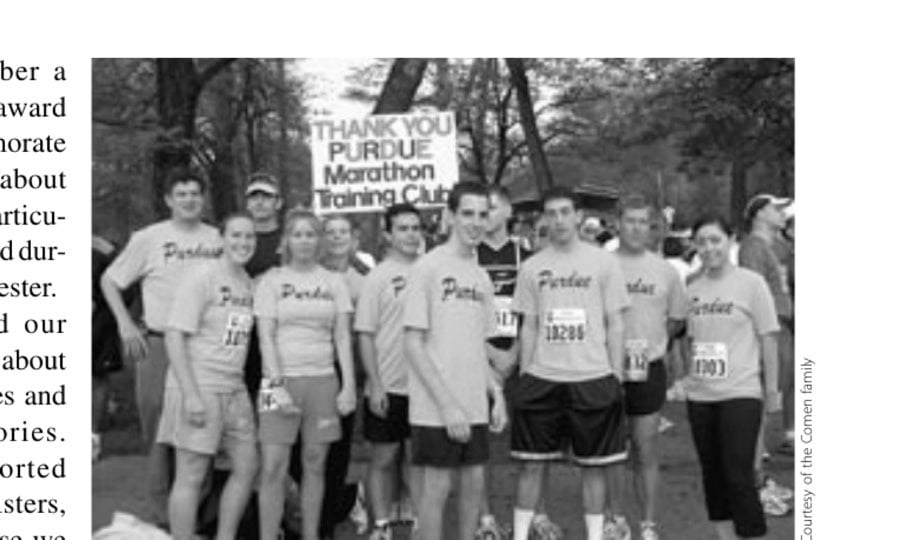
class member a humorous award to commemorate something about what that particular runner did during the semester. We told our war stories about our struggles and our victories. Some sported gigantic blisters, and of course we all were stiff and Ben, center, with some of the Purdue runners before the start of sore. This was our the marathon. last class together. On Thursday, some of us met for a recovery run. During the run, we talked some more and reflected on the things that we had gained.
I am glad I took the class. I learned more about the wonderful creation that our physical bodies are and learned more about training and sports physiology. I met some people with differing life perspectives and had a change in my normal training routine. I also got to participate in a race that I might never have run and got to visit Louisville for the first time.
After a rest, I think I’ll put to use some of the things I learned and begin training for my next marathon. That Boston qualifying time is still waiting to be claimed.
This article originally appeared in Marathon & Beyond, Vol. 9, No. 4 (2005).
← Browse the full M&B ArchiveMore like this
1,000+ stories from 19 years of Marathon & Beyond
The complete archive of the legendary long-distance journal — digitized and free to read.
