

Here And Back
Iremember my final ultra in April 1999. I was a man on the gallows seeing his world for the last time. I was starting a race that I had no enthusiasm for. My quads were huge, but I was deeply tired. Only habit sustained me. I prayed I would make it to the finish line in one piece.
I started slow and got slower. By 25 miles, I was passed by people I had never met. At 38 miles, I couldn’t even lift my legs to run . . . downhill. I dropped at the 42-mile aid station. Riding home, I told my girlfriend I was finished with running ultras. We rode home in silence. I did nothing the first two weeks after the race, hoping this situation was temporary. Then on a Sunday 10-mile run, I struggled to keep up with my friends. The next morning I woke up completely poisoned, hung over with a migraine headache. That was the last run I went on for over nine months.
In the immediate aftermath of the meltdown, I struggled with overwhelming fatigue. Dragging to work, I would sleep heavily in the car at lunchtime. My weight ballooned from 155 pounds to 180, where it hovered, and then began gaining even more. I went through a succession of doctors who ranged from clueless to mendacious. I got blood tests from a lab noted for its venality. One doctor was convinced my thyroid was dying, and eager to put me on Syntheroid—his Rx pad at the ready for my lifetime commitment.
This overnight disaster was two years in the making. The main ingredients were a highly intensive training schedule between 1997 and April 1999, an excessively protein-lean and carbohydrate-rich diet, and insufficient rest. All it needed was a catalyst. The likely culprit was a food poisoning-type virus 72 hours before the Leadville 100. I recovered enough to run strongly and finish in 24:20:00.
Then 1997 became 1998. I trained for the 1998 Wasatch 100 through a series of 50Ks, 50-milers, and long back-to-back runs on weekends. My average peak mileage was about 100 miles per week. This was consistent with every other training year since December 1992. I f
inished the 1998 Wasatch 100 in 28:17, far better than my 1992 finish of 33:30. Afterward, rest never seemed to help. I began taking presumably natural
animal-gland supplements, courtesy of the sports massage clinic I had been going to. The supplements were weirdly toxic and served only to make my quads bulk up like the Incredible Hulk, and the attendant virulent flatulence smelled like burning tires.
INTO THE FUNK PERSONALLY AND PROFESSIONALLY I was in a deep funk for months, simultaneously crawling out of the grave but also trying to reinvent myself professionally. I freelanced in ad agencies and in print-production studios while I went to art director’s night school, building my advertising portfolio. It was brutal. The first breakthrough came in February 2000. My amazing acupuncturist looked at the blood test lab numbers and told me I definitely didn’t need Syntheroid, only a lot of rest. He had healed a blindingly painful sciatica inflammation I had suffered in 1995. Again, his acupuncture treatments enabled me to heal myself through deep relaxation. The needles would slide into various points on my body, and I would painlessly pass out for 30 minutes or more.
The second breakthrough was an MD/Naturopath in West Los Angeles. I knew he was honest when he charged me $125 for a blood panel, compared with the $650 I had paid earlier. He also rearranged my diet: I stopped drinking milk and cut back almost entirely on eating wheat. I dropped 15 pounds in three weeks. At the follow-up exam three weeks later, he cheerfully told me to come back when I had a “real problem.”
By April 2000, my health had improved markedly. I was able to run slowly around my neighborhood. On weekends, I would go on 10-mile hikes, wearing hiking boots to make sure I didn’t attempt to run. On weekdays, I would drive to work, look up at the thunderheads towering over the San Gabriels, and mourn my inability to be up there running.
Larry Gassan
▲
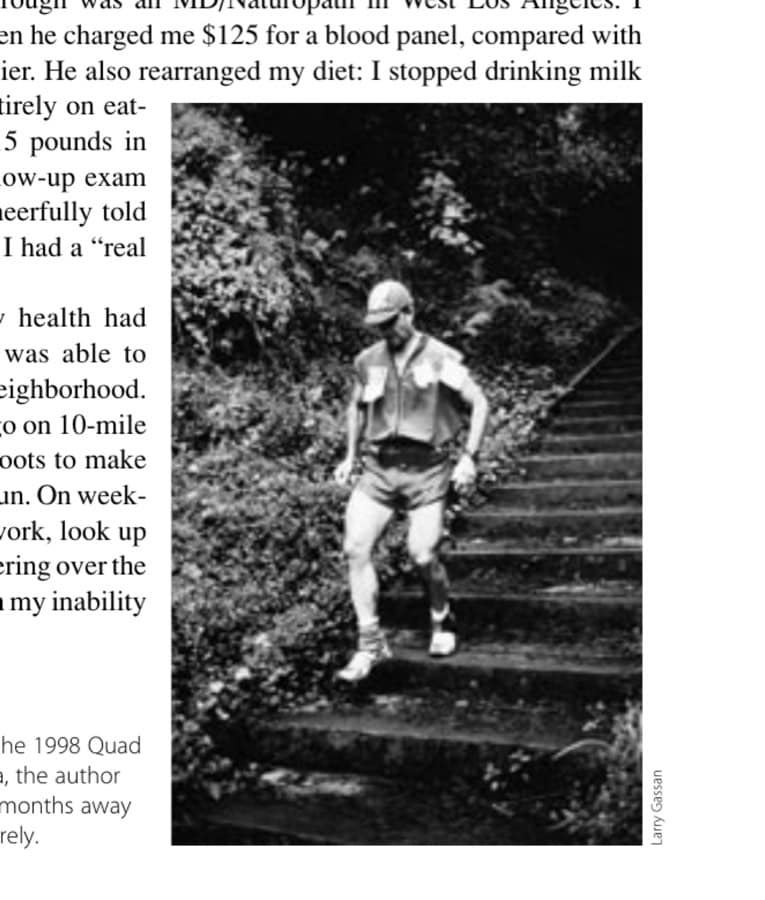
Steps from the finish of the 1998 Quad Dipsea, Mill Valley, California, the author is struggling but is still five months away from quitting the sport entirely.
While in Tucson, Arizona, in May 2000, I took a hot 12-mile loop run up Sabino Canyon. I crawled out five hours later with my tail between my legs. It was humbling to completely start over. By summer 2001, I was doing 25- to 30-mile training runs with friends as they trained for the Angeles Crest 100. On Sundays, I would shuffle through flea markets. I did my final mountain 50K in February 2001. I finished it, but I had lost any remaining interest in racing. I no longer defined myself by wearing a race number. That chapter of my life was closed.
In March 2002, I was introduced to Argentine social tango. Social tango has no relationship to the stunt tango recently seen on television. Tango is nonverbal and improvisational, based on a shared vocabulary and a highly developed awareness of where, who, and what your partner is. Tango music has fluid tempos, without the utterly regular beat particular to swing, rock, disco, and so on. Tango’s emotional range is far broader and more nuanced, treating loss, regret, envy, heartache, and other ambiguities that make most Americans uneasy. It is also melodic and sweeping in a way that is completely absent from any other current music form—adult thinking and meditation in our emotionally retarded culture. It’s that big.
My teacher came to tango from Muay Thai kickboxing after a stint in the Israeli Defense Forces. He’s like guys I had climbed, run, skied, and surfed with. I was able to relate to his physicality, innovative teaching methods, and esoteric, non-traditional tango music choices, which helped open up the art for me.
The learning curve in tango is especially steep for men. A woman with aptitude can be pretty good in about six months. A man needs at least three years to begin to understand the art—provided his ego remains in check.
GETTING TO KNOW KALI In 2003, I was introduced to Kali Escrima, a syncretic Filipino martial-art system. Kali incorporates the successful elements of Spanish sword fencing, boxing, wing chun, karate, aikido, and kung fu. It is both weapons-based and openhanded. Bruce Lee was the most famous exponent of Kali.
How hard can it get? Going three three-minute boxing rounds is far worse than humping over any mountain pass in any training run or race. Sparring with the 27-inch long, 1-inch diameter fighting sticks is also mind-bending. The combat art is improvisational, where any change on any angle can lead to a variety of countermoves or strikes. There are a staggering amount of things to process, with no time to overthink it.
It took another several years before I realized that Kali and tango shared common roots in footwork and coordination, in particular cross-body neural programming that a parallel system like running doesn’t offer. Both arts work in
counterpoint and are dependent on a fit, flexible base for successful execution. My crash also sensitized me to the difference between legitimate coaches and personality-driven cult figures who are never shy in running their charges into the ground. It is the runner’s ultimate and primary responsibility to know when to quit and to warn others of this exploitative behavior. This is problematic in the generally accepting culture of ultrarunning.
Ultras will always be part of my life. I now enjoy running without a watch. I use my ultra experiences in my photography, as I do fine-art documentary portraits of 100mile race finishers. This way I am able to remain connected to a life and commitment that gave me so much in the 10 years I was in it.
Larry Gassan
▲
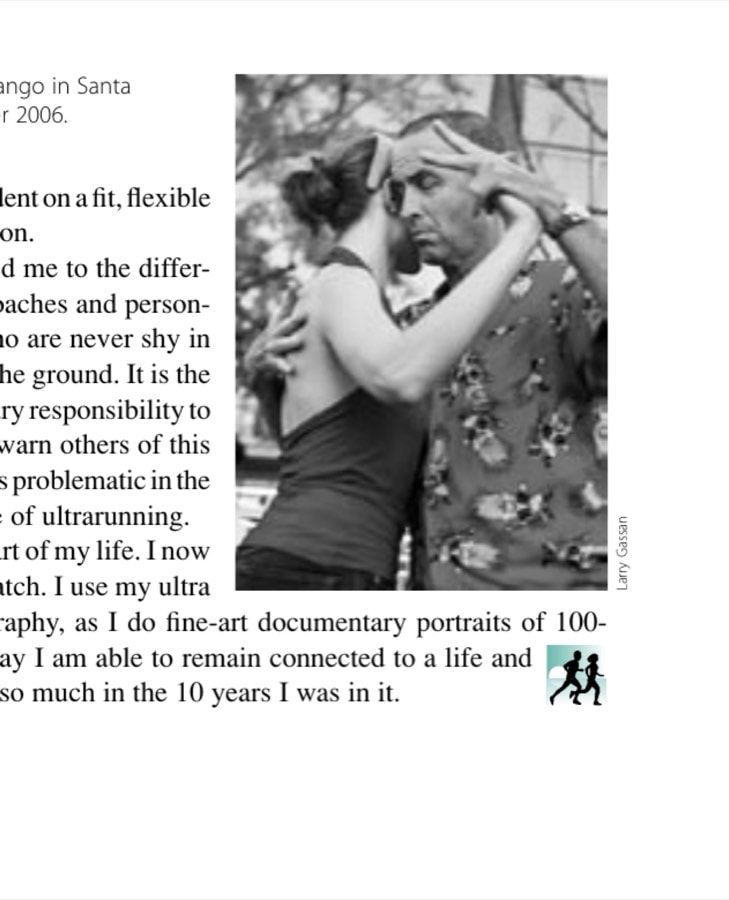
The author dancing street tango in Santa Monica, California, in December 2006.
This article originally appeared in Marathon & Beyond, Vol. 11, No. 5 (2007).
← Browse the full M&B ArchiveMore like this
1,000+ stories from 19 years of Marathon & Beyond
The complete archive of the legendary long-distance journal — digitized and free to read.
