

How Running Saved My Life
Ithink I’m a fairly typical obsessive-compulsive 62-year-old marathon runner. My running started 26 years ago when an equally chubby and inactive friend challenged me to run in some short beach runs here on the west coast of Florida. In the ensuing years, I have gotten great physical and emotional benefits while running over 100 marathons in all the states and five of the seven continents— modest accomplishments compared with many of my friends.
I learned that several of those friends were running the Great Wall Marathon near Beijing, China, in May 2006. Since I needed to pick up Asia on my goal to completing a marathon in each continent, my wife, Becky, and I decided it would be a good way to combine a marathon with a nice vacation.
We were with fun people on a great 17-day trip that included running on
▲
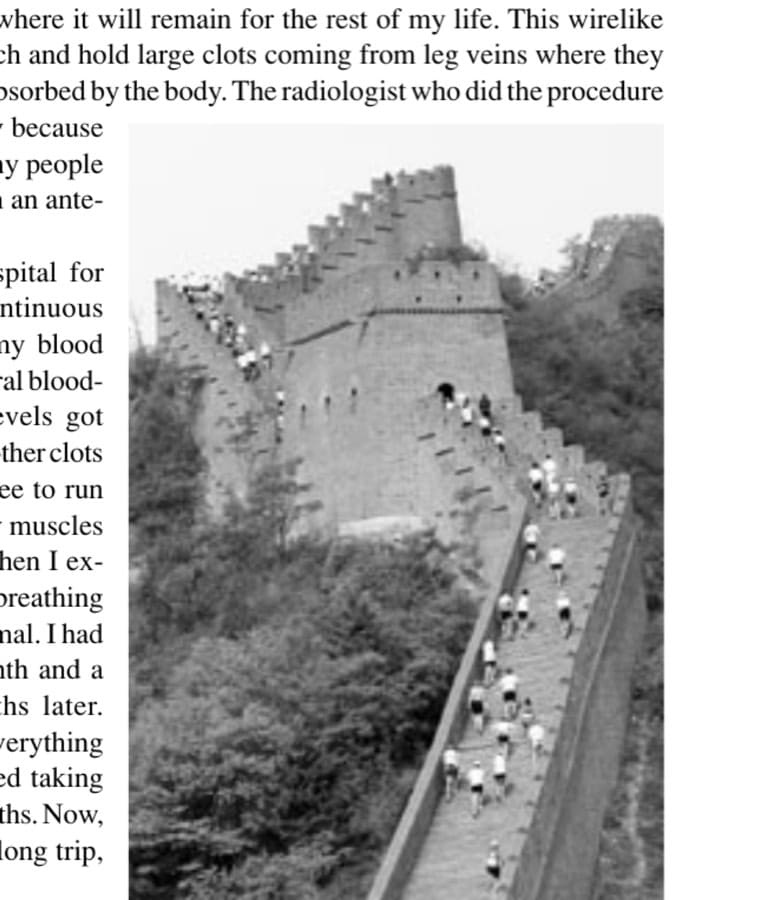
The steps of the Great Wall of China are often steep and of varying heights.
© Bob Wehr
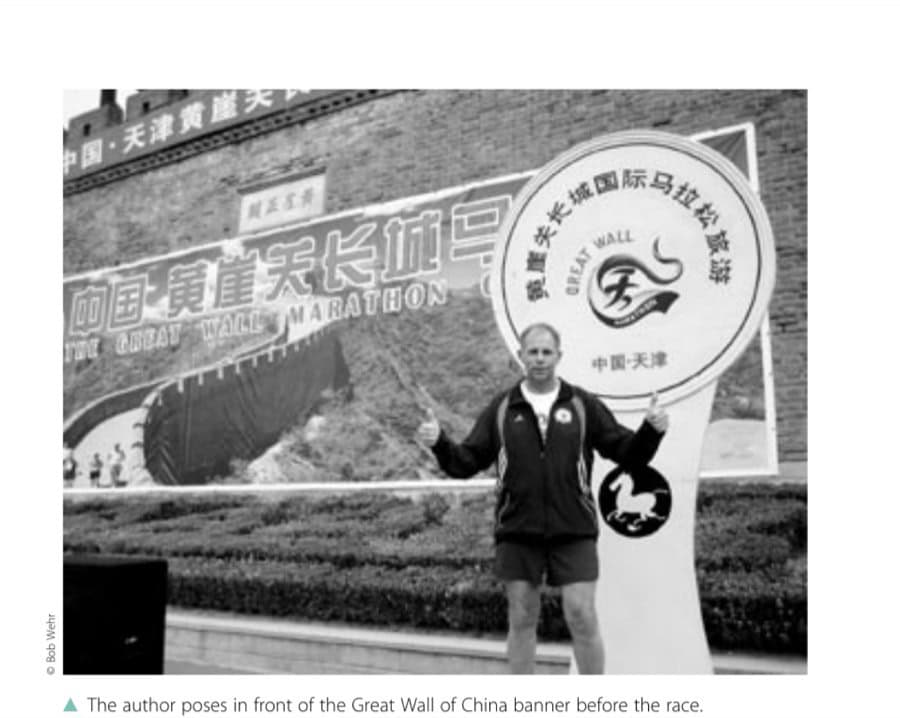
▲ The author poses in front of the Great Wall of China banner before the race.
the Great Wall in Beijing, visiting the site of the terra cotta warriors in Xian, cruising for three days down the Yangtze River, and bargain shopping everywhere we went. All of the Chinese people were very friendly and nice, but the very young
and old were especially fun to interact with. The young were eager to show their knowledge of English by saying “Hello,” and we would answer back Ni hao (hello), happy to show our equal expertise in their language.
When we got back to Florida, I had trouble going more than a hundred yards before running out of breath. I’m no longer a speedy runner, but that was unusual even for me. I can usually run 3 to 15 miles without difficulty, even on a hot
day. I pushed myself harder and assumed that my poor endurance was due to the 90-degree weather or maybe some Chinese bug that left me panting after those short periods of exertion.
AN UNEXPECTED COLLAPSE The month of June went by without improvement, but things got dramatically worse when I pushed myself harder and I blacked out while running on June 27, an especially hot Tuesday. I caught myself just before hitting the pavement and
was lucky to wind up with only a scraped hand, knee, and elbow. I slowly rolled over and sat up in the middle of the street. I tried to figure out what had happened but had no good answer. I was still weak, so my next problem was how to get up because I was sitting in the middle of a road with no traffic. The only person I could see was focused on yardwork and just out of earshot. I struggled to get up. Eventually, I was able to push myself up, and after standing still for a minute to catch my balance and assess things, I slowly made my way back to the house. I cooled down with a cold drink and decided I had to start looking for a medical answer.
A physical exam and blood results were normal on Thursday, just two days from the blackout episode. The next day, an echocardiogram and stress test ruled out many cardiac diseases and most of the arrhythmias that could cause fainting and breathing difficulties. My doctor scheduled a pulmonary function test on Monday, while another doctor friend talked to a pulmonologist about my symptoms and the recent trip to China. He strongly recommended a CAT scan to rule out other heart and lung conditions that might not show up on routine tests.
Because the pulmonary function results were normal, they took me directly to radiology for the CAT scan. When finished, the technician said he thought he could see a pulmonary embolus (PE) and showed me on the computer screen the area that concerned him. He pointed to two of the large branches of the pulmonary artery that were mostly blocked by some obstruction. After a quick phone call, the technician walked me to the emergency room where the cardiologist was waiting. He directed me to sit in a chair in the office and said, “Now, you’re not to get out of that chair—and plan to stay in the hospital for several days. You have a massive pulmonary embolus.” After taking several vials of blood, a nurse started an IV heparin drip while I made phone calls and waited an hour or so for a room to open in the cardiac unit.
My wife and two of my daughters were visiting when the pulmonologist came in later that evening. After introductions, the pulmonologist said, “You are a very, very, very lucky guy. Eighty percent of the people who have a clot the size of yours in the pulmonary arteries die very suddenly. If you were not a runner, you almost certainly would be dead.” He then explained that most likely during my 12-hour flight from China, I had formed large blood clots in the veins (DVT, or deep-vein thrombosis) that run in the upper part of the legs. The one in my right leg had released and traveled to my pulmonary artery, blocking over a third of the normal blood flow to my lungs. An ultrasound showed that I still had a clot completely blocking my left leg from groin to knee that could release at any time and go to my heart and lungs. He added that clots were like a snowball going downhill and that once a clot forms, it becomes a seed for other slow-moving blood to accumulate and add to that clot.
GETTING EDUCATED ABOUT CLOTS
▲
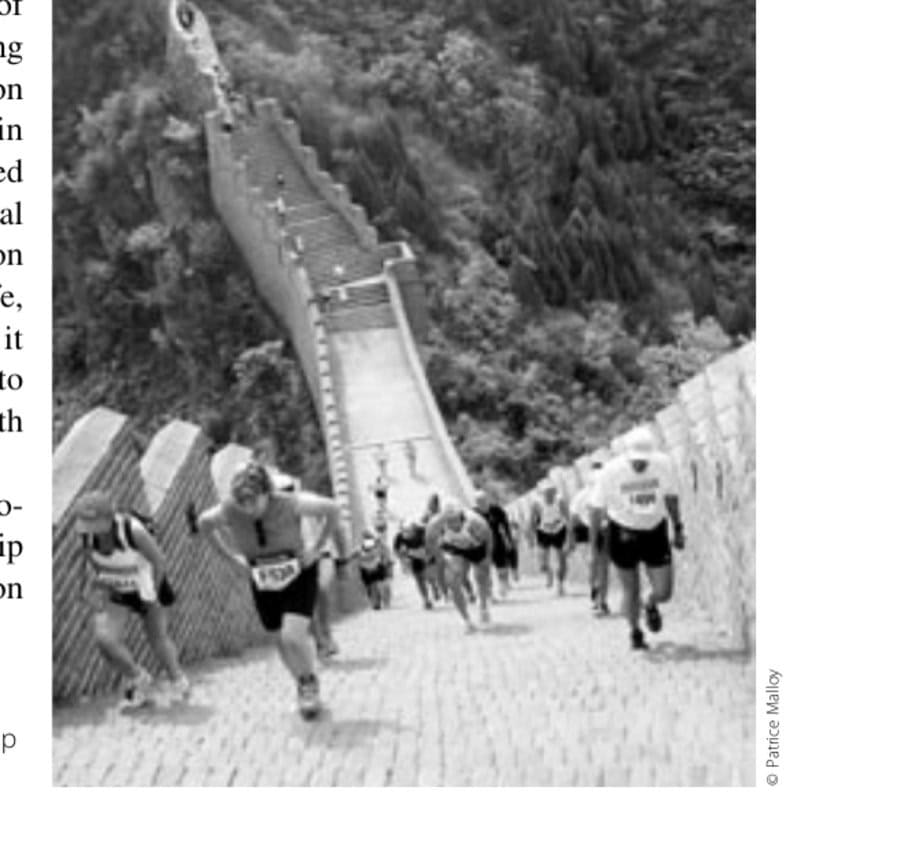
Runners climb the Great Wall of China as it follows the mountainous terrain.
© Patrice Malloy
I learned that clots usually form in the deep veins of the legs and often break loose to become pulmonary emboli that block the normal blood flow going from the right side of the heart to the lungs. If the blockage is severe, you will likely die. If the blockage is not complete, you may be able to breathe normally under resting conditions, but on exertion you don’t get enough oxygen to your tissues. When lungs don’t get to oxygenate the blood, the body responds by taking short fast breaths to get more oxygen to the tissues. If the brain doesn’t get enough oxygen, you pass out. Yep, I had two of those symptoms.
Even though the next day was the Fourth of July, I was taken to radiology, where a catheter was guided from my groin up my femoral vein into the vena cava with guidance from a fluoroscope. A titanium filter was then expanded into my abdominal vena cava, where it will remain for the rest of my life. This wirelike filter is designed to catch and hold large clots coming from leg veins where they will dissolve and be reabsorbed by the body. The radiologist who did the procedure said I had made his day because he didn’t get to see many people with such a large PE on an antemortem basis.
I stayed in the hospital for seven days with a continuous heparin drip to keep my blood from clotting until the oral bloodthinner (Coumadin) levels got high enough to prevent other clots from forming. I was free to run within eight weeks. My muscles were pleasantly sore when I exercised, but at least my breathing seemed to be fairly normal. I had a blood test every month and a CAT scan three months later. The scan showed that everything was normal so I stopped taking Coumadin after six months. Now, before and during any long trip,
I take Coumadin as a precaution to prevent other clots from forming. I have run several marathons since this all happened and have had no problems.
REVIEWING FAMILY HISTORY After the scare of this episode wore off, I looked back on my family history and realized that my dad as well as an uncle and grandfather had died of sudden unexplained causes. No autopsies were done, but it seems possible that one or more of them died of PE. Could my family genetics cause my blood to clot faster than that of most people? Blood tests have found no abnormality that would suggest that was the problem.
It’s of interest to me that in recent months, my doctors have seen one triathlete and two other marathoners with pulmonary emboli, one of them fatal. So could it be possible that athletes with large veins and a slow heart rate from continual exercise set up the right conditions to form a clot? I couldn’t find any article that suggested a higher incidence of PE or DVT in athletes. I do feel fairly certain that the large capacity of an athlete’s heart and lung vessels greatly increases the chance of surviving such an event.
I’ve learned several precautions that might be wise for all of us to consider on our long flights: 1. Drink lots of fluids before and during long flights. 2. Flex your feet and contract your muscles while sitting.
3. Get up frequently and walk or stand in the aisle. 4. Consider wearing compression socks. A final possibility is to upgrade your plane seat so you have more room to stretch your legs and flex your muscles. I have a smart aleck friend who says, “You might as well fly in business class or your children will be flying in first-class.”
This article originally appeared in Marathon & Beyond, Vol. 11, No. 5 (2007).
← Browse the full M&B ArchiveMore like this
1,000+ stories from 19 years of Marathon & Beyond
The complete archive of the legendary long-distance journal — digitized and free to read.
