

Icelandic Hipwreck And The O. Henry Factor
As I gazed up at the cascading water of Dynjandi (“Thundering Falls”), I told my German friend Thomas Nuzinger “Der Blick ist schön” (The view is beautiful), and I wondered how long it would take the Icelandic Rescue Squad to arrive with morphine.
My spouse Lynne and I were in Iceland on a two-week hiking trip with friends. We had scheduled the tour so that we would start with the Reykjavik Marathon races. Besides the marathon, there would be a half-marathon, a 10K, and a 3K fun run. Marsha Kramer, Thomas, and Lynne would run the 10K, and Ellen Kelly and I would run the 3K.
A 3K may not seem like much to you, but it seemed like a marathon to me. It would be my first race in exactly 10 years. During that time, I had had two hip replacements, the last seven months ago, due to acetabular dysplasia, a hip defect that dogs sometimes have—thoroughbred dogs, mind you. My surgeon said, “Although we do not advise it, you can run, but there are so many ways to stay fit without running.” Being a runner, I heard, “You can run.” So I started training a month before the trip. Our friend Barbara Heiles met us at the track early in the morning, and I built up my distance. I was going to say “built up my mileage,” but that would be an exaggeration. Besides, I would be running in a country with kilometers, not miles.
I did work my way up to 17 loops around the track, and I considered running the 10K. That would be 10 kilometers in 10 years, or one kilometer per year. However, I began to encounter the O. Henry factor.
My left toe was hurting, so I went to Doctor Doug Tumen, a marathoning podiatrist, where I learned I had hallux rigidus. That sounded like something from a Harry Potter novel: As Harry Potter ran, Lord Voldemort aimed his wand and snarled, “Hallux rigidus!” Harry immediately started to hobble as bone spurs overwhelmed his left toe joint.
Dr. Tumen said, “You can run, but I would not recommend running every day.” I heard, “You can run.” I continued to train with my left toe in bondage—wrapped
tightly with tape so it would not move at all. Then, four days before our flight, the O. Henry factor surfaced again. I somehow wrenched my back, and I could barely walk. After three chiropractic adjustments, one massage, and one back brace, I was able to hobble on board the plane. Of course, that meant I would run the 3K! On race day, memories of prerace jitters came flooding back to me. How to dress? The temperature in Poughkeepsie had been 90-plus degrees. Reykjavik would be a low of 40 degrees and a high of 57 degrees with intermittent rain. I decided to wear shorts, a Woodstock ’94 headband, and the race T-shirt. Yes, I know that conventional running wisdom says “Do not wear the race T-shirt” (bad karma, man), but the Woodstock ’94 headband should negate the bad karma. Besides, a DNF was not an option, O. Henry factor or not. I walked five minutes from our bed-and-breakfast to the starting line on Laekjargata to photograph the approximately 320 marathoners who were warming up before the 10:00 A.M. start. The sun fought with the clouds, and the clouds were winning. The race announcer said, “To our guests: this is Icelandic weather, and we will have even more before this day is over.”
MY KINGDOM FOR A WAY TO THE BACK
Bob Kopac
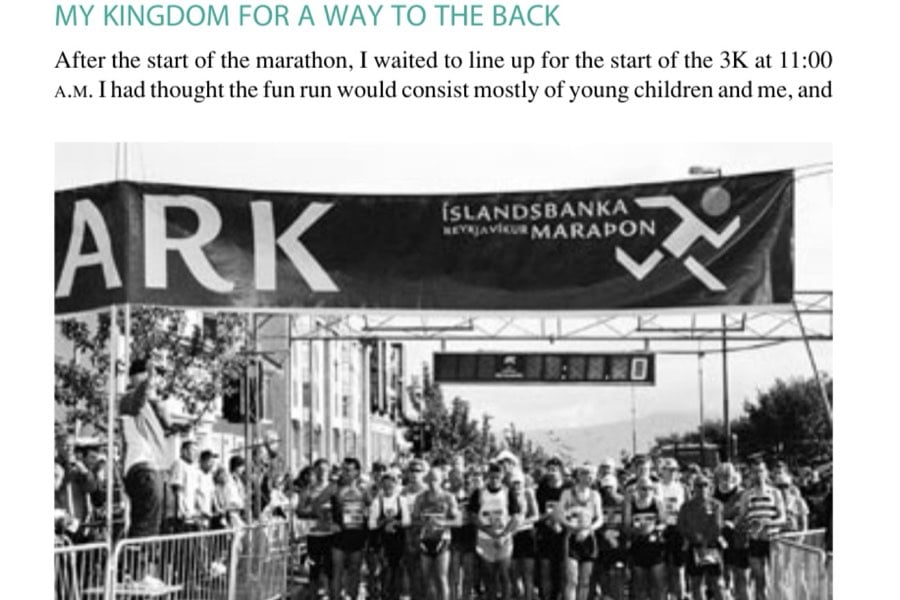
After the start of the marathon, I waited to line up for the start of the 3K at 11:00 A.M. I had thought the fun run would consist mostly of young children and me, and
▲ The Reykjavik Marathon starting line.
I would be a conspicuous giant among munchkins. Thus I was surprised by the hundreds of adult runners. There were so many runners that I could not squeeze my way through the crowd to get to the back of the pack where I belonged, so I had to settle for being very near the front.
The announcer counted down from 10 to 1 in Icelandic, and then we heard the sound of the gun in Icelandic. Women in the front row pushing baby strollers slowed me down. However, that turned out to be a good thing, as the baby-stroller bottleneck prevented me from going out too fast. As I ran on Frikirkjuvegur past Tjörnin (the Pond), the Icelandic rains came. A youngster played a trumpet; fortunately, the tune was not “Taps.” I made a right turn onto Skothúsvegur and ran across the bridge and started up a hill, wiping the rain from my eyeglasses.
I began to feel a familiar pain—not hip pain, but good old running pain—and I remembered a running trick I had learned many years ago. I decided to focus on something else to forget the pain, so I focused on a cute Icelandic blonde runner in front of me. At least I thought she was Icelandic; the odds were she was. However, she could have been a California surfer-chick type for all I knew, as there were runners from California. I settled into a pace behind her. Perhaps my heavy breathing (caused by running, of course) frightened her, for eventually she slowed down, and I passed her.
I then chose my next target from whom to suck running energy (the running vampire trick). As it was past the halfway point of the race, I chose an opponent I thought I could beat (the Guy Thing). The male runner in front of me seemed a likely candidate, so I concentrated on keeping up with him as we “sped” past the shops that lined the street. As we turned onto Laekjargata, I realized I would not catch my opponent. However, his energy helped drag me across the finish line in a time of 16:41. It was my first race in 10 years after all, so I was a little bit rusty. After the race, I used my press pass to finagle a spot right at the finish line for the ending of the 10K and half-marathon that had started at 11:10 A.M. From that vantage point, I witnessed unexpected obstacles on the course. Runners had to dodge many loose balloons that had escaped onto the course. Some runners kicked the balloons high into the air. I was able to see Thomas, Lynne, and then Marsha cross the line. After the race, I talked with Lynne and Marsha.
Lynne: It was interesting trying to pace myself, when I am used to running miles and I know where the mile markers are. I am clicking off kilometers and wondering am I going too fast? Am I going too slowly? Where am I? After a while, I kind of got used to it.
Marsha: The kilometers are nice because they come more often. Lynne: But you have more of them. [Laughs.] Marsha: What I was doing was looking at the kilometers, knowing what they were in miles, and imagining where I was on my run at home. So I knew how far I had to go.
Dieter Nuzinger
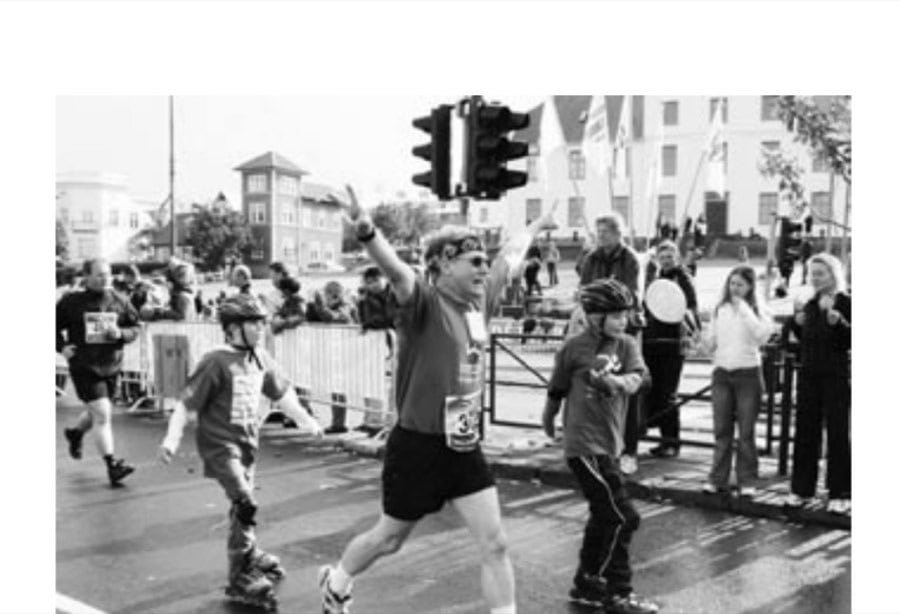
▲ Bob floating on air at the finish line.
Lynne: When I hit the 5K, I realized I was going faster than I normally go in a 10K because it was one of the best 10K splits I ever had. . . . They just had the kilometer signs. The scenery was very nice along the harbor. Then we ran through what I would call the high-rent district. There were some really big houses that were really pretty, after we turned at the bridge over the lake. Marsha: What was also nice, making a turn somewhere along the lake, and you could see in front of you the whole street filled with people running ahead of me. . . . I was on such a high when it was over that I completed it and felt good. I was on cloud nine.
THE WINNER WASN’T A KENYAN? WHAT GIVES? For the half-marathon and the marathon, I watched runners from 30 nations cross the finish line, including 200 runners from Canada who were raising money for diabetes research. It was disconcerting to me to be at a marathon where the winner was not a Kenyan, but Mans Höiom of Sweden in a time of 2:29:10. Of course, the Reykjavik Marathon does not offer prize money. Colin Deasy and Jeremy Rogers, both of Great Britain, finished in 2:38:35 and 2:40:18, respectively. The fourth-place finisher in a time of 2:47:02 was an
American who, let’s hope, has a job as a private eye: Paul Danger. The first female marathon finisher was an Icelandic runner, Bryndís Ernstsdóttir, in a time of 2:55:39, ninth overall. While the marathoners continued to stream in, two female fire-eaters entertained the crowd by shooting flames from their mouths into the rainy sky. This was a good precursor of the entertainment to come, for the Reykjavik Marathon is the start of Reykjavik Culture Night, featuring diverse events such as plays, opera, classical music, Icelandic rap, rock music, and fireworks. In case you were wondering, rap is bad no matter what the language is.
I even witnessed two Icelandic women performing belly dancing. I did not know that belly dancing was indigenous to Iceland or that traditional belly-dancing costumes are DayGlo, but I suppose that is one of the benefits of traveling—to expand our knowledge. When we got back to our bed-and-breakfast, a heavymetal band at a rock club a block away serenaded us during the night with what I supposed was traditional Icelandic music: “Die. Die. Die. You will die. You will die. Die. Die. Die.”
The next day, we started our two-week hiking trip through the northwest fjords of Iceland, passing volcanoes and glaciers. Then, a week into the trip, I once again encountered the O. Henry factor. While crouching down to take a photograph of glistening red rock and green moss, I heard a click, but it was not my camera. Instead, it was the sound of my left hip dislocating, followed immediately by intense pain. I had hipwrecked.
The rock and moss were glistening because I was at Dynjandi Waterfalls, halfway up a mountain in a very remote region. I also was over an hour away from the rescue squad. My fellow hikers covered me with raincoats and a sleeping bag to keep me from suffering hypothermia, as the waterfall was covering me in a fine spray. My friend Fran Garofalo was an emergency medical technician, and she kept checking my vital signs.
I asked my friends to lift my dislocated leg off of my good leg, which had to be done in spite of the pain. I then asked my German friend, Thomas, to pile up rocks under my left foot because my left foot was unsupported and putting pressure on my dislocated hip.
I then said, “Thomas?” He leaned over with concern and asked, “Yes, Bob?” I replied, “Can I please have my camera?” From where I was lying, I had a phenomenal view of the waterfalls above me. Thomas gave me my camera, and I took what I hoped was a great shot of the waterfalls. (“Der Blick ist schön.”)
The rescue team from Thingeyri arrived, covered me with a wool blanket, and apologized that no one was authorized to give me morphine. I waited another half hour for a female doctor from Isafjördur to arrive and give me morphine. Morphine is a wonderful thing.
You can always find good in bad situations. The doctor had been in Isafjördur for 18 months and was leaving for Reykjavik in two days. She had never found the time to visit Dynjandi. Now, here she was six feet from the waterfalls, thanks to me.
Although a helicopter was on standby, the doctor looked at me and decided that, since I was not the typical overweight American, the six-person rescue team could take me down the mountain on a stretcher. The team slowly carried me down the steep and slippery slope. Part of the six-person rescue team were the female doctor and a policewoman. I thought the policewoman was so cute that she could arrest me anytime. Someone later said it might have been the effects of the morphine, but I doubt it.
STRANGE HIP IT’S BEEN
Dieter Nuzinger
I then had a 1 1/2-hour ride in an ambulance over mountainous rock and gravel roads. At one point, the ambulance lurched sideways and threw all my weight against my dislocated hip. At that point, I swear I saw the northern lights. After I reached the hospital, within a half hour a doctor showed me X-rays where the top
▲ Dynjandi rescue. “Morphine is a wonderful thing.”
of my artificial hip stem was outside and above the artificial hip socket. The doctor said, “We don’t have this type of hip device in Iceland. But, don’t worry, I went to Stanford Medical School, and I have seen this type of hip device before.”
The doctor said he would have to anesthetize me because what he was about to do would be very painful. I was doubtful that it could be more painful than what I encountered on the mountain, but I agreed to be put under. I woke up to stiffness but no pain. The doctor showed me an X-ray where the stem was back inside the socket. He then told me that he really had not done anything. He said they had rotated the X-ray machine so it appeared that the stem was in the socket. It was amazing to find a doctor in Iceland who had my sense of humor. What he had done was knock me out, pull down on my leg, align it, and then slam the hip implant back into the socket. It is similar to Legos.
I left the hospital the next day and rejoined my hiking group. I hiked for another week, but our tour guide, Sverrir Ragnarsson, limited me to easy hikes. Fortunately, he was a schoolteacher and had to leave the tour for two days to teach, so we had a substitute tour guide. Thus I was able to hike the rugged and spectacularly scenic Landmannalaugar area.
After I got back to the United States, I called my doctor’s staff and told them what had happened. I was informed that it was more serious than I felt. The staff ordered me to follow the hip protocol as if I had had hip-replacement surgery. So, for the next six weeks, I had to use a raised toilet seat, sit on a pillow, and sleep with a pillow between my legs. Although I did not hear the doctor say, “You cannot run,” I did not run during that time; I did not want to encounter the O. Henry factor again. However, since then . . . but that’s another story.
For more information about the Reykjavik Marathon races, see the www. marathon.is Web site and click on the British flag symbol for an English translation of the site.
This article originally appeared in Marathon & Beyond, Vol. 11, No. 6 (2007).
← Browse the full M&B ArchiveMore like this
1,000+ stories from 19 years of Marathon & Beyond
The complete archive of the legendary long-distance journal — digitized and free to read.
