

In Defense Of Low Mileage
Iwas within days of lining up for the start of the Rock ’n’ Roll Arizona Marathon, and the latest issue of Marathon & Beyond arrived. Hidden in the back of the magazine was a column that would ignite panic. A runner’s query about how to improve his marathon time elicited a unanimous response from a professional forum: more volume! “Increase your mileage,” “the number of miles you run each week is the most important part of your training,” “your first step is to add more volume,” and my favorite piece of advice: “
You can’t expect to approach your marathon potential on 50 miles per week!” I had an uncanny sense of my sixth-grade teacher, Miss Rumple (that really was her name), looking down on me, shaking her head, and lecturing me on my untapped potential while I mumbled something about how it was not my fault.
My 43 miles per week, the highest volume I had ever averaged for a marathon, seemed meager. More than that, I was committing the ultimate sin of not pursuing my potential. That’s un-American. What was wrong with me? I had 10 days until I toed the line in Arizona. Could I fit in a couple of 20-milers, maybe log 70 miles this week?
Running marathons on low mileage All marathoners recognize my emotions as classic symptoms of a taper meltdown. I did calm down and run my race without doing anything too stupid in the days before my marathon. But the M&B column, with expert after expert recommending more mileage, would not get out of my skull. I never had run high training mileage. I realized as I thought about that column that I was feeling defensive about the volume I ran. I felt as though the experts recommending more volume were
criticizing me, personally, for not being true to my sport and for not respecting my athletic gifts. Increasing volume does have value. But more mileage is not an option for everyone. For most of the runners in most marathons, running is a hobby. The marathoner has only so much training time. Our bodies are also a limiting factor; some runners, particularly runners of (ahem) advanced years, can tolerate only a limited number of miles before our bodies rebel.
I believe that completing a marathon is one of the most fulfilling experiences a person can have—and that if an athlete does not have the time to build up to 60 miles a week or more, that should not be a deal-breaker. I also believe that the first priority to having a successful marathon and to steadily improve finishing times is to not get hurt. Running a conservative amount of mileage, because of time constraints or injury concerns, does not have to get in the way of a good result, and a satisfying race.
Here are a few examples of relatively low-volume training cycles that I’ve followed and that led to Boston-qualifying marathons. I have not been able to run elite times, certainly, but getting to Boston is a challenging goal for me and for many marathoners. I don’t have any scientific arguments as to why these programs worked for me, and for that matter, I can’t say that these approaches will work for everyone. I’m simply sharing what has worked for one middle-aged marathoner.
San Diego 2006: An accidental marathon Twenty-eight miles per week I thought that I could never be a marathoner because I could not handle the mileage. My high school coach said he thought that the marathon would become my best event. When I started to think about running a marathon, I was told that I would have to run 70 miles a week. Every time I ramped my mileage over 50 miles per week, I got hurt—repeatedly. I decided that my body was not going to let me be a competitive long-distance runner, and I decided to stop fighting it. I got on with my business career and ran now and then for fitness.
In 2005, I was 46 years old when Julie, one of my best friends, said she was tired of hearing about my glory days as a Willow Glen High School (go Rams!) runner, and she challenged me to run a half-marathon. I got out one of Alberto Salazar’s books and started running consistently. I just did the basics: started at three to four miles per day every other day. Every three weeks, I would add a couple of miles. After three months, I was running over 20 miles per week of easy mileage, and I started adding some of the quality workouts Salazar recommended: 400 repeats, 800s, 1,200s, and some longish tempos. If I could hit 1:50 on my quarters or get under eight minutes for a mile on my tempo runs, it was a good day! I was running one of Salazar’s interval workouts every four or five days, my
Courtesy of Kirk Flatow
▲
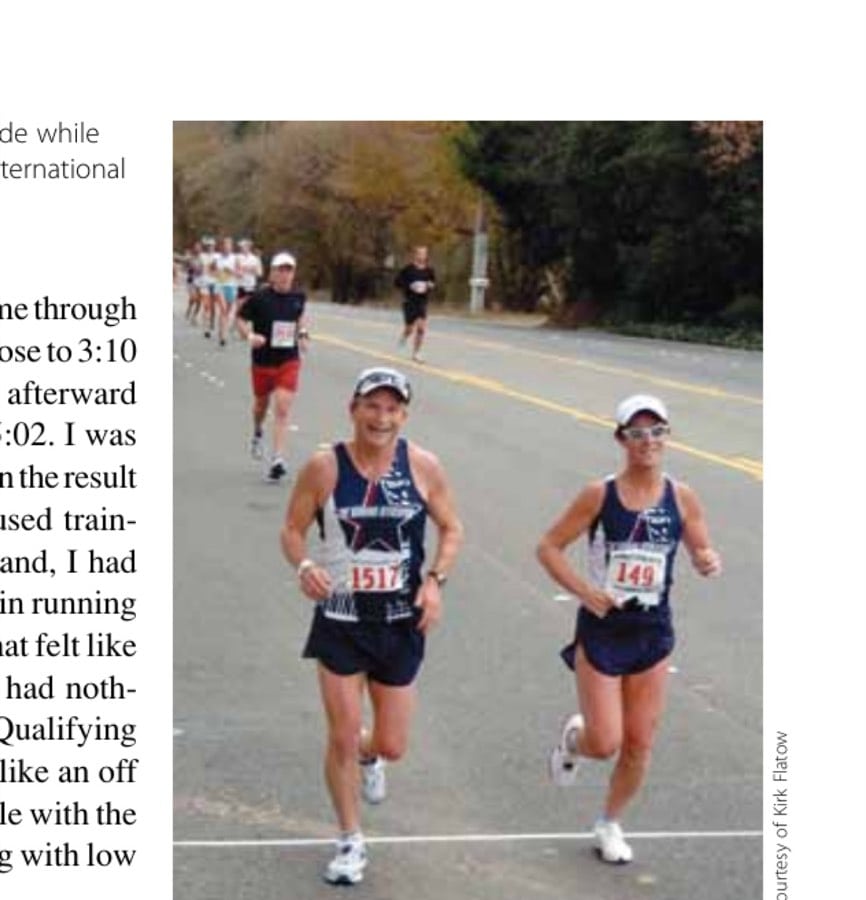
San Diego: Every step after 18 miles was a new distance record for the author.
volume was close to 30 miles a week, I had lost 15 pounds—and my right knee hurt like hell by the time the Avenue of the Giants Half-Marathon came around. I ran 1:32:51. Wow! That was my first half-marathon,
and my time felt great to me. But my knee was also telling me the same thing it had when I was younger, that I could not handle any more mileage—in fact, I may have exceeded my warranty limits! I feared that my knee was going to
shut me down, maybe forever. Maybe this was the best fitness I would achieve in my life. If that was true, then if I’m ever going to run a marathon, I should go for it! My friend Tim Schenone, owner of our local running shop, the Running Revolution, poured gasoline on that
fire. Tim is a great runner and coach, and he was coaching Team In Training that season. “Sure, come along down to San Diego with us in a couple of weeks, run
Rock ’n’ Roll San Diego 2006 Training Summary Average mileage: (20 weeks before marathon)
28 miles/week
Peak weekly mileage:
43 miles
Runs over 16 miles:
1 (18 miles)
Injuries/Weeks missed:
Right knee soreness, right hamstring soreness; one training week missed
Training plan/guide:
Alberto Salazar’s Guide to Road Racing
Sample quality workouts:
12 400M with full recovery; 6 [600M hard + 200M jog]; 8 800M; 5 [1,600M tempo + 800M jog]
the race, and find out what a marathon is all about!” Tim told me he was sure that I could do it (that’s what he told me; Tim also told my pal Julie—but thankfully not me!—that Kirk’s last eight miles might be pretty ugly). So the Saturday after my debut half-marathon, I ran the longest run of my life—16 miles. The next Saturday, I ran 18 miles. After that two-week training cycle, I had a two-week taper—and ran 3:19:50, qualifying me for Boston!
In a seminar I attended, Jack Daniels talked about how the human body has a fantastic ability to do amazing things in a one-time effort. Jack gives an example of a craze for long-distance walks in the 1960s, when middle school classes went out for 50-mile continuous walks with no training. Sometimes it’s best not to overthink your goal. I think that being relaxed helped me during this cycle—I was not thinking about marathon training at all until the last few weeks! All I did was get out Salazar’s Guide to Road Racing and pull out some of his workouts in a fairly random order, trying to get in basic racing shape. No one had told me (yet) how many 20-milers I should have done, how much more volume I should be doing, or what my training paces should be. I wasn’t trying to do too much, and perhaps as a consequence I did not get hurt badly enough to miss any training time at all. I just ran, mixed up the types of runs, and was able to qualify for my first Boston Marathon when I was 47 years old.
California International Marathon 2007: The full Daniels Twenty-nine miles per week After San Diego, I became overconfident—well, to be honest, a little cocky. Hey, this marathon stuff wasn’t so hard! All I needed to do was to bump up my mileage, run harder, and become more structured in my training, and I would really do something!
Not so fast, kid. For the next year, I fought injuries. I was forced to stop running, twice, for a month each time. My main curse was my right hamstring and knee. I would get a tweak and not stop running until I had ground that tweak deep into fullfledged injury, despite regular bodywork. Nonetheless, I had fallen in love with the marathon, and I kept working to race again.
My battles with injuries had been frustrating, but I still wanted to have more structure to my training plan. I decided to run the California International Marathon (CIM); I decided to follow Jack Daniels’s marathon training plan, and I talked my friend Barb Acosta into being my partner for the training cycle.
The cycle started with three weeks of virtually no running as I was rehabbing from yet another injury. Back to running, Barb and I followed Marathon Plan A from Daniels’ Running Formula as closely as possible. Dr. Daniels provides a week-by-week plan for the 26 weeks prior to race day. Two quality workouts
per week are described in detail beginning in week seven. In Daniels’s plan, the athlete determines training mileage; you pick your peak weekly mileage and then use percentages to calculate your target volume for each week.
The major modification we made to the training plan was due to the low mileage we were running. Daniels’s program specified that the long run would be no longer than 25 percent of our weekly mileage; and since we were often barely topping 30 miles per week and our peak was 50, a long run of 7.5 to 12.5 miles just did not seem sufficient! Daniels specifies long runs the lesser of 2.5 hours or 25 percent of your weekly mileage; we went with the greater of those two options. We capped our long runs at around 2.5 hours, however far we could get in roughly that amount of time. Otherwise, we tried to follow Daniels’s plan. Daniels provides very specific instructions for 36 workouts over the 18 weeks prior to race day, and we missed only one of those workouts!
Barb and I really liked the Daniels plan. We thought the workouts were varied and seemed to do a good job of working the various systems we needed to run a good marathon. Barb and I are both sticklers for pacing—each of us thinks that speed sense is one of our own personal superpowers! And Daniels’s plan is very specific. So we became a little bit notorious for our bickering about pacing during workouts (“That feels like 6:50 pace, not 7:00.” “I knew that last mile was going to be too fast! Why didn’t you listen to me?”).
CIM race day dawned, and I felt that a 3:10 marathon was in reach. CIM has a reputation as a fast course, and I felt fit and ready to PR. However, that was not the
California International Marathon 2007 Training Summary Average mileage: (20 weeks before marathon)
29 miles/week
Peak weekly mileage:
50 miles
Runs over 16 miles: (longest run)
6 (22 miles)
Injuries/Weeks missed:
Right hamstring, quad, knee; 3 training weeks missed at beginning of cycle
Training plan/guide:
Jack Daniels’s Daniels’ Running Formula Marathon Plan A
Sample quality workouts:
Warm-up, 2 1.5 miles at tempo pace, 8 miles easy; “Daniels Sandwich”: 2 miles warm-up, 4 1,200, 8 miles easy, 4 1,200; 13 miles at marathon race pace (we signed up for half-marathon races for these workouts).
▲
Jack Daniels was our guide while training for the California International Marathon.
Courtesy of Kirk Flatow
case on that Sunday. I came through the halfway point very close to 3:10 pace, but I faded hard afterward and finished with a 3:25:02. I was somewhat disappointed in the result after a half year of focused training—but on the other hand, I had qualified for Boston again running 29 miles per week on what felt like a dud of a day. Truly, I had nothing to complain about. Qualifying for Boston on what felt like an off day made me comfortable with the idea of marathon training with low mileage.
The Flying Pig Marathon 2009: Anarchy and McMillan Thirty-three miles per week During 2008, I became increasingly disciplined during two more serious attempts at a marathon PR, at Boston and at Chicago. I achieved two more runs in the 3:20s. I was coming to the conclusion that maybe I was stuck at that pace, given my age and the volume I was able to run.
So I said the heck with it—I would still run marathons, but I was not going to pursue PRs with the same single-mindedness. I signed up for the Flying Pig Marathon, which no one claims is a fast course; I signed up because a marathon with Pig in the name sounded like fun. I decided to run only four days per week to try to avoid injuries. And I decided to race more, and I started signing up for 5K and 10K races every couple of weeks.
I was having a blast racing! I ran a long run only every other week or so, because many Sundays my friend Josh Shipp and I would head off to little local races. As the training cycle went on, we raced a couple of half-marathons. We fit workouts into the race schedule rather than targeting races based on the state of our training plans. The Running Revolution training group met every Thursday morning, and I would run whatever Tim had planned that week, which went from Yasso 800s to sets of 400s to pyramids (short intervals to long intervals and back to short) or ladders (increasing or decreasing lengths of intervals over the course of
Courtesy of Kirk Flatow
▲
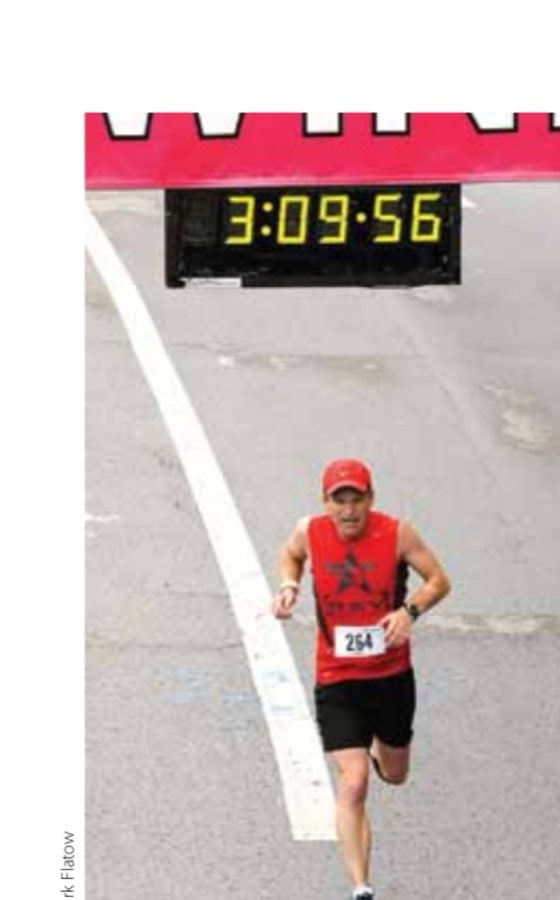
After years of trying, a 10-minute PR at the Flying Pig Marathon! Even the race director was surprised.
a track workout). Whatever workout Tim came up with, I’d run as hard as I could. The only planned workouts specific to my upcoming marathon were my long runs. Every three weeks or so, I would try to get in a 15- to
20-mile run, which I modified based upon a column by Greg McMillan. Greg described a “fast finish” workout that started as a long, easy run. During the last few miles of the long run, the pace would increase to
target-marathon race pace. Over the course of my season, I started with a 2.5-mile fast finish at the end of my long run, and increased that to 7.5 miles by the end of my training cycle. Racing was fun, and I was
faster than I had been since graduate school. I broke 19 minutes in a 5K and 40 minutes in a 10K for the first time since high school. I went under 1:30 for a half-marathon for the first time ever! I was starting to think that maybe I could put together a marathon PR after all.
My expectations in Cincinnati were for fun more than speed. My training log was in many ways less impressive than it had been before other races (except in one important area—no injuries). As I said, no one claimed the Flying Pig course
was a fast course, and every course description I saw emphasized the horrors of a long hill at miles seven and eight. My plan was to go out under control, not worrying about pace and not trying to race until the top of the hill. That simple
plan exceeded all my expectations as I came though the first half in 1:37, ran a 1:33 back half, and finished in 3:09:48—another Boston-qualifying time, my first marathon under 3:10, and a 10-minute PR!
I’m not an exercise physiologist, and it’s hard for me to explain exactly why this unstructured plan worked so well for me. I was still running low mileage for most marathoners. My feeling is that three major factors helped me make my jump: •
A high percentage of my miles was fast, hard miles—races, tempo, fast finish, track work. This hard work must have had a real impact on all my
The Flying Pig Marathon 2009 Training Summary Average mileage: (20 weeks before marathon)
33 miles/week
Peak weekly mileage:
46 miles
Runs over 16 miles: (longest run)
3 (20 miles)
Injuries/Weeks missed:
Nothing beyond normal training soreness; no weeks missed
Training plan/guide:
Mostly unstructured training and racing, adding “fast-finish” long runs as described by Greg McMillan
Sample quality workouts:
5K, 10K and half-marathon races (raced 7 times during 20 weeks prior to Flying Pig); 8 to 12 200M hill repeats; fartlek 6-5-4-32-1 minutes hard with 3-minute recovery runs; “Yasso” 800s; “fast-finish” long runs (for example, 20-mile run with last 7.5 miles at target marathon pace)
muscle fibers, fast and slow twitch, and ability to maintain a faster marathon pace more efficiently. • My marathoning “training age” had increased—even though my weekly average miles had increased only slightly (from 28 to 33 miles per week from 2006 to 2009). I had been running that mileage consistently for almost four years when I raced in Cincinnati. • I did not miss a week of running due to injury in the 20 weeks before my race.
The Portland Marathon 2009: The odd double Thirty-five miles per week I liked racing more often! I was having fun with the shorter distances, and I still loved marathons. This situation led to a peculiar question I posed to Jack Daniels. I was coaching marathoners for Team In Training and was invited to a seminar with Dr. Daniels. After the class, I cornered him for the following exchange: Me: Coach, I’ve been marathoning for a few years now, but back in high school I was a decent miler; my PR was 4:40 (I know that’s not an amazing time, but I was still happy with it!).
Coach Daniels: Yes? Me: So I was thinking, it might be fun to try to work on my mile for a cycle, just as a change of training stimulus. Coach: Yes . . . [He’s kind of intrigued at this point; this is not the normal TnT coaching conversation.] Me: So I signed up for the Fifth Avenue Mile in September. Coach: Yes! [Now Jack is really excited.] Me: And I’ve also signed up for the Portland Marathon a week later. Coach: Ugh. [I can see what is going through his mind: something on the order of “What the heck is this guy thinking?”] Me: So do you have any suggestions? Coach: [He mumbles something and starts to disengage from what is clearly a deranged runner. But as he starts to turn away, I could see the coaching wheels start to turn in his head, and he thinks for a minute and says to me:] “Look, it is tough to do both those races so close together. But what you might want to do is train for the mile for most of the summer, then switch to marathon training. Try to hang on to your speed with some 200s and 400s after your long runs.”
The Portland Marathon 2009 Training Summary Average mileage: (20 weeks before marathon)
35 miles/week
Peak weekly mileage:
47 miles
Runs over 16 miles: (longest run)
4 (20 miles)
Injuries/Weeks missed:
Nothing beyond normal training soreness; no weeks missed
Training plan/guide:
Track workouts borrowed heavily from Daniels’s 1,500-3,000M Training Plan A from Daniels’ Running Formula, adding McMillan ”fast-finish” long runs
Sample quality workouts:
Six races, including three one-mile races; 4 200 + 2 400 + 1 800 + 2 400 + 4 200; 2 [2 (1-mile tempo + 1-minute recovery) + 4 (200 hard + 200 jog)]; 16 hilly miles at easy pace + 6 400 w/400 recovery
Courtesy of Kirk Flatow
▲

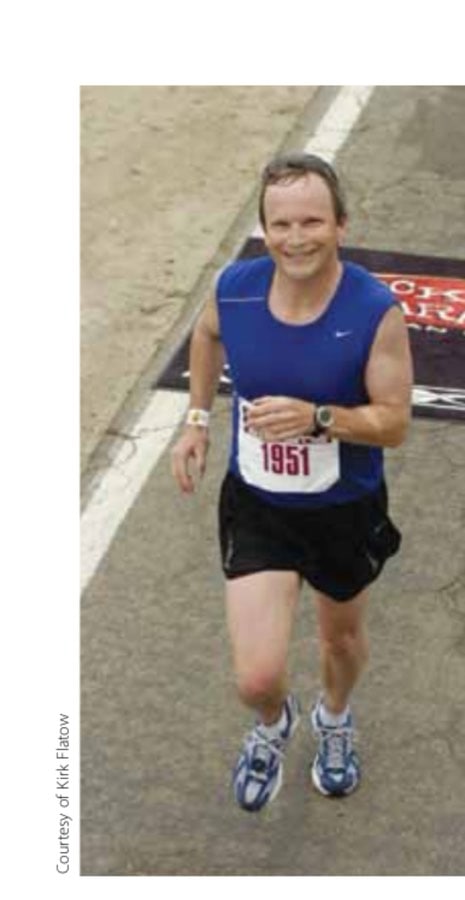
Portland was the back end of a strange road-race double with the Fifth Avenue Mile.
That tepid support was all the encouragement I needed! I pulled out my dog-eared Daniels’ Running Formula and ran many of the workouts from the 1,500-3,000 meter training plan. I found this to be a lot of fun and
an interesting change from the track work I had been doing the last couple of years. I typically skipped the third quality workout in favor of a weekend long run. I would usually take Coach Daniels’s suggestion and add some
track work or fartleklike surges at the end of the long runs. I distinctly remember running repeat 400s with my friend Tim after a hilly 14-mile run and thinking along the back turn, This is money! Running the Fifth Avenue Mile was
a total blast, and even though I felt like the finish line was backing up on me as I tried to kick, I still recorded a 5:22 (which age-graded was not all that far from my high school 4:40!). Feeling sore afterward, I wondered what would happen in
a week in Portland? I did not feel that great at the cold and damp start but came through the half in 1:35:35 feeling decent; and somewhere in the next few miles, I started feeling really good, running a 1:32:37 second half to record a 3:08:12 PR.
A defense of low mileage I started writing this article to talk about why higher mileage was not necessarily the answer for marathon training, and maybe I lost the thread a little bit. And I do not intend to argue that high mileage is bad—there is a reason why the
marathoners on our Olympic team log 100-plus miles per week! I am not an elite runner or even an elite age-grouper by any means, and I don’t have the depth of knowledge or experience of the experts I’ve cited. However, I have managed to
put up Boston-qualifying times while running relatively low volume, so there are very satisfying achievements to be made even if a runner can’t log elite mileage totals. Some of the lessons I’ve taken to heart during my training include:
• It is important to be injury free; uninterrupted training is more valuable to me than higher volume with a missed week or more of training. • Good high-quality work can compensate to some extent for a lack of
volume. I find that it did not seem to hurt me to skip a five-mile recovery run in order to feel sharp for a hard interval workout the following day. • There is fitness, and then there is race fitness. At least for me, racing
shorter distances seemed to develop mental toughness and readiness for a marathon better than hard training alone. • Many training programs can work. Salazar, Daniels, and McMillan all have great approaches that can be adapted to lower-volume regimens.
I was talking about this article with elite runner Josh Cox during his run-up to the Olympic Marathon Trials, and he said to me, “You know, those experts are right. You are not reaching your marathon potential at 30 miles per week.” Ouch! Well, perhaps I will find that I can ramp up my mileage and continue to improve! But I hope that this article inspires those who can’t or choose not to run a lot of miles to nonetheless attack the marathon with enthusiasm, unapologetically training for marathons with low mileage!
This article originally appeared in Marathon & Beyond, Vol. 17, No. 2 (2013).
← Browse the full M&B ArchiveMore like this
1,000+ stories from 19 years of Marathon & Beyond
The complete archive of the legendary long-distance journal — digitized and free to read.
