

In the Mood: Flow, Mood, and the Marathon
Marathons attract a diverse set of runners with a variety of race motives. Some choose to run in a marathon to improve health or perhaps for social reasons. Some participate to try a new activity, to seek the feeling of camaraderie from training with a partner or group, or to seek the group accomplishment felt during the marathon race. Still others may seek the challenge of running 26.2 miles as well as the desire to race against others. The feeling of challenging other runners, a previous race time, or the marathon course can be motivators for many runners, thus keeping them adherent to the marathon culture (for example, being regular marathon runners). Ogles and Masters (2003, 70-71) added additional motives for marathon running: “mood control, self-concept enhancement . . . psychological well-being . . . social status, etc.”
Because marathon runners are a diverse, individualistic group of athletes, understanding the factors that help and hinder their performance has been of interest to researchers. Of particular interest is understanding the relationship between mood states and achieving flow during a marathon race.
Flow
Flow, colloquially referred to as “being in the zone,” is a feel-good, intrinsically motivating state that “when individuals are fully involved in an activity, they tend to find the activity enjoyable and intrinsically rewarding” (Csikszentmihalyi, Abuhamdeh, and Nakamura 2005, 602). Flow is often described as a “positive” and “motivating force” (Schüler and Brunner 2009, 169) experienced during an activity. Such a cognitive state involves challenging, goal-directed behavior that produces a feeling of full absorption within the given task and consists of the following nine dimensions (Jackson and Csikszentmihalyi 1999):
- Challenge-skills balance: refers to the perceived matching of one’s skills to the current challenges in the event; for this balance to occur, both the skills and challenge must be relatively high.
- Merging of action-awareness: refers to one’s actions and thoughts becoming merged with conscious awareness (of those actions), resulting in the action feeling effortless and automatic
- Clear goals: refers to athletes having set strategies, goals, or directions that provide a blueprint in monitoring their progress throughout performance
- Feedback: refers to receiving information from various sources during competition in order to gauge performance
- Concentration: refers to complete focus on the task or event
- Loss of self-consciousness: refers to athletes not overanalyzing their performance
- Sense of control: refers to athletes simply letting go of the need to control their actions; letting go allows the athletes to feel more in control as they are no longer overthinking their performance.
- Transformation of time: refers to the feeling of time shifting; thus, athletes feel time may have moved more quickly or slowed down.
- Autotelic experience: refers to the intrinsic reward and pleasure felt during a flow state
Anecdotally, athletes have reported experiencing flow and its components during competition. Because of the harmonious nature of flow, athletes search for the ideal training regimen, mental-skills strategy, and prerace (and during-race) routine to regulate emotional, cognitive, and/or physiological states before and during competition to enhance performance and the likelihood of experiencing flow. The concept of the “runner’s high” can be seen as an example of being in a flow state. Similarly, peak experiences are likely to be found when in a flow state, as well as peak performance. These are exalted feelings that are especially memorable for runners, given the potentially extended periods of time during a run when they might have these experiences, and the desire to experience these feelings again is strong.
Schüler and Brunner (2009, 169) suggest that flow can directly and indirectly enhance performance as “this mechanism is based on the rewarding effect of the positive experience that accompanies the deep involvement during flow.” However, to achieve flow, we must consider the various internal and external factors that help and hinder athletic performance, such as weather, gear, physical ability, negative or positive thoughts concerning the race, and performance, as well as mood states before and during competition. When considering the many factors that affect performance, particular attention should be paid to marathon runners’ moods during a race. For example, runners may experience such moods as frustration, anger, happiness, and relaxation. Comparing their mood states to their experiences of flow and overall performance provides the sport of marathon running as well as the field of sport psychology with potential insights into the relationship that positive moods (such as happiness) and negative moods (such as frustration) have on flow and overall race performance.
Flow and Mood
The connection between mood, flow, and performance operates on an individualistic and sport-specific level whereby moods can serve distinct purposes for the racer, ranging from motivational to assisting with mood regulation and arousal. For example, the mood of excitement may assist the runner in getting “amped up” for the race, whereas feeling annoyed during a marathon may motivate the runner to push through an obstacle.
Therefore, moods and emotions defined as negative (such as anger, frustration, and irritation) can facilitate flow and enhance performance just as much as positive mood states (such as happiness, joy, and excitement). However, mood states are very much relative to the individual, whereby the runner’s individual interpretation of the mood’s benefits on performance and flow is relative to the runner’s relationship with such moods.
To expand on this idea, comparisons can be made between the construction of emotions in team sports in relation to marathon running; in team sports, “there is a sharing of collective emotions” (Collins 2008, 285) which are felt in the ups and downs of a game. This sharing of emotions creates an emotional momentum that assists in enhancing individual and group performance through the positive emotions these points in the game elicit. Such “emotional energy” (Collins 2008) is similar to the ups and downs individually experienced during a marathon race whereby the racer’s individual challenges, areas of accomplishment and reloading, as well as the crowd energy (cheering and support from the crowd) elicit positive mood states for the runner, thus enhancing performance due to the motivational qualities such energy generates. Moreover, such emotional energy can facilitate flow as runners feel a sense of control and confidence during their race.
Because emotions and moods are natural, sport psychology research can explore how optimal levels of any emotion can assist in experiencing a flow state and enhancing performance. Sport-specific norms as well as the individual’s relationship with certain mood states are key factors in understanding mood’s role in attaining flow. Research exploring the interactions among flow, mood, and performance is currently under way at Temple University.
Study Purpose
Leeja Carter and Michael Sachs are currently testing the role that mood states during a marathon have on achieving flow in marathon runners. Marathon runners were recruited through an announcement of the research study that was posted on running blogs and forums, such as active.com. Additionally, announcements were posted to club, university, and relevant organizations’ listservs. We also conducted a search of marathon running clubs in the United States via the website www.google.com. After identifying these clubs, we contacted them by e-mail and requested that they forward the study information to marathoners who might be interested in participating. Marathon runners who met the requirements of the study were asked to contact us by e-mail to participate in an online study, and we then provided a link to the online survey through surveymonkey.com.
Upon completion of the online consent form, participants were given a demographics survey that requested general information (including age, sex, and education) as well as their frequency of marathon participation, their level of expertise (first-time marathoner, seasoned, and so forth), and the date of their next race.
Next, participants took the Dispositional Flow Scale-2 (DFS-2) to measure their innate ability to achieve a flow state during competitive performance (Jackson 2009a). Then participants were asked to participate in their scheduled marathon race and, after completion of their race, were contacted within five days to complete the second part of the study.
The second portion of the study asked participants to take a demographics survey with general information about their most recent marathon race (date, location, and name of the event) and a modified version of the Brief Assessment of Mood (BAM) inventory to measure their mood states retrospectively for specific mile markers in the marathon (at the start, 13 miles, 20 miles, 25 miles, and the finish). Upon completion of the BAM, participants took the Flow States Scale (FSS-2) to measure their flow achievement within their most recent marathon retrospectively using nine subscales to assess the nine components of flow: challenge-skills balance, merging of action-awareness, clear goals, unambiguous feedback, concentration, sense of control, loss of self-consciousness, transformation of time, and autotelic experience (Jackson 2009b; Jackson and Marsh 1996).
Results
Demographics
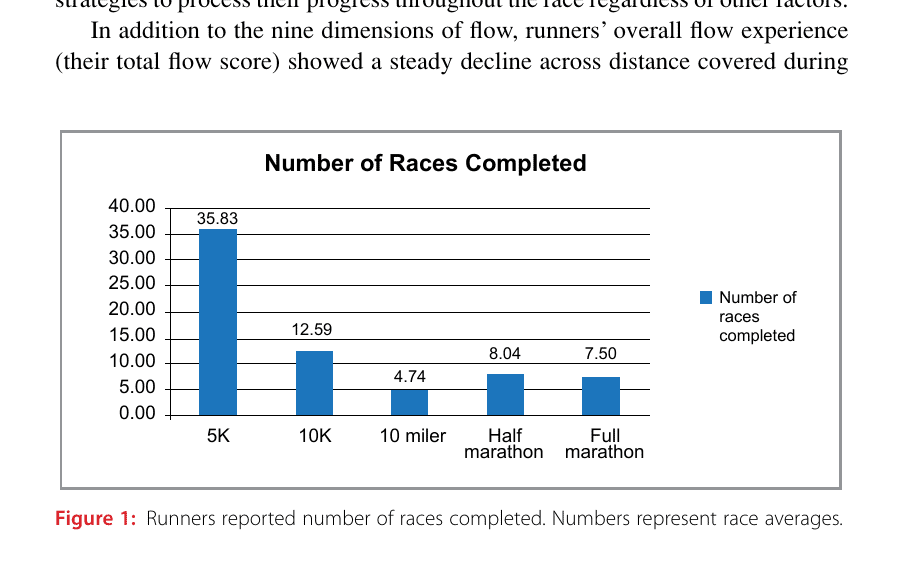
Preliminary participant demographics are as follows: marathon runners above the age of 18 were recruited for voluntary participation beginning September 2011. Participants were 24 marathon runners (11 females, 13 males). The sample was primarily Caucasian, with 20 participants identifying as Caucasian, three as Hispanic or Latino, and one as Asian American. Five participants reported that their highest education or degree was a doctoral degree (such as PhD, EdD, and PsyD), eight had another graduate degree (MA, MEd, MS, for example), four had some graduate school, six had an undergraduate degree, and one had some college. Last, runners provided the total number of races and distances completed to date (they were asked to estimate, if necessary). The average number of races completed was 35.83 for the 5K, 12.59 for the 10K, 4.74 for 10 miles, 8.04 for the half-marathon, and 7.50 races for the full marathon (see figure 1).
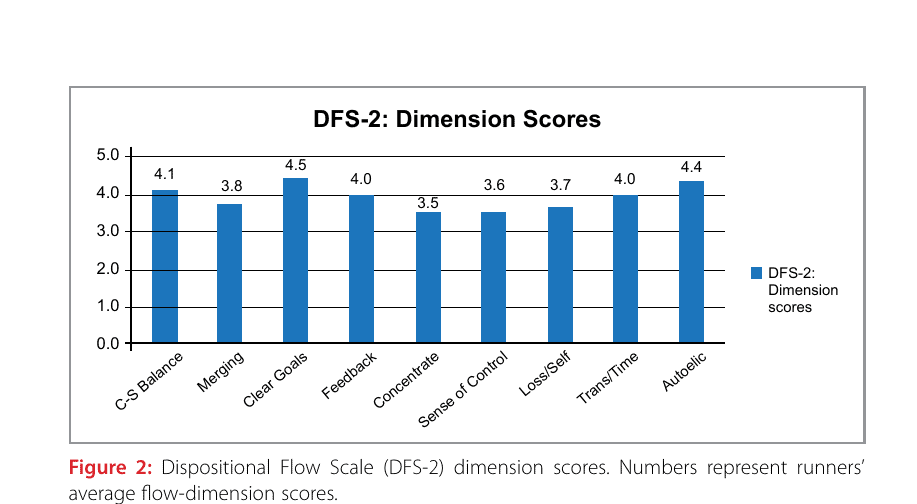
Prior to running their marathon, participants completed a demographics survey and the DFS-2. Preliminary results found that, on average, all runners experienced a moderate to high level of flow as assessed by the flow-dimension scores. As represented in figure 2, runners’ dispositional flow-scale scores range between 3.5 and 4.4, which suggests moderate to high scores on the flow dimensions. Therefore, we concluded that participants possess the ability to achieve flow and, indeed, have achieved flow.
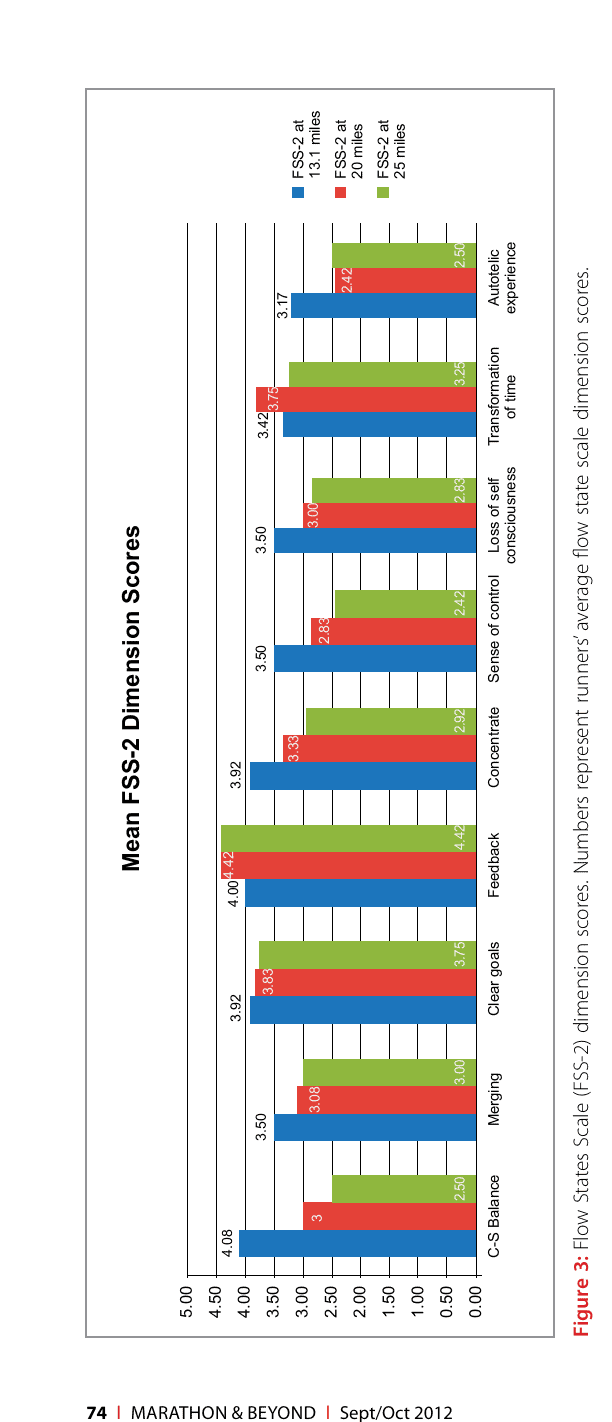
After participants ran their scheduled marathon race, they were asked to take the Flow States Scale (FSS-2) to measure their during-race levels of flow and flow dimensions. We modified the flow scale and tailored each question to ask participants about their flow experience at specific distances in the race (at 13.1 miles, 20 miles, and 25 miles). Results suggest that the flow dimensions of clear goals and feedback were least affected by distance completed in the marathon (see figure 3). Prerace goals may provide runners with the ability to stay fixed on set strategies in the race, allowing for clear goals to provide athletes with a set of tools or strategies to process their progress throughout the race regardless of other factors.
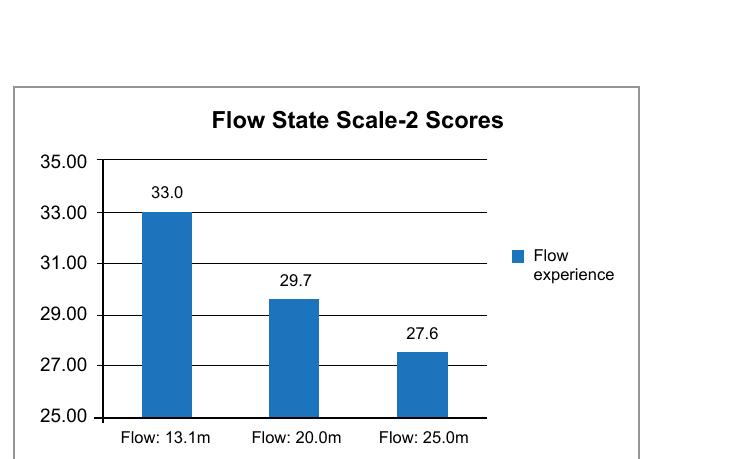
In addition to the nine dimensions of flow, runners’ overall flow experience (their total flow score) showed a steady decline across distance covered during the marathon, indicating that as runners progressed throughout the marathon, their overall experience of flow decreased (see figure 4).
Brief Assessment of Mood (BAM) Scores and Analysis
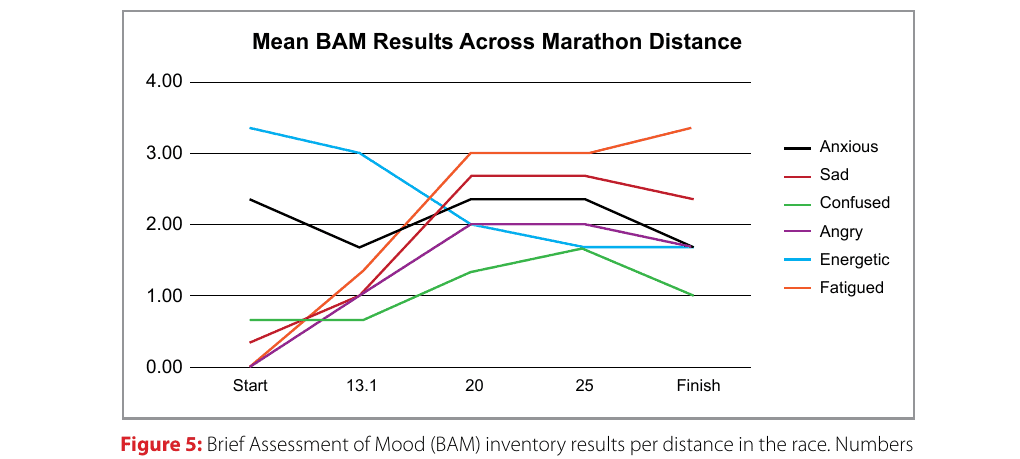
Of the six mood states, the moods of confusion and anxiety were least influenced by distance in the race (see figure 5), with the moods of sadness, fatigue, and energy being the most affected by race distance.
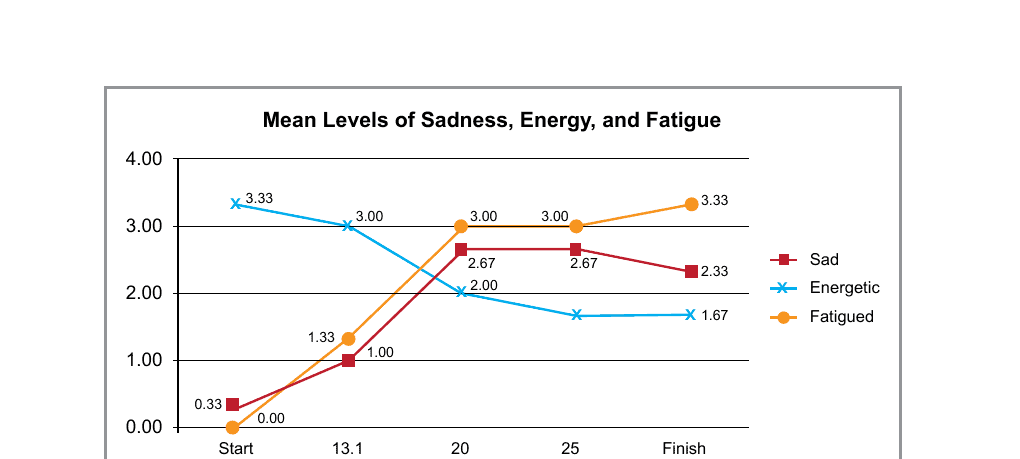
The moods of sadness, energy, and fatigue show the most interaction with race distance, with the moods of fatigue and sadness low at the start of the marathon and progressively increasing across the distance of the marathon as the mood of energy decreases (see figure 6). Race distance affects a runner’s feeling of energy. Thus, as runners feel tired, they are more likely to feel the negative mood of sadness.
Conclusions for Study
According to the Brief Assessment of Mood inventory, the negative moods of sadness and fatigue showed a steady increase across race distance. More specifically, sadness showed a steady increase from race start to 20 miles, plateaued through 25 miles, and then slightly decreased at the finish (perhaps exhilaration at finishing the race). Runners’ energy levels (represented by reports of “energy” and “fatigue”) may be closely associated with feelings of sadness during the race; the more energized and less tired runners feel during the race, the less likely they are to feel sad or depressed. Moreover, overall flow scores showed a clear decline across race distances (from 13.1 miles to 25 miles), suggesting a relationship between runners’ flow achievement, negative mood states (sadness), and distance in the race. Therefore, as runners progress throughout the race and increases in sadness and fatigue are apparent, flow states will probably decrease.
Preliminary findings suggest that the negative moods experienced as you progress throughout the race may reach their peak at specific race distances because that is where runners experience clear race challenges such as extreme fatigue, motivation, or a hill. Therefore, positive moods are first clearly affected. Mental skills like positive self-talk can minimize the encroaching negative moods and replenish the positive moods of energy and excitement to push runners through the race.
The applied side: enhancing mood and flow
Following up on these suggestions, we can recommend a number of strategies for facilitating a positive mood state during your training runs as well as races (including marathons and ultramarathons). First, consider the general “mantra” that anytime we run is a good time; this positive focus on doing something we enjoy and that is good for us gets us started with a positive mind-set. Second, we can use a strategy that sport psychologists call “parking” or “compartmentalizing”—we can park our negative mood states (before the run) in some side area (or put them in a compartment, like a box or drawer) and say that we won’t let this negative mood or these negative thoughts or problems distract us during our run. We give ourselves permission to put them aside for the moment, and we can return to them later (unpark them, take them out of the box or drawer) if we wish. But our run is our “sacred” time, and we’ll leave the negative stuff behind for the moment.
Of course, some runners “enjoy” being in a “bad” mood, feeling that this drives them to push harder, in a cathartic sense, to run these negative moods out of their systems. Runners need to find what works best for them and use that to their advantage. Other strategies may work for runners. Books such as Galloway (2011), a recent one on mental training, may be of interest.
Recommendations for flow
On the flow side, we recommend considering the nine characteristics of flow that we noted earlier and check the degree to which you can facilitate these in your running. Most runners who are reading M&B already have a good idea of how to get into a flow state, experience the runner’s high (Sachs 1984), and have an exceptionally positive experience. One recent development within psychology in general and sport psychology in particular is something called “mindfulness.”
Mindfulness is about “paying attention in a particular way, on purpose, in the present moment” (Eiring and Hathaway 2010, 3). It is about being “present” and focusing on what is happening right here, right now, with you as you run. This not only takes your attention away from potential negative mood states noted above but also focuses on the joy of movement and running.
Using psychological skills techniques has been found to enhance performance as well as to promote positive psychological performance. Psychological skills techniques (PSTs) are a set of techniques that provide athletes with psychological tools to assist in enhancing performance (such as goal-setting, attention/concentration, arousal control, self-talk, and imagery). Marathon runners finding themselves with lower levels of certain flow dimensions can use various psychological skills as outlined below to help with achieving flow during their race.
Challenge-skills balance
To some degree, this requires selecting appropriate events (setting realistic goals) in which to participate. If you are not ready for the marathon distance, then undertaking one may be too much of a challenge. In addition, if you are ready to run but have a goal that is realistically most likely unattainable (say, three hours when your PR is 3:30 and your training hasn’t been that much different from before), this may also be too much of a challenge. But assuming that you are ready for the challenge, using positive self-talk where you are verbalizing positive affirmations (such as “I can do it” or “Goal” or “Push”) about your performance during the race would curtail negative thoughts and enhance self-confidence.
Clear goals
Having clear goals during your marathon is essential to experiencing flow as well as positive moods related to performance. If you find that this dimension of flow is lacking, then work on goal-setting strategies before the race whereby you can strategize on specific points in the race to “run through,” relax, and hydrate. You can use other psychological skills, such as self-talk, to assist in your experience of flow. For example, one goal you may have is to be mindful of using positive self-talk at a specific point in the race due to a hill or obstacle or this just being a place where you feel you need to dig deeply.
Additionally, to further enhance your goal-setting skills, using imagery is recommended; imagery is mentally rehearsing a situation or event. Runners can use imagery before their races (and incorporate it into their training) to mentally rehearse various sections of their races where they intend to use their goal-setting strategies. For example, you may have the goal of using relaxation techniques during a specific point in the race (or perhaps right at the start), and using imagery to mentally rehearse running through the race and using your relaxation techniques will give you the mental rehearsal and practice needed to successfully complete this goal.
Concentration
To experience a deeper level of focus while running, using one or more of the psychological skills has been found to promote concentration. For example, using such arousal-control techniques as relaxation, deep breathing, or self-talk can assist you in minimizing negative moods and distraction while promoting focus during the marathon. Using the strategy of parking or compartmentalizing mentioned earlier may be helpful as well. Although runners will not likely be distracted by trash talking from fellow runners or competitors or by distracting negative comments or signs from spectators, there is a considerable amount of time for runners’ minds to wander and, perhaps, attend to negative self-talk. Being able to concentrate on the task at hand (running smoothly, comfortably, enjoyably) is key.
Feedback
To enhance this dimension, use emotional, kinesthetic, and psychological cues to inform you about your performance. Ways to accomplish this are through, first, being cued in to your moods during the race, as the way we feel (our moods) informs us of our performance. Listening to our moods and emotions can allow us to make any necessary adjustments during our race. Second, utilizing the skill of goal-setting would benefit feedback as well as sense of control; by having clear goals as a product of goal-setting, you are aware of your progress through the race and the need for any adjustments.
Loss of self-consciousness
Overanalyzing performance distracts runners from being present in their activity; runners should use the psychological skills of self-talk, imagery, and arousal control as well as mindfulness to assist in minimizing self-consciousness during their races. Runners who find themselves overanalyzing their runs may feel distracted by these thoughts, with these thoughts getting “inside their head.” To assist, imagery training that works on specific issues that runners find distracting or worrisome—as well as mentally rehearsing during-race solutions when they feel nervous, are overanalyzing, or are distracted—can minimize feelings of self-consciousness surrounding performance.
Using mindfulness and positive self-talk can also be very beneficial in minimizing self-consciousness, teaching runners to remain present in the moment (mindfulness) and focus on each step rather than on the outcome of the race (that is, time or a soon-to-come obstacle). Additional use of positive self-talk, such as “Focus” or “I can do it,” may be helpful as well.
Running an ultramarathon is not for the faint of heart. Preparation for the race requires dedication and discipline, and the race itself probes deeply into aspects of the psyche that were previously untouched. After the race, there is so much relief that the event is over that the recovery period is either neglected or taken for granted and allowed to occur passively. The lack of attention to recovery often extends to the daily training sessions. This attitude toward recovery is not unique to ultramarathoners—indeed, appropriate recovery after exercise is one of the most neglected aspects of training across all sport (Smith 2003). This behavior exposes a poor understanding of basic physiology and increases the risk of the runner becoming stale and not adapting fully after each training session. Runners who have the passive approach to recovery need a reminder of basic physiology, as this will empower and encourage them to change their attitudes and adopt a more proactive approach.
Physiology 101
Running an ultramarathon imposes considerable physiological stress on the body. Consider, for example, that during a 50-miler each foot strikes the ground about 25,000 times. Each foot strike represents a high-impact collision of 1.5 to three times body mass within 50 milliseconds of the foot striking the ground. Prior to each foot strike, the muscles of the lower limb contract to prepare the muscles for the impending contact with the ground and the subsequent shock absorption. As the race progresses and fatigue develops, the preactivation of the muscle is regulated less well and the shock-absorbing ability of the muscle deteriorates. This reduced ability to absorb shock causes muscle damage and explains the muscle stiffness that occurs for several days after an ultramarathon (Burgess and Lambert 2008).
While we know that muscles are designed to repair and regenerate after injury, some runners have a limited capacity for this to occur, resulting in the “acquired training intolerance syndrome,” which has nasty consequences and often results in a running career ending prematurely (Derman et al. 2008). To reduce the risk of this happening, it is important to treat the recovery period after a race seriously. A recovery strategy should be planned and implemented seriously, just as seriously as the training in preparation for the race is planned. To fully appreciate the importance of recovery after exercise, it is necessary to understand the dose/response relationship for a bout of exercise and the basic processes that occur during the period after exercise.
“Dose” of exercise training and the subsequent “response”
A training session for any sport can be interpreted as an application of a biological stimulus, which elicits a “response.” The response to the exercise session can be explained in biological terms and is represented as physiological, structural, and metabolic changes that contribute to an improved athletic performance. In the case of training for long-distance running, the adaptations are associated with the muscles being able to resist fatigue so that greater distances can be covered at a faster speed and, most important, without a decrease in running speed as the distance of the run progresses. The “dose” of exercise training depends on the interaction between the duration and the intensity of the training session. Other factors such as the athlete’s nutritional and training status and the recovery period after the training session can also influence the training stimulus. The frequency of the training sessions also affects the nature of the stimulus. Training for an ultramarathon involves a systematic application of a training load, followed by a period during which recovery and adaptation can occur. If there is an imbalance between training load and recovery, the runner will not reach peak shape (if the training load is too low) or will get symptoms of fatigue (if the training load is too high). In both cases, the runner will underperform during competition.
What happens after a training session or race?
After a training session or a race, different physiological processes recover at different rates ranging from minutes to months. For example, heart rate, blood lactate, and body temperature, which are all elevated during exercise, may take minutes to return to their preexercise levels. Oxygen consumption, which is also elevated during a training session, may take hours to return to resting levels after training. If the training run was longer than about 12 miles, muscle-glycogen
This article originally appeared in Marathon & Beyond, Vol. 16, No. 5 (2012).
← Browse the full M&B ArchiveMore like this
1,000+ stories from 19 years of Marathon & Beyond
The complete archive of the legendary long-distance journal — digitized and free to read.
