

Island Fun
AS THE jet descended toward the runway, it wasn’t difficult for me to remember why I had decided to come to Bermuda. Palm trees. Here it was, the middle of January, and through my window I was seeing palm trees. Back home in Washington, DC, another 2 months would pass before the season offered up even a hint of green.
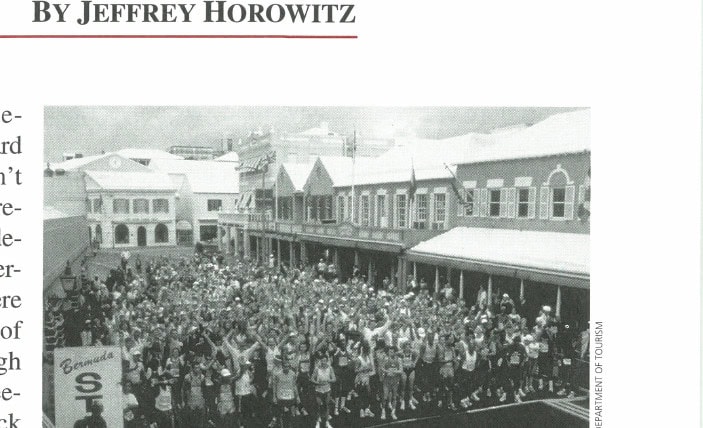
Inside the skin of the airliner, the temperature was controlled. Outside, just as the Department of Tourism brochures had promised, temps were in the mid 60s. The day was partly overcast and a little on the warm side for someone who’d come from damp, frigid DC, but for me, it would be a perfect setting for a race vacation. “Just hydrate and have a good run,” I told myself, my eyes still on the palm trees.
I had come to Bermuda to enjoy the warmth and run a marathon for fun. Every January, the Bermuda Track and Field Association, in conjunction with the Department of Tourism and a private marathon tour company (Marathon Tours), sponsors an International Race Weekend, which includes an invitational mile, a 10K, a half-marathon, and a full marathon.
After safely getting through another fall marathon season, running the Bermuda Marathon seemed a good way to take advantage of the big conditioning base I’d built over the past 6 months, and to reward myself for completing the season without injury.
Bermuda is a commonly misunderstood place. Often associated, albeit distantly, with the Caribbean islands, Bermuda actually lies far north of the Caribbean, about 570 miles east of the North Carolina coast. And although Bermuda is commonly considered a single island, it is really a collection of some 150 separate islands, many of them no more than a speck of rock peeking above the bright blue waters.
These islands are the tips of long-dormant volcanoes. Put together, they form a long, fishhook-shaped archipelago, inhabited by 61,000 people. Because the islands are swept by the friendly Gulf Stream waters and winds, the temperature in Bermuda stays moderate all year long, ranging from a low in the 60s to a high in the mid to upper 70s.
In the middle of this fishhook is the city of Hamilton, established in 1790 as a convenient meeting place for all of Bermuda’s scattered residents. Hamilton is the capital of Bermuda, and its streets are filled with pubs, restaurants, and little shops. The main thoroughfare is Front Street, which runs parallel to the harbor and features a roofed sentry box affectionately called “the birdcage,” from which a police officer directs traffic.
Near the birdcage is the Number 1 Passenger Terminal, site of the race packet pickup. After checking in at my hotel, I hustled over to get my race number, but I found surprisingly few people at packet pickup. I learned that the field would be—how shall I say this?—an intimate gathering of runners.
A SMALL AND INTIMATE FIELD
There were 392 runners registered for the full marathon and 313 for the half—a far cry from the maddening crowds at New York, Boston, and Chicago. But small races do have their charm.
Race secretary Pam Shailer told me that the day before last year’s marathon, she had been contacted by a runner making last-minute plans to fly to Bermuda to run the race. He was not registered and had not arranged for lodging and transportation. Pam accepted his registration, helped arrange his stay, and picked him up on race day to drive him to the starting line. While I would never dream of imposing myself on a race official that way—and I can’t guarantee that Pam would do something like that again—it’s nice to be part of a race in which the support is a little more personal than the norm.
I dabbled the rest of the day in sightseeing, shopping, eating—but mostly I rested, waiting for race day. I’d heard a report that rain was expected, so I’d come prepared for the worst. In the middle of the night I heard a light tapping noise: rain splashing against the window. Grrrr, I thought, clutching my pillow. I imagined the wet huddled mass of runners waiting at the start. But, no. Hours later, when I rose and headed out the door, the rain had tailed off, leaving a cool, overcast morning. Perfect!
By 7:30 A.M., I was once again on Front Street, 30 minutes from the start of the race.
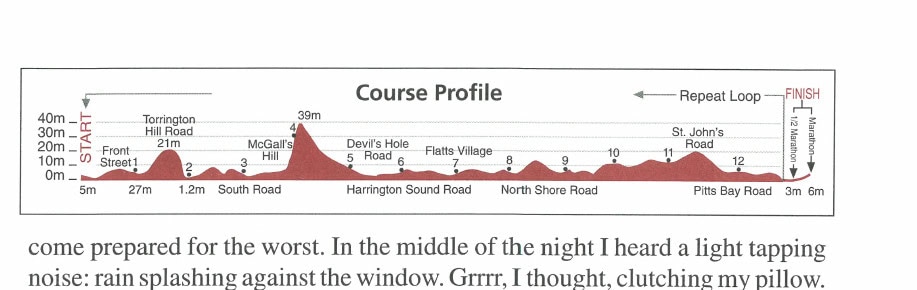
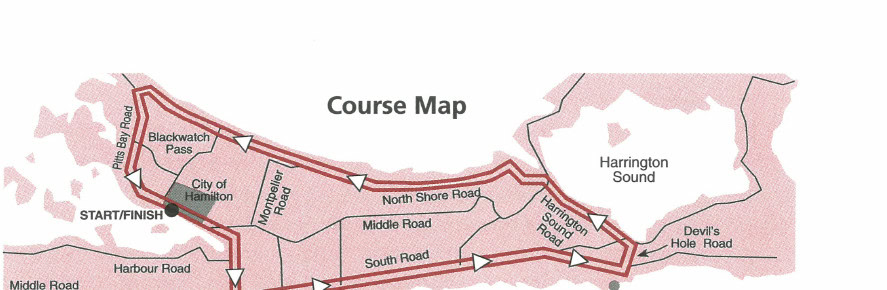
The course is a double loop, circling back to the start, where half-marathoners pull over to the side, while marathoners forge ahead for another circuit of the path just traveled. When I first began to consider running this race, my initial question was, “Where’s the hill?” After all, in a marathon, there’s almost always a hill. Sure enough, it was there: a nearly 40-meter climb at 3.5 miles called McGall’s Hill, revisited at 16.5 miles. I decided to keep that little impediment in mind.
After a quick bathroom visit (short lines!—another benefit of a small race field), it was time to line up. The signal was given, and suddenly we were off and running.
The first mile flashed by in a blur of storefronts and adrenaline, and then we slipped out of the city center and onto a beautiful country road, heading east. The road was not crowded, but neither was it empty: there were runners all around me, and I always feel at home in that community. We approached a few rolling hills and then arrived at the foot of McGall’s Hill. The climb looked impressive but fell easily under our eager feet. As I crested the hill, I wondered how it would seem to me a bit over an hour from now, when we returned to visit it again.
THE GREEN WORLD
Green. I’d noticed it upon arriving, but into the run, I noticed it everywhere. Lush green, bright green. The island doesn’t have a soil base deep and rich enough to support large-scale agriculture, but its native plants thrive, lining the marathon course with color. And there are other colors as well: houses splashed with blues and yellows and pinks, and the bright white of their rooftops, kept clean so the water that falls from their sides may be stored in underground cisterns for later use.
I also noticed something else—or, more correctly, the lack of something else. Garbage. I saw no trash on the streets, not in Hamilton, not on the country roads, not anywhere. So far, it was a runner’s paradise.
We turned north onto Devil’s Hole Road, and at mile five we were treated to a view of Harrington Sound. From there we turned towards Flatts Village.
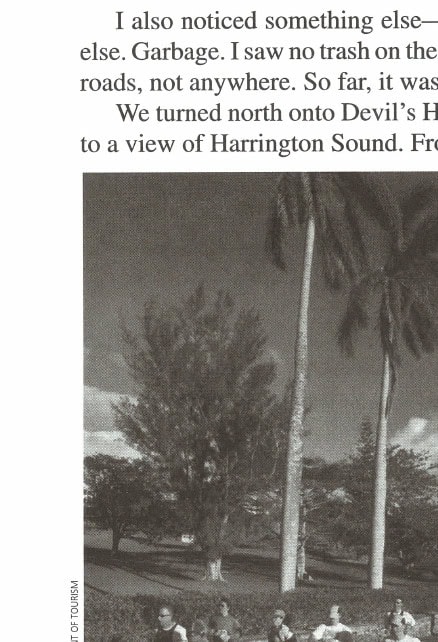
True to its name, the approach to Flatts Village is indeed flat. Crowds had been sparse, but at this point people began to show in larger numbers. There were several small groups of spectators. They appeared interested and supportive, though more reserved than the boisterous crowds you find at major marathons. Not exactly the Wall of Sound as you turn off the bridge and onto First Avenue at New York, and it certainly isn’t the Valley of Sound you pass through at Boston when you reach Wellesley. The restraint seems to be in line with the character of Bermuda. The islands are, after all, in possession of Great Britain, and they retain some of the Old World mannerisms and gentility. Bermudans don’t scream and yell along the course, but they are quick to return a polite “Hello” or “Good morning.”
Upon leaving Flatts Village, we turned left and headed west along the North Shore Road. Here, at mile 8, I was rewarded with the first ocean view of the race—and it was breathtaking. Jagged dark volcanic rock meets glorious blue water in a spray of white foam. The scene was almost enough to make me want to stop and sit, but I continued, consoled in the thought that I’d be back to see this again later in the morning when I did my second loop.
YOUNGER THAN IT LOOKS
The road then settled into a pattern of rolling hills, and I noticed that the porous nature of the limestone used as a building material made structures appear weathered and ancient—a stone archway overhead looked positively medieval. I also noticed a salty breeze blowing in off the ocean, another welcome distraction.
To my left, I saw the Railway Trail, a running path made up of segments from Bermuda’s old railway line, completed in 1931 and abandoned in 1947. The trail looks filled with beauty and adventure, carved through rock and draped in foliage. I fought the urge to head out and explore it.
At mile 11 we turned and headed south, back toward Hamilton. An old man sitting in a folding chair by the side of the road called out: “Once you pass me, it’s easy to the finish!”
“Great!” I called back. “See you again soon!” And I hoped I would.
The last 2 miles into Hamilton are downhill and fast. By this time, the sun had fought its way through the clouds and scattered them, and the foliage seemed to have retreated. “Not good,” I thought to myself as the temperature began to climb.
The halfway point loomed ahead, and the half-marathoners around us burst into speed. I joined their enthusiasm and flew through the finish line, but my race was only half over, and my legs, as if acknowledging that, lost some of their springiness.
I realized that McGall’s Hill was waiting for me a mere 3 miles away. As I tried to regain my focus and marshal my reserves, a man on a scooter passed by and offered me a piece of candy. “I’ll be with you guys all the way!” he promised as he sped ahead to the next runner. Just then an older Japanese man passed me and called out, “I’m faster than last year!”
“Good for you!” I called back. I felt oddly energized by his enthusiasm. I threw an invisible lasso around him, and let him pull me along for a few miles. Before long, I’d found my stride again and settled into a groove.
BERMUDA HAS always been a strategic outpost. After the American colonies won independence, England relied more on Bermuda, and in the 1820s the Royal Navy Dockyards were built at Bermuda’s far western tip. This structure was expanded over the years and supplemented with forts and lighthouses. During World War II, Bermuda became a center for intelligence operations, and Americans built an airfield on St. David’s island, reclaiming land and increasing the size of Bermuda by 5 percent. The U.S. forces introduced motor vehicles to the island, which until that time had been successfully resisted. Once planted on the island, though, cars refused to leave. They remain today but are strictly limited to one per household.
THE HILL LOOMS
And just in time, too. McGall’s Hill loomed ahead, and it seemed to have grown since my last circuit. That leaden feeling crept back into my legs, and I concentrated on just moving ahead, putting one foot in front of the other. Looking off to my left, I saw rolling green fields. On a distant hill a woman with long brown hair sat, a dog by her side. She smiled and waved, and I waved back, transfixed. And then I was on top of the hill. I noticed for the first time that there is a church there, and, on the right, a cemetery. Appropriate, I supposed. But not for me. Not today. I was moving on.
I began to breathe a sigh of relief as I remembered the flat miles that lay ahead. The heat had taken its toll, however, and I feared that soon I’d start slowing down. As I came upon Flatts Village again, I tried to put a confident face on my running—for myself as well as the spectators. I heard someone call out “You’re 17th!” Really? I’m not an elite runner, and I’d never before been told my place during a race. One more benefit of a small race field—and it was enough to boost me over the next few miles.
As I continued, I realized that the crowds, though sparse in numbers, were as determined as the runners to see the race through. They remembered me and called out as I passed by. The children waved, and the women smiled. “You’re looking good!” they called. “You too!” I yelled back to them.
Then came the old man, still sitting in his chair, waving to me as if he’d known me for years. And up ahead was Runner number 16. That could be me, I thought to myself, and as the miles passed, I felt confident it would be.
The street signs indicated 4 kilometers to Hamilton, so I tried to speed up. There was the man on his scooter again. No thanks, I shook my head: no more candy for me, but thank you, thank you.
Now there were more people along the path, and I’d begun counting the minutes. Mile 25 was downhill, and I wondered if the extra speed I gained from the descent would be worth the pain in my legs and lungs. But just ahead was Mister 16 and I was near, very near . . . and then next to him. He smiled and said “Hello.” I smiled back and surged onward. Then there was Front Street again, and the finish line just ahead, a real finish line for me this time, and I crossed it, relieved and grateful for having completed another marathon. A medal, and I turned around, and there was Mister 16—now Mister 17. I thanked him for being there to help me finish the race.
POSTRACE ENJOYMENTS
Now I stepped inside the terminal, upstairs where I’d left my baggage, and where there was the promise of food and drink. I took in fluids during the race, but I was still so thirsty. It had been hot out there, but Pam Shailer, the race secretary, told me that it had hailed during race weekend the year before, so I was happy to have been spared any rain or ice.
There were pastries, fruit, hot chocolate, and soup, and soon I felt revived. Downstairs, two massage therapists were administering to the runners, and I went down to get in line. When it was my turn, the therapist introduced himself as John Ford. From what I could tell, he knew just about everyone there. More important, his fingers were magic and brought welcome relief to my tired body.
SLAVERY WAS introduced to Bermuda in 1616, but because of the unsuitability of the island for large plantations, most slaves became skilled tradesmen rather than fieldhands. Slavery was finally abolished in 1834 throughout all the British possessions, including Bermuda. Segregation, however, was the policy in Bermuda, just as it was in the United States, well into the 1950s. A boycott of movie theaters and restaurants in 1959 brought about an end to segregation in those and other businesses, and universal suffrage was adopted in 1963. A new constitution, adopted in 1968, provided for full self-government on domestic issues, but in a referendum held in 1995, Bermudans rejected full independence from Britain by a margin of nearly three-to-one.
Getting There And Enjoying It
IF YOU decide to attend the Bermuda Marathon, a long weekend would be enough time to see most of the sights and to appreciate the island’s beauty and history. To help plan and enjoy your trip, I recommend that you use The Lonely Planet guidebook to Bermuda. Also, check out the race Web site at www.bermudatracknfield.com.
Arrange your flights and lodgings early, as there are not many daily flights in and out of Bermuda, and the hotels fill up fast. I enjoyed staying at The Grotto Bay Resort, east of Hamilton, and the off-season prices were a bargain. But if you don’t like waiting for a bus or paying for a long taxi ride (renting a car is difficult and expensive), the better idea would be to get a room in one of the hotels just outside downtown Hamilton. The Hamilton Princess Hotel is one of the old grand dames and is near to the finish line. This should be your first choice if it is within your means.
Expect to pay a little more than usual for all your meals. There is no prerace pasta feed, but I recommend La Trattoria Restaurant, 22 Washington Lane, for good, cheap carboloading. For lighter fare and a beer or two, the Frog & Onion, out by the Royal Navy Dockyards, is a fun pub to visit. And if you have a chance, treat yourself to High Tea in one of the finer hotels.
As it turned out, the finish line stayed open well past the advertised deadline, and the last finisher crossed almost 9 hours after the race began. The men’s winning time was 2:21:18 by Fedor Ryzkov, and the women’s winning time was 2:43:17 by Lioudmila Kortchaguina. Both came from Russia.
As I made my way back to my hotel for a well-earned shower, I wondered about the future of the race. We have seen lots of races grow so big that they have become, as Yogi Berra might have said, so crowded that no one goes to them anymore. So what can we expect to happen to the Bermuda Marathon?
Here’s what we know. The Bermuda Marathon is held in an exotic location, but it’s easily accessible from many U.S. cities. It’s a wintertime race that offers moderate to warm temperatures and has relatively little competition from other marathon races at that time of year.
Finally, it has already become a destination race for one major charity fundraising organization, and others can be expected to follow. So, assuming continued corporate sponsorship, it’s a good bet that this race will grow significantly over the next few years. There’s no reason to believe that this will be a problem, however, since both the Bermuda Marathon course and the race administration appear ready to handle bigger crowds. For now, and for the foreseeable future, the Bermuda Marathon is a jewel of a race and deserves to be added to your running to-do list.
marathon • 2 person relay • 5 person relay • wheelchairs • marathon walk • kid’s marathon • memorial walk • expo
Sunday, April 28th, 2002 — Oklahoma City, Oklahoma
This article originally appeared in Marathon & Beyond, Vol. 6, No. 1 (2002).
← Browse the full M&B Archive1,000+ stories from 19 years of Marathon & Beyond
The complete archive of the legendary long-distance journal — digitized and free to read.
