

Basic Training for the Marathon
When the marathon was created as a special Olympic Games event in 1896, it was considered by many sports enthusiasts to border on cruel and unusual punishment of the human body. Those who raced the marathon were considered by some as supermen, by others as madmen. They were, in reality, both.
But the cult of the marathon has over the years—due to experimentation and evolution—become the avocation of the marathon. Today, in the United States alone, more than 400,000 people per year run at least one marathon; this is more than four times the number of marathoners per year in 1979, the peak of the original running revolution.
With proper dedication to training, virtually anyone without serious medical concerns (and some with them, such as recovering heart patients) can cover the marathon distance in a reasonable amount of time. This is in no way meant to denigrate or underestimate the challenges inherent in covering 26.2 miles under your own power. The marathon remains one of the most demanding athletic events in the world. Before embarking on such a strenuous challenge, a runner should have his or her current health and fitness evaluated by a physician. Some potential medical problems are not easily detected.
Most first-time marathoners—and this program is aimed at first-timers—(the next two issues of M&B will offer programs for breaking 3:30 and 3:00, respectively) set a goal of safely finishing a marathon, not running one as fast as they can. Time and speed goals usually come later, and they present a whole ‘nother set of challenges.
Quantity Versus Quality
The past decade has seen an unfortunate shift away from high mileage as base training for marathoners and more toward quality mileage. This is unfortunate because the stronger base a runner can build before honing his or her talents with hills and speed, the better.
Certainly a first-time marathoner who does not have tremendous amounts of time to spend on training must emphasize quality. But quantity, as in building a solid foundation or base of easy mileage, must not be overlooked. The base of (relatively) high mileage is the foundation on which all other specific/quality training is built. Build a skyscraper on a faulty foundation at your own risk.
Marathon-training programs built on a foundation of high mileage go back to the New Zealand coach Arthur Lydiard. Virtually every American who shone on the world stage in the 1970s and 1980s followed the basic Lydiard philosophy. Unfortunately, in America, Lydiard’s proven training philosophies were overshadowed by the “scientific approach,” which dictated a much smaller base—and the results, or lack of results, are obvious on the world stage. The program that follows here, as well as the subsequent two programs, are based on Arthur Lydiard’s teachings.
Although some people have taken up running and done a marathon within less than a year, this isn’t a good idea. And the older the runner, the less advisable is such a scenario. Jumping into marathon training without a sufficient base of several years of aerobic training is a good way to become a chronically injured ex-marathoner. Nor is it wise to get into a running program and decide to do a marathon as your first race. Although often done, it begs common sense and good judgment. There is much to be learned about racing itself by racing at shorter distances first (pacing, where to line up, what a race feels like, etc.), and races at shorter distances work wonderfully well as speed training toward an initial marathon.
The simple rule of physical training is this: stress the body, rest, then stress the body a little more to move it to a higher level, then rest again. Without rest, the body never adapts to the stress—it merely breaks itself down.
Before embarking on the 20-week, first-time marathon-training program that follows, a runner should be comfortable running 25 miles a week and should have the ability to do a long run of 10 miles at least every third week.
The Prime Building Blocks
Several factors are at play when building a solid marathon-training program:
1. The Long Run. The long run is the backbone of any marathon-training program. The long run should be increased by several miles every 2 weeks until it reaches at least 18 miles but works better climbing to 20 to 22 miles. If your body is not taught to run long, and then to run longer, the marathon itself will be one of the longest—and most excruciating—experiences of your life. Not the way to enjoy a first marathon. Some contend that it’s best to build a long run longer than the marathon itself; this is a bad idea for anyone except very experienced marathoners. For the first-timer, it is doubly inadvisable. First of all, a run this long can open the would-be marathoner to overuse injuries by overdoing it. Second, for the first-time marathoner, it is a real psychological plus to be running your first marathon-distance event on the day of your planned marathon, rather than the race itself becoming anticlimactic because you ran the distance before. Long runs should not be “slogged.” They should be run at a speed roughly one minute slower than what you plan to run the marathon itself.
2. Regularity of Training. To run well, the body needs to be trained regularly—that is, 5 to 6 days a week, with set workouts for certain days, set up on a hard/easy pattern. Regularity of workouts allows you to set your workout schedule around your week (or your week around your workout schedule).
3. Good Nutrition and Hydration. Good nutrition fuels the body’s performance and rebuilds broken-down muscles. As for all the trendy dietary manipulations out there, ignore them and cut back on fats and increase carbohydrates, the body’s gasoline. This isn’t rocket science, merely common sense. As far as hydration goes, drink eight to ten glasses of water a day. Yes, you’ll have to urinate frequently, but that just indicates you are properly hydrated. Virtually every organ in your body needs to be bathed in water for it to work efficiently—including your brain. Cut back on alcohol 2 days before a long run; besides its capacity to dehydrate, alcohol can also make it more difficult for your blood system to transport much-needed oxygen. Don’t drink soda pop—it’s no good for you (read the contents of a can some time).
4. Speed Play. Don’t be afraid of speed. If you can throw some speed play (fartlek) into your workouts during the week, it will train your legs to turn over faster, and as a result, the marathon—run at a much slower speed—will seem less of an effort. Repeat miles at the track allow you to gain speed, practice good running form, and learn pacing, as it is a precisely measured environment, which very few training courses are.
5. Shorter Races. Some runners take up the sport and then train for and run a marathon without ever running a shorter race. Bad move. Racing at shorter distances presents an opportunity to do speedwork under the guise of racing while also familiarizing you with the road-racing environment. Running the marathon as your first race is putting unnecessary stress and strain on your experience.
The Basic Program
The 20-week training program that follows is for a runner who is currently running regularly, at least 25 miles a week, and who has been running 10K races at slower than 40 minutes.
- WHR refers to “working heart rate.” Although there has been some breaking away from the traditional methods of calculating working heart rate, the new methods can merely complicated a relatively simple process. Why complicate your life? To determine your WHR, subtract your age from 220. This gives you your theoretical maximum heart rate, which translates to 100 percent. From that number, chart rates that equate to 60 percent, 70 percent, 80 percent, and 90 percent of your maximum rate. If you use a heart-rate monitor, so much the better. You can program the monitor for target 60 percent of maximum heart rate for that day’s workout, for instance. If you don’t train with a heart rate monitor, periodically take your pulse while on the run. Because everyone coming to this program has different abilities, but each has a chronological age and a heart rate, the WHR is the easiest way to get everyone working at the same rate. Naturally, your level of fitness, your gender, and your body weight are significant factors.
- Hills. When the workout calls for hills, do not use rugged mountains—unless you’re training for a rugged mountain marathon. The course should contain a regular diet of hills, but the hills should be no steeper than 3 to 4 degrees. Don’t charge the hill, but run it under control and with an eye to good form.
- Rest. A rest day means rest. Don’t exercise, unless it is casual exercising such as bike riding (not racing) or swimming.
- Mile repeats. Always do the warm-up and also a 1-mile cooldown followed by a 1-mile walk. Walk one lap of the track between each mile repeat.
- Long runs. Do your long runs at the WHR indicated—don’t merely slog through them. Long run courses should not be excessively hilly or difficult, as the long run should allow you to get into a rhythm and cruise along. Practice fluid-intake on long runs, either by having someone crew you or by hiding bottles along the course. Practice with the drinks (water or sports drink) that you plan to drink on race day.
- Upper-body workouts. Although few marathoners do a regular upper-body routine, doing a simple three- to four-times-a-week session of sit-ups, push-ups, and arm curls can add strength to the upper body. This strength comes in very handy when you would otherwise begin to droop after the first 18 to 20 miles in a marathon.
What follows is your basic marathon-training program counting 20 weeks from your marathon:
20 Weeks Out
| SUN | Rest |
| MON | 3-mile run at 60% WHR |
| TUE | 1-mile warm-up jog, 1-mile hill run at 70% WHR, 1-mile cooldown jog |
| WED | 3-mile run at 60% WHR |
| THU | Track: 2-mile warm-up, 2 repeat miles at 70% WHR, 1-mile cooldown jog, 1-mile cooldown walk |
| FRI | Rest |
| SAT | 10K race |
19 Weeks Out
| SUN | Rest |
| MON | 3-mile run at 60% WHR |
| TUE | 4-mile run at 70% WHR |
| WED | 3-mile run at 60% WHR |
| THU | Track: 2-mile warm-up, 2 repeat miles at 70% WHR, 1-mile cooldown jog, 1-mile cooldown walk |
| FRI | Rest |
| SAT | 10-mile run at 70% WHR |
18 Weeks Out
| SUN | Rest |
| MON | 4-mile run at 60% WHR |
| TUE | 1-mile warm-up jog, 1-mile hill run at 80% WHR, 1-mile cooldown jog |
| WED | 4-mile run at 60% WHR |
| THU | Track: 2-mile warm-up, 2 repeat miles at 80% WHR, 1-mile cooldown jog, 1-mile cooldown walk |
| FRI | Rest |
| SAT | 8-mile run at 70% WHR or 10K race |
17 Weeks Out
| SUN | Rest |
| MON | 3-mile run at 60% WHR |
| TUE | 4-mile run at 70% WHR |
| WED | 3-mile run at 60% WHR |
| THU | Track: 2-mile warm-up, 1 repeat mile at 70% WHR, 1-mile cooldown jog, 1-mile cooldown walk |
| FRI | Rest |
| SAT | 12-mile run at 70% WHR |
16 Weeks Out
| SUN | Rest |
| MON | 4-mile run at 60% WHR |
| TUE | 1-mile warm-up jog, 2-mile hill run at 70% WHR, 1-mile cooldown jog |
| WED | 3-mile run at 60% WHR |
| THU | Track: 2-mile warm-up, 3 repeat miles at 70% WHR, 1-mile cooldown jog, 1-mile cooldown walk |
| FRI | Rest |
| SAT | 10K race followed immediately by 5K jog |
15 Weeks Out
| SUN | Rest |
| MON | 5-mile run at 60% WHR |
| TUE | 1-mile warm-up jog, 2-mile hill run at 80% WHR, 1-mile cooldown jog |
| WED | 3-mile run at 60% WHR |
| THU | Track: 2-mile warm-up, 3 repeat miles at 80% WHR, 1-mile cooldown jog, 1-mile cooldown walk |
| FRI | Rest |
| SAT | 14-mile run at 70% WHR |
14 Weeks Out
| SUN | Rest |
| MON | 5-mile run at 60% WHR |
| TUE | 1-mile warm-up jog, 3-mile hill run at 70% WHR, 1-mile cooldown jog |
| WED | 3-mile run at 60% WHR |
| THU | Track: 2-mile warm-up jog, 4 repeat miles at 80% WHR, 1-mile cooldown jog, 1-mile cooldown walk |
| FRI | Rest |
| SAT | 8 to 10-mile run at 80% WHR or 10K race immediately followed by 5-mile jog |
13 Weeks Out
| SUN | Rest |
| MON | 4-mile run at 60% WHR |
| TUE | 1-mile warm-up jog, 2-mile hill run at 70% WHR, 1-mile cooldown jog |
| WED | 3-mile run at 60% WHR |
| THU | Track: 2-mile warm-up jog, 3 repeat miles at 70% WHR, 1-mile cooldown jog, 1-mile cooldown walk |
| FRI | Rest |
| SAT | 15-mile run at 70% WHR |
12 Weeks Out
| SUN | Rest |
| MON | 5-mile run at 60% WHR |
| TUE | 1-mile warm-up jog, 3-mile hill run at 70% WHR, 1-mile cooldown jog |
| WED | 4-mile run at 60% WHR |
| THU | Track: 2-mile warm-up jog, 4 repeat miles at 70% WHR, 1-mile cooldown jog, 1-mile cooldown walk |
| FRI | Rest |
| SAT | 10K race followed immediately by 5-mile jog |
11 Weeks Out
| SUN | Rest |
| MON | 5-mile run at 60% WHR |
| TUE | 1-mile warm-up jog, 3-mile hill run at 80% WHR, 1-mile cooldown jog |
| WED | 4-mile run at 60% WHR |
| THU | Track: 2-mile warm-up jog, 4 repeat miles at 80% WHR, 1-mile cooldown jog, 1-mile cooldown walk |
| FRI | Rest |
| SAT | 16-mile run at 70% WHR |
10 Weeks Out
| SUN | Rest |
| MON | 5-mile run at 70% WHR |
| TUE | 1-mile warm-up jog, 4-mile hill run at 70% WHR, 1-mile cooldown jog |
| WED | 4-mile run at 60% WHR |
| THU | Track: 2-mile warm-up jog, 5 repeat miles at 70% WHR, 1-mile cooldown jog, 1-mile cooldown walk |
| FRI | Rest |
| SAT | 10 to 12-mile run at 80% WHR or 10K race immediately followed by 5K jog |
9 Weeks Out
| SUN | Rest |
| MON | 4-mile run at 60% WHR |
| TUE | 1-mile warm-up jog, 3-mile hill run at 70% WHR, 1-mile cooldown jog |
| WED | 4-mile run at 60% WHR |
| THU | Track: 2-mile warm-up jog, 4 repeat miles at 70% WHR, 1-mile cooldown jog, 1-mile cooldown walk |
| FRI | Rest |
| SAT | 18-mile run at 70% WHR |
8 Weeks Out
| SUN | Rest |
| MON | 5-mile run at 60% WHR |
| TUE | 8-mile run at 70% WHR |
| WED | 4-mile run at 60% WHR |
| THU | Track: 2-mile warm-up jog, 5 repeat miles at 70% WHR, 1-mile cooldown jog, 1-mile cooldown walk |
| FRI | Rest |
| SAT | 10K race followed immediately by 10K jog |
7 Weeks Out
| SUN | Rest |
| MON | 5-mile run at 70% WHR |
| TUE | 1-mile warm-up jog, 4-mile hill run at 80% WHR, 1-mile cooldown jog |
| WED | 4-mile run at 60% WHR |
| THU | Track: 2-mile warm-up jog, 5 repeat miles at 70% WHR, 1-mile cooldown jog, 1-mile cooldown walk |
| FRI | Rest |
| SAT | 20-mile run at 70% WHR |
6 Weeks Out
| SUN | Rest |
| MON | 6-mile run at 60% WHR |
| TUE | 8-mile run at 70% WHR |
| WED | 4-mile run at 70% WHR |
| THU | Track: 2-mile warm-up jog, 5 repeat miles at 80% WHR, 1-mile cooldown jog, 1-mile cooldown walk |
| FRI | Rest |
| SAT | 12 to 14-mile run at 80% WHR |
5 Weeks Out
| SUN | Rest |
| MON | 5-mile run at 60% WHR |
| TUE | 1-mile warm-up jog, 4-mile hill run at 70% WHR, 1-mile cooldown jog |
| WED | 4-mile run at 60% WHR |
| THU | Track: 2-mile warm-up jog, 4 repeat miles at 70% WHR, 1-mile cooldown jog, 1-mile cooldown walk |
| FRI | Rest |
| SAT | 21-mile run at 70% WHR |
4 Weeks Out
| SUN | Rest |
| MON | 6-mile run at 60% WHR |
| TUE | 10-mile run at 80% WHR |
| WED | 5-mile run at 70% WHR |
| THU | Track: 2-mile warm-up jog, 5 repeat miles at 80% WHR, 1-mile cooldown jog, 1-mile cooldown walk |
| FRI | Rest |
| SAT | 13 to 15-mile run at 80% WHR or 20K race or 20K time trial |
3 Weeks Out
| SUN | Rest |
| MON | 6-mile run at 60% WHR |
| TUE | 1-mile warm-up jog, 5-mile hill run at 70% WHR, 1-mile cooldown jog |
| WED | 5-mile run at 70% WHR |
| THU | Track: 2-mile warm-up jog, 5 repeat miles at 70% WHR, 1-mile cooldown jog, 1-mile cooldown walk |
| FRI | Rest |
| SAT | 22-mile run at 70% WHR |
2 Weeks Out
| SUN | Rest |
| MON | 5-mile run at 60% WHR |
| TUE | 6-mile run at 60% WHR |
| WED | 4-mile run at 70% WHR |
| THU | Track: 2-mile warm-up jog, 2 repeat miles at 80% WHR, 1-mile cooldown jog, 1-mile cooldown walk |
| FRI | Rest |
| SAT | 10 to 12-mile run at 70% WHR |
1 Week Out
| SUN | Rest |
| MON | 4-mile run at 60% WHR |
| TUE | 2-mile run at 60% WHR |
| WED | 3-mile run at 70% WHR |
| THU | Track: 2-mile warm-up jog, 1 repeat mile at 90%, 1-mile cooldown jog, 1-mile cooldown walk |
| FRI | Rest |
| SAT | Rest or 2-mile slow jog |
| SUN | MARATHON race at 70% WHR |
Get up plenty early on race day so you’re not rushing yourself. Get to the start at least 30 to 45 minutes before the race is to start. Jog easily for 1 mile to loosen up, but don’t do any fast running. The race itself will give you the chance to gradually loosen up your stride.
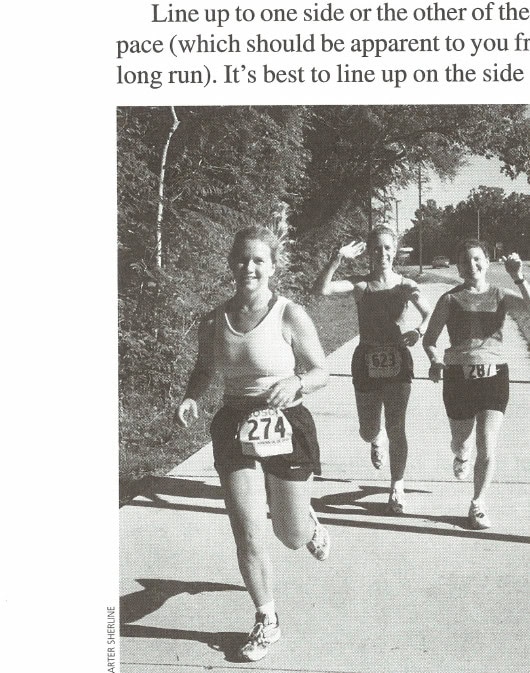
Line up to one side or the other of the field that approximates your planned pace (which should be apparent to you from the pace you kept in your 22-mile long run). It’s best to line up on the side so you don’t get trapped in the center of the field. Don’t line up in the front unless you plan to win the race. You’ll only hamper faster runners. Don’t get sucked into a fast pace by the excitement of the race environment. Get into your planned pace (i.e., 70% WHR) as soon as possible and stay there.
Mentally break the race into segments: 5 miles, 10 miles, 5 miles, 10K. This pattern goes like this: 5 miles—get into groove, find pace, get rhythm, warm up; 10 miles—smoothest miles of race; be cautious to hold pace down when it begins to feel too easy; 5 miles—concentrate on keeping smooth and regular pace against impression of increasing effort; 10K—the hard work segment; concentrate and work to hold pace.
The final 10K is difficult for everyone. If you have not exceeded your pace in miles 5 through 15, once your muscles loosen up and you feel good, you should have some energy reserved for the final miles.
Once you cross the finish line, pick up your medal and then keep jogging, or at least walking, for 2 miles or so to bring your heart rate down gradually and to work some of the stiffness out of your legs before it sets in.
Use the week after the race to rest and bask in the glow of a job well done and to restock the carbohydrates you burned during the race. If you exercise at all, take some gentle walks.
Congratulations: you’re a marathoner!
This article originally appeared in Marathon & Beyond, Vol. 6, No. 1 (2002).
← Browse the full M&B ArchiveMore like this
1,000+ stories from 19 years of Marathon & Beyond
The complete archive of the legendary long-distance journal — digitized and free to read.
