

Jenny Kyle Stays In It For the Long Run
Georgia woman overcomes physical problems to remain top runner. by Stephen Prudhomme
Jenny Kyle’s marathon career has spanned over three decades, one in which quality rather than quantity has been the overriding characteristic. Her marathon accomplishments gain even more stature when measured against the physical difficulties that reduced her to walking, albeit at a brisk pace. With the determination forged by years of training and racing, she has managed to overcome these setbacks and return to running with a renewed sense of purpose and energy while working a demanding job in which she is on her feet much of the day.
Although the marathon isn’t her favorite distance, Kyle is definitely in it for the long run. A native of England, the 62-year-old Kyle lives in Savannah, Georgia, where she works as the chief radiation therapist at the Anderson Cancer Institute. She has lived in the United States for more than 30 years, calling on the competitive skills she honed in various sports in England to become a top runner in distances ranging from the mile to the marathon.
Kyle grew up in Manchester, England, and played field hockey, cricket, lacrosse, and tennis. Although she didn’t compete in any footraces, she certainly was no stranger to running. “I did a lot of running while playing sports in England,” says Kyle, whose words tumble out and still carry a noticeable English accent. “People don’t always realize how much running you do in field hockey. That certainly helped when I took up running later on.”
Kyle’s introduction to running as a sport took place thousands of miles away from her homeland. She and her husband, Dave, had moved to New Orleans in 1976. The following year, Kyle started running with her husband.
▲
Jenny Kyle has discovered the fountain of youth in Savannah, recording race times that belie her age.
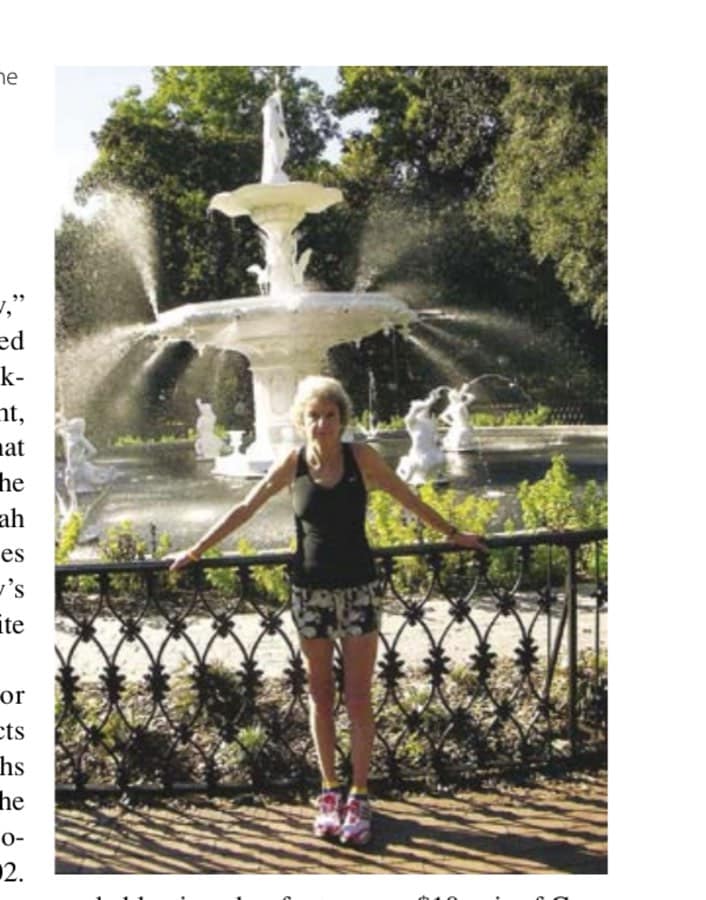
“I enjoyed it right away,” says the wiry, curly-haired Kyle, whose athletic background has produced a light, economical running style that makes it appear as though she is floating along. Savannah runner Brian White describes her form as efficient. “Jenny’s a very natural runner,” White says.
It didn’t take long for Kyle’s competitive instincts to kick in. Just several months after taking up running, she entered her first race, a twomiler, and finished in 15:02. Kyle’s time was all the more remarkable given her footwear: a $10 pair of Converse basketball shoes. “
I didn’t know anything about running shoes,” Kyle says. “It was quite hard. I hadn’t run fast or raced.” Kyle had added incentive to run a fast race. Her husband promised her some top-of-the line running shoes if she finished under 16 minutes.
Her basketball shoes relegated to the closet, Kyle started doing races on a regular basis and, as runners are inclined to do, upped her distances. She completed a 10-mile race in Louisiana in 82 minutes and ran a half-marathon in 1:40 in Denver, where she and her husband had moved.
Moving up to the marathon It wasn’t long before the marathon beckoned. Kyle had her first chance at the 26.2mile distance in Denver in the fall of 1979. Her goal was to best her husband’s marathon time of 3:50. Kyle tweaked her training schedule, increasing her weekly long runs and logging two to three 20-milers. That training regimen allowed her to claim family bragging rights in the marathon.
Running at altitude, she finished in 3:18 and won her age group. Says Kyle: “I really surprised myself with the time. I really went out there and just ran out. I kept up a steady pace and never hit the Wall.”
Many runners spend a lifetime dreaming of competing in the Boston Marathon, the only one of its kind that requires a qualifying time, but never making it to the starting line at Hopkinton. Here was Kyle, a relative newcomer to running, having qualified in her first marathon. She was part of a select company, poised to achieve even more marathon glory on the streets of Boston. Given her performance in her first marathon, at altitude, Kyle appeared to have a realistic shot at breaking three hours. Yet the difficulty of the course, the weather conditions, and a hankering for sightseeing conspired against Kyle, who labored to match her inaugural marathon time of 3:18. “
The day before the race, I walked the Freedom Trail,” she says. “Then, on race day, I had to wait until noon before starting. There’s so much downhill. It made my quads ache. It’s a very challenging course.”
Kyle also had to contend with warm temperatures. “I was used to training in the cold and snow,” she says. Kyle’s next marathon came overseas, in her native England. She competed in the 1980 Avon International Women’s Marathon and, lo and behold, ran her third consecutive marathon in a time of 3:18. “I didn’t do much training,” Kyle says. She adds that it was a neat experience and she enjoyed running with only women.
Back in her element, after a one-year sabbatical from the 26.2-mile distance, Kyle set her sights on the 1982 Denver Marathon. Following Boston, she says she wanted to do “one better.” Five weeks prior to the race, taking an approach that few training programs advocate, Kyle ran 26.1 miles. “Psychologically, it’s good for you running the marathon distance,” she says.
A unique long-run approach It was hard to argue with her results. Kyle ran a personal-best time of 3:06 and was the second female finisher. She says she could have run an even faster time if she hadn’t started out as fast and then slowed down in the latter part of the race. Kyle accomplished her goal of doing one better after Boston. “I really enjoyed it,” she says.
It would be 12 years before she ran another marathon. Kyle and her husband left Denver in the mid-’80s and moved to Dallas, Texas. During their two-anda-half-year stay, Kyle planned on running a marathon but had to pull out due to sickness. One of her better running performances during that time came at a half-marathon in Calgary, where she recorded a 1:23.
In 1988, the couple moved to Savannah. It didn’t take Kyle long to make her mark in local running circles, setting the Georgia record for masters at the
1990 Savannah Half-Marathon with a time of 1:22:40; at the time, there was no Savannah Marathon. The following year, Kyle experienced the first of several physical setbacks that forced her to temporarily give up her favorite recreational pursuit. Suffering from a foot injury that wouldn’t heal, Kyle didn’t run for six months. She stayed in shape by riding an exercise bike and swimming. After her foot healed, Kyle couldn’t wait to hop off the bike and out of the pool and go back to the roads and paths. She says that despite the half-year layoff, she didn’t lose any speed. “I was surprised how quickly it came back.”
In 1993, Kyle could have run the Savannah Marathon on city streets but decided against it. “There was too much traffic on the marathon course,” says Kyle, who ran the half-marathon instead and was the top female finisher, in a time of 1:25.
Her marathon sabbatical ended the following year when the Savannah Marathon moved 15 miles east, to Tybee Island, where marathoners run two loops around the island and encounter only minimal traffic.
Kyle says her plan was to run the race at an even pace. She did that one better by completing the second half three and a half minutes faster than the first. Even better, she finished as the top female, in a time of 3:14. The race was decided over the last several hundred yards.
ad
▲ It’s a run in the park for Jenny Kyle, who loves exercising her passion in downtown Savannah.
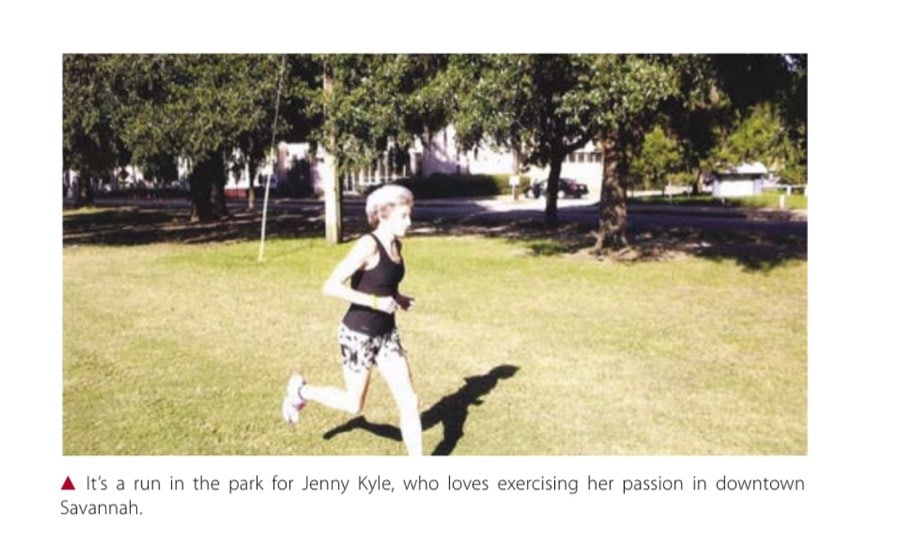
Kyle says a friend standing along the course near the 25-mile mark told her the “winner” (first-place female) was several hundred yards ahead. Kyle picked up her pace and passed the woman with one-tenth of a mile to go on her way to breaking the tape.
Kyle says she felt really good throughout the race and was motivated by bystanders calling out her name. Says Kyle: “It was a local crowd. The people knew me. They really helped. That was one of the best experiences I had running.”
The euphoria didn’t last too long. In 1995, Kyle began experiencing muscle soreness and fatigue and was diagnosed with fibromyalgia, a disease of the immune system that is associated with raised levels of the brain chemicals that transmit nerve signals. Not only did her muscles hurt to the touch, Kyle says, but the disease also tended to make her depressed. Then, to add to her woes, doctors discovered and removed a large mass from her abdomen.
As she was treated for fibromyalgia and recovered from her surgery, Kyle had to face another piece of depressing news—she couldn’t run. But she could walk, and the competitor in her called out for anything but a leisurely stroll. “
I had (time) goals for walking,” Kyle explains. “Toward that end, I started running/walking. I did an awful lot of walking. I was determined to come back.”
On the comeback trail That determination paid off. Some 10 months after her surgery, Kyle entered a 5K race in downtown Savannah, finishing in 24 minutes. She says that was the first time she ran three miles since being sidelined, and it “felt good.”
The following year, after having carefully worked her way back into running, Kyle competed in the half-marathon on Kiawah Island. She finished in a time of 1:25. In 1997 and 1998, Kyle served as a race volunteer at the Tybee Marathon/Half-Marathon. “I really enjoyed that,” she says. In 1999, it was time to return to the marathon. Kyle recalls that she had built herself back up again to do a marathon and, as added incentive, some friends were doing it.
Kyle responded with a 3:23 on a course that she describes as “OK.” The dearth of runners during the second loop didn’t bother her. She says she doesn’t really like big races but prefers those where people know you. As to how she negotiates those lonely miles in the last half of the Tybee Marathon, Kyle says she keeps her own thoughts.
Two years later, she returned to Tybee and duplicated her marathon time from 1999, good for third overall female finisher. Kyle says she was happy with her 3:23 times at both Tybee Marathons. Kyle concedes she has a certain reluctance to train for marathons. She doesn’t have to deviate much from her typical training week, which includes 40 miles of running, including a long run and speed work, to prepare for a half-marathon. However, she says her best marathons have come on the heels of 55-mile training weeks, mileage that is difficult to accumulate because of her busy work schedule.
ad
▲
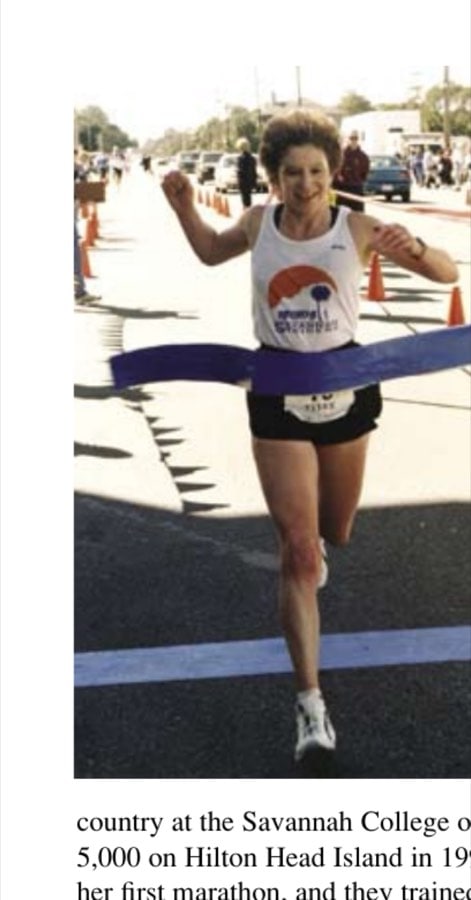
Jenny Kyle was the top female finisher at the 1994 Tybee Marathon, winning the race over the last couple of hundred yards and recording a 3:14 time.
“If I had more time, I would probably do more marathons,” Kyle says. “I’m on my feet all day, and I do my training at night. It’s difficult to get in the necessary mileage for a marathon.” Still, running is just what the doctor
ordered at the end of the workday. Noting that her job can be stressful, Kyle says running helps to relieve the stress. Working with cancer patients, she adds, motivates her to exercise and eat right.
In turn, Kyle motivates a number of runners, including Gabi Hauck, a former cross-country performer at Armstrong Atlantic State University in Savannah. Hauck, 41, who also coached crosscountry at the Savannah College of Art and Design, met Kyle at the Firecracker 5,000 on Hilton Head Island in 1997. Kyle subsequently helped train Hauck for her first marathon, and they trained together for a number of marathons.
Hauck describes Kyle as a very dedicated and consistent runner who has had her ups and downs but always comes back. “Jenny shows how consistency and dedication pay off,” Hauck says. “She loves running. That’s her love. She’ll always do that.”
Hauck says Kyle has very good form and is very efficient, noting that her form does not change whether she is going fast or slow. She adds that Kyle is really light on her feet and an inspiration to her and other female runners. “
It’s impressive how she runs at her age,” says Hauck. “There are not many females her age or younger who can keep up with her. If I can run like that in 20 years, I’ll be very happy. For the longest time, I was the fastest one. Now I don’t think I can keep up with her.”
More dedicated fans Another Kyle fan is Ragan Lee. One of the top local runners in Savannah, Lee, in her early thirties, trains and competes with Kyle. She marvels at her ability and attitude.
“Regardless of the race or gender, Jenny remains in the mix of things, with a smile on her face,” says Lee, who works at Fleet Feet running store in Savannah. “We push each other. You can see that Jenny is happy running. She’s encouraging and fun to be around.”
When she is healthy, Kyle is a formidable runner. The key for her is staying healthy. In 2005, Kyle ruptured her appendix and didn’t run for six weeks. Her first race back was the Savannah Bridge Run, considered one of the toughest 10K courses in the Southeast. Kyle finished in 48 minutes. “
I did really well,” she says. “I had missed running. I was excited about it.” That excitement carried over to the 2007 Gate River Run in Jacksonville, Florida. Running a hilly course on a hot day, Kyle finished the 15K course in 1:06:18, which was three minutes faster than the previous record for a 57-year-old woman and topped the best time for a 55-year-old woman by several seconds.
Kyle has showed few signs of slowing down. In February 2010, she ran the Tybee Half-Marathon in 1:36, practically matching her time from the previous year. She says she would have done the marathon if it had been offered, but she was happy to do the half. Then, last May, in Savannah’s version of the Fifth Avenue Mile, Kyle flashed some of the speed that had served her so well in different athletic pursuits during her younger years by winning the female 60–64 age group in a time of 6:21. “I was happy with that,” she says. This year, Kyle ran a 6:34 to defend her title in the 60–64 age group.
Given her running history, Kyle can avoid the marathon for only so long. She plans on doing the inaugural Rock ’n’ Roll Savannah Marathon on November 5. “I’m really looking forward to that race because it’s in Savannah and it’s a marathon,” notes Kyle, who battled injuries following the death of her husband last fall that she attributed to being “worn out.” She adds: “I don’t have to go anywhere else to do it.”
As to her training regimen, Kyle will stick with the plan she has adopted in recent years as she has gotten older. She will run four to five days a week, do the rowing machine another day, and then take a well-deserved day off. “It works pretty well,” she says, adding that she will incorporate longer runs into her marathon training in the coming months.
Kyle credits her running success to natural ability and the competitiveness she developed while playing team sports in England. She says she works hard at it, probably more so than the average runner given her litany of physical challenges, yet it’s a labor of love. “
I like being outside, no matter what the elements are,” Kyle explains. “Sometimes I run by myself. Other times I run with other people. It’s a great stress reliever. I’ll keep going ’til I can’t go anymore.”
This article originally appeared in Marathon & Beyond, Vol. 15, No. 4 (2011).
← Browse the full M&B ArchiveMore like this
1,000+ stories from 19 years of Marathon & Beyond
The complete archive of the legendary long-distance journal — digitized and free to read.
