

Jewish Girls From Brooklyn Are Not Supposed To Run
When I was a little girl, there were two places I knew to find my mother. Either she was sitting at her desk in the fourth bedroom, a little attic crawlspace housing her desk, a typewriter, and stacks of papers, or she was at the track. My mother, a nice Jewish girl from Brooklyn, was the granddaughter of a union organizer and the daughter of a model. Beautiful, with thick brown hair, she wore an ERA (Equal Rights Amendment) bracelet, but she was no bra burner. She wore her sports bra all the time so she would always be ready to run. She ran in her patched Levi’s or gym shorts—yes, the classic ’70s version that are so in vogue right now. She was the first woman in our neighborhood to buy a pair of three-striped blue-and-orange Adidas running shoes, and she competed in every race from 10K to half-marathon. She loved to run. She had a 1.3-mile route around the block that would allow her to park my brother and me in front of the TV and still get in a reasonable loop. She would run a loop, check on us, and then run another. Then one day, she went out with my Uncle Lee for a run on Falls Road, and she felt pain in her knee. The stabbing pain was chondromalacia—softening of the cartilage. Her orthopedist told her, “You should never run again.” She was heartbroken but not defeated and immediately turned our cinder-block basement into a home gym with stack weights—unheard of, once again, at the time for a nice Jewish girl from Brooklyn.
Just about that time, I began running. I would meander around my mother’s loop around the block (1.3 miles) or run to my friend Terry’s house—six miles away in the fancy section of town. My mother encouraged me but worried that my knees had only a certain longevity. I ran through my teens for conditioning but did not find my true passion for running until medical school, when I ran my
first marathon. Let the games begin—that fateful NYC Marathon in 1990 would light a fire in me and my mother for years to come. My mother had severe claustrophobia, but she came to cheer me on that November day in 1990, even though the crowds were enormous seas of people all jockeying to see the runners finish. We never saw each other, but my mother saw hundreds of women crossing the finish line. In the back of her head, an idea was planted. If they could do it, so could she.
My mother the Amazon Two years later, after coming in from a run around Fort McHenry, I got a call from my mother. She found a lump in her breast, on her right side. She had a biopsy, and it was cancer. She was scheduled for a mastectomy the next day (my father, an oncologist, would have cut it out himself right then, if he could!). I immediately drove from Baltimore to my parents’ home. My mother, always nervous, was uncharacteristically calm. She would let my father make the decisions, all of them. The next morning, while she underwent her mastectomy, I ran around the block—my mother’s 1.3-mile loop—10 times. Julia, our cleaning lady, flagged me down off the street to take the call from my father. The doctors were able to remove all the cancer and leave no worrisome cells behind. It was 1.3 centimeters and had all of the “bad” markers—ER-, PR-, if left untreated. I went to the hospital to see her, and she asked me to stay the night and sleep in the bed next to her. I brought my pharmacology textbook from medical school at Johns Hopkins and read about the anticancer drugs, their activities, and their side effects. There was no way she would get away with not having chemotherapy. My father had devoted his career to drug development for cancer. He intended on
Courtesy of Elizabeth Thompson
▲
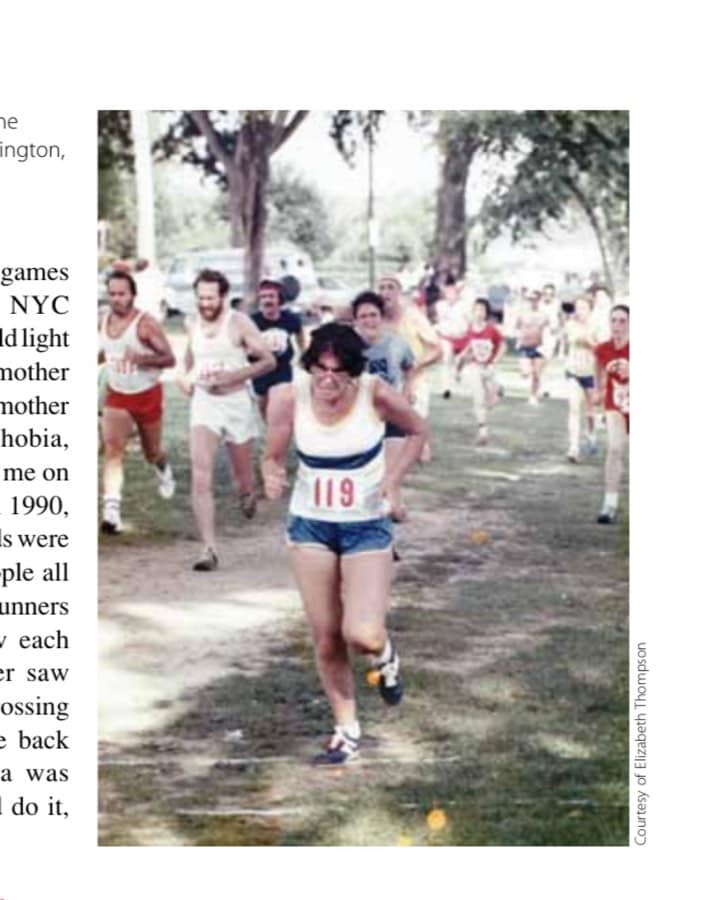
My mom running in the Schlitz Light 10K in Washington, DC, in the late seventies.
curing her cancer. This meant the full-court press: Cytoxan, Adriamycin, 5-Fluorouracil. The Adriamycin might affect her heart. The next six months would not be easy. She would definitely lose her hair. I panicked because I had already sent my “match” choices for residency—I put San Diego as my first choice, Johns Hopkins as my second. When I filled out my forms for residency, the last thing on my mind was the possibility that I would be taking care of my mother. She always took care of me!
The biggest immediate challenge, however, came from changing her bandages. She could not look at her chest; she refused. She whimpered when the surgeon even “took a peek.” Now the surgeon asked me to take the dressing down and let the area get some air. She turned her head as I took off the gauze and reapplied another clean piece. She was now, in the true meaning of the term, an Amazon— a female warrior with no right breast. Greek mythology tells the tale of fierce women warriors who cut off their breasts to facilitate shooting an arrow from a bow. My mother was going to fight this cancer like a warrior, even if she could not look in the mirror. In her mind, she would beat it. She looked at the next six months of recovery and chemo as an athletic event. She would plod along and not let it get her down. She still wanted to run that marathon.
Initially, the hardest part of the chemo was the smell of the hospital and the clinic. Just walking in the door, before an IV was in her arm, my mother felt nauseous. The medicines to stave off the nausea also made her incredibly sleepy. Her friends rallied and drove her back and forth to her appointments. I was busy finishing medical school, taking my boards, and getting ready to move to San Diego.
When I left for San Diego in late June, her chemo sessions began to take their toll—she lost her hair, her appetite, and her energy. She refused to wear a wig and preferred cotton scarves or a bald head. Washington, DC, summers can be brutal, but she spent hours lying in the sun on our deck, sleeping the cancer away, and patiently waiting for it all to be done. There was no talk of running, training, or exercise.
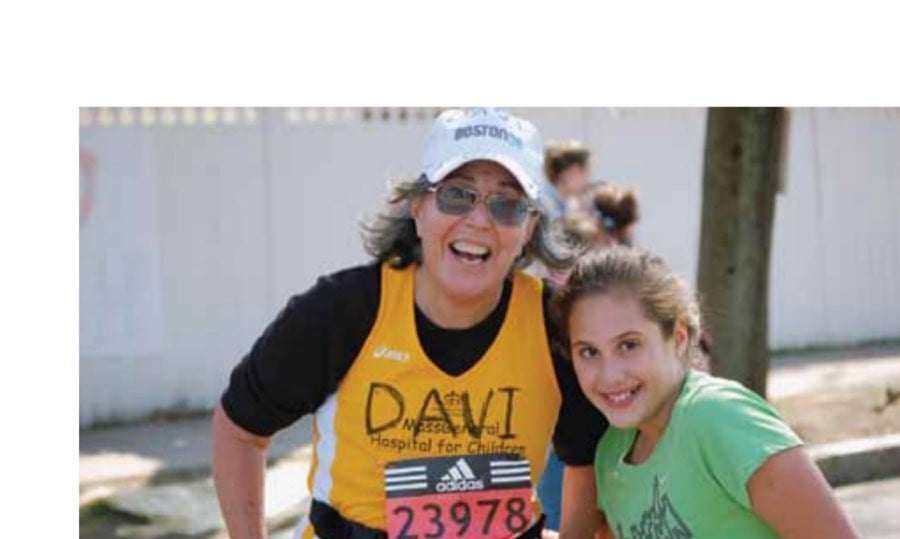
Fast forward to 2000 Seven years and 16 pounds later, my mother was fed up. She was distracted by grandchildren and work and could not stand the bulge below her belt. A veteran marathoner, I had decided to try to qualify for the Boston Marathon for the first time. I thought that she could do it, too, so she obtained a number as a charity runner for Mass General Hospital and decided to train for and run the marathon. She committed to raising money for the MGH Children’s Cancer program, and she did a great job inspiring people to contribute. At age 57, she would run her first marathon!
She had not exercised vigorously for years. She discussed the plan with her medical oncologist who did blood work, a chest X-ray, and an EKG. She had received Adriamycin, a potent anticancer chemotherapy agent, when she had breast
cancer. The drug can affect heart-muscle function, and he wanted to make sure that she was healthy enough to withstand 26.2 miles and potentially six hours of continuous exercise. He gave her the green light to train; she was strong.
Just to prove that the athlete was still alive, my father suggested that my mother support a local three-mile race for Friends Fighting Breast Cancer. My mother would claim that it was a fluke, but she entered and won the race in her
age category, women over 50! The reinforcement of the trophy added fuel to the fire. The athlete inside her woke up. When I asked her about it, she recalled, “I did it for one main reason. To me, running a marathon, training and sticking it
out to finish meant that I was strong again, even after a diagnosis of breast cancer, losing a part of my body, and receiving chemotherapy. I was making a statement to myself and to other women that it was certainly possible to accomplish an
endurance athletic event after great trauma to the body. My breast cancer and recovery was a great motivational factor in my training and the race itself.”
The Jeff Galloway method seemed reasonable for her with the run/walk scheme. (I was a devoted Hal Higdon follower.) She planned on building her base for four months and then following the 16-week training plan. On Nantucket, she would
complete serial loops around the one-mile paved road. I could watch her from the deck and keep an eye on the kitchen clock. If she didn’t come around once every 15 minutes, I would set out with my two children, Bebe
and Sol, then ages 1 and 2, and we would check on her and run beside her. The first few runs of two to three miles, she found that she had trouble catching her breath. That gradually eased up once she built up her stamina. Eventually, after a few months, she
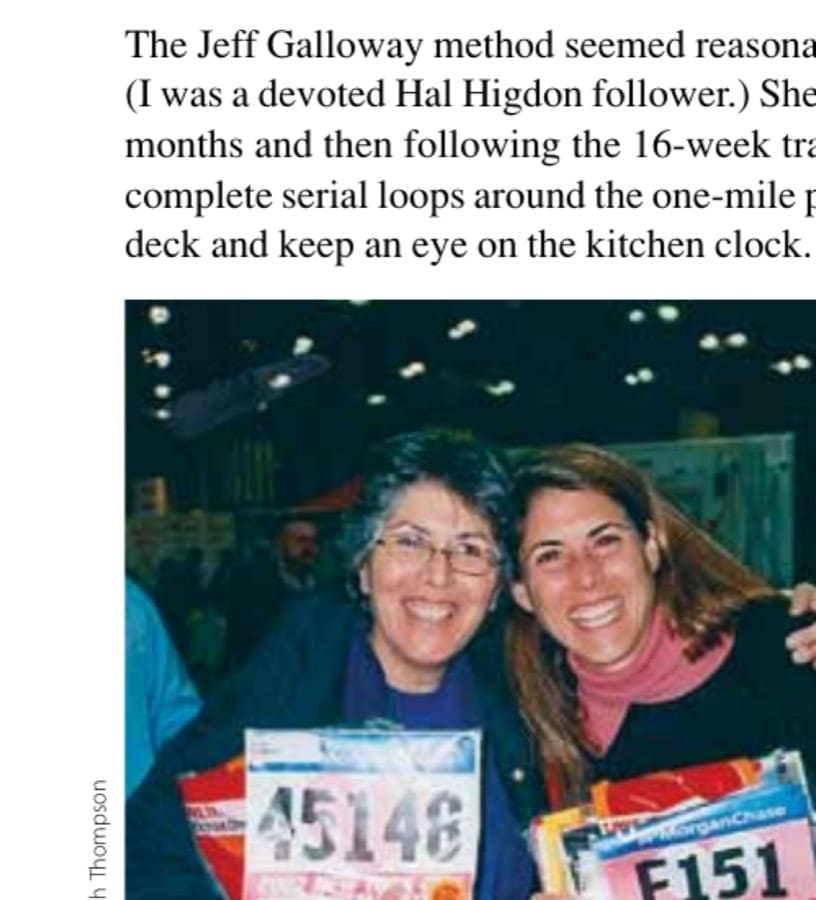
The author and her mom at the 2002 New York City Marathon expo.
▲
Courtesy of Elizabeth Thompson
Plodding along
began to think that she would be ready for more serious training. She had trouble with recovery. To help her cross-train on her days off, she put on her “granny belt” and ran in the pool. Committed to finishing her first marathon, she took everything seriously. In addition to building endurance that summer (eight months before Boston), she decided to lose the extra weight. The combination of training and weight loss was amazing; she began to see the athlete again. But she had several hurdles to overcome, even with the positive start.
Running shoes While the blue-and-orange Adidas of the 1970s had been her favorite back then, my mother discovered a brave new world of running shoes; but this time, she needed to go up a few sizes. She found good shoes in the men’s section—size 10 men’s!—and realized that her feet had the tendency to swell on long runs. She needed orthotics, thick socks, and lots of Bodyglide to prevent blisters. She wore a running belt and carried a stock of Band-Aids and other goodies for her long runs.
Bra and prosthesis Initially, she had a hard time finding a comfortable running bra and figuring out which prosthesis to wear. Foam or silicone? Most running-bra companies do not make a bra with a pocket for a prosthesis, either. Who could imagine a breastcancer survivor needing a running bra? Crisis! She had to go to the “old-lady bra store” and persuade the ladies there to sew a pocket into an exercise bra. “You’re doing what?” they asked with a look of complete confusion. Balance and weight of the prosthesis must also be taken into account. A foam prosthesis weighs less than a silicone prosthesis, but after an hour of running the body can detect a weight difference, so silicone seemed a better idea. Silicone is closer in weight to a natural breast, so one feels balanced side to side. The silicone prostheses were heavy and made for sedentary women. Prostheses for athletes did not exist. Once halfway through a run, my mother took her prosthesis, which kept sliding around, and put it in her fanny pack! Instant Brazilian butt lift.
Lightweight foam prostheses for athletes did not exist either. My mother commissioned her Japanese friend, Kyoko, who sewed “falsies” out of Japanese stockings and cotton batting. Although weighing less, the foam hardly felt natural. After several months and different bras, she decided to ditch her prosthesis altogether and run without it. Any runs over 12 miles would leave her with hot spots where her skin chafed. She had altered sensation on her chest wall and under her arm anyway, so it felt better with no prosthesis. “Who cares what I look like?” she asked. She ran unbalanced, but soon the rhythm of the running took over, and she forgot about the right side.
Fatigue and recovery A 57-year-old woman does not recover as quickly as a 35-year-old. My mother decided that she needed help. She hired a crew to get her through the winter months of running. A stretching coach kept her limber, a Pilates instructor strengthened her core, and a masseuse kneaded her fatigued muscles. My father teased her that he had to take out a loan to pay for the marathon staff. Money was no object to her—determination was the driving force. She wanted to cross the finish line. My father and I were her biggest fans. My mother felt it critical to have my father’s full support. He took it seriously and made it his project as well.
When my parents traveled to medical meetings or vacation, my mother brought an extra suitcase filled with her training gear. She ran 20 miles in Palm Beach, 16 miles in Vancouver, and dozens of miles in New York while visiting me. She followed Jeff Galloway’s method as though it were a bible. Variation was not an option.
Her breathing sounded like “Huh, huh.” Who can listen to that for 26 miles? My mother was always a heavy breather. When we were kids, we knew where she was in the house because she always made noise and a big mess. This became accentuated while she ran. After about three miles, each breath was “Huh, huh.” I couldn’t stand listening to it. I could not fathom how anyone let her stay awake during childbirth. She must have driven her obstetrician crazy with her breathing. So she ran alone. Nobody could take the noise of running next to her, especially since iPods had not made it to the market in time for her first marathon. An iPod would have helped to drown out the din of her breathing.
Nutrition and style My mother became a protein junkie. She made friends with the “meat heads” at GNC. Jugs of protein powder lined her kitchen counter. Each morning she took a dozen vitamin supplements: chondroitin, fish oil, multivitamin, St. John’s wort—you name it, she would take it, as long as it promised to make her stronger. She ate egg whites with peanut butter, sliced turkey, and cheese—anything that promised to make her stronger.
We teased her mercilessly but with complete support of her efforts. My father called her “the penguin” for the style of her running, but he was completely devoted to her cause. He worried about her ability to stay hydrated and to maintain electrolyte balance. Once winter set in, she had to increase her mileage, and my father would drive her to a point along the course—first Wellesley, then Natick, and then Hopkinton. He would let her run along the marathon course toward Newton, always finishing at the top of Heartbreak Hill. He would find her every few miles with a banana or Gatorade or coffee. Along with a soft handkerchief, she kept a dozen protein/energy bars in her running belt, and she indulged every 30 minutes.
Courtesy of Elizabeth Thompson
▲ Bebe meets her grandmother at mile 20 of the Boston Marathon.
We teased her that she was the only person who would gain weight training for a marathon. Truth be told, she lost weight, and she got herself in great shape. We researched the brand of electrolyte support and nutrition provided on the course. We tested bagels, oatmeal, and cereals before long runs so that nothing would be left to chance on race day. My mother drank only yellow Gatorade. We discovered that PowerBar would provide the mile-17 gels, so my mother trained with PowerBar nutrition.
Psychological stamina—everyone needs a coach and a cheerleader I would call her in the evening to discuss her next day’s run and then call her in the morning to make sure she would get out of the house. Boston winters are tough on a marathoner. No one would believe that a grandmother and cancer survivor would start her marathon career at age 57 and choose subzero Boston winters to try her first one. But the pressure of knowing that her MGH marathon-team supporters were counting on her finishing kept her on track.
Race-day logistics The weekend before marathon Monday came along quickly. It seemed like a surreal experience. We drove to Hynes Convention Center to pick up our numbers and
▲
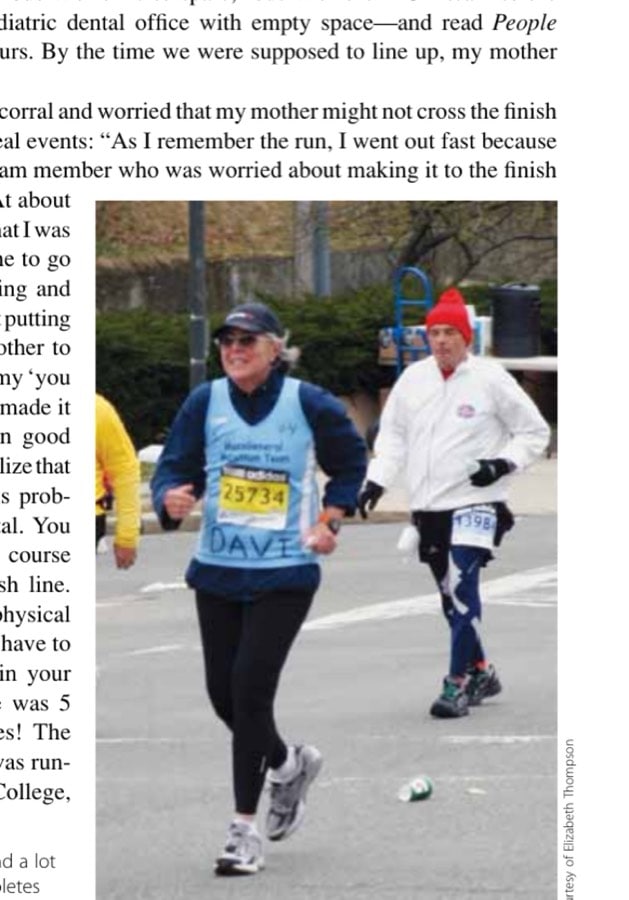
With determination and a lot of heart, Davi-Ellen completes another Boston Marathon.
Courtesy of Elizabeth Thompson
bought as much Boston Marathon gear as our checkbooks could bear. We loved the giveaways! We ate pasta and hydrated and tried to get a good night’s sleep despite having two little children in the house and being teased by our husbands.
On marathon morning, my mother woke up at 4:00 a.m. She took a bath, went to the bathroom, drank a few cups of coffee, and then fell into dark thoughts. I’m not going to finish. What if they take me off the course? I won’t finish in six hours, and they won’t give me a certificate. What if I need to go to the bathroom? What if I can’t find Dad at the finish?” On and on. I had to calm each thought with a soothing answer. Everything would be OK.
We made it to the bus with time to spare, rode with the MGH team to the waiting house—a pediatric dental office with empty space—and read People Magazine for four hours. By the time we were supposed to line up, my mother was ready to run.
I took off with my corral and worried that my mother might not cross the finish line. She recalls the real events: “As I remember the run, I went out fast because I was with a fellow team member who was worried about making it to the finish in at least six hours. At about mile 11, he could see that I was lagging, and he left me to go ahead. I just kept going and talking to myself about putting one foot ahead of another to get to the finish. I had my ‘you can do it’ mantra and made it up Heartbreak Hill in good shape. I’ve come to realize that running a marathon is probably 80 percent mental. You have to visualize the course and crossing the finish line. You have to do your physical training, but you also have to know you can do it in your head. My finish time was 5 hours and 19 minutes! The best part of the race was running past Wellesley College,
my alma mater 37 years ago! I was sure that I was the oldest alum running! The Wellesley women seemed to be cheering for me alone!”
Again and again and then retirement Each year after running Boston, my mother let herself rest. She would throw herself into volunteer activities, teaching, traveling, and taking photographs of nature, friends, and her favorite subjects—her grandchildren. But for the next eight summers, she could not resist the temptation to keep it up. She recalls: “To prove that it wasn’t just a fluke, I ran eight more Bostons and one New York in 2002 (again at my daughter’s suggestion). Actually, when I stopped running in 2010, I was worried that not doing the marathon would be a signal that I was aging and weak (my legs just didn’t have the oomph). Running the marathon had become such a big part of my life. However, now it seems the better part of valor to know when your body tells you to move on. I’m still exercising and recently have found yoga, which is also good for me, for strength, flexibility, and endurance, and for my head as well!”
Every time I watched my mother cross a finish line, I would get choked up. Her grit and determination were always right out there for everyone to see. How could anyone try so hard? Her accomplishments belonged to everyone she knew: Paul and Trudy at the barbershop; John, the framer; her friends, Brenda and Jackie; her decorator, Mollie; and her grandchildren. Everyone somehow felt that they, too, crossed with her and shared her glory.
This article originally appeared in Marathon & Beyond, Vol. 16, No. 3 (2012).
← Browse the full M&B ArchiveMore like this
1,000+ stories from 19 years of Marathon & Beyond
The complete archive of the legendary long-distance journal — digitized and free to read.
