

My daughter, Katie, first saw me run while she was cradled in her mother’s arms more than 20 years ago. Over the years, as Katie moved from toddler to teenager, she watched me accumulate a drawer full of race shirts. She joined me in “Dad and Me” runs and school fun walks, and eventually she graduated to 5Ks, 10Ks, and half-marathons during her high school years and breaks from college. Running had always been our thing, our bonding time, but lately time and distance had left little time for father-daughter running.
My eyes lit up when Kate broached the idea of the two of us running the Kilauea Volcano Wilderness Marathon on the island of Hawaii, an event billed by race organizers as one of the toughest endurance events on the planet. It had been a long-standing family tradition that we (my wife, Mary; Katie; sons Brian and Andrew; and I) would run one of the series of wilderness races held annually in late July in Hawaii Volcanoes National Park. The events celebrated the tradition of Hawaiian runners from premissionary days, when fleet-footed messengers spread news to scattered villages on well-worn lava trails. Mary first started the tradition when, on a dare for more vacation time in Hawaii, she ran the difficult 10-mile course and hooked the rest of the family into this annual event. I was the only one in the family to attempt the marathon course that followed footpaths on the tortured southern slope of the still-active Kilauea volcano. Now, I had visions of Katie and me negotiating these tricky and often dangerous paths as a team before crossing the finish line together, to the thunderous applause of the assembled cast of family and friends.
I saw the race as my best and perhaps last chance to reconnect with Katie in a big way. My all-too-independent daughter had turned 22, and she had decided to move to Hawaii for graduate studies at the University of Hawaii after completing her undergraduate degree at Washington College in Maryland. She is studying historic preservation and American studies, and she lives four blocks off Waikiki in an apartment, more than 2,800 miles from our family home in Seattle. Katie had lately become more and more occupied with something outside of school, namely Dave, a fellow Washington College graduate. He is a natural athlete, a former college sailing champion and lifeguard. Together, these two sail, swim
for miles in the ocean—I keep reminding her about the sharks—surf, hike, and enter triathlons, biathlons, and 5K, 10K, and half-marathon road races. They had recently completed their first marathon as part of the 25,000-runner extravaganza known as the Honolulu Marathon.
TRYING TO KEEP UP WITH YOUTH I needed a scorecard just to keep up with their hectic pace. Katie seemed caught up in the happy whirlwind that had become her new life in Hawaii. I was glad for her but a bit unsettled by my role as cheerleader and spectator in my little girl’s world. I knew, though, that my chance would come to regain a foothold in Katie’s life after we shared the adventure of tackling the Kilauea Volcano Marathon, but I soon realized that I needed to make room for Dave in my vision of father/daughter marathon glory. I smiled a fatherly smile at the news but secretly thought he would be no match for me, the great middle-aged, three-time conqueror of Kilauea.
Six months before the marathon, I sent the kids a detailed training schedule, and we exchanged e-mails and phone calls on a variety of marathon-related subjects including proper prerace diet and the merits of my battle-tested training regimen. Katie seemed to treat my advice with a sense of wonder, as if I had become an ancient oracle of wisdom on all things dealing with the marathon. But as we edged nearer to the marathon, I saw that she would follow her own path, twisting and changing my treasured training schedule to fit her busy life. I didn’t want to preach to her about putting in the required miles but simply tried to stress that the Kilauea race would take every bit of strength and energy that she could glean from her training. Ah, youth! So much to do and so little time. I hoped for the best and tried to stop badgering her.
One week before the race, Mary and Andrew (both veterans of many 10- and five-mile races on Kilauea) and I met Katie at Honolulu’s interisland terminal for the short 40-minute flight to Kona on the big island of Hawaii. Katie looked fit, tan, and confident, glowing with what I took to be an aura of a trained marathoner. And taking a page from her parents’ past marathons, she carried her marathon essentials with her in a neatly packed kate spade (a stylish brand) carry-on, not wanting to risk having her running shoes waylaid in the lost-luggage department.
A few days later, her friend Dave arrived at our prerace staging area at the Kona Village Resort, which is about 90 miles by car from the Hawaii Volcanoes National Park. He came with gift basket in hand, filled with a wide array of energy bars, gels, and sports drinks. I had to admit that he seemed much like Katie: fit, trim, and brimming with the enthusiasm of a novice endurance runner, which I said to myself would soon be erased by the Burma road experience of tackling the volcano marathon. A day later we were treated to a visit from his parents, Linda and Don, who had timed their Hawaiian vacation to coincide with their son’s race.
The two, like Dave, were very pleasant and enthusiastic, even after having flown all the way from their seaside home at Cape May, New Jersey. Dave’s parents seemed a bit in awe of me as a three-time veteran of the race. I tried to casually brush off their compliments but secretly wondered whether I could live up to my ironman reputation.
THE YOUTHS PREPARE, WHILE THE OLD MAN . . .
Courtesy of Charles Kastner
The day before the race, we made our pilgrimage to the Volcanoes National Park, where the race would be held at 6:00 the next morning. After we checked into our bed-and-breakfast for the night, I was impressed by Katie and Dave’s meticulous preparation: they laid out their running clothes, gels, and sports drinks, and set and double-checked their alarm clocks. These two seemed ready but also at ease for what I thought would be one of the greatest athletic challenges of their lives. I, on the other hand, seemed to have suffered a mental breakdown in my prerace preparation, either signaling the onset of advance memory loss or that I had just turned 50 and received, to my horror, a formal application to join the AARP. I had forgotten essential things—my racing watch and my well-worn fanny pack and water bottle. In a mad search of local stores, I could turn up only a makeshift, ill-fitting replacement pack that I would abandon before the start of the race.
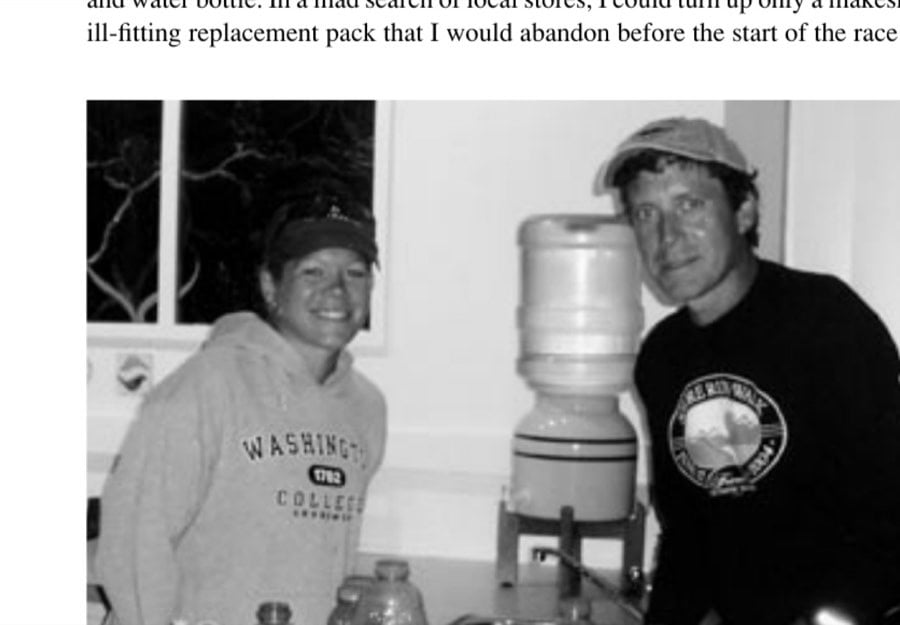
▲ Katie and Chuck Kastner during their prerace breakfast before the start of the marathon.
After a fitful sleep, I awoke to the multiple bonging of alarms set for 4:00 A.M., and after a quick prerace breakfast, we arrived at the start by 5:00. It was
shrouded in a cold mist that made our fellow runners look ghostlike in the gloom that encased the 4,000-foot summit of Kilauea. It was an appropriate metaphysical vision, for this is the home of Pele, the Hawaiian goddess of volcanoes, a spirit noted for her violent lava-spewing moods if offended. The mist soon evaporated as the tropical sun’s rays pushed back the chill by the 6:00 start, revealing about 150 extremely fit-looking runners gathered for the start. Ahead of us loomed Kilauea’s massive 13,000-foot sister, Mauna Loa, glowing a Mars-like red in the morning light.
The marathon began with Dave and Katie lagging behind me as we began the 14-mile descent down the south slope of the volcano, navigating across twisted and broken lava fields on, at times, a barely identifiable path marked with small pink flags. The flags fluttered in the stiffening breeze, tinged with sulfur that oozed from cracks in the lava. I really worried about the kids here. This was the danger zone where people tripped and fell on often knife-edged lava, resulting in race-ending broken bones and gashes, but I had little time for worry since every step required my full concentration to avoid tripping on the trail. By mile 10, I had been beaten up by the course. I felt terrible as a hot dry wind gained strength and the temperature rose into the 70s; my legs ached, sweat flew off my hat like ocean spray, and every impulse told me to quit and give up this torture—that is, until I caught sight of Dave as he motored past me with efficient and fluid strides. He looked like he was out for a pleasant training run. He was supposed to be sweating and exhausted; he looked anything but that—fresh as a daisy, on a lark, having fun. Oh God!
Visions of me leading the children to the promised land at the finish faded as Dave became a receding speck on this sand- and lava-blasted wasteland. When we left the trail and began winding back up the mountain on giant fern-shrouded roads, I had a chance to regroup and collect my thoughts. I hoped and prayed that my daughter was all right. I need not have worried. Both Dave and Katie survived in fine fashion. He went on to win the age-group award for the 20- to 29-year-old men.
THE WORST TIME EVER As I crossed the finish line with my worst time ever, my wife, Mary, yelled, “Smile, this is supposed to be fun.” Andrew and Mary hugged me and both managed to mutter out an obligatory “good job” and “you did so well,” but they knew it was not what I wanted or trained for. Dave looked at me, a sore and broken man, and said with unbelievable enthusiasm, “Wasn’t that just the best race, Mr. Kastner?” I felt like saying, “No, Dave, not really,” but I held my tongue and managed a
Courtesy of Charles Kastner
feeble smile. I looked at him in wonder, wanting to say: “You’re supposed to be exhausted after your trial on the mountain. You should be vowing, as I always did, never to attempt such a hellish course again.” But Dave didn’t seem to suffer from the pains of mortal men; he looked ready to run it again. I didn’t even get to see Katie finish. I had to stuff my aching body back into the rental car and drive back to the bed-and-breakfast to check out. When Katie finished, Mary told me, she looked just as fresh and just as happy as Dave had. To add to the moment, she crossed the finish line just as a race official announced Dave’s name as the winner of his age group. With his adoring fans, his parents, my family, and of course, Katie surrounding him, he mounted the award stand in triumph just as I returned limping, exhausted, and bleeding, after having impaled my hand on an ill-placed pencil in the car.
Katie and Dave (holding his trophy) came up to me with compassionate eyes and big smiles on their faces; they couldn’t stop talking about the race, reliving every step of the marathon, apparently caught up in its afterglow. I smiled, of course, but felt as though I had entered the twilight zone where unseen forces had ripped my marathon dreams to tatters and provided these youngsters with God-like powers.
The drive back to Kona Village was a celebration for Katie and Dave. They both couldn’t wait to run the race next year. I, on the other hand, felt less than enthusiastic about another go at the volcano. I could barely make my aching legs push the car pedals, my pencil-stabbed hand throbbed, and my badly chafed
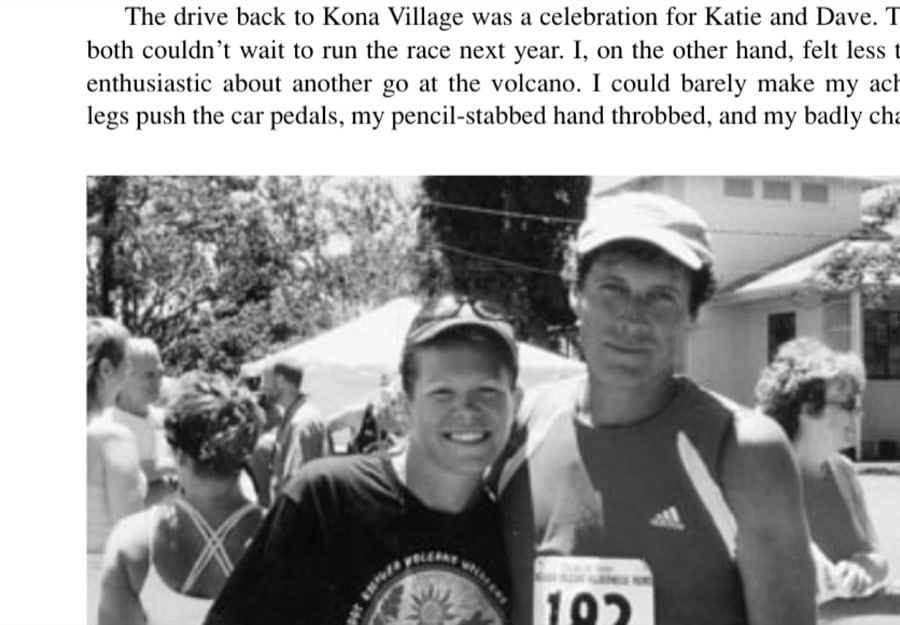
▲ Katie and Chuck Kastner after finishing the marathon.
Courtesy of Charles Kastner
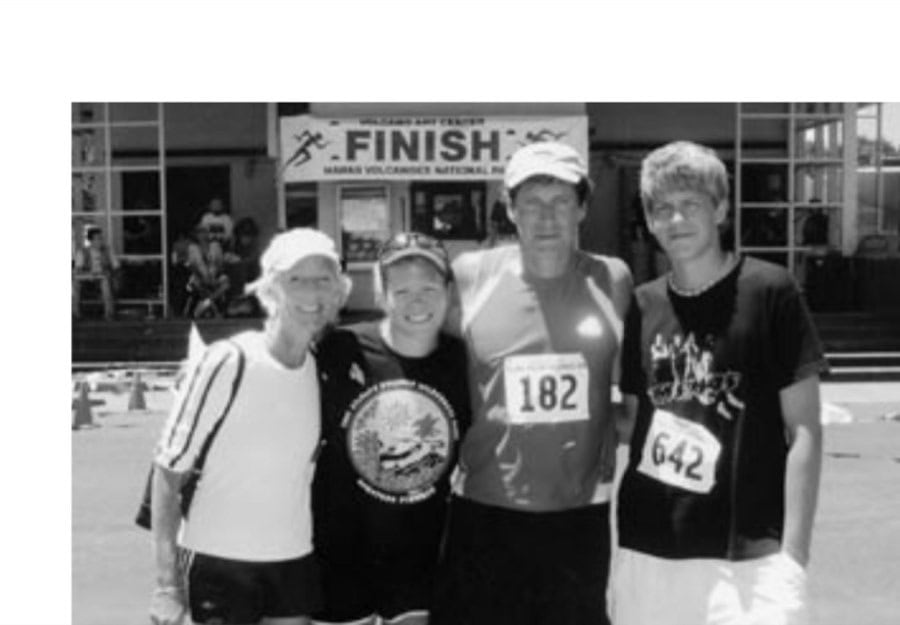
▲ The Kastner family after the race, from left to right: Mary, Katie, Chuck, and Andrew. (Son Brian, studying at the University of Edinburgh in Scotland, missed the gathering.)
groin sent a new rush of pain up my spine each time I shifted my legs in the car. But later, after a few days of recuperation on a tropical beach, a goodly number of mai tais and Kona Big Wave ales, and after much consoling from my patient wife, I began to a see a silver lining to my personal humiliation.
It slowly dawned on me that over the course of the marathon, both Katie and Dave had found a new passion for endurance running, a love for pushing their bodies far beyond what most people thought possible and for sharing the joy of marathoning with a true friend. In short, they both had fallen in love with my sport and had come under its spell. And I realized that no matter what Katie does or where she goes, that passion will bond us together. She will carry that piece of me in her soul as she straps on her running shoes for a long run or toes the line for a race. I definitely did not set an example of marathoning excellence that day on the slopes of Kilauea, but I did in some way help my beautiful, talented, and amazing daughter find a passion for running, a passion for seeing the world on her two feet and on her own terms. To my way of thinking, helping her find that passion means a lot more to me than any victorious sprint across any finish line. But it goes without saying that I’m already plotting my revenge and plan to train hard to repair my reputation in the next version of the Kilauea Volcano Wilderness Marathon. Aloha!
This article originally appeared in Marathon & Beyond, Vol. 11, No. 1 (2007).
← Browse the full M&B ArchiveMore like this
1,000+ stories from 19 years of Marathon & Beyond
The complete archive of the legendary long-distance journal — digitized and free to read.
