

Less Than Four
First, I’m old, and I don’t want to be. All my adult life I’ve been told I look younger than my years. If that’s what people tell me, I guess it must be true, or so I want to believe. But I know what I see in the mirror: thinning hair, lines, spots. It’s all proof that at 65 I’ve been around.
Some will tell you there’s not much you can do unless you prefer the doctors who prey upon us, adding hair and taking away those lines and the spots. Most of us who are runners do so to stay fit and to beat the odds, and maybe in our own minds to avoid getting old. Others of us run to stay away from the other doctors, the ones who deal with cholesterol and high blood pressure and who make their living from those afflicted with diabetes and heart problems.
Every day I think of how fortunate I am. When my mother passed away over a decade ago, she had been slowed significantly with muscular dystrophy. And that terrible disease has been passed on to two of my brothers, Bill and Chuck. My third brother, Larry, suffers with arthritis, which our mother also lived with.
In our youth we were all active. Sandlot baseball, fishing, swimming, and motorbikes filled our lives. We were never home. Reaching adulthood, Bill was the first in the family to run. And run he did. It was nothing for him to run from his house to our parents’ home nine miles away, say hello, and then run back to his place. He ran in marathons all over Ohio. One year for a Christmas gift, his wife had a shirt made for him stating that for the year he had run a thousand miles and had played 5,000 holes of golf. Bill has had four holes in one, and he’ll tell you, “And still counting.” Today, with MD, he has a hard time walking up only a few steps. His house has been converted for his coming need for a wheelchair.
Chuck, my youngest brother, ran for a period of time as well. He will tell you about his kick at the end of his races, never allowing other runners to get by him. But his claim to fame is his motorcycle riding. We might have thought Bill was a bit crazy with his running, but his interest pales when compared with Chuck and his motorcycles. Quite frankly, Chuck is over-the-top consumed by it. A few years back, with the MD, he had to give up riding a conventional two-wheeled cycle and move on to trikes, the three-wheeled motorcycle. His legs simply didn’t have the strength in them to support the bikes he loved. Within the next year,
if he can stay ahead of his MD, Chuck will have ridden all of the bikes he has owned a combined 1 million miles. That’s two trips to the moon and back! Few motorcycle riders can say that.
Stoic in all things To this day my brothers have never complained. I’ve never heard an ill word from them. I truly admire them. Somehow, I’ve avoided all of what they live with. Bill found running in his 30s and Chuck his love for motorcycles in his early teens. My interest in running didn’t come about until I was in my 50s when my son, Kevin, started running cross-country in middle school. Prior to that I thought that people who ran anything longer than it took to get to your car in a downpour were nuts. But at that point I needed to be in better shape just to get from point to point to watch him in his races. Somewhere along that path, I began to get a bit more engaged and in a few more years I was one of those nuts.
Being a runner doesn’t necessarily imply talent, only effort, and effort has never scared me. Years ago, before the life change, I did try running once, only once. It was a bucket-list item, running a marathon. Even today when I consider that attempt, I’m not certain of my sanity at the time. At the finish line, I told my wife, “Never again.”
Until my retirement a year ago, I was a freelance photographer. In all honesty, outside of my family, my photography has been at the forefront of all my interests. Even today I carry a camera with me most of the time. During that marathon I used my camera to shoot four rolls of film, with each new roll forcing me to stop and reload. That reloading cost me valuable time, enough to extend me a minute and change beyond my four-hour goal. Some things you just need to do. At the time I decided that missing my goal was no big deal, but that disappointment never quite went away. You can fool yourself for only so long.
It got so that I almost believed it. What really altered my state of mind was Kevin qualifying for the Boston Marathon. Maybe not to you, but to me running in Boston means you’re a real runner, not some guy who jogs an occasional Saturday morning. I had never really given Boston much thought. Only the speed merchants run there. On my birthday, in the fall of 2013, I took a peek at what I would need to run to qualify. What I saw, 4:10, made me do a figurative double take. Four hours and ten minutes—maybe, on a good day, I could do that.
So 15 years after that first go-round, I had my head—let me change that to “heart”—set on Boston. A few years back, Kevin and I had run the Marine Corps Marathon together, and last year I ran the USAF Marathon in Dayton. In both I had set too fast a pace at the beginning and quite frankly had taken too many pictures. I knew I could fix that.
Courtesy of Ken Frick
▲
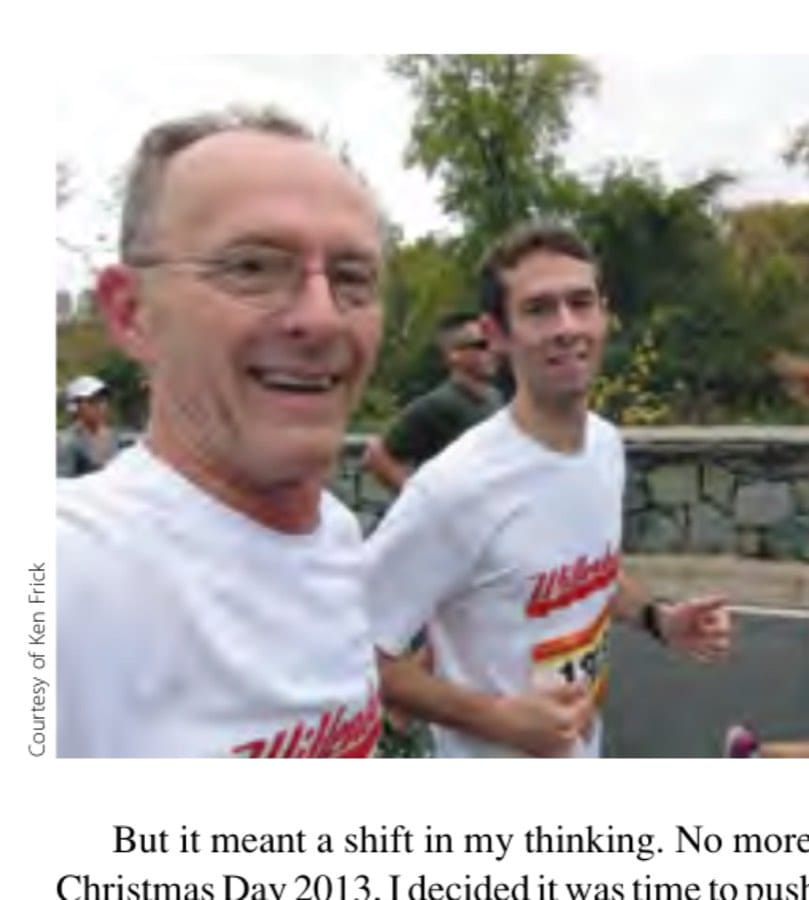
The author and his son, Kevin, wearing matching Wittenberg University running shirts, ran every step of the 2012 Marine Corps Marathon together.
But it meant a shift in my thinking. No more camera, no new pictures. So on Christmas Day 2013, I decided it was time to push for the big deal, to qualify. What I couldn’t have known at the time was how terrible the Columbus, Ohio, winter
would be and how impossible it would be for me to run outside. With ice on the streets and the bitter cold, I was relegated to running on, of all things, a treadmill. I had never set foot on one before, but there I was, watching “Good Morning
America,” Fox News, CNN, whatever was on the television in the exercise room of the building where I live. For three days every week, plus a cross-training day, that’s where I put in my miles, running whatever Kevin had typed in my training
program: four single-spaced pages of instructions. After a long month I would move on to the next page, and then the next, and so forth.
Doing something I had never done before Kev’s big day, Patriots’ Day in Boston, was first. While my wife, Cindy, and I waited and watched for Kevin to run past, my thoughts went back to my first marathon all those years ago. Kev was only 11 at the time and had decided to run
with me for the last three miles. I admit that the end of the run was a struggle for me. I remember looking over at him and thinking, Gee, he sure is running slow. When we reached the end of the 25th mile, the timer said 3:52. Kev, knowing of
my four-hour goal, asked if I had an eight-minute mile in me. I told him it wasn’t just a mile, it was one-point-two. I still remember the disappointment in my voice, telling my son I couldn’t do it.
And me, six days after his Boston I would be running the Glass City Marathon in Toledo. My goal was simple. All I had to do was something I had never done
before: run my fastest for 4 hours and 10 minutes. My Toledo was to be a onetime effort. I had decided at the beginning of my training that this would be it. There would be no further attempts in any marathon with the goal beyond simply finishing. Any marathons after Toledo would be for fun, to be able to look around and enjoy where I was and to take pictures. At my age, training for speed was simply too difficult. It would be Boston, yes, or Boston, no. If I missed on this effort, I would move on. I would know that I had done my best but that Boston was beyond my reach.
My training had gone well. I could run my Tuesday five-mile effort in 40 minutes and the eight-mile Thursday runs in an hour. Sunday’s longest indoor run of 16 miles went on for well over two hours. My only break was to reset the treadmill. It had a 60-minute limit. On my long runs I would drink up to five containers of bottled water. All the time I knew that running indoors would offer one advantage. I was practicing at 68 degrees. I would be ready for warm weather, or I would have an advantage if things were cool on marathon day. I can’t think of anything I’ve ever done that required more physical effort.
A few weeks back I had filled Kevin in on what I was doing. His reply when I told him about the long Sunday runs was that he would “shoot himself in the foot” rather than be tethered to a television set, watching the morning news programs.
Running in the real world What I couldn’t know was how all of this would translate to running outdoors. Kev lent me his fancy GPS watch, and from that I learned quite a bit. On my first long run outdoors, I covered almost 19 miles in 2:45, a much faster pace than I had ever run for any long distance. But at the end I was exhausted. There was no way I could have run even a hundred more steps. Two weeks later, after being invited to run with the MIT group (Marathoners in Training), I learned even more. My 20-mile run ended in a mixture of cold and rain and wind. What I knew when I finished was that I needed to make some sort of adjustment. At the conclusion there simply wasn’t any gas left in my tank. And at Toledo I would need to run for nearly an hour longer!
So as I was standing near the starting line at the Glass City Marathon, it was Boston or bust. Kev’s race on Monday had gone well. He had been hampered by an injury so he hadn’t been able to train as he would have liked, and it turned out to be a very warm day. On his special run it was he who chose to carry a camera. Way to go, I thought! Still, he ran well. It was an exhilarating weekend for our family.
Now it was my turn. The horn couldn’t have sounded early enough. I had been ready for weeks. I would soon be off with thousands of other runners. Some were there for the excitement, but most had their mind set on a goal. Two years earlier
at the Marine Corps Marathon, I had run 4:17, and last year 4:22 in Dayton. I had work to do. I needed to keep in my mind how poorly my previous marathons had ended. In 1999 I had run a good race but simply tired at the end. The end of my Marine Corps Marathon was telegraphed by the beginning. I simply started far too fast, as I had also done in the USAF last year. It may sound like a good idea to run your race and plan to simply hold on at the end. Sometimes you can do that, but not when the end of the race is still six miles away. Standing at the starting line, I needed to know that I had learned my lesson. From my first step, Toledo would demand my best. I was confident and self-assured.
My training had put me in a place where I just might succeed. But I knew all too well that this could all come crashing down, just as it had before. When I had mentioned the heavy winds in the forecast, Kevin told me to simply not think about it and to just run.
In short, I may need to go to a place where Kevin had been, a place he knew all too well. In high school and college, Kevin had never been one to run well in training. In the competitions he and his running mates ran every week in practice, Kev was rarely the first to finish. But it was in the actual races where he excelled. From somewhere inside, he had been able to summon the willpower to find another gear, to run beyond his pedigree. On this day I might need to go there as well.
Running downhill This would be it. I was no doubt in the best shape I would be for the rest of my life. Over a span of five Sundays alone I had run 75 miles. The dull ache in my legs had eased as I had tapered the past two weeks. Maybe the final question to be answered was whether I could run relaxed, something I had never been able to do. If I could, I might have a chance. At the starting line I was ready.
Over my months of training I had kept my brothers informed on what I was doing and of the process that goes into training for a marathon. Bill and Chuck told me that they were simply amazed that anyone my age would be running a marathon. I tried to correct them by telling them the results of my races and how well so many other runners my age and older had performed, many with astonishing times far beyond my talent level. I don’t believe that they were listening. Their first and maybe only thought about my marathon was for me to run my best, to succeed.
In the past two years I had come to revere the Boston Marathon and its city. It’s more than a sporting event, it’s a celebration. Kevin called it a reward for runners who had done something special in other races (or who had requalified in the previous year’s Boston Marathon). As a spectator I found it unlike anything
else I had ever seen. I could only imagine what it was like to run the course. This was why I had come to Toledo, to see if I had what it took. In the starting area I had found Ryan Phillips and Aaron Stanley, the four-hour pacesetters. The temperature was 38 degrees and would be no higher than 45 by the time I finished. My plan was to run with their group for as long as I could and simply ease up a bit when the inevitable fatigue hit. I hoped to run with them for 20 miles, but I had no idea whether I could keep up for that long. They would be running at a 9:10-per-mile pace.
When the starting horn sounded most of us stood still, waiting for the line of motion to come back and meet us. With hundreds and hundreds of marathon and half-marathon runners well ahead, we acted like cars backed up at a stoplight. The first car would leave, followed a second or two later by the next car, and so on. It could have taken a full two minutes for us to start walking and another minute for us to get from where we waited to the actual starting line. Most marathons distinguish between “gun time,” the time from when the horn sounds, and “chip time,” the actual time from when you cross the start line. There are sensors in all of the bib numbers, the numbered labels that every runner wears that trips their chip time mechanism. It’s the chip time that you race for.
The start is an anxious time. After four or five months of training runs, literally hundreds and hundreds of miles for some of us, you’re revved up and ready to go. The three-minute wait might have been good to remove some of the prerace jitters. Finally, we were off.
With the four-hour group The four-hour group was teamed with the half-marathoners for the first eight or nine miles. We were a large group. It may be different for other runners, but I watch to see how I’m feeling at miles six, 10, the halfway point, 18, and 20, and from there for most runners it’s simply a time to hang on to the finish.
The Glass City Marathon in Toledo is well run. It goes through beautiful parts of town to the north and west, follows a bike trail, and comes back into suburban north Toledo and finally through Wildwood Metro Park and the University of Toledo to the finish. The finish line is on the track that surrounds the UT football field, inside the famed Glass Bowl.
If you looked around as you ran you could see wonderful things. Along the way I noticed Santa Claus, a nun carrying a baby, and Brian Hackenburg, a firefighter running in full firefighting regalia in memory of firefighting brothers James Dickman and Stephen Machcinski, who had died in the line of duty. And there were signs galore. In every marathon they are much the same. We all know Forrest Gump, and none of us run like him. And we do on occasion lose toenails due to the stress and to shoelaces not tied quite tight enough. But our hats are off to all who support us.
Gone in a flash Lisa was running very strong, and I was matching her. The only difference was in our breathing. Hers was calm, whereas I had started breathing a bit harder. Even so, I felt good. Our mile splits were in the 8:45 to 8:55 range. She was setting the pace far above what I considered within my comfort level. Mile after mile we ran together. She was a marvelous running companion. Somehow, when she mentioned our mile-split times, she conveyed them with a sense of calm and ease. Surprisingly, at the start of mile 25, Lisa told me that she was going to pick up her pace.
© Runphoto LLC
At mile six all was well. At 10 and 13, after we had split from the half-marathoners, our group became more intimate. We told stories and made light talk and shared a laugh or two. Our two pacesetters were gliding along, almost effortlessly. The banter took our minds off the race. As the miles wore on, some of the conversation was replaced with quiet thoughts. The effort that had once been easy was now requiring more of us, and more concentration.
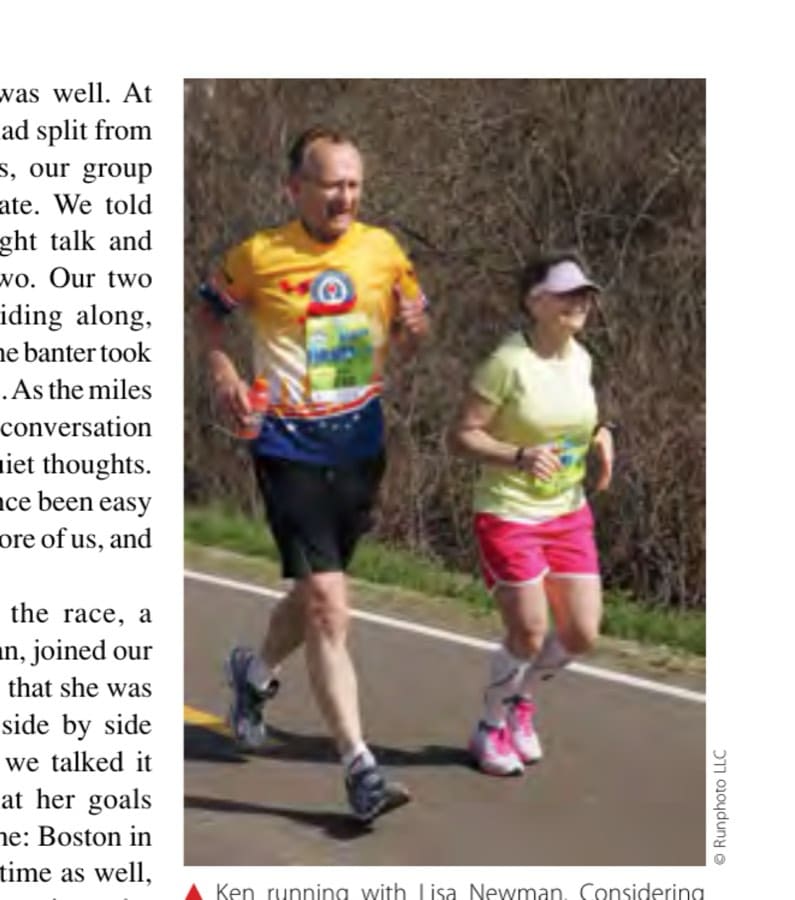
Rather early in the race, a woman, Lisa Newman, joined our group. I would guess that she was in her 50s. We ran side by side for many miles. As we talked it became apparent that her goals were the same as mine: Boston in 4:10, her qualifying time as well, ▲
Ken running with Lisa Newman. Considering and she hoped to come in under the younger age of all of the other runners in their four hours, something she had group, they formed a natural team. never accomplished, either. As we turned east beyond the halfway point, we were welcomed by a rather stiff head wind. We would feel it again in the final four or five miles of the race. I thought back to what Kevin had told me and gave the wind no thought. Somehow, when we turned south at mile 20 toward Wildwood Metro Park, Lisa and I found ourselves a bit ahead of our group. It’s at this point that most runners rise or fall. I knew my history.
At that point we had only a little over two miles to go. Lisa had been setting a pace to pull me along with her, but when it was apparent that I would meet my goal, she simply sped away. She had her own goals to achieve. Quickly she got
smaller and soon she was gone. It was impressive. Now it was up to me. It wasn’t until I reached the start of mile 26 that I felt my reserves starting to slip. My pace slowed a bit but I continued to run as fast as I could, throwing one foot out in
front of the other. No way was I going to give in now. At the USAF Marathon I had basically collapsed in the final five miles. I had felt my age. The hills over the last few miles had cut me off at my knees. I wasn’t about to let that happen
here, not again. At the finish line, Kevin was waiting. From where he stood he could see some distance back along the course as it spun its way through the University of Toledo campus. Maybe a quarter of a mile from the finish, the course passed within his
view for a short time. From where he stood he had made out what he thought was my Fisher House shirt. There weren’t many yellow shirts in the field, and he later told me that he was 99.9 percent certain it was me. What we both wondered
was how long it would take me to complete the distance to the finish line. What we both wanted was for the finish clock to read under four hours. The area of the course where Kev saw me was all downhill, a
place where those with anything left could open it up a bit. I knew it was coming and I celebrated, racing as fast as I could. Soon there was a short incline at the entrance to the stadium and from there a quick 50-yard race to
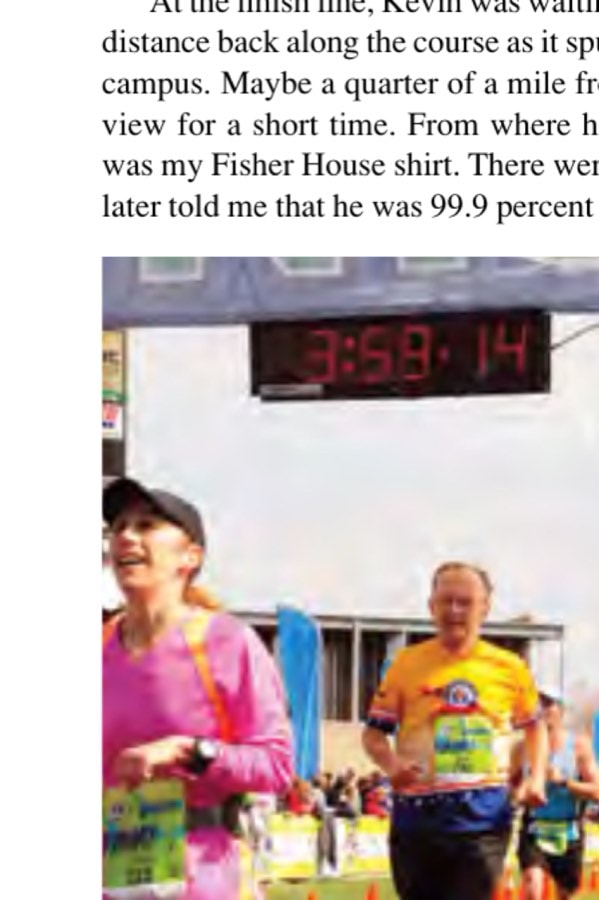
the finish line. Faintly, I seem to remember my name being called, but my mind was somewhere else. The clock read 3:59:14 as I finished my marathon. © Runphoto LLC
What four-hour barrier?
▲ The author crossing the finish line inside the Glass Bowl on the University of Toledo campus.
Lisa was at the finish line and we congratulated each other. I thanked her for helping me. To me she was truly an angel, one who that day
Courtesy of Ken Frick
▲
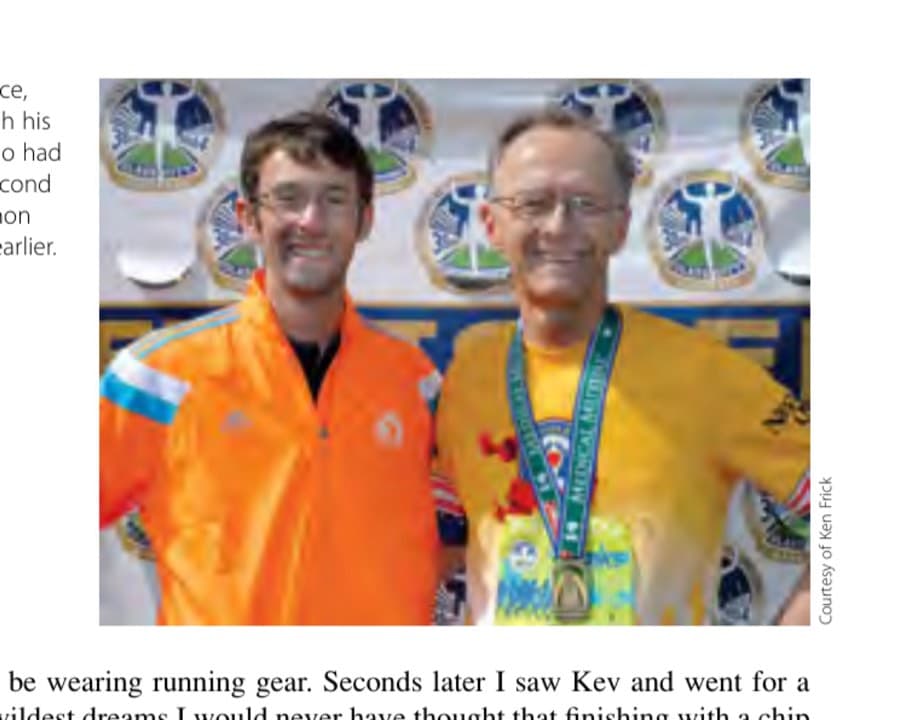
After the race, the author with his son, Kevin, who had finished his second Boston Marathon only six days earlier.
happened to be wearing running gear. Seconds later I saw Kev and went for a hug. In my wildest dreams I would never have thought that finishing with a chip time of 3:56:36 was possible—and second in my age group. The look on Kevin’s face was one of pure joy. My first words to him were, “We’re going to Boston.” And there may have been a tear or two.
I couldn’t help but think of my mother. In her life her family was her cornerstone. Our dreams became hers. I couldn’t help but wonder if she was watching. If she was, I know there were tears in her eyes. On my way home I stopped to call Chuck. He would call Bill with my results. I couldn’t know for certain, but I imagine that he was shaking his head when I gave him the news, and with a big smile on his face. Yes, on this day I had run my best. That’s all I had to do, run my best just once. Bill and Chuck need their best every day, and Larry with his arthritis as well. I simply cannot say enough about my brothers, what fine men they are.
For the previous four months there was only one place I dared not go. I knew from the start that the 4:10 time was within my reach. Getting there was simply a matter of preparation and running a smarter race. An hour after I had crossed the finish line, with my stomach filled with pizza and a fresh shower to make me feel even better, I was finally able to go there. With Kevin at my side and my medal still around my neck, I was finally able to put my deepest hope and prayer into words. Aiming my thoughts to no one specifically, to no one other than maybe just me, I said what I had long thought and hoped for. Looking up into the sky I said, “I knew I could do it. I just knew.” I had reached far beyond what I thought were my limits. I had run a marathon in under four hours. My personal celebration was just beginning. This might go on for a few days. On the outside I might be hurting a bit, but inside there was no evidence of an old man.
This article originally appeared in Marathon & Beyond, Vol. 19, No. 2 (2015).
← Browse the full M&B ArchiveMore like this
1,000+ stories from 19 years of Marathon & Beyond
The complete archive of the legendary long-distance journal — digitized and free to read.
