

Courtesy of Sarah Lavender Smith
My husband and I celebrated our 20-year wedding anniversary with our idea of a dream date. We ditched our two kids with relatives and ran the Dipsea Trail from Mill Valley to Stinson Beach and back. Along the 14 miles of rutted trail and steep stairways that climb out of redwoods to reveal the San Francisco Bay, I wondered how I’ve been married and running for so long when I generally struggle with commitment and battle boredom. I drop in and out of the workforce and start way more books than I ever finish. Half-baked projects litter my desk, and unaccountable gaps wreck my resume.
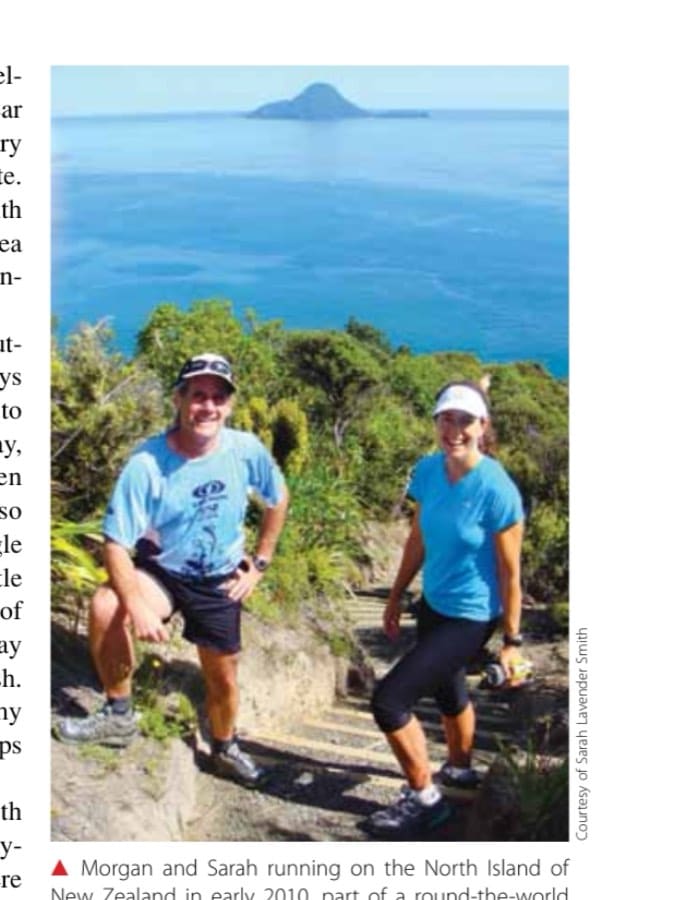
And yet here I am with Morgan, the high school boyfriend I married at 21, and here ▲ Morgan and Sarah running on the North Island of New Zealand in early 2010, part of a round-the-world I am training for a 50-mile trail journey they took with their kids. race after 15 years of running and finishing some 30 marathons. I can tell myself, I must not be a total flake or failure because I have a good marriage and I’m a good runner.
Courtesy of Sarah Lavender Smith
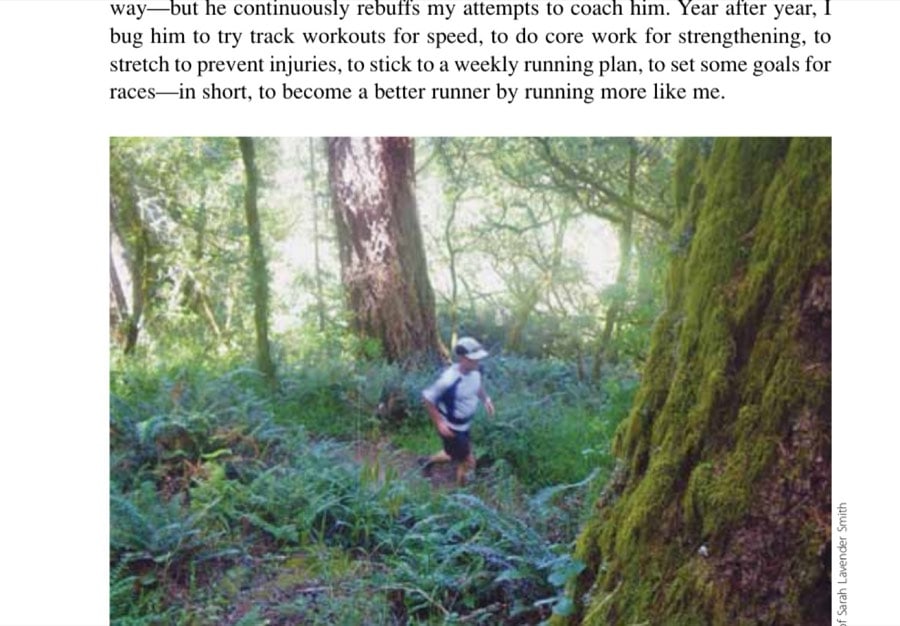
Surely there’s a connection between my marriage and running, but what is it? Relationships and running both start the same way, with that magic potion called passion. Both spark a thrill that inevitably wanes and takes ongoing effort to rekindle. The rekindling happens by deliberately trying new things, new routes, new challenges.
But as much as anything, relationships take acceptance and respect for differences. Having my life partner also be my running partner helped me better understand this. A few miles into the Dipsea, I let Morgan pass so we could take turns setting the pace. I noticed he inadvertently put his shirt on inside out and probably forgot to put sunscreen on his neck. He’s experimenting with running in sandals, so he kept pausing to shake out pebbles trapped underfoot. He didn’t care at all about how long the run took us because he never logs his time or mileage, and he doesn’t even wear a stopwatch.
We’re so different as runners—and, of course, I think my way is the right way—but he continuously rebuffs my attempts to coach him. Year after year, I bug him to try track workouts for speed, to do core work for strengthening, to stretch to prevent injuries, to stick to a weekly running plan, to set some goals for races—in short, to become a better runner by running more like me.
▲ Morgan on the Dipsea Trail.
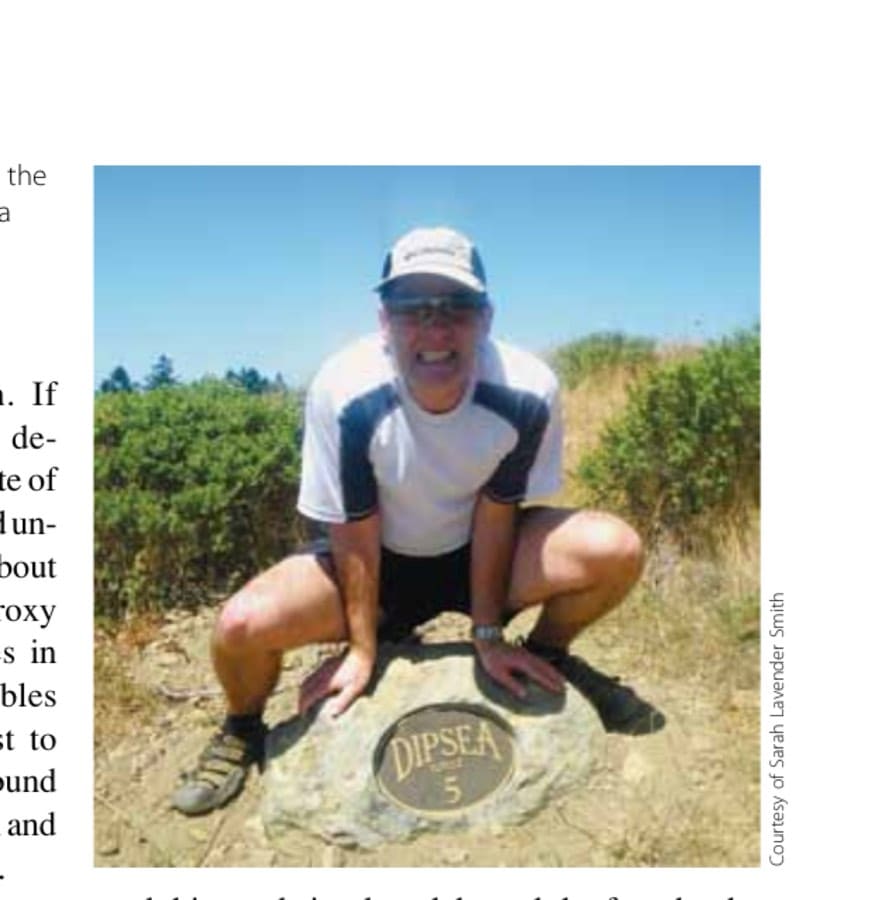
But he won’t listen. If anything, he rebels and deliberately does the opposite of my advice. Our spoken and unspoken communication about running devolves into a proxy for other power struggles in our relationship—squabbles both mundane (how best to cook and clean) and profound (how to deal with personal and professional frustrations).
Finally, I gave up trying to coach him and simply celebrated the fact that he runs at all and that he supports my running. And then Morgan surprised me: he got better on his own. He started running more frequently and longer and also started mountain biking. He’s doing it his way, and I’m impressed and totally happy for him.
Likewise, I stopped constantly coaching him about what to do about his stress and unhappiness—I tried to act more like a consultant with a sympathetic ear and less like a frustrated mother toward him—and boy, did he surprise me. He decided on his own to change his life and in the process quit his job and took the kids and me around the world for a year of travel and home schooling. I’ve never loved him more, and we definitely laugh a lot more these days.
People sometimes ask, “Don’t you get bored running?” And they often ask, “Have you and Morgan been together this whole time?” which is an indirect way of asking, “Don’t you get bored with each other?” I tell them it doesn’t have to be boring. Year after year, you just have to keep it fresh and keep growing and improving, always on the lookout for signs of burnout and injury.
A few years ago, I was forced to take several months off from running to cope with severe Achilles tendinitis, and I worked with a podiatrist and trainer to fix my flawed biomechanics. This ultimately helped me run better on the trails and prevented further flare-ups. Someone told me at the time, “Sometimes you have to break down to retool and rebuild the right way.”
The same could be said of our marriage: it broke down nearly completely, and after years of effort and pints of tears shed on a therapist’s couch, it significantly improved and has pretty much avoided reinjury.
Courtesy of Sarah Lavender Smith
▲
Morgan, midway through the anniversary run on the Dipsea Trail.
I’ve always thought that marriage mirrors a long point-to-point trail run with exhilarating peaks and a few tough valleys. But perhaps long-term relationships and long-term running are more cyclical than linear. Both cycle through periods of comfort and crisis; that is, a relationship can hum along, and a partner can be almost an afterthought, just as a six-mile loop you run week after week at the same pace can feel as familiar as your own house.
Then along comes a crisis, which really is the flip side of an opportunity. Maybe it’s a new job or a move, or maybe it’s something more ominous like infidelity, and it presents an opportunity for the couple to decide whether they will confront the challenges together, openly and honestly, and navigate change, or whether they will give up on the union.
The same thing can happen with running. You get injured and yearn to be able to run even half of that six-mile loop, so you stop taking it for granted. Or you discover a new sport and decide to put running on hold. It’s an opportunity to consider whether running is really “your thing,” and why, really, do you do it day after day? What could make it better?
Marriage, like trail running, is an adventure full of risks and rewards. It takes effort and always can be improved. Sometimes you will like your partner more than at other times, just as some weeks or months you will feel better running than at other times. Sometimes you will have no desire for either. But if given the choice to commit or quit, ask yourself whether you genuinely love the person, flaws and all, and whether you genuinely love the experience of running, fatigue and all. Yes, I do, and I’m glad I said “I do” way back when.
This article originally appeared in Marathon & Beyond, Vol. 16, No. 2 (2012).
← Browse the full M&B ArchiveMore like this
1,000+ stories from 19 years of Marathon & Beyond
The complete archive of the legendary long-distance journal — digitized and free to read.
