

Masters of the Marathon
THIS PIECE is a personal reminiscence, not a researched analysis. A full history of the masters marathon would have to recognize such pioneers as Jack Holden, the Englishman who in 1950 won the Commonwealth (then Empire) and European marathons, at age 42 and 43, and American heroes Ted Corbitt and Johnny A. Kelley. The legendary prewar South African ultrarunner, Arthur Newton, deserves a place, too. But these men were from an earlier generation than the great vintage years I knew, years that began when Jack Foster crossed the finish line in Christchurch in 1974.
JACK FOSTER
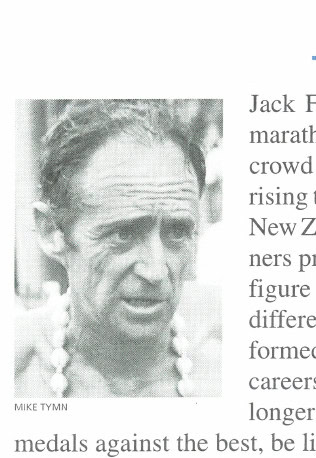
Jack Foster brought fire to the world of the masters marathon. On that hot 1974 evening in Christchurch the crowd acclaimed him primarily as a New Zealander, rising to cheer his all-black uniform and silver medal in New Zealand’s Commonwealth Games. But for the runners present, especially those past their first youth, the figure skimming around the stadium meant something different. A 41-year-old man running 2:11:19 had transformed our sport; he had raised our sights, extended careers, revised human potential. Older runners need no longer be shuffling gray joggers. They could race, win medals against the best, be like Foster.
For me, it took several hours before all this sank in. As the stadium announcer, I was enslaved to the frenetic demands of the moment: accurate coverage of five or six events simultaneously, names, stats, pronunciation, timing, clarifying and highlighting the crazily complicated sport of track and field. You need to be a martian, with eyes on stalks all around your head. After a meet I often can’t remember what happened. So it was later, as I ran the warm, dark eight miles home from the stadium, limp as a discarded sock, that I conjured up that dignified, springy runner in black. I thought to myself, He beat Ron Hill and Derek Clayton. He pushed Ian Thompson to one of the fastest finishing times ever. He got silver. He’s 41. 2:11! The old goat!
I was 34, and I had not yet run a marathon, represented New Zealand, or met Jack Foster. I was also at a downpoint in running, apparently fading into what one sportswriter called “the twilight of an outstanding career.” I won’t say Jack Foster was the only reason I declined to go gentle into that night, but he helped. Thanks to making the twilight last 20 more years, I got to be a participant and eyewitness in one of the greatest movements in sporting history: modern masters running.
My first conversation with Foster was inauspicious. We were in the fast-moving spearhead at the front of the New Zealand 10K road championship in 1976. I was having problems with blisters caused by hot road surfaces, and I had learned to seek water to cool my feet. Two miles into the race, with six or seven still in the front group and moving at sub-5-minute pace, I spotted a puddle in a roadside patch of dirt. I veered aside to splash through it, but misjudged how close the others still were. An indignant Lancashire voice spoke at my right shoulder. “Thanks very bluddy mooch, mate. Filled me bluddy shoes wi’ bluddy mook.”
Soon after that he floated lightly away, and I more laboriously fought through to second. He was 44, I was 37. I ran over to apologize. Low-key and kindly, as he always is, he just waved a hand and said, “Forget it.” But what a folly! There I was, living a fantasy, running alongside The Legend, and all I could do was squish mud into his best racing flats. Jack never gave it another thought, but it remains one of my life’s more embarrassing memories. Worse even than the day I ate Carl Lewis’s lunch.
Racing at world-class level into his later 40s, Jack was a rarity then. Nowadays we expect a master or two in the top 10 of most races. Martin Mondragon, Antoni Niemczak, Steve Plasencia, Jane Welzel, Regina Joyce, Gillian Horowitz—all did it in 1997.
Back then, Foster was treated as a freak, and he liked to play it up in his droll way. “I’m a bit deaf, like, coom round to me good ear,” he would say, claiming that his secret to success was “a nice coop o’ tea.” He half-jokingly titled his book The Tale of the Ancient Marathoner; it remains one of the best running autobiographies.
Foster had a low-key, pragmatic wisdom that could cut through stacks of running magazine “10 Ways to Put One Foot in Front of the Other” solemnities. On injuries: “If it hurts, don’t run on it.” On postrace recovery: “One easy day for every mile of the race.” On hill training: “When you hit flat country, you really fly along.” On hosing down his legs in his front yard after a run: “If it’s good enough for race horses, it’ll do me.”
Yet wily old campaigner that he was, Jack retained a zest for running that could become a childlike exhilaration. There is a film sequence of him leaping down the steep, stoney slope of one of New Zealand’s volcanoes, slithering down through the loose shingle with giant bounds, whooping with excitement. He was 45.
On his favorite hilly forest circuit near his home in Rotorua, he was irrepressible. Hal Higdon (another master who deserves a mention) visited that forest on my advice in 1997 and pronounced it the best training route he had ever seen. To get the full experience, you had to zoom to the forest from Jack’s home in his little open-topped sportscar, a secret pleasure that he reserved for special visitors. Then you had to keep up with Jack at his nimblest and quickest, as the reassuringly tidy wood-chip of the lower tracks gave way to sand and mud, as the hills became steeper and sharper, the twists and turns tighter, the tree branches closer and the pace hotter. “Coom round to me good ear,” he would say, and as you fell back a stride, he’d dart away up some unseen root-tangled precipice through the pines.
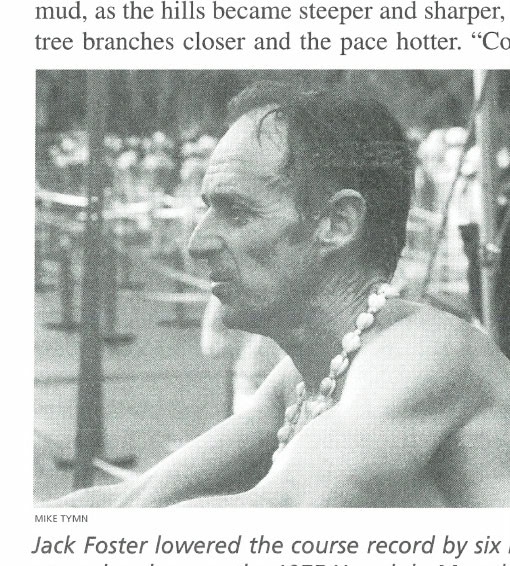
He simply loved the sport, and loved it simply. After the New Zealand cross-country team had run as guests in the German championship in 1977, as preparation for the world championship there, I remember Jack afterwards calculating an unofficial team result between us and the Australians, who had also competed. He counted off the places with the earnest glee of a sportsm-ad schoolboy: “Them – ooz [us] – ooz – ooz – them.” The glee showed in his stride, too. He ran with the lithe, joyful fluency of a Kenyan, and he was as floating and fearless.
He had many fine races after his dramatic emergence in his late 30s as a world-class runner, but he always resisted praise or pretension. His modesty is essential to the man. That’s why after a few weeks Foster withdrew from a contract to make appearances in America for a shoe company. He disliked razzmattaz, hated being fêted as a star. Instead of living off his legend, he took a year off work to ride with his wife on a tandem bicycle all around the coastline of New Zealand.
His origins were modest, working-class, urban northern England. If he had not emigrated to New Zealand, he might have labored all his life in a Liverpool factory. His boyhood was one of wartime deprivation. Sitting together once during an airplane meal, we each noticed the other’s compulsion to finish the scraps and confessed to that shared childhood experience. The plenitude of America gave him no pleasure.
After recurrent leg and breathing problems ended his running in his early 50s, we met at an age-group road time-trial cycling event in a small New Zealand town. (It was 1985, one of my injury years.) Naturally, he won. We sat together as we waited for the casually organized awards presentation to begin. “This is what I like,” Jack said quietly, looking around the dusty little hall filled with clusters of aging cyclists. “A hard race, and a coop o’ tea wi’ a few mates.”
He found the obscurity he prefers. Occasionally now Jack is seen at track cycling events, since his son is a top competitor. That son’s first name—Jackson—is the only sign of pride Jack ever revealed.
PIET VAN ALPHEN
Jack Foster’s inspiration percolated through the age groups as masters running got going, with the first World Association of Veteran Athletes (WAVA) Games at Toronto in 1975. For many years, however, his 2:11:09 stood unchallenged like some towering mountain. Ron Hill did 2:15 across the bridge at New Orleans, wafted along by a wind so strong the paper cups were overtaking the runners. Otherwise it was more than a decade before the sub-2:18s began to come. For a while, my 1981 2:18:20 put me third on the list of top masters marathon performances. Foster’s New York record, 2:17:28 (at age 46), stood for 10 years until Ryszard Marczac ran 2:15:54 in 1988.
The two 1970s masters who equaled Foster by ranking among the world’s open best were both women. Joyce Smith (England) was over 40 when she converted from a distinguished track career to win the 1978 Avon International Marathon in Waldniel in the days when that race served as a women’s world championship. Her best was 2:29:43, at age 44. And after age 40, Miki Gorman was twice the first woman finisher at New York, with a 2:39:11 at age 41 in 1976 and a 2:43:10 in 1977 at age 42. Although the women’s fields were much smaller then (a record 250 in 1977), only two masters women have subsequently run New York faster than Gorman did.
Foster’s equivalent in the upper age groups, as pioneer and inspiration, was Piet Van Alphen of the Netherlands. In the 1982 Rotterdam Marathon, at aged 53, he ran a staggering 2:22:14, which is still off the charts for that age.
In 1984 I found myself running with him in the excellent Veterans 25K race in Bruges, Belgium (Jacques Serruys’s race introduced many essentials that others still overlook, like color-coded numbers on the back). There in the lead group was a stocky, silver-haired man with an over-50 number and a brisk, economical stride. It was Van Alphen. He may even have been 55 by then. I had missed seeing him at the WAVA championships in New Zealand in 1981, but Hal Hidgon recounts how his winning run in the 45–49 marathon put him two places behind Van Alphen, the 50–54 winner. “So the next age group up was tougher. He was extraordinary,” Hal says.
I had only one brief conversation with Piet, at New York, when he was about 56. “Getting slow, getting slow, is bad,” he told me. That’s all. A year or so later he was dead. He has become a hazy figure therefore, and even here I am conscious of not giving him the informed recognition he deserves. A letter in one of the running magazine claimed that his early death proved that older runners should not race hard. I thought it proved only that men of 57 sometimes die.
VILLANUEVA, MIELKE, AND OTHERS
As running boomed, and a little travel and prize money became available even for masters, the top ones began to race head-to-head, usually in America. No shyness or dodging the competition among this group—we wanted nothing more than to get out of the confines of our own countries, lay the chips down, and establish the global pecking order.
At the top over distances up to 15K were Mexico’s Antonio Villanueva and Germany’s Günter Mielke. Despite significant marathon victories, however—each won New York—neither reached the same level in that event as in shorter races, perhaps because Antonio’s racing was too tempestuous, Günter’s too analytical. For three years we were the oddly assorted gray musketeers of the masters circuit, liable to be found hanging out at all hours in the elite runners’ suite heatedly conversing in a unique but impenetrable language made up from equal parts of English, German, Spanish, and split times.
Others came close. Barry Brown is of honored memory, his 2:15:15 record (at St. Paul in 1984) a landmark. Then two other distinctive characters emerged. The first was Dave Clark, a dapper, bespectacled Englishman who looked and acted more like a brainy boffin in a James Bond movie than a top athlete. He had three New York wins, with a best of 2:17:30. His supreme performance, however, was 2:21:04 in the stifling New York humidity of 1984, the year Orlando Pizzolato won despite stopping several times to walk. Clark’s masters win was worth 2:15. That’s an informed opinion, since I too was on that wilting road, wading through what seemed to be viscous waves of hot fog to finish second to Clark in 2:26, after having won Boston six months earlier into a headwind in 2:20.
If anyone coped, it would be the meticulously prepared Clark. His two-day prerace routine, which I once witnessed by sharing a hotel room, was like a surgeon preparing for brain surgery, and extended to hanging a little barometer out of the hotel window and charting its readings.
If Clark seemed like the scientist who discovered the secret of electricity, Kjell-Erik Stahl was the galvanized body. The Swedish automaton, in the 1980s years before and after he turned 40, cranked out sub-2:20 marathons almost weekly, like some prototype Volvo being test-driven to destruction. Amazingly, over 50 now, he is still going. It’s the more amazing, since in many races he was stopped in the early miles by disrhythmic heart palpitations. Kjell would simply wait in his patient and unemotional Swedish way until normal service was resumed and then lope off to record yet another sub-2:20.
“I lost two minutes, 12 seconds this race,” he would tell me afterwards. He must love running, but he always appeared to maintain an outlook on life of such unrelieved melancholy that he could have played in Ingmar Bergman movies without make-up.
“Kjell, how are you?” I unwisely greeted him once in a crowded elevator. There was a long pause while he gave himself a systematic mental medical review. “Oh . . . well, at least I do not think I am ill.”
For Kjell, that was an upbeat moment. I was doing some TV commentary in those days and used to have nightmares about having to interview Kjell.
NORM GREEN
Norm Green remembers Piet Van Alphen with admiration. “He was the only runner older than myself ever to beat me,” he says.
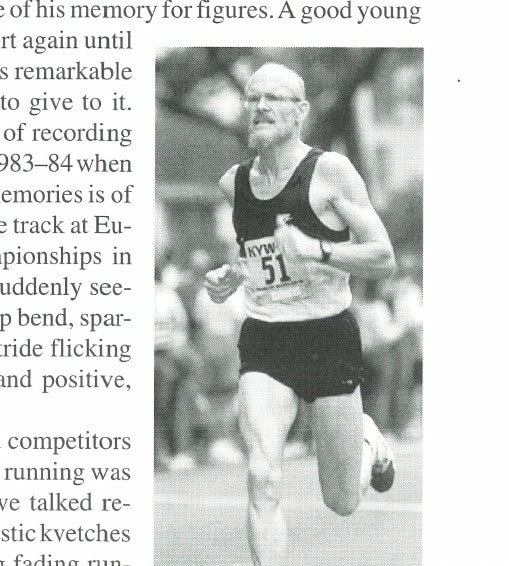
A generous man with a boyish enthusiasm for his sport, Green can still reel off all the top performers, usually giving you their percentage ratings on the age-graded tables. His own marathon bests put him on the brink of the very greatest: 97.99 percent for his 2:27:42 at Twin Cities at age 55; and 96.8 percent (I forget the hundredths; unlike Norm, I’m bad at figures) for 2:25:51 at age 52. It was always chastening to be following in the dynamic footsteps of the crop-headed, tidily bearded minister of religion from Wayne, Pennsylvania. I remember now my delight at 1:10:15 at the Philadelphia Half-Marathon at 50 was dampened by discovering that Norm in a previous year had run only a few seconds slower at 55 (1:10:23).
He is a feisty racer. Aggressive would not be the right word; it’s more kind of irrepressibly positive, as if he knows that Providence is on his side. He studies the sport with an equal zest, like a 10-year-old discovering the delights of baseball scores.
If I admire his running, I’m in awe of his memory for figures. A good young runner, Norm did not take up the sport again until his late 40s. He discovered a talent as remarkable as the commitment he was willing to give to it. Norm achieved the rare satisfaction of recording his set of lifetime personal records in 1983–84 when he was over 51. One of my abiding memories is of returning after an evening meal to the track at Eugene during the WAVA world championships in 1989, walking under the stand and suddenly seeing Norm Green flying around the top bend, sparkling in the floodlights, that quick stride flicking out under the barrel chest, poised and positive, looking every year of 21.
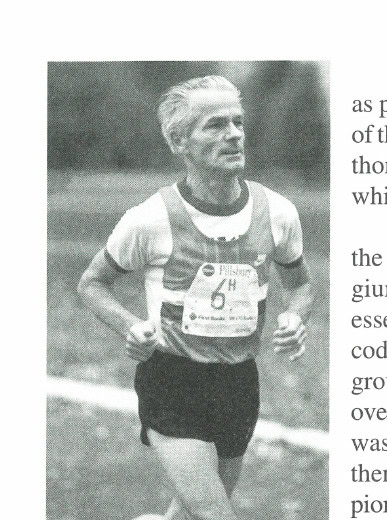
Prostate cancer did what age and competitors had failed to do: slow him down. His running was interrupted for over a year. When we talked recently, we enjoyed one of those ritualistic kvetches that are common consolation among fading running friends.
“Nobody used to pass me after the first mile of a race,” Norm tells me. “Now they do, and I can’t do anything about it.”
“Hills,” I say. “I used to look forward to hills, as the place I could break almost anyone. Now people pass me going uphill, and it drives me crazy.”
“My body will not take the training,” says Norm. “Thirty miles a week is max.”
“The cardiovascular system wants 10 times the work,” I say, “but every time I crank it up, the knees or tendons go.”
“The weight went up with the treatment,” says Norm.
“The weight went up with the injury,” I say.
And so on. Nevertheless, Norm was just back from Barbados, where he had been on business for the WAVA region he represents and had managed to find a road race. “A long five miles,” he says, precise as ever. He finished in the top 20 percent of the field, age 65. Now retired from his full-time role in the church, Norm holds at least six demanding administrative positions (I lost count even of those) on USATF and WAVA, puts out newsletters, keeps the statistics, is membership chair, treasurer, delegate, on and on.
His zest and willingness to work are undiminished. So, as I read him, is the sense of giving service by using his God-given talents to the full. Fifty years ago his career as an official would have been the only outlet for a man over 45. Masters running made it possible for Norm Green not only to keep the sport’s records, but also to know that he has one of the most honored places in them.
PRISCILLA WELCH
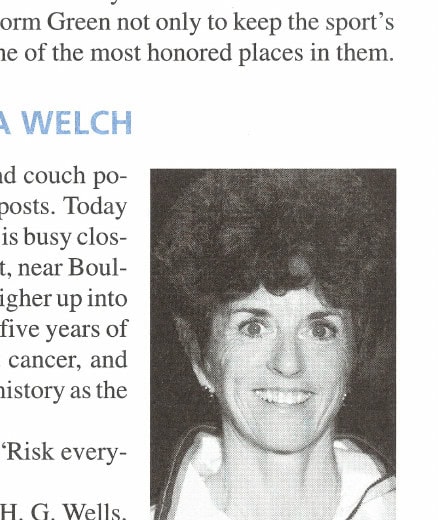
Twenty years ago she was a smoker and couch potato, living on remote British military posts. Today (as I write, on November 19, 1997), she is busy closing the sale on a big house in Longmont, near Boulder, Colorado, preparing for the move higher up into the Rockies. She is celebrating exactly five years of clean health since treatment for breast cancer, and she remains unchallenged in marathon history as the greatest female master of all time.
“Risk!” said Katherine Mansfield. “Risk everything!”
“If you do not like your life,” said H. G. Wells, “change it.”
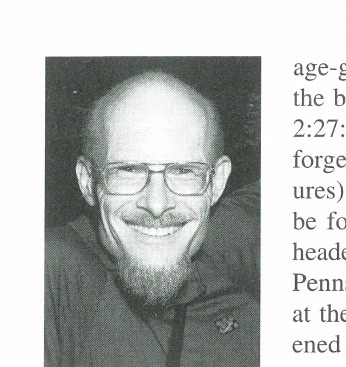
Prompted and supported by her husband Dave, Priscilla Welch risked becoming a runner, and their lives were transformed. None of us knew her when she raced into sixth place in the 1984 Olympic Marathon at Los Angeles. She was 39. She had begun running at 35. We soon knew her very well as she traveled the world in pursuit of the best competition, consistently confirmed her standing as one of the world’s open elites, and, almost incidentally, compiled a set of over-40 records that still look impregnable. (“Well,” she says, not
DEREK TURNBULL
“Feel like rattlin’ yer dags down to the corner?” Derek asked nonchalantly. And without waiting for a reply, he took off, lengthened that fluid, flexible stride over roots and hillocks and reached the trail gateway at what must have been sub-70 second 400 speed.
To know Derek Turnbull, visit Tussock Creek in the pastoral far south of New Zealand, where he and his wife Pat run a farm of about 3,000 sheep, and a sideline in entertaining passing travelers, especially runners.
He claims always that his running is just his hobby, a break from farm work, but to see him on his land, striding the paddocks in a battered check bush shirt,
driving the even more battered truck ahead of a work gang of yelping border collies, manhandling big ewes in preparation for shearing or dipping, fixing fences, milking cows, feeding the warm milk to the pigs, is to understand that when he goes loping off into the hills for his relaxation, his other life as a runner grows also at some deep level from these green, river-flat pastures. One large area of the land has been preserved untouched as native bush and bequeathed to the nation. “Turnbull’s Bush” may in the long term be a more lasting memorial than Turnbull’s records and Turnbull’s medals.
Derek’s homespun philosophy and laconic style make him a memorably quirky character in the usually earnest context of prerace seminars. You meet the same droll modesty at home over the bacon (ample) and eggs (several).
“I don’t know about all this aerobic business,” he says. “I don’t train. I just run—when I feel, where I feel, and how I feel.”
A week on the farm reveals that following what he feels produces a perfectly balanced program of distance, tempo, quality, and rest. He may run for relaxation, but the relaxation includes stretches when you rattle your dags very vigorously. “Dags” in New Zealand are the long tassles of wool that hang behind an unshorn sheep, heavy with dried droppings. When the sheep runs, its dags clatter together. So “rattle your dags” means “hurry it along”; or, you might say, if Derek wasn’t listening, “after adequate aerobic warm-up, include some controlled anaerobic repetitions.”
He resists scientific descriptions of running as stubbornly as he refuses to master any of the computer and telecommunication technology imported by the savvy Pat for her various editorial, church, and genealogical work. She also keeps an exquisite garden, holds church services in the farmhouse, reads extensively, keeps close contact with all their children and grandchildren, and works on the farm as needed. This year she seriously hurt a hip by a fall from the truck. My own contribution to the land’s continuous demands on human labor is to collect the eggs.
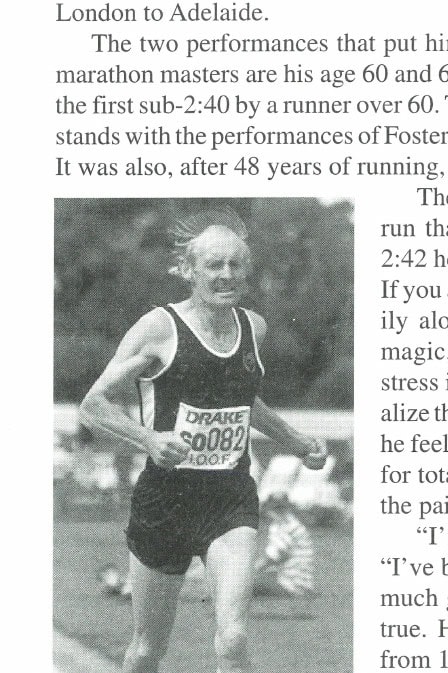
The Fastest Old Man in the World is the title of the enthralling half-hour movie about Derek. As guest speaker at its premiere, I pointed out that he has been earning that description since masters running became organized in the 1970s. In age-group after age-group he has swept world records from 800 meters to the marathon, collecting gold medals at the rate of one a day at WAVA championships whenever the demands of the farm allow him to travel, and thrashing tens of thousands of much younger runners in major marathons from London to Adelaide.
The two performances that put him indubitably among the very greatest marathon masters are his age 60 and 65 records. In 1987 he decided to try for the first sub-2:40 by a runner over 60. The 2:38:46 he ran at Adelaide that year stands with the performances of Foster and Van Alphen as truly epoch-making. It was also, after 48 years of running, a personal record.
Then, in 1992, when he turned 65, came the run that is the centerpiece of the movie, the 2:42 he gutted out on a windy day in London. If you are inclined to think Turnbull floats easily along on some Arcadian cloud of rustic magic, watch his concentration, effort, and stress in movie footage from the race. You realize that the droll, genial hobbyist who runs as he feels coexists with a will of iron, a capacity for total commitment, and a rare resilience to the pain of hard running.
“I’m not specially talented,” he says. “I’ve been running since I was 13. Never did much good. I just haven’t slowed down.” It’s true. His 880/800 times stayed around 2:06 from 1945 to 1985, and he still runs sub-2:30 at age 70.
“He always had his running shoes with him,” laughs Pat. “When we were courting, he used to take me to the cinema and then run home.”
The shoes were possibly the same ones I saw him wearing as he lined up for the New York City Marathon in 1990—mud-stained, flattened, and see-through. He ran 2:47:25 in them at aged 63. Utterly without pretension, Derek enjoys the glamorous races overseas for their carnival atmosphere and the fun of travel, but they mean no more to him than some local mid-week road run for Invercargill Harriers in a field of 30, who all gather in the same pub afterwards.
Foster, Welch, Campbell, and others have all stopped, or were stopped. Only Turnbull seems indestructible. Even in 1997, at 70, he retains his amazing ability to come off a wet farm winter of little running and race himself to fitness in a few weeks. When I last stayed on the farm two years ago, he had turned to triathlons, racing on his bike on Wednesday evenings and driving to the swimming pool at 6:00 every morning. Then he had some health problems and Pat’s injury was a complication.
As a result, his preparations for the August 1997 WAVA championships in Durban were minimal. They stopped in Wellington on the journey, and I joined him for the last two miles of a half-marathon. “It’s my longest run for three years,” he grunted, and it showed. He looked listless, lacking the usual sinewy spring in the stride. Three weeks later in Durban he won every race he entered. He’s like the annual miracle on his land that brings the apparently dead earth into renewed life. Or perhaps, as he would much prefer to put it, it was just time to rattle his dags.
A few years ago, researching a feature on John, I revisited Ravensbourne, a working-class suburb perched on a wind-swept hillside outside Dunedin. The streets where John at the age of 10 worked before school as a milk-delivery boy are steep, angular, and exposed. At 6:00 in the morning they could be bitter. The sea off the Taieri Rivermouth where he started his adult life trawling for flounder and red cod is stormy and cold. He once survived several hours when the boat capsized and his skipper drowned.
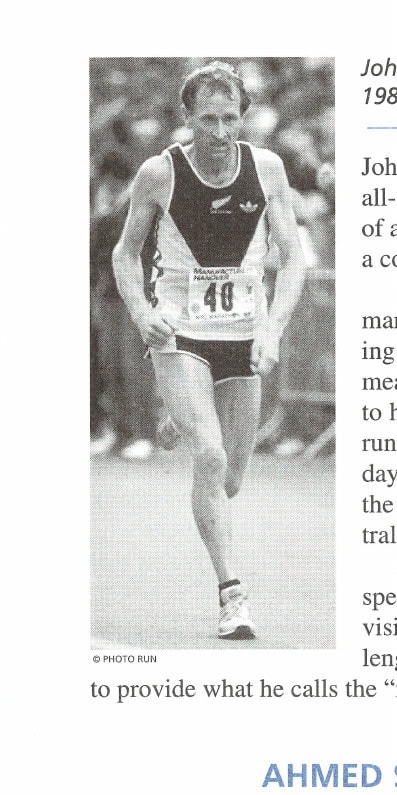
Every time we meet, John is preoccupied with work. At different times it has been his fishing, his bread-delivery round, his fish-and-chips takeaway, his corner convenience store, his professional running, his mountain ski and tourist lodge. The day’s schedule is always unremitting. His capacity for intense training is legendary, his self-discipline unwavering.
Yet it would be wrong to think of Campbell as only a joyless toiler. When we first chatted after that race in 1969, his young eyes gleamed when I told him about the world cross-country championship (or “international” as it was then). He was idealistic about representing New Zealand. He still is. Anyone who collected his autograph in his great years on the American circuit will note that he invariably signed as “John Campbell, New Zealand,” not “2:11:04” or “World Record Holder” or “Adidas,” though the shoe company did supply the postcards. His pride in his country, admiration for heroes like Foster and Turnbull, his sheer love of running, all spring from a romantic streak in this rigorous man.
“I’ll tell you what,” he said as we ran together around Auckland’s foreshore in 1991 (5:45 miles for an hour and a half). “Auckland’s a magic place. Great for training. And you can sail out to an island and run on it. There’s no one there. The water’s calm in the gulf. I want a boat, house, income; maybe a farm? I’m always looking at businesses and investments.”
The mix of idealism and pragmatism is typically Campbell—or typically Dunedin, where aspiring immigrants from the Scottish highlands have always had to work hard for their dreams, and where the southerly wind blows cold off the Antarctic. Whatever drives him, no masters runner, even Priscilla Welch, has compiled a catalog of achievements like Campbell’s in the two years after he turned 40 in February of 1989: 2:14:19 and 2:11:04 at Boston, 2:16:15 and 2:14:34 at New York, wins at Los Angeles, masters records on over 30 courses, masters world bests at every recognized distance from four miles to the marathon, three minutes carved from the world half-marathon mark (1:02:28 at Philadelphia in 1990), every top master of his generation comprehensively put away (Cuevas, Tibaduiza, Navarro, Marczac, Waigwa) and defeats handed to elite younger runners like Hussein, Garcia, and de Castella. It was awesome, a kind of audacious, unceasing odyssey.
Perhaps that perturbed spirit is now at rest, but I doubt it. It’s been a year or two since we got one of those tentative evening phone calls announcing that John was half an hour away on one of his habitual all-day drives and would be glad of a bed. He’s a bit of a hobo, who also (another contradiction) enjoys a comfortable hearth.
Last seen, John was almost single-handedly managing and maintaining his tourist lodge, cleaning the 30 or 40 units during the day and cooking meals at night. He can never find staff who come up to his standards of commitment. And, yes, he was running, an hour or two in the middle of the working day, on roads and trails that climb the steep slopes of the cluster of volcanic peaks in New Zealand’s central North Island.
His next-door neighbor is Mount Ruapehu, whose spectacular eruptions were seen on the world’s televisions in 1996. It’s country tough enough to challenge even John Campbell’s need to strive, yet able to provide what he calls the “magic” that he also seeks as he labors.
AHMED SALAH AND OTHERS
A few masters remain, though I feel embarrassed at reducing such fine athletes and, in several cases, good friends, to a footnote.
Sister Marion Irvine has run six of America’s best 10 marathons by women over 50 (information courtesy of Norm Green). Her 2:51:01 at age 51 famously qualified her to take part in the 1984 Olympic Marathon Trials. She has revised for the better concepts of female middle age, and of school principals, and of nuns. She also tells brilliant nun jokes.
Shirley Matson ran slightly faster, 2:50:26 at age 50. Evy Palm of Sweden also leaps from the lists with her 2:38:00 at age 48. Ron Robertson (yet another New Zealander) is rewriting Turnbull’s 55–59 records, though not yet in the marathon. Fay Bradley of Washington, D.C., is on the brink of some remarkable over-60 running when he passes that birthday early in 1998. Clive Davies of Oregon, with 2:42:44 at 64 and 2:42:49 at 66 is barely in the shadow of Turnbull.
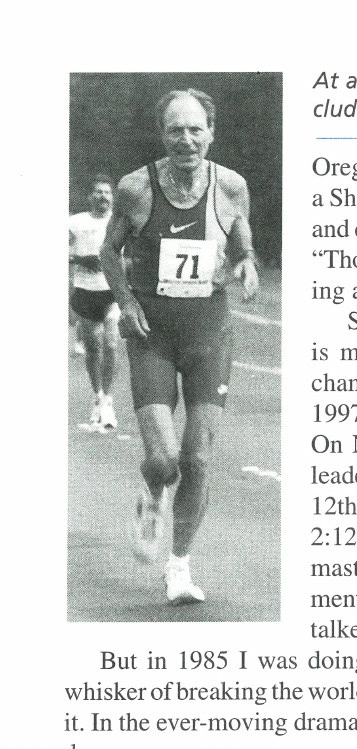
And in the over-70 group, surpassing even the 3:03:05 that Davies ran in 1987, is John Keston, who ran 3:00:58 at age 71 at Twin Cities. Like Davies, Oregon-based and originally from Britain, Keston was a Shakespearean actor. I look forward to meeting him and dropping in a few well-rehearsed quotations, like, “Though I look old, yet am I strong and lusty” or (cheating a little) “the three-hour traffic of our stage.”
Shakespeare is always good for an ending, but there is more. Olympic medalist (1988) and World Cup champion Ahmed Salah of Djibouti is now 41. In May 1997 he won the Vienna Marathon outright in 2:12:53. On November 1 in Chuson, Korea, he ran with the leaders for most of the distance before fading to a 2:15 12th place. In Monte Carlo on November 23 he ran 2:12:44. In 1996 he reputedly broke John Campbell’s masters marathon record. If he did, his accomplishment has gained no recognition, and no one I have talked to can confirm or deny it.
But in 1985 I was doing TV commentary when Ahmed went within a whisker of breaking the world marathon record. Maybe as a master he has done it. In the ever-moving drama of our sport, the final curtain never comes down.
This article originally appeared in Marathon & Beyond, Vol. 2, No. 2 (1998).
← Browse the full M&B ArchiveMore like this
1,000+ stories from 19 years of Marathon & Beyond
The complete archive of the legendary long-distance journal — digitized and free to read.
