

Running For My Life
There were no guarantees for me as I toed the line of the 2005 Seattle Marathon. If you had seen me seven months and two days before, you would have written me off. One thing was certain, however: I would do everything within my power to finish.
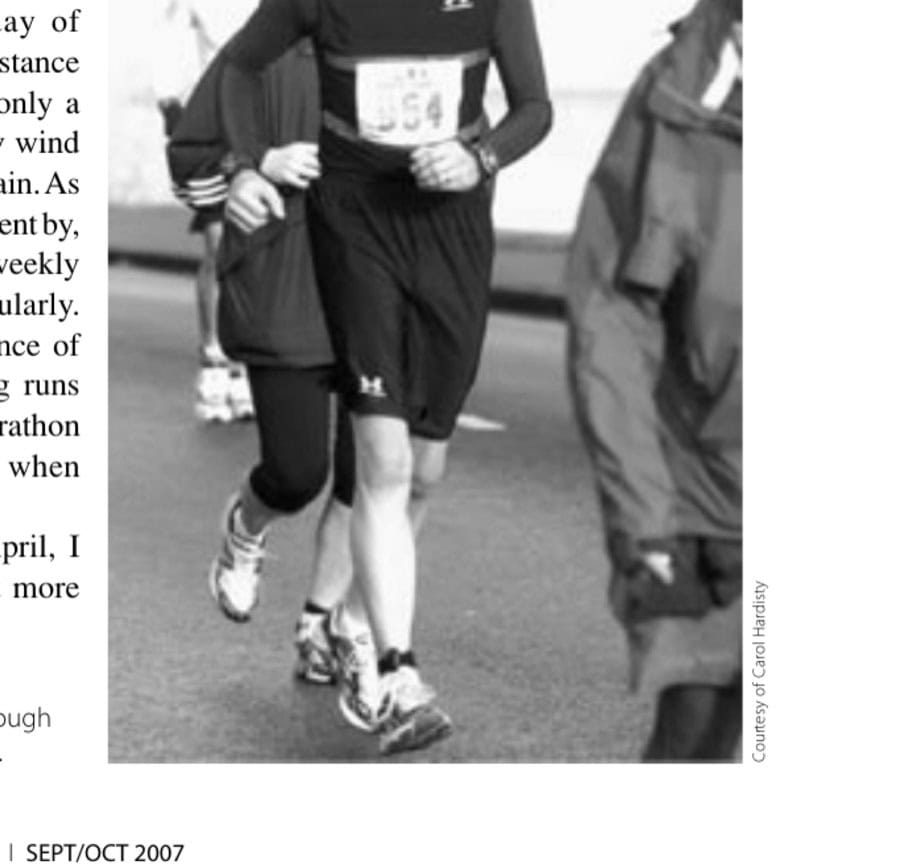
My story begins in September 2004, the month I began training in earnest for the 2005 Portland and Seattle marathons. I remember how fatigued I was after running a mile on my first day of training, but being a distance runner I knew it was only a matter of time until my wind and legs grew strong again. As the weeks and months went by, my level of fitness and weekly mileage increased regularly. I had achieved a distance of nine miles on my long runs and entered the half-marathon phase of my training when tragedy struck. One Saturday in April, I ran four miles and felt more
▲
The author, halfway through the 2005 Seattle Marathon.
Courtesy of Carol Hardisty
Tfatigued than usual. I also noticed a cold sensation in my windpipe. The feeling passed, and three days later I set out again to run four miles, but this time the feeling of cold occurred at about two miles, and I had a tingling in my forearms. A few days later, I planned on doing at least six miles and maybe more, depending on how I felt. How I felt after only one mile would change my life forever. At one mile, my forearms cramped up, and the cold windpipe feeling hit me so hard I could barely function. I walked home immediately, not sure whether I would make it.
When my wife, Carol, got home from work, I told her about my troubles. She is a respiratory therapist and a few days prior thought I might have sports-induced asthma. When I told her about my forearms aching, she feared it might be heart related. My father had died of heart disease, and you can’t take family history lightly. I went to see my doctor the next day, and he tested my lungs and urged me to do a treadmill stress test to rule out my heart.
I knew the problem was breathing related but humored him nonetheless. The stress test revealed a blockage of my coronary artery, and the cardiologist wanted to perform an angiogram the next morning to determine how to best remove the blockage.
Carol and I prayed that evening that I would be repaired the best way possible and that I wouldn’t have to worry about my heart anymore. The angiogram showed the blockage to be at the bifurcation—or split—of my artery, and the only way to properly repair me was to open me up. We would be getting what we prayed for, although open-heart surgery wasn’t exactly what I had in mind. Two days later I had open-heart surgery and spent a week in the hospital recovering.
Upon my release, I met with my mother, who had been on vacation while I was having surgery. She had been diagnosed with terminal lung cancer in March, and I wanted her to enjoy her last vacation, so I waited for her return to tell her. As my strength and stamina increased, hers decreased until, on July 5, 2005, at 83, she passed away, but not before giving her life to the Lord. I took comfort in that but of course miss her very much.
ROAD TO RECOVERY . . . AND SEATTLE I continued to rehab in Eugene, at the Oregon Heart and Vascular Institute’s cardiac and pulmonary rehab center. Eight weeks after my surgery, I was told that I could start running again and that very day went to the track and did three miles. I also made a deal with Aaron, my rehab technician: no Portland Marathon, but if I wanted to do the Seattle Marathon, which fell seven weeks after Portland, he would help me train. By this time, I had only 16 weeks and five days to go from walking to running to training for the marathon. It was a daunting task, but I was compelled to do
it to show other members of the zipper club that life goes on and that with faith you can do anything you set your heart and mind on. Aaron would supervise me one day a week in rehab and tell me what I needed to do that week during the rest of my training. Three weeks before the marathon, I completed my longest training run of 2 hours, 15 minutes. At my pace, that equated to about 13 miles—hardly enough for a marathon, but I was running out of time.
So as I stood there at the starting line, I knew that I could probably run for two and a half hours, maybe even three, but I had no idea what my body would be able to do after that. I also knew that my father had died at 46 years of age of a heart attack and that was my age as I stood there waiting for the horn to start the race. I had tremendous support from my wife and two teenagers during my recovery, and they were there at the line to cheer me on through the race. As youth leaders in our church, we had the entire high school group praying for us as well as members of the congregation. All my friends at the rehab center were behind me, too. I felt a lot of pressure to do well for them, as it would also mean a great deal for their program.
At 8:15 A.M., the horn sounded and I set off with the other 2,735 entrants, each of us at war with the course, the elements, and The Wall. In 1997, I ran the Portland Marathon, finishing in 4:54. As I ran, I hoped I could beat that time. After 22 miles and a couple of killer hills, I felt my strength fading. I prayed to myself, “I will run and not grow weary,” even though
www.asiphoto.com
▲
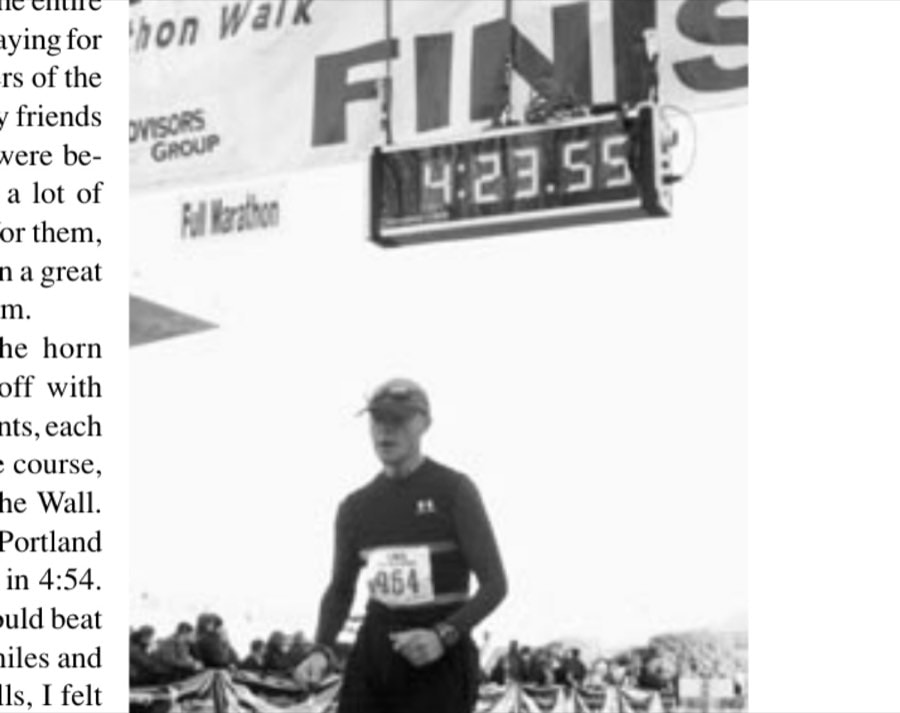
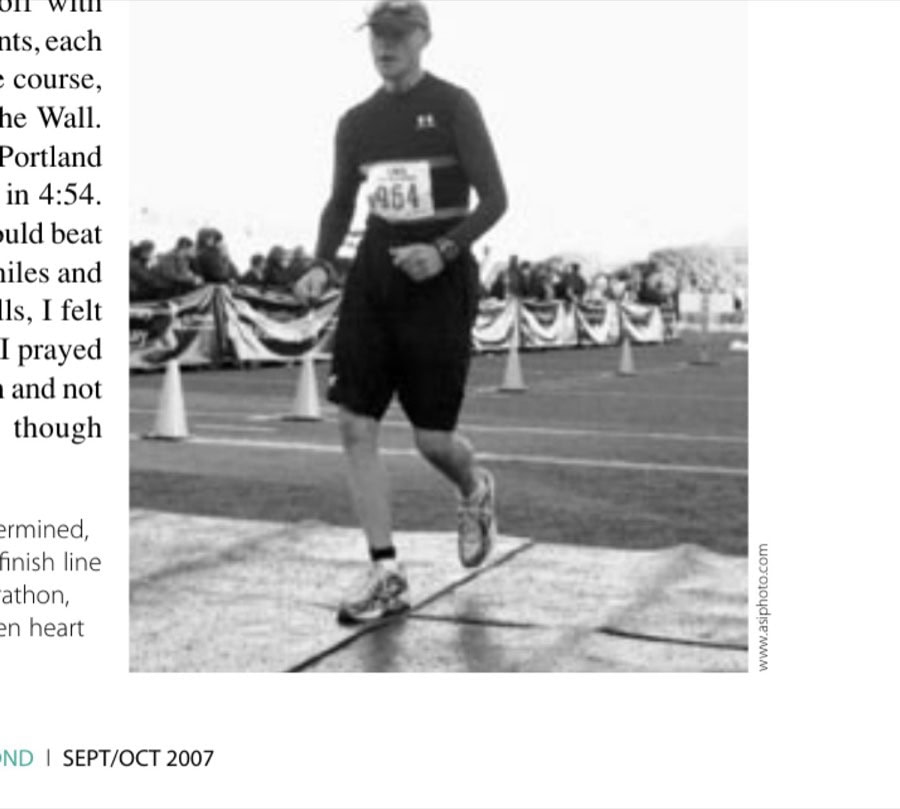
Dehydrated but determined, the author crosses the finish line of the 2005 Seattle Marathon, seven months after open heart surgery.
I knew it was a lie. I thought of Elijah, who ran ahead of Ahab and his chariot all the way from Mount Carmel to Jezreel. My bible map indicates that to be a distance of 25 or 26 miles. That’s the power of the Lord for you.
WILL WONDERS NEVER CEASE? I hit the finish line in 4 hours, 23 minutes, setting a PR by 31 minutes. I’ve met and read about other heart patients doing triathlons, marathons, and other endurance events, but professionals in the cardiac rehab field have told me they’ve never heard of a patient doing a marathon seven months after surgery. It was more by the grace of God than my abilities that this was accomplished.
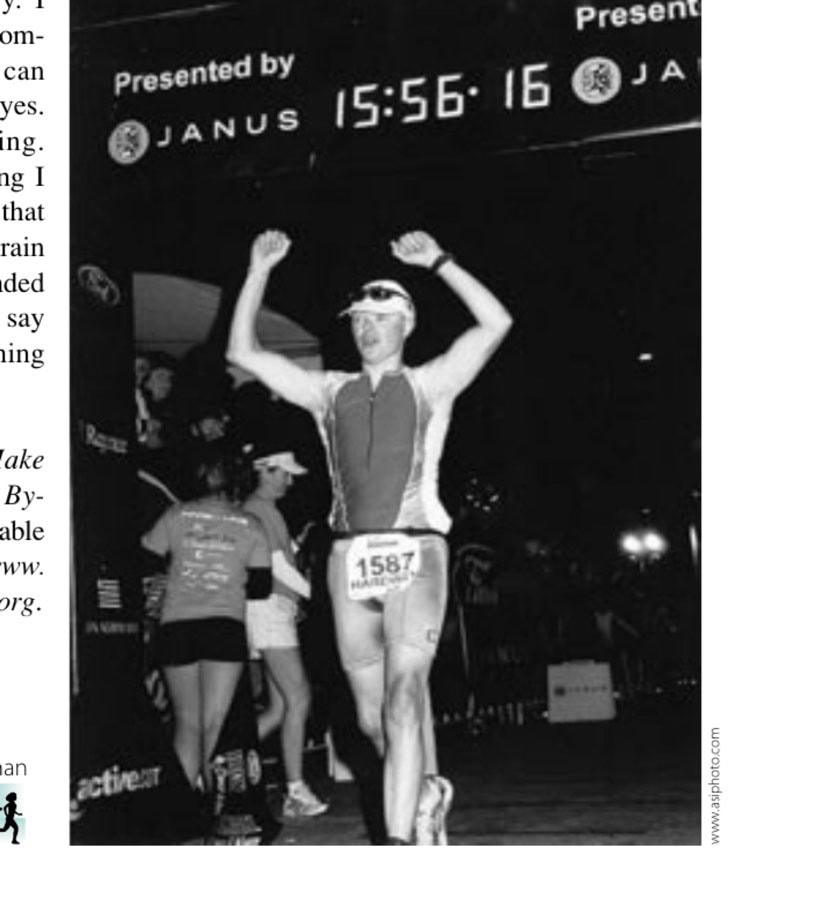
And so, I stood at the starting line, 46 years of age, knowing my father had died of a heart attack at 46, yet thanks to modern medicine I was given the chance he never had and wanted to make the most of it. I wanted to set the bar a little higher for those who came after me, to show that life is not over no matter your situation. I am now a volunteer for the hospital’s pulmonary-care unit and visit with patients who have just had open-heart surgery. I tell them of my accomplishment, and I can see hope in their eyes. It’s very rewarding. One important thing I took from rehab is that I should eat and train as if my life depended on it. I’m here to say that I’m still running for my life.
Jeff’s book, Make Mine a Triple . . . Bypass That Is, is available on his Web site: www. jumpstartmyheart.org.
www.asiphoto.com
▲
The author’s latest accomplishment— completing the Ironman Coeur d’Alene in June 2007.
This article originally appeared in Marathon & Beyond, Vol. 11, No. 5 (2007).
← Browse the full M&B ArchiveMore like this
1,000+ stories from 19 years of Marathon & Beyond
The complete archive of the legendary long-distance journal — digitized and free to read.
