

Matriarchs Of The Ultra
Before Ann Trason and Pam Reed started giving the men a run for their money, the duo of Sandra Kiddy and Sue Ellen Trapp dominated women’s ultrarunning for much of the 1980s. Because both Kiddy and Trapp ran in their 40s and well into their 50s, and very competitively as you’ll see, they were still a force to be reckoned with in the 1990s.
For example, while Trason was garnering six of USA Track & Field’s women’s ultrarunner-of-the-year awards in the 1990s, Trapp earned three—and she didn’t stop there, as she was still winning major races and setting records in 2001 and 2002. First, though, we’ll take a look at Sandra Kiddy’s ultrarunning career and how she became the first woman inducted into the Ultrarunning Hall of Fame.
SANDRA “SANDY” KIDDY From Nonathlete to Hall of Fame Champion When Sandy and her husband, Fred, were in their early 30s, they took up jogging in hopes of burning off the 30 to 35 bonus pounds each was carrying. Sandy had little in the way of athletic experience to draw upon. She remembers as a child playing games and some sports at summer camp. Another fond recollection was climbing the rope in gym class. Other than that, she wasn’t very athletic and had little interest.
She and Fred started with regular two-mile jogs, including weekends when they enjoyed running together around the neighborhood. She joined up with a group of four other runners for daily runs. The running must have helped, because Sandy eventually dropped from 140 pounds on her petite 5-foot-2-inch frame to 98 pounds (when she was racing in her 40s and 50s), and Fred went from 175 pounds to a svelte 139 in just 18 months’ time.
Six years after starting their running, they moved to Palm Springs, where Sandy got involved with a more serious group of runners. These folks were into racing and were getting ready for a marathon. They soon talked Sandy into taking up
racing. As a result, she started running every morning, eventually putting in 10 to 15 miles at a pop with Kiddy’s Critters, as the group came to be known. Sandy’s first race was an eight-miler in December 1976; she had just turned 40. It had been about eight or nine years since she had started jogging to lose weight, but now she was hooked on racing. She estimates that by her late 50s, she had run more than 125 races, 75 or more of them ultramarathons. In her prime, from age 40 to her early 50s, Sandy was running about a race a month. In 2002, the American Ultrarunning Association (AUA) enshrined her in the American Ultrarunning Hall of Fame as one of the first two inaugural inductees (the other being the father of American ultrarunning, Ted Corbitt). Let’s take a brief look at how Sandy earned her Hall of Fame status. • 1979—At age 42 in her very first ultramarathon, Sandy burst on the scene
with a world-best 3:37:08 50K, breaking the record by an amazing 3 minutes, 40 seconds. • 1981—In her first 50-mile race, she ran 6:24:19, putting her fourth on the all-time women’s list. In subsequent years, she improved her time
to 6:15:47 and then to 6:09:09 (at age 47), which at the time placed her second on the all-time U.S. list of 50-mile performances. • 1982—Sandy won the Chicago Lakefront 100K (62 miles), the premier American ultra road race, with a time of 7:59:59, making her just the second woman to break eight hours and the first to do it in the United States. •
1983—She won the Women’s World Cup 100-Mile in Waldniel, Germany, with a 15:40:50, breaking the world record by over three minutes. That year she also lowered her 50K personal best to 3:32:34, taking over third
place on the all-time U.S. list. • 1984—She won the Edmund Fitzgerald 100K, a major race with a large and competitive field, in 7:49:16, passing the men’s winner in the last 100 meters. She was 47 at the time, so not only did she strike a blow for
women, but she also showed that age need not be a factor. • 1986—One week shy of her 50th birthday, Sandy ran 7:56:21 to win the Philadelphia-to-Atlantic City 100K. • 1987—Now 50, she won the Ice Age 50-Mile Trail Race in Wisconsin. •
1991—Sandy ran 6:34:28 in a 50-mile race to qualify for the U.S. team for the 1992 World Championship 100K in Palamos, Spain. • 1992—As a chic 55-year-old, she became the oldest athlete ever named to
an open U.S. track team. At the World 100K in Palamos, she finished in 8:42:36, the second American woman, a world age-group record. Of interest: she was leading the American contingent until the last few miles.
▲
This is the running form Sandy Kiddy used to set 16 U.S. and world records.
Training of a Champion As we saw earlier, Sandy started out with two-mile runs. She and Fred didn’t start out with a combination of walking and jogging as many neophyte runners do. In fact, she says that she never walked—a sign of her persevering nature and things to come. Before she started to run ultras, she did some speed work with a group of avid racers she ran with each morning by picking up the pace for a quarter mile or a half mile.
Here’s how Sandy describes her training during her record-setting years: “After I began running farther than the marathon, I would use races for speed work. We tended to do races at least monthly and sometimes more often. Marathons became speed work for longer races. While living in Palm Springs, we ran 12 miles every Saturday morning from a friend’s condo, which was two miles running to the road leading up to the Palm Springs aerial tramway, four miles up the road to the base of the tram (500 feet [of elevation] to 2,500 feet [elevation]), and [then we would] return to the condo. We did that from 1974 until 1986. I have done speed work on the track, but I preferred races where refreshments were available and the excitement of the race made me work harder. It was also more fun.”
Courtesy of Sandra Kiddy
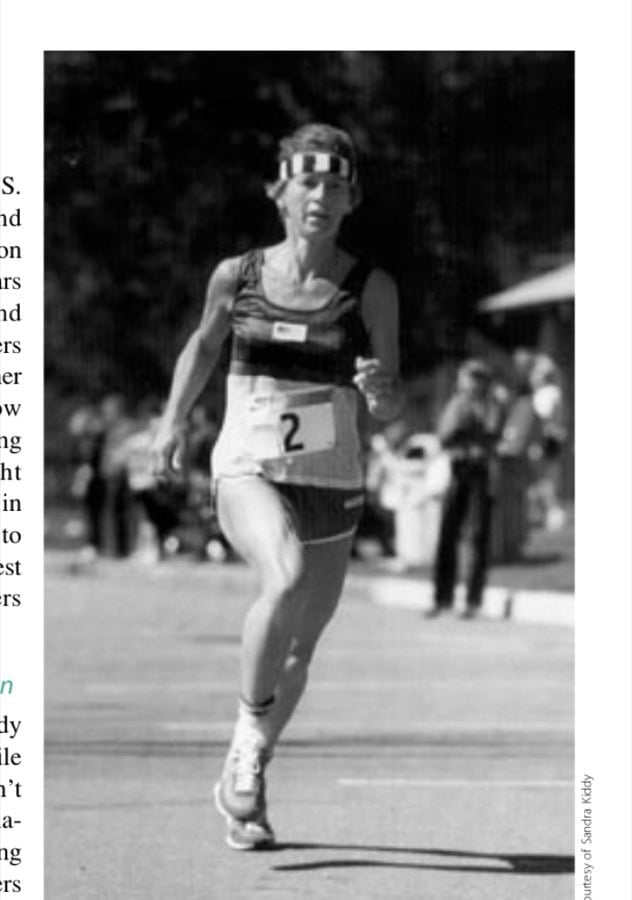
In all, Sandy set 16 U.S. and world records, and nine of the 16 were still on the books 10 to 20 years after she set them; and she did it all as a masters runner (past age 40—in her case, past age 42). How did Sandy go from being 35 pounds overweight and having no interest in sports in her early 30s, to being one of the greatest woman ultramarathoners of all time?
The Duo’s Age-Group Dominance: Women Ages 45 to 49—U.S. Records Road Events Event/distance
Time or Distance
Runner
Year
50 km
3:32:34
Sandra Kiddy
1983
100 km
7:59:59
Sandra Kiddy
1982
50 mile
6:09:09
Sandra Kiddy
1984
100 mile
15:12:54
Sandra Kiddy
1985
12 hour
127,777 m (79.39 miles)
Sandra Kiddy
1985
24 hour
233,816 m (145.28 miles)
Sue Ellen Trapp
1993
48 hour
360,090 m (223.74 miles)
Sue Ellen Trapp
1993
6 day
501,712 m (311.74 miles)
Sally Middleton
1995
Source: American UltraRunning Association (AUA)—as of 1/27/01 by Jason Hodde
In preparation for races, Sandy would run 85 to 95 miles per week. It must have worked, because she never had a DNF (did not finish) in over 125 races, more than 75 of them ultramarathons, some of which were as long as 100 miles. My unofficial calculations indicate that Sandy averaged 7 minutes, 34 seconds per mile for the 62 miles of the 100K in 1984 where she was the overall winner. That’s quite a pace to maintain for nearly eight hours.
Sandy, now 70, no longer races, but does put in nine or 10 miles of daily recreational running, or about 65 miles a week. About the only days she doesn’t run are Tuesdays if she has a golf tournament. Her times for the 9- to 10-mile runs haven’t slowed all that much, either. She estimates that she averages between 8:30 and 9:15 per mile on the winter runs when it’s cool (40s to 70s) and a little slower (9:00 to 9:45 per mile) during summer runs when the temperature hovers in the 90s and the shade is sparse. However, when she and Fred travel, she tends to go faster and longer because the fresh scenery is invigorating.
Before her runs, Sandy warms up by doing about 30 to 40 minutes of stretching (full body) and hamstring-strengthening exercises. Concerning stretching after a run, she says, “I don’t really go very fast any more to get my heart rate up too much. I never have done much stretching after a run.” A recent article on UltraRunning.com said, “Sandra stays just as active as ever. In fact, she still exhibits more energy than many marathoners today.”
Diet of a Champion How did Sandy fuel up for her 26- to 100-mile races? For Sandy, as with most ultrarunners, it’s carbohydrates and more carbohydrates before and after each race. Here are some of the foods Sandy has been known to fill up on:
• Breakfast—cereal, open-faced sandwiches, fruit, leftover pizza, rice, and so forth • Lunch—none • Supper—pasta, pizza, potatoes, more carbs, and salads • Snacks—none
Courtesy of Sandra Kiddy
That’s it: just two meals a day and no in-between snacks. She says: “I like to be hungry.” With no races in sight, Sandy loads up on fruits, vegetables, and grain products. She seldom eats red meat (no more than about once every two weeks). Fish meals are a little more common. When she does have a high-protein
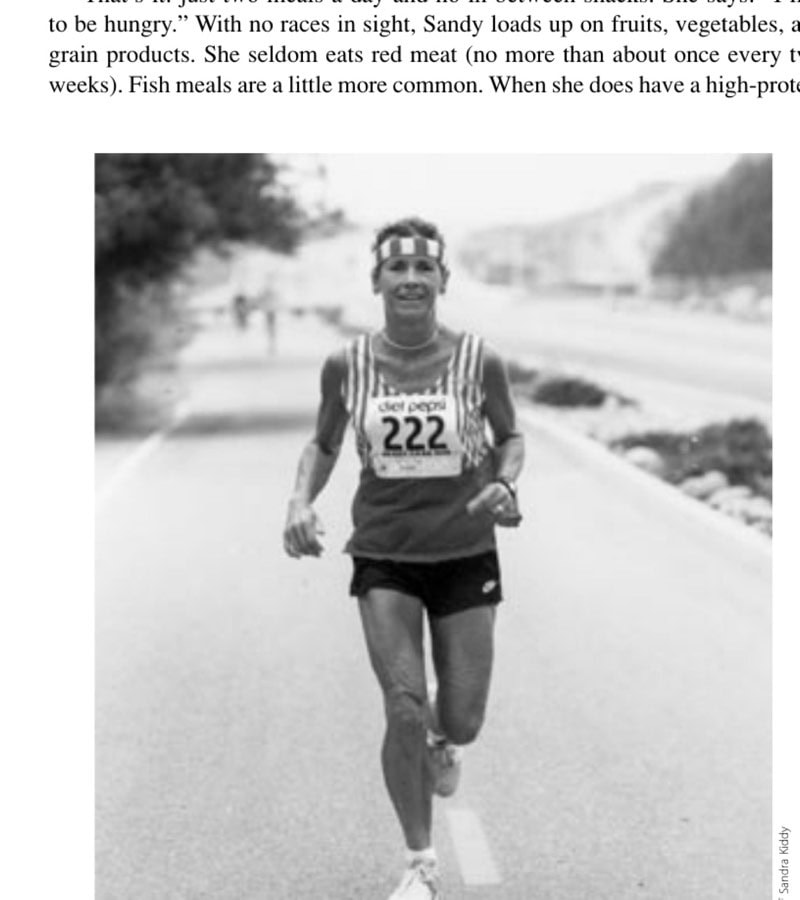
▲ Sandy, at age 48, running one of the marathons she liked to use for her speed work.
meal, she drinks a lot of water with it to flush the toxins, since she considers large portions of protein to be hard on the kidneys. Despite eating only two meals a day, Sandy loves the fact that she can put away (read that: enjoy) large amounts of food because of her running.
Food supplements consist of one multivitamin and 1,500 milligrams of calcium a day. During races and long runs (especially in hot weather), she loads up on ERG (electrolyte replacement drink with glucose) and nonfizzy coke—seldom water.
As far as liquids go, Sandy doesn’t much like water but will force herself to drink more of it in the hot summer months. It appears that she gets her daily requirements of water in the form of a cup of coffee in the morning; tea during the day; and wine, fresh fruit juice, a rum drink with citrus, or a margarita with lime at supper. Some experts say that alcohol and coffee don’t count toward our daily water requirements, while others now say that we can get our water from these sources and that a large percentage of our need is also quenched with water-rich fruits and vegetables. It seems likely that Sandy received the water she needed since she was fit and healthy enough to run far and fast—and frequently did.
The Thinking of a Champion When Sandy started running in her early 30s, she just wanted to lose a few pounds. She had no idea she would even like running, never mind that inconceivable idea that she would one day be a champion ultrarunner. What are the mental aspects of her success?
In the beginning, one of the keys was having someone to run with. When she first began running, she and Fred ran together during the weekends, which she enjoyed a lot. She says this was most important, as she would not have started running by herself. She and Fred no longer run together because “our paces are no longer the same.” Although she now loves solitary runs—to be alone with her thoughts and to enjoy the rhythm of the run—Fred’s support and that of her running group were important to her sticking with running in the beginning.
When running in ultras, Sandy didn’t race other runners head-to-head. She liked to get off by herself where she could get into a rhythm and pace that best suited her. It was almost like a meditative experience: getting lost in the repetitive, rhythmic pattern of one foot in front of the other. Some would call it a moving meditation. Unlike ultrarunning legend Helen Klein, who focuses constantly on her body posture and the relaxation of various muscle groups, Sandy didn’t focus her mind on anything in particular, unless it was on how she felt in the moment and what she would do to feel better.
If there was a problem (there weren’t many, she says), she would put her thoughts on coming up with a solution (such as drink more fluids, eat some carbs, change pace). She knew enough about the course, conditions, and her pace to know whether she would set a record in a given race. In other words, Sandy focused
© Jane Byng
▲
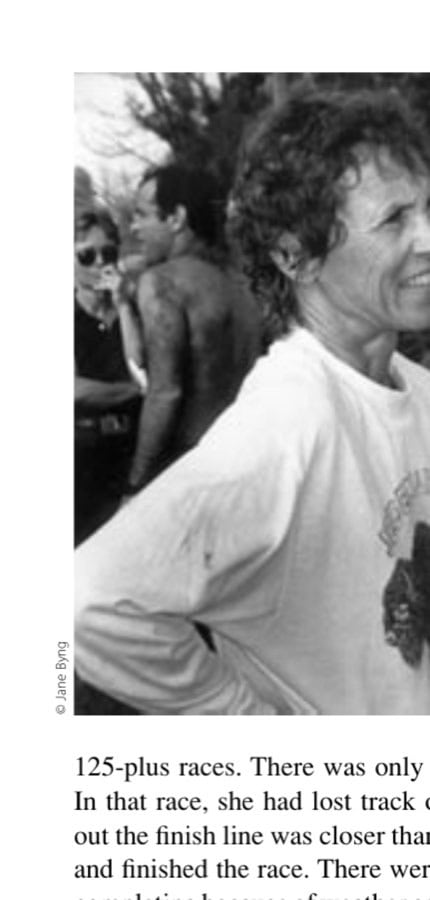
Well into her 50s, Sandy was very competitive at the national and international levels.
on her own race, the course, and the conditions, rather than racing directly with other runners. The morning of each race, Sandy’s attitude was: “Let’s get started!” There was never any worry or anxiety right before
an ultrarace. She knew she had trained sufficiently and was familiar enough with the course to have complete confidence that she would run well and complete the race. Sandy enjoyed the races. As mentioned earlier, she completed
every race she ever started: all 125-plus races. There was only one race that she thought she might not finish. In that race, she had lost track of how many miles remained. When she found out the finish line was closer than she had thought, she was mentally reenergized and finished the race. There were two other races that she had her doubts about
completing because of weather conditions, but she always reached her goal. Sandy credits her perseverance to a “stick-to-itism” she learned at summer camp as a kid. Her thinking is: “Once you start, you keep going until you’re there.”
Sandy has never run the popular 5K distance. She didn’t much like 5Ks, 10Ks, or even half-marathons because she had to run faster than her comfort level. Give her a race of 26 miles or more, and she was happy.
The following will offer a little glimpse of the wonderful, humble person Sandy is. In our interviews, she didn’t want to talk about her 16 records. She didn’t know how many were still on the books or what the records were. Sandy
could recall only two races as highlights of her career that were worth relaying to me. She hasn’t even kept her myriad medals and trophies. “That’s not what it was all about . . . Fred and I gave them to local schools many years ago because
recognition means much, much more to children.” In a letter responding to my request for interesting stories she might have, Sandy told me: “There are no records that sparked any special memories that
might be interesting . . . . There were a lot of memories from all of the races, but they are special to me and Fred.”
Concerning her current habit of running nine-plus miles every day, she says, “I got used to eating and drinking whatever I liked. It’s hard to break those habits if you quit running.” So there you have it, the picture of a humble but confident goal-oriented individual who enjoys running as she enjoys life.
Although Kiddy and Trapp had competed in a collective total of well over 100 ultras through the 1980s and into the ’90s, they raced each other on only two or three occasions, according to Sandy’s recollections. They never struck up a friendship, although they had great respect for each other’s running prowess. Indeed, Trapp included Kiddy (as well as Ann Trason) on a short list of ultrarunning idols. With that said, we turn our attention to the other half of our dominating duo, world-champion ultrarunner Sue Ellen Trapp.
SUE ELLEN TRAPP Expanding the Boundaries of the Possible By age 56, Floridian Sue Ellen Trapp had run about two dozen races of 100 miles or more (24-hour and 48-hour races) and various other events in her 23-year ultrarunning career. We say about two dozen because, like Sandy, she doesn’t keep track of such things. She ran all these races while sharing a thriving dental practice with her husband, Ron, and raising their daughter, Kristina. Let’s take a look at her ultra-successful running career.
At age 55, Sue Ellen Trapp became the oldest person ever to win a U.S. open title in a track event. She did this by running 126 miles at the 2001 24-Hour National Championships at Olander Park in Sylvania, Ohio. Sue Ellen was one of six women to total over 100 miles in this race, and she won by almost 13 miles over her closest competitor.
This was her seventh 24-hour national title, surpassing track star Lynn Jennings’s record six U.S. championships in a single event. (In Lynn’s case, it was 5,000 meters.) Just four months prior to this event, Sue Ellen had set a world record for her age group (55-59) with a 206-mile run (breaking the previous record by about 10 miles) at the Surgeres 48-hour race in France. Lest you think it would be easy to win the 55-59 age group because there would be little or no competition, you should know that there were 20 elite women competitors in her age group from around the world.
There’s more to this story. About 15 months before this race, Sue Ellen had tripped over her Saint Bernard, tearing her anterior cruciate ligament, so she ran more than 200 miles on a reconstructed knee in which doctors had replaced her ACL with that of a cadaver. Amazing! The following fall, then 56, she ran a disappointing third (113 miles) at the 2002 24-Hour National Championships. It looked as if she were finally slowing down. However, just three months later,
at the Addison 24-hour race in Texas in December 2002, she covered 133 miles, 308 yards, the most by any American woman that year. This was over a mile farther than she had run at age 53 when she had won her sixth 24-hour title and just about three miles short of her U.S. track record of 136 miles, 946 yards that she had set 11 years earlier in Portland, Oregon.
Sue Ellen has set many U.S. and world records and age-group records for various distances. Here’s a sampling: 1. She holds the American record and overall record for the 24-hour race with 145.3 miles set at Olander Park when she was 47. (The 145.3 miles
was run on a road. There are separate records for races run on roads and for those run on a track. The track record of 136 miles, which Sue Ellen held for 12 years, was broken in 2003 by Pam Reed.) 2. At Surgeres, France, she set the open world record for a 48-hour race
with 234 miles, 1,428 yards at age 51. This makes her the oldest person to set an open world record in a track event. This is just one of four open women’s ultradistance world records she has set in her three-decade-plus career.
3. At age 45, she ran an age-group U.S. record of 7:39:31 for 50 miles and 16:08:55 for 100 miles at a Portland, Oregon, 24-hour event. Sue Ellen spent much of her late 50s on the mend from three stress fractures and the surgical repair of a 10-year-old shoulder injury (resulting from having been run off the road by a car). Sue Ellen recently turned 60, is healthy again, running marathons, and looking forward to returning to ultras and picking up where she left off in her mid 50s.
Training of a Champion Where does the energy come from to run virtually nonstop for 48 hours (206.9 miles, or almost the distance from Boston to New York City), as Sue Ellen did at age 55? It might be noted that she didn’t sleep at all during this contest of supreme endurance, while nearly all of her competitors, most of them younger than she, did take naps at night. Experts say that naps as short as 30 to 60 minutes during 48-hour events will refresh runners so that they can keep up a good, steady pace when they return to the track. Sue Ellen was able to maintain relatively high levels of energy without these sleep breaks.
It is not uncommon for ultrarunners to alternate running with walking respites. For example, they might maintain a pattern of running seven laps and walking one, or alternating 20-minute runs with five minutes of walking. Sue Ellen has a reputation as one who walks very little during 24-hour and 48-hour events. According to Shawn McDonald, an ultrarunning coach and expert, “[Sue Ellen] can
© Jane Byng
▲
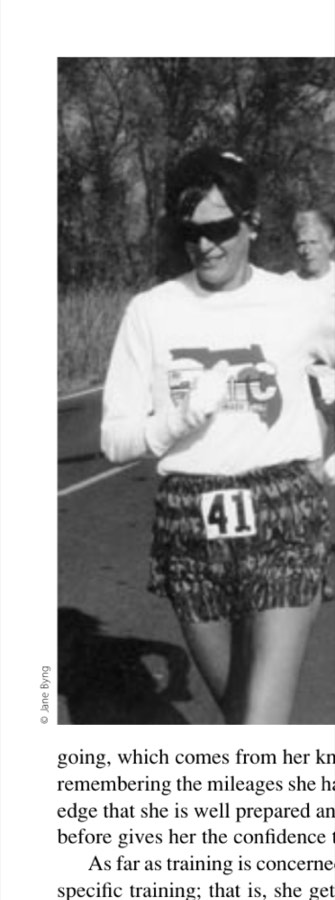
Sue Ellen won countless awards and set a myriad of records, including the 48-hour endurance run world record of 234 miles, at age 51.
run for many hours at a cruising pace of 10 to 11 minutes per mile, to ring up some impressive mileage totals.” Again the question is where does Sue Ellen get the stamina to keep running while many fellow elite competi
tors need walking breaks and naps? This doesn’t mean that Sue Ellen went nonstop during her 206.9-mile run at age 55. She did stop to stretch her legs with the help of her husband, Ron; to adjust equipment and clothing during
these two cold and rainy days; and to take bathroom breaks. Let’s just say she needed fewer breaks than most of the other runners, most of them younger. Her remarkable endurance comes from her training; staying sufficiently hydrated and nourished during the
race; and the belief that she can keep going, which comes from her knowing that she has trained adequately and from remembering the mileages she has rung up at previous similar races. This knowledge that she is well prepared and that she has successfully run similar distances before gives her the confidence to persevere.
As far as training is concerned, over the years Sue Ellen has believed in sportspecific training; that is, she gets ready for running races by just running (with no strength training and only sporadic stretching as conditions call for it). She
does her heaviest training in the months right before big events such as a 48-hour race. Typically, she would run four miles before work and run 10 miles home afterward (she’s retired now from her dentistry practice). During the weekend,
she would put in a run of up to 25 miles. With another run or two thrown in, her weekly total would be 100 to 120 miles. During the rest of the year, when an ultra was not imminent, she was content to run just 80 to 90 miles per week. (Note: As she closes in on age 60, she is
looking at running a pedestrian 70 miles a week and cross-training.)
To build her lung capacity, in the middle of her 10-mile workouts, Sue Ellen would pick up the pace five to 10 times for about the length of a city block each time. Why didn’t such high mileage for so many years wear her down? After all, that’s a lot of running with very little downtime due to injuries (discounting her shoulder injury, she had no major injuries other than her torn ACL until her stress fractures in her mid- to late-50s).
One reason she could thrive while putting her body through these paces is that she takes major breaks. She says, “After an ultra, I don’t run at all for a month.” This well-earned vacation from training refreshes her body (and psyche) and allows her to come back with enthusiasm and renewed energy. Sue Ellen suggests that any ultrarunners who get stale would benefit from taking a month or more off from running. She believes they would then come back and enjoy ultras more than ever.
Another reason her body has withstood all that mileage so well is that she has not done a lot of speed work. Her runs are at a more leisurely pace than middle-distance runners, for example, who need to stress their body more to gain speed for 5K or half-mile races and ultrarunners who push their limits and then some during training runs and races. In contrast, Sue Ellen often finds herself running in a “flow state” where she notices that she is moving but is not aware of her legs being involved—kind of a floating sensation. She also © Jane Byng
▲
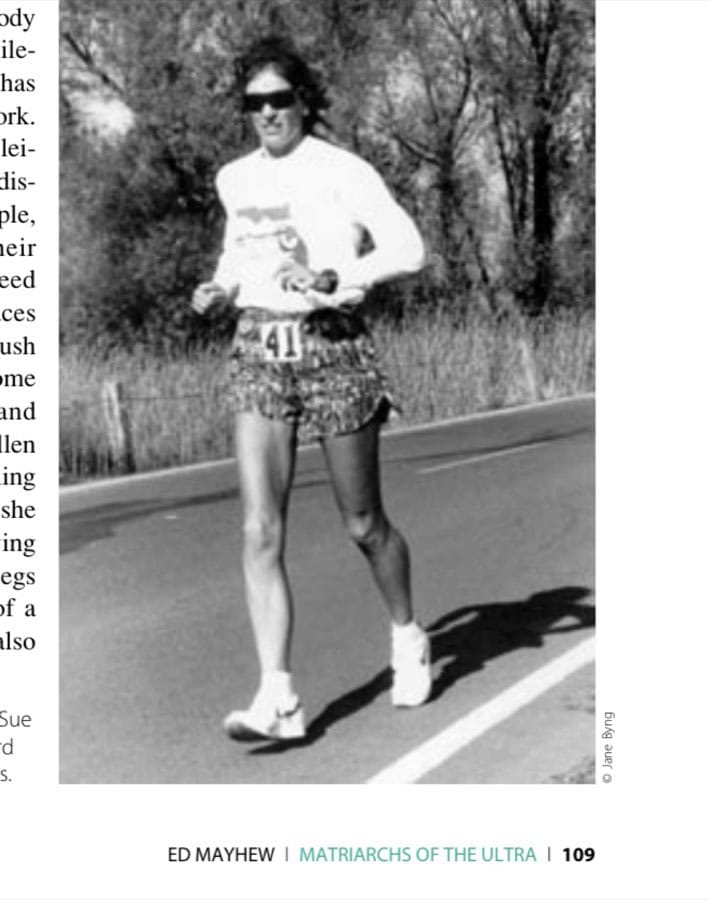
Here’s the running style Sue Ellen used to garner a record seven national 24-hour titles.
likes to train while listening to books on tape on her headphones. After all these years of running, this helps her put in the requisite long training runs without getting bored. She has never paid a lot of attention to her diet. She loves the fact that she can eat anything and not gain weight, because of her running. Sue Ellen describes her diet as a mix of good food and junk food. She admits that she has been known, in years past, to down a hamburger or two right before a race. She tries to eat better in the three weeks leading up to a race. Due to her recent stress fractures, she now takes extra calcium and a drug that strengthens bones.
Birth of a Champion In her early years, Sue Ellen showed little evidence of becoming a world-class runner. She says, “When I was young there was nothing for girls in the way of sports.” Her only recollection of sports activity in elementary school was running relays at the annual school field day, where she ran faster than the boys (to their chagrin).
Otherwise, she had no sports background and played no sports in junior high or in high school. Her introduction to track came in college, where she rooted for her husband, Ron, who was an All-American track star. Her interest in running began after the birth of their daughter, when Sue Ellen found herself overweight for the first time in her life. She started to run more and more, as she found that it helped her lose weight and gave her the endurance to outplay her tennis partners. Her first race, which she ran with Ron, was the Bay-to-Breakers 12K road race in San Francisco. Gradually she increased the distance, working up to marathons. In 1980, she tried her hand at a 100K race in Miami, in which she missed breaking the American record by just two minutes. Coming this close and not getting the record made her mad and let her know that she could excel at ultrarunning. A Champion in Her 50s How do we explain Sue Ellen’s phenomenal success in her 50s? Remember that she set a world record for the 48-hour event at age 51 and won her seventh 24hour national title at age 55.
First, we must not overlook the role her family played. Having the full support of Ron and their daughter, Kristina, was instrumental to her longevity and record-setting performances. Sue Ellen cannot say enough about the importance of Ron’s support. The way she puts it, “I have one of the best handlers—my husband, Ron.” He takes care of everything—food, liquids, equipment, medical readiness—so that all Sue Ellen has to think about is her running. Ron has been her handler at all her ultraraces, and he loves his role. However, many ultrarunners have similar, excellent support and encouragement but don’t have near the results. There must be more.
The answer may lie in Sue Ellen’s amazing recuperative powers, which have everything to do with stress—or rather, the lack of it. Let me explain. We all cycle in and out of two states: the anabolic state (the building up and repair of the body) and the catabolic state (the tearing down of the body and the creation of energy). Ultrarunners are in the catabolic state during races and long training runs. While running, the body depletes its glycogen stores, sustains microscopic tears and injuries to the muscle cells, and converts a small amount of protein or muscle into an energy source.
Between runs, the body needs to be in the anabolic state for repair, regeneration, and resupply of the glycogen stores. Stress interferes with this recuperation process. The less stress a runner experiences between training sessions, the more time he or she spends in the recuperative, anabolic state.
Why is stress so deleterious? When you feel stressed (signaled by negative emotions) the body assumes (that is, it acts as if) there is an external threat that must be dealt with. This results in the body’s channeling its resources away from repairing cells, fighting microorganisms, and refilling glycogen stores and toward fighting or running away from the immediate threat to its existence—whether real or merely perceived.
The more time the body spends feeling stressed out between runs, the less able it is to recuperate sufficiently or optimally in time for the next race or hard training run. From a more positive slant, the more time the body spends feeling good (that is, experiencing low stress levels), the better prepared the body and psyche
Sue Ellen Trapp’s Age-Group Dominance: Women Ages 45 to 49—U.S. Records Track Events Event/distance
Time or Distance
Runner
Year
50 km
4:40:11
Sue Ellen Trapp
1991
100 km
9:43:25
Sue Ellen Trapp
1991
200 km
21:08:47
Sue Ellen Trapp
1991
50 mile
7:39:31
Sue Ellen Trapp
1991
100 mile
16:08:55
Sue Ellen Trapp
1991
12 hour
123,050 m (76.45 miles)
Sue Ellen Trapp
1991
24 hour
219,340 m (136.28 miles)
Sue Ellen Trapp
1991†
48 hour (road only)
360,090 m (223.74 miles)
Sue Ellen Trapp*
1993*
6 day
458,663 m (284.99 miles)
Vivian Corres
1989
Source: American UltraRunning Association (AUA)—as of 1/27/01 by Jason Hodde †
Pam Reed broke the 24-hour track record in 2003.
*There is no track record for the 48-Hour event—only a road record, which Sue Ellen set in 1993.
will be for the stress of future races or training sessions. This brings us back to Sue Ellen. Sue Ellen enjoys life immensely. She has many interests and hobbies, including reading, cooking, hiking, swimming, playing tennis, traveling, spending time with her family, and caring for and enjoying her pets. (At one time, she had a Saint Bernard, a whippet, three parrots, six cats, and nine llamas.) These varied interests keep her fully engaged in life, which translates into minimal stress.
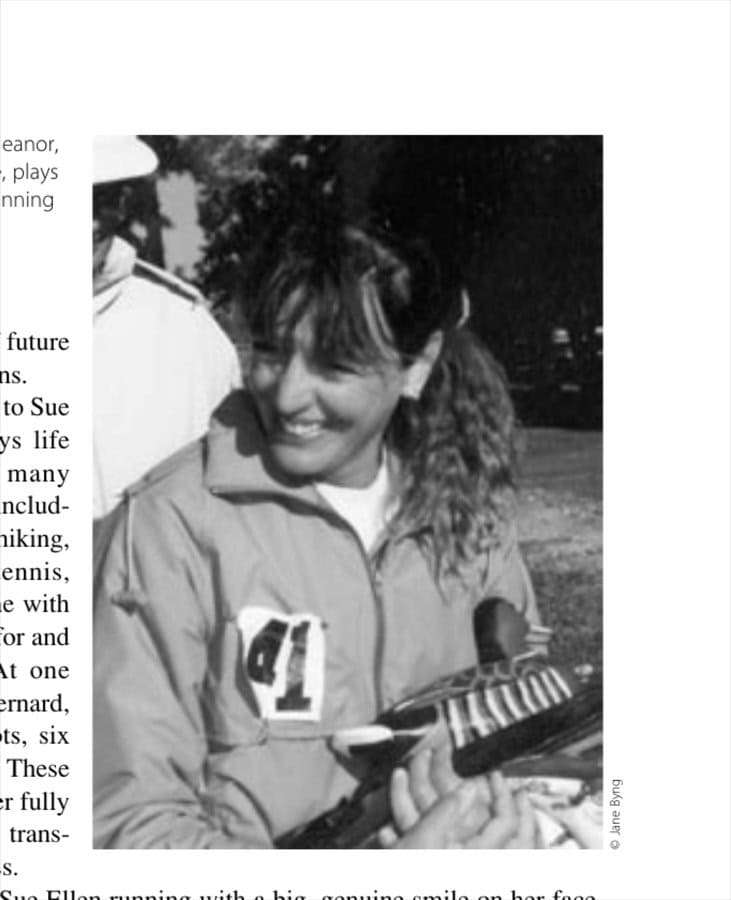
Look at a photo of Sue Ellen running with a big, genuine smile on her face, and you can see that she enjoys running and that she is generally a happy person. Ultrarunning pioneer Ruth Anderson, for whom the USATF Female Ultrarunner of the Year award is named, said, “I have met no one sweeter than Sue Ellen . . . always friendly. . . . Always smiling [even] when the going is tough.” Genetics, training, support, and long breaks aside, Sue Ellen’s ultra-successful running in her 50s could to a large extent be attributed to her being an extremely happy person—that is, spending more time in the anabolic state than most of us. It’s something to think about.
It’s obvious that Sue Ellen excelled during her 40s and 50s. Now that she’s 60, and over the ailments of her late 50s, Sue Ellen looks to show the younger 30- and 40-year-old competitors that she doesn’t run like 60 but rather that she runs—well—like 60! Note: Parts of this article are excerpted from the book Fitter for Life: The Secrets of 25 Masters of Fitness by Ed Mayhew.
© Jane Byng
▲
Sue Ellen’s positive demeanor, pictured in her ready smile, plays an important role in her running successes.
This article originally appeared in Marathon & Beyond, Vol. 10, No. 6 (2006).
← Browse the full M&B ArchiveMore like this
1,000+ stories from 19 years of Marathon & Beyond
The complete archive of the legendary long-distance journal — digitized and free to read.
