

Measured Versus Self-Reported BMI of Recreational Endurance Athletes: Health Implications
Abstract
Objectives: Few studies, mainly in controlled laboratory settings, have examined the physical attributes and training of recreational competitors. Endurance running/walking event participation has dramatically increased in recent decades. As a result, health and exercise professionals have dedicated renewed attention to safe training—both for individuals who participate in multiple races and for people preparing for only one endurance event annually to support specific causes. Media reports have suggested people placed themselves at health risk because of inadequate knowledge and awareness of training-related factors and strategies like weight maintenance.
Methods: From March 23 to 25, 2007, we assessed measured and self-reported (SR) height, weight, and body mass index (BMI) among 221 volunteers participating in a half- or full marathon in Atlanta, Georgia. We separately recorded prerace weight (including SR height) and height without shoes (including SR weight) at the indoor exposition 12 to 36 hours before races. For weight, we used calibrated Tanita Body Composition Monitor BC-534 digital scales placed on hard, flat surfaces. For height, we used tape measures fixed to straight poles secured to building walls.
Results: While most participants had normal BMI, about one in eight participants changed health-related BMI categorization based on SR versus measured data; nine people appeared healthier.
Conclusions: Accurately measured weight, including for BMI, of recreational endurance athletes is an important metric. With valid, objective information, people can consult health care providers, registered dieticians or sports nutritionists, and certified coaches. Health professionals can provide training recommendations for both safe participation and improved performance over time in endurance running/walking events and any other health-promoting physical activity.
Introduction
The renowned British physiologist Archibald Hill1 first proposed the notion that data from athletic competition can be a wonderful source of highly consistent information regarding the effects of increased physical activity on organ function. When people toe the line and compete, they are in a real sense beginning a highly controlled biological experiment. They must obey the sport’s rules, which promote a consistent test environment. Subjects likely trained seriously and thus are in optimal health and fitness, reducing the occurrence of outliers. Sophisticated equipment (see figures 1-2) after informed consent is used to safely document performance.
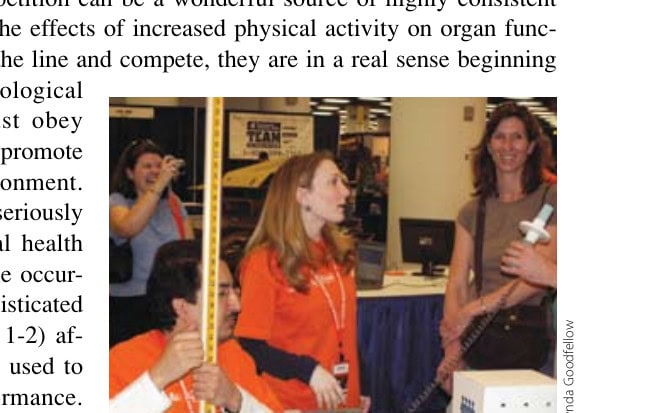
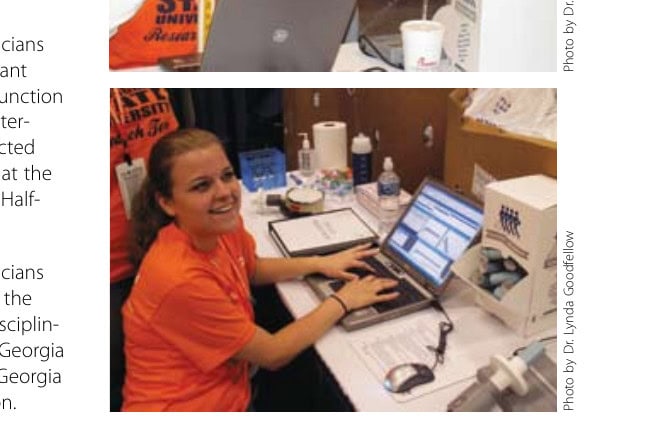
The increasing popularity of road racing, especially marathon and half-marathon running, creates almost unlimited opportunities for trained researchers to examine the effects of such training and recreational competition on organ function and on other human health indicators. Moreover, researchers are increasingly conducting their work within interdisciplinary teams at universities, agencies, and health organizations.
People compete in endurance events across multiple sports. Excluding elite, professional, and collegiate athletes, few studies examined physical attributes and training of recreational-level competitors in controlled laboratories or at events such as full marathons or half-marathons.2-10 Endurance running and walking event participation dramatically increased from 1976 to 2007. Indeed, there are now well over a half-million participants finishing marathons.11 Health and exercise professionals have dedicated renewed attention to training both elite and recreational athletes safely. These people include competitive individuals who participate in multiple races and those preparing for one endurance event annually to support specific causes. Available research and media reports have suggested people have placed themselves at health risk because of inadequate knowledge and awareness of training-related factors and strategies concerning heat, nutrition and hydration, and weight maintenance.12-24
BMI (body mass index) is a common quantitative clinical indicator of body composition. BMI, however, may inaccurately portray the actual body composition of certain groups of individuals such as highly trained elite or competitive recreational athletes because of typically higher body density. This higher body density may be due in part to increased muscle mass and/or bone mass as well as less fat mass. Defined BMI categories identify at-risk individuals25-26 (tables 1-2 on pages 65, 66, and 67). These health-related categories are:
- Normal equals a calculated BMI value between 18.50 and 24.99.
- Overweight equals a calculated BMI value between 25.00 and 29.99.
- Obese equals a calculated BMI value of equal to or greater than 30.00.
- Underweight equals a calculated BMI value of less than 18.49.
There has been increased concern about higher percentages of people—across age, sex, and race or ethnicity—who are overweight and obese, given known or suspected relationships to adverse chronic health outcomes. Existing U.S. population-based data, however, are based on self-reported measures27 with limitations due to information bias leading to nondifferential error. In other words, the average (arithmetic mean) or median reported BMI values are likely underestimated.28 Public health professionals have also placed increasing importance in education on and promotion of long-term healthy behaviors such as physical activity, including walking and running.
We assessed measured height and weight and self-reported (SR) values, plus resulting BMI values, among 221 of an overall study sample of 2,073 volunteers, who represented about one in seven registered participants. We collected data during an interdisciplinary study conducted at the inaugural ING Georgia Marathon and Half-Marathon in Atlanta. This event was held the weekend of March 23 to 25, 2007; Sunday morning, March 25, was race day, with a two-day exposition
TABLE 1A: Body mass index (BMI) values [((weight in pounds)/(height in inches)2) × 703] from both accurately measured (meas) and self-reported (SR) weight and height of registered, participating athletes of the 2007 ING GA Marathon and Half-Marathon.
![TABLE 1A: Body mass index (BMI) values [((weight in pounds)/(height in inches)²) × 703] from both accurately measured (meas) and self-reported (SR) weight and height of registered, participating athletes of the 2007 ING GA Marathon and Half-Marathon.](https://marathonhandbook.com/wp-content/uploads/906070_fig3.png "Measured Versus Self-Reported BMI of Recreational Endurance Athletes: Health Implications 11")
| Variable | Definition or formula | No. of athletes, N | % | No. of missing values, n (N=221-n)a | % | Mean | Median | Mode | Min | Max |
|---|---|---|---|---|---|---|---|---|---|---|
| height (HT) | Meas, inches | 186 | 84.2 | 35 | 15.8 | 67.9 | 68.0 | 72.0 | 48.0 | 76.0 |
| HT | SR | 101 | 45.7 | 120 | 54.3 | 67.1 | 67.0 | 65.0 | 48.0 | 76.0 |
| absdiffHT | Meas-SR HT | 75 | 33.9 | 143b | 64.7 | 0.1 | 0.0 | 0.0 | 0.0 | 1.0 |
| weight (WT) | Meas, pounds | 132 | 59.7 | 89 | 40.3 | 162.1 | 160.8 | 118.0 | 102.4 | 278.0 |
| WT | SR | 184 | 83.3 | 37 | 16.7 | 157.5 | 155.0 | 140.0 | 85.0 | 285.0 |
| absdiffWT | Meas-SR WT | 103 | 46.6 | 118 | 53.4 | 4.2 | 3.0 | 0.0 | 0.0 | 34.0 |
| BMI-Meas | Meas | 130 | 58.8 | 91 | 41.2 | 25.0 | 24.2 | 23.2 | 17.1 | 38.0 |
| BMI-SR | SR | 187 | 84.6 | 34 | 15.4 | 24.0 | 23.5 | 25.1 | 17.4 | 38.0 |
| BMIabsdiff | difference between BMI-Meas and BMI-SRc | 105 | 47.5 | 116 | 52.5 | 0.76 | 30.433 | 0.000 | 0.000 | 9.715 |
a Number of missing values (n)—i.e., calculations not possible because measured height (would have been with lung-function testing substudy at prerace expo) or measured weight (would have been with nutrition/hydration survey at prerace expo) were not recorded for the participant since some participants chose, after completing informed-consent process, to do only one to three of three available substudies. Similarly, calculations may not have been possible because self-reported weight (would have been on data sheet for lung-function testing substudy at prerace expo) or self-reported height (would have been with nutrition/hydration survey at prerace expo) were not provided.
b The values for three wheelchair athletes (absdiffHT = 2.0, 7.0, 12.0) were excluded.
c Absolute values of [(BMI-Meas) – (BMI-SR)] were used; only registered, participating athletes with BMI-Meas and BMI-SR were included.
prior to the race and then a postrace celebration. The specific research question addressed in this paper was to examine—given the increasing role of BMI as an indicator of health—whether prerace self-reported height and weight and measured height and weight led to similar or different BMI values and then the same or a different health-related category.
Background
In general, mean BMI of athletes is lower than that of nonathletes. BMI for soccer, judo, and water polo players was lower than for controls.29 In contrast, nonprofessional body builders were found to have similar BMI to sedentary, overweight subjects; however, body builders had a higher body density because of a lower fat mass.30
Mean BMI values have also depended on sport, sex, and position played. Rugby players had mean BMI of 28.8, soccer players 23.1, skiers 25.8, sailors 26.9, and cyclists 21.3.31 An Alpine skier study reported a mean female BMI of 23.6 and mean male BMI of 26.6.32 Among American football players studied, skilled players (quarterbacks, running backs, receivers, defensive backs, and kickers) had BMI less than 28, and whereas linemen had BMI greater than 32.33 Weight-classified athletes such as sumo wrestlers, judo competitors, and weight lifters exhibited varying BMI values.34
Studies investigating scholastic sports participation found inverse correlations between the number of sports played and BMI. Teenage girls participating in two or more sports had a lower mean BMI than nonparticipating girls.35 Results across sex were similar. A higher percentage, 30.3 percent, of nonparticipating boys had BMI above the calculated 85th percentile compared with 23.2 percent of boys playing three or more sports.36
Runners generally had BMI toward the lower end of normal. Female runners had mean BMI ranging from 18.8 to 20.8, depending on menstrual cycle classification.37 Mean BMI of female Boston marathon runners studied was 21.4 and for participating male runners was 24.0.12 Mean BMI for runners investigated with different fluid and salt supplementations was 23.8, 24.8, and 23.4 (unsupplemented control, unsupplemented hypokinetic, and supplemented hypokinetic, respectively).38
Overall, subjects participating in endurance sports had lower BMI than participants of sports requiring large amounts of muscle mass for power and anaerobic activity, and runners had relatively lower BMI. Also, on average, BMI varied by sex, with females lower than males.
Methods
This project received approval from the Institutional Review Board at Georgia State University, Atlanta. Three protocols for the overall project pertained to this paper’s substudy.
Volunteer subjects completed various study components, after we obtained informed consent, at the indoor exposition March 23 to 24, 2007, or 12 to 36 hours before races on Sunday morning, March 25, 2007. The subjects participated in one to three brief surveys, prerace weight (including self-reported [SR] height) and/or lung-function measures, and height measurements without shoes using tape measures secured to poles (including SR weight). After races, among briefer surveys and measures, weight was similarly obtained outdoors. Pre- and postweights were conducted with calibrated Tanita Body Composition Monitor BC-534 digital scales placed on hard, flat surfaces.
Prerace, subjects were weighed without socks and shoes and were asked to remove nonessential articles. Postrace weights were taken soon after the finish line, without socks or shoes; athletes were first provided paper towels to remove sweat and were asked to remove miscellaneous personal items. This paper focused on the prerace measures; the other data were for other research questions presented elsewhere.39-40
Results
We have presented calculated BMI and the associated health-related categories25-26 from both the accurately measured data and the self-reported (SR) data on weight and height (tables 1a-b) of registered, participating athletes across events.
Overall, the mean and median BMI based on the measured data were higher, by about one unit (~1.0), than the values based on the SR data. The ranges of values calculated (min-max) were nearly the same. Based on the mean and median values, most participants had normal BMI, and few participants were underweight. However, higher percentages of participants were categorized as obese and fewer as normal based on measured BMI relative to SR BMI. Similar percentages of participants were categorized as overweight based on calculated BMI from both the measured data and the SR data.
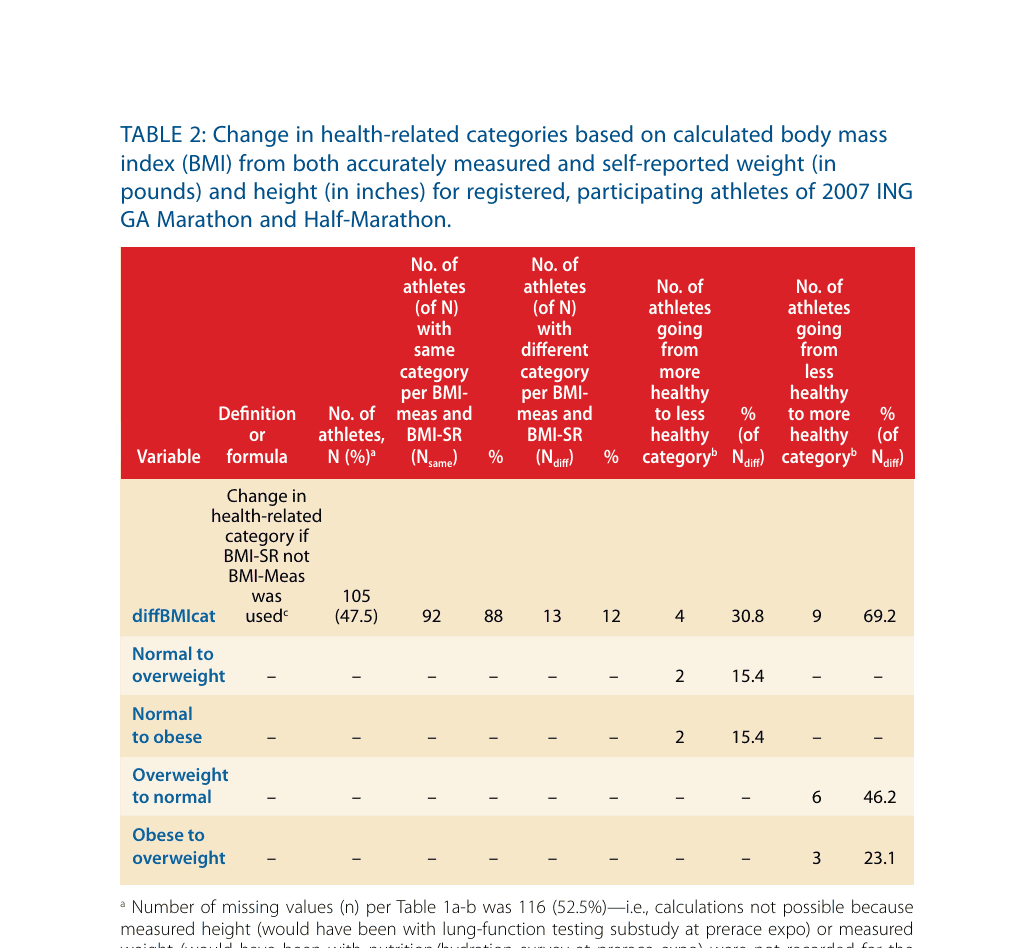
We have also presented observed changes in the BMI-determined health-related categories based on the measured data compared to the SR data (table 2) for the same registered, participating athletes across events.
Our data analysis suggested about one in eight study subjects changed in their health-related BMI categorization based on the SR data compared with the measured data. Specifically, among these study subjects, four appeared to be less healthy (toward overweight or obese) and nine appeared to be healthier (toward normal).
Conclusions
There are known strengths and limitations in general population-based field research of using cross-sectional designs and of using BMI to measure risks of weight-related, adverse chronic health conditions. Nevertheless, this study focused on recreational athletes in endurance running and walking events, which are aerobic activities where training over time places relatively larger physical, nutritional, and hydration demands on the body than the average person’s daily routine. Our data suggested the importance of using accurately measured weight and height, and thus BMI values, for assessments of recreational athletes competing in endurance events. With valid, objective information, people can consult health care providers, registered dieticians or sports nutritionists, and certified coaches. These health professionals can provide training recommendations for both safe participation and improved performance over time in endurance running/walking events and any other health-promoting physical activity.
Acknowledgments
We appreciate the efforts of dozens of undergraduate respiratory therapy and physical therapy students and master’s students in nutrition who volunteered time to help set up the various running events March 16 to 25, 2007 and/or to assist with data collection and entry. We thank Ms. Meryl Sheard, MS, RRT, for reviewing with researchers and students the respiratory therapy research protocols, including laptop software used for field data entry. We acknowledge Georgia State University Research Foundation for our interdisciplinary team research funding (2007–2008).
TABLE 1B: Body mass index (BMI) values [((weight in pounds)/(height in inches)2) × 703] in health-related categories from both accurately measured (meas) and self-reported (SR) weight and height of registered, participating athletes of the 2007 ING GA Marathon and Half-Marathon.
| Variable | How defined or formula | No. of athletes, N | % | No. of missing values, n (N=221-n)a | % | Normal | % | Overweight | % | Obese | % | Underweight | % |
|---|---|---|---|---|---|---|---|---|---|---|---|---|---|
| BMI-Meas | Meas | 130 | 58.8 | 91 | 41.2 | 76 | 58.5 | 36 | 27.7 | 16 | 12.3 | 2 | 1.5 |
| BMI-SR | SR | 187 | 84.6 | 34 | 15.4 | 121 | 64.7 | 52 | 27.8 | 11 | 5.9 | 3 | 1.6 |
a Number of missing values (n)—i.e., calculations not possible because measured height (would have been with lung-function testing substudy at prerace expo) or measured weight (would have been with nutrition/hydration survey at prerace expo) were not recorded for the participant since some participants chose, after completing informed-consent process, to do only one to three of three available substudies. Similarly, calculations may not have been possible because self-reported weight (would have been on data sheet for lung-function testing substudy at prerace expo) or self-reported height (would have been with nutrition/hydration survey at prerace expo) were not provided.
b Normal = BMI of 18.50–24.99; overweight = BMI of 25.00–29.99; obese = BMI of > 30.00; underweight = BMI of < 18.49 (see references 25–26)
TABLE 2: Change in health-related categories based on calculated body mass index (BMI) from both accurately measured and self-reported weight (in pounds) and height (in inches) for registered, participating athletes of 2007 ING GA Marathon and Half-Marathon.
| Variable | Definition or formula | No. of athletes, N (%)a | No. of athletes (of N) with same category per BMI-meas and BMI-SR (Nsame) | % | No. of athletes (of N) with different category per BMI-meas and BMI-SR (Ndiff) | % | No. of athletes going from more healthy to less healthy categoryb | % (of Ndiff) | No. of athletes going from less healthy to more healthy categoryb | % (of Ndiff) |
|---|---|---|---|---|---|---|---|---|---|---|
| diffBMIcat | Change in health-related category if BMI-SR not BMI-Meas was usedc | 105 (47.5) | 92 | 88 | 13 | 12 | 4 | 30.8 | 9 | 69.2 |
| Normal to overweight | – | – | – | – | – | – | 2 | 15.4 | – | – |
| Normal to obese | – | – | – | – | – | – | 2 | 15.4 | – | – |
| Overweight to normal | – | – | – | – | – | – | – | – | 6 | 46.2 |
| Obese to overweight | – | – | – | – | – | – | – | – | 3 | 23.1 |
a Number of missing values (n) per Table 1a-b was 116 (52.5%)—i.e., calculations not possible because measured height (would have been with lung-function testing substudy at prerace expo) or measured weight (would have been with nutrition/hydration survey at prerace expo) were not recorded for the participant since some participants chose, after completing informed-consent process, to do only one to three of three available substudies. Similarly, calculations may not have been possible because self-reported weight (would have been on data sheet for lung-function testing substudy at prerace expo) or self-reported height (would have been with nutrition/hydration survey at prerace expo) were not provided.
b Healthy category was considered normal (versus underweight, overweight or obese—i.e., U-shaped curve). Also, we considered going from overweight to obese to be moving from a relatively more healthy (but still unhealthy) category to a less healthy category.
c This summary includes only registered, participating athletes with both BMI-Meas and BMI-SR. Of the four people whose BMI increased from BMI-Meas to BMI-SR, two moved to the overweight category and two moved to the obese category. Of nine people whose BMI decreased from BMI-Meas to BMI-SR, six moved from overweight to normal (healthy) category and three moved from obese to overweight (but still unhealthy) category.
References
- Hill, A.V. 1924. The physiological basis of athletic records. Lancet 2: 481-486.
- Oliver, S.K., and M.S. Tremblay. 2002. Effects of a sports nutrition bar on endurance running performance. J Strength Conditioning Res 16:152-156.
- Bonsignore, M.R, G. Morici, L. Riccobono, G. Insalaco, A. Bonanno, M. Profita, A. Paterno, C. Vassalle, A. Mirabella, and A.M. Vignola. 2001. Airway inflammation in nonasthmatic amateur runners. Am J Physiol Lung Cell Mol Physiol 281:668-676.
- Delmont, M. 2005. “Looking at American Leisure Time” (master’s thesis). Columbia J Am Stud New York, New York: Columbia University.
- Worme, J.D., T.J. Doubt, A. Singh, C.J. Ryan, F.M. Moses, and P.A. Deuster. 1990. Dietary patterns, gastrointestinal complaints, and nutrition knowledge of recreational triathletes. Am J Clin Nutr 51:690-697.
- Kippelen, P., C. Caillaud, E. Robert, P. Connes, P. Godard, and C. Prefaut. 2005. Effect of endurance training on lung function: A one year study. Br J Sports Med 39:617-621.
- Jokl, P., P.M. Sethi, and A.J. Cooper. 2004. Masters performance in the New York City Marathon 1983-1999. Br J Sports Med 38:408-412.
- Vergès, S., G. Devouassoux, P. Flore, E. Rossini, M. Fior-Gozlan, P. Levy, and B. Wuyam. 2005. Bronchial hyperresponsiveness, airway inflammation, and airflow limitation in endurance athletes. Chest 127:1935-1941.
- Whyte, G., K. George, R. Shave, E. Dawson, C. Stephenson, B. Edwards, D. Gaze, D. Oxborough, J. Forster, and R. Simpson. 2005. Impact of marathon running on cardiac structure and function in recreational runners. Clin Sci 108:73-80.
- Martin, D.E., and J.F. Buoncristiani. 1995. Influence of reaction time on athletic performance. New Stud Ath 10:67-79.
- Running USA. “Running USA-RRC: Annual Marathon Reports” (1976-2007, including total number of participants, gender and age-group breakdown for selected years). Internet, available at: http://www.runningusa.org/statistics, last accessed May 8, 2009.
- Almond, C., A.Y. Shin, E.B. Fortescue, et al. 2005. Hyponatremia among runners in the Boston Marathon. NEJM 352:1550-6.
- Davis, D.P., J.S. Videen, A. Marino, G.M. Vilke, J.V. Dunford, S.P. Van Camp, and L.G. Maharam. 2001. Exercise-associated hyponatremia in marathon runners: A two-year experience. J Emer Med 21:47-57.
- Twerenbold, R., B. Knechtle, T.H. Kakebeeke, P. Eser, G. Müller, P. von Arx, and H. Knecht. 2003. Effects of different sodium concentrations in replacement fluids during prolonged exercise in women. Br J Sports Med 37:300-303.
- Noakes, T.D., N. Goodwin, B.L. Rayner, T. Branken, and R. Taylor. 1985. Water intoxication: a possible complication during endurance exercise. Med Sci Sports Exer 17:370-375.
- Hsieh, M. 2004. Recommendations for treatment of hyponatremia at endurance events. Sports Med 34:231-238.
- Decaux, G. 2006. Is asymptomatic hyponatremia really asymptomatic? 2006. Am J Med 119:S79-S82.
- Speedy, D.B., T.D. Noakes, and C. Schneider. 2001. Exercise-associated hyponatremia: A review. Emer Med 13:17-27.
- Wharam, P.C., D.B. Speedy, T.D. Noakes, J.M. Thompson, S.A. Reid, and L. Holtzhausen. 2006. NSAID use increases the risk of developing hyponatremia during an Ironman triathlon. 2006. Med Sci Sports Exer 38:618-622.
- Goudie, A.M., D.S. Tunstall-Pedoe, M. Kerins, and J. Terris. 2006. Exercise-associated hyponatraemia after a marathon: Case series. J Royal Society Med 99:363-367.
- Hew, T.D., J.N. Chorley, J.C. Cianca, and J.G. Divine. 2003. The incidence, risk factors, and clinical manifestations of hyponatremia in marathon runners. Clin J Sports Med 13:41-47.
- Hew, T.D. 2005. Women hydrate more than men during a marathon race: Hyponatremia in the Houston marathon: A report on 60 cases. Clin J Sports Med 15:148-153.
- Lanier, A.B. 2003. Use of nonsteroidal anti-inflammatory drugs following exercise-induced muscle injury. Sports Med 33:177-186.
- Farquhar, W.B., A.L. Morgan, E.J. Zambraski, and W. L. Kenney. 1999. Effects of acetaminophen and ibuprofen on renal function in the stressed kidney. J Appl Physiol 86:596-598.
- United States Centers for Disease Control (CDC). About BMI for adults. Internet, available at: http://www.cdc.gov/nccdphp/dnpa/bmi/adult_BMI/about_adult_BMI.htm, last accessed May 10, 2007.
- United States Department of Health and Human Services (HHS). Aim for a healthy weight: Information for patients and the public, part I: Assessing your risk. Internet, available at: http://www.nhlbi.nih.gov/health/public/heart/obesity/lose_wt/risk.htm, last accessed May 10, 2007.
- Galuska, D.A., C. Gillespie, S.A. Kuester, A.H. Mokdad, M.E. Cogswell, and C.M. Philip. 2008. State-specific prevalence of obesity among adults—United States, 2007. MMWR 57:765-768. Internet, available at: http://www.cdc.gov/mmwr/preview/mmwrhtml/mm5728a1.htm?s_cid=mm5728a1_e, last accessed July 22, 2008.
- Ezzati, M., H. Martin, S. Skjold, S. Vander Hoorn, and C.J. Murray. 2006. Trends in national and state-level obesity in the USA after correction for self-report bias: Analysis of health surveys. J Royal Soc Med 99:250-257.
- Andreoli A., G. Melchiorri, et al. 2003. Effect of different sports on body cell mass in highly trained athletes. Acta Diabetol 40: S122-S125.
- Gippini, A., A. Mato, et al. 1999. Effect of resistance exercise (body building) training on serum leptin levels in young men. Implications for relationship between body mass index and serum leptin. J Endocrinol Investigation 22:824-828.
- Banfi, G., M. DelFabbro, and G. Lippi. 2006. Relation between serum creatinine and body mass index in elite athletes of different sport disciplines. Br J Sports Med 40:675-678.
- Neumayr, G., H. Hoertnagl, et al. 2003. Physical and physiological factors associated with success in professional Alpine skiing. Int J Sports Med 24:571-575.
- Garry, J. P., and J. J. McShane. 2001. Analysis of lipoproteins and body mass index in professional football players. Prev Cardiol 4:103-108.
- Kanehisa, H., M. Kondo, et al. 1998. Body composition and isokinetic strength of professional sumo wrestlers. Eur J Appl Physio 77:352-359.
- Beets, M.W., and K.H. Pitetti. 2005. Contribution of physical education and sport to health-related fitness in high school students. J Sch Health 75:25-30.
- Choate, N., C. Forster, et al. 2007. The prevalence of overweight in participants in high school extramural sports. J Adoles Health 40:283-285.
- Rosetta, L., C. Williams, et al. 1998. Diet and body composition of female recreational runners of differing menstrual status. J Sports Sci 16:629-637.
- Zorbas, Y., K. Petrov, et al. 2002. Effect of fluid and salt supplementation on body hydration of athletes during prolonged hypokinesia. Acta Astronautica 50:641-651.
- Witteveen, M.Z. 2007. Does NSAID use result in hyponatremia symptoms in endurance athletes? Master of Science Thesis. Atlanta, Georgia: Division of Nutrition, School of Health Professions, College of Health and Human Sciences, Georgia State University. Internet, available through https://gil.gsu.edu/ (call number RC1220.E53 W58 2007).
- O’Dea, N.K., D.B. Benardot, M.Z. Witteveen, L.T. Goodfellow, D.G. Shendell, D.E. Martin, A. Ari, R.D. Zimmerman, and F. McCarty. 2008. The relationship of hydration strategies and NSAIDs use on self-reported symptoms of dehydration and hyponatremia in runners participating in the 2007 ING Georgia Marathon. Poster presented at the 55th Annual Meeting of the American College of Sports Medicine, May 28-31, 2008, Indianapolis, Indiana.
This article originally appeared in Marathon & Beyond, Vol. 13, No. 4 (2009).
← Browse the full M&B ArchiveMore like this
1,000+ stories from 19 years of Marathon & Beyond
The complete archive of the legendary long-distance journal — digitized and free to read.
