

Midpacker No More
It’s the first weekend in August 2013, around 7:00 in the morning, in the Los Angeles suburb of Altadena. Bouncing down Altadena Drive is a petite, pixiehaired woman wearing split running shorts and a hydration pack, headed for Loma Alta Park. A smile consumes her face. Up onto the grass of the park’s acres she lopes, and when she reaches the banner strung above her head that says, “FINISH,” she jumps up to slap it in triumph. Diana Treister, age 45, resident of Altadena, has finished the Angeles Crest 100 in 26:25, more than three hours faster than she has ever done before. And she has a lot to say about her experience, things that will help and inspire all of us who have spent time as midpack runners, whether in marathons or in ultras. “
You’re not trapped in that [middle of the pack] group. You are if you think you are. Sometimes you need the experience to convince yourself of breaking out, like I did.” Diana’s voice, on the other end of a phone call, is speaking about performance possibilities for middle- or back-of-the-pack runners in ultras. She is cheerful yet adamant. “Now I think I cracked into this new territory, and I believe more things are possible.”
Diana of the pixie hair didn’t find ultrarunning until injury and happenstance at age 40; once there, she found her tribe and her mojo in the mountains next to her home near Los Angeles. But first, it started with cycling and a long mountain ride with a bunch of rocket scientists—really.
Riding with rocket scientists It was 1989, or thereabouts. Diana was cycling on the Angeles Crest Highway, participating in the JPL annual century ride with some geeks from the valley—JPL, as in Jet Propulsion Laboratory. One of the riders gestured out toward the thick of the Angeles National Forest, toward the trails and the wilds, and said, “They run a hundred miles out there.” They? Diana was a little bit freaked out. Who, exactly, were “they”? It didn’t sound like a sane endeavor; maybe it was just one legendary guy who lived in a cabin and did such things as a matter of obsession. Of course, she wasn’t too far off with the obsession bit, but the Angeles Crest 100 had been
undertaken at that point for several years by more than a hundred runners, and it was becoming one of the standards of tough-love hundreds in the country. For a decade more, Diana did her sport of bicycling—mountain-bike racing was a specialty—until a day on the slopes at Mammoth left her with nearly everything in her knee torn or otherwise mangled. Long rehab began, including a lot of hiking in those mountains where the mythical “they” ran a hundred miles. She bounced back to mountain biking, but it was during a hike that she came face to face with the myth, a sign that said, “This is the highest point on the Angeles Crest 100 course.” It was real! That was 2006, and there was no turning back. With a history of long bicycle events up to 24 hours, Diana decided that of course she would run this footrace.
She did the research. To enter Angeles Crest you must complete a 50-mile ultra. Logically, this meant she needed to run a 50K and, before that, a marathon. She got to work. Seattle Marathon: check. Catalina Marathon (for some trails): check. Wild West 50K: check. In 2007, she spent time at the 75-mile aid station, seeing just how impressive and crazy and determined these runners could be.
When the calendar rolled over to early 2008, Diana was excited beyond belief to get this Angeles Crest thing going. She had heard that the race was full but hoped her local voice could open some doors. An e-mail was dispatched to race director Ken Hamada, asking if there might be one more slot for an Altadena woman. His response was brief and to the point, “We’re full.”
This roadblock was a mere hiccup. She went to the event in 2008 anyway to pace a friend, getting an even better feel for the flow of the race and the energy of this strange day-plus of being out on the trails. Pacing left her hungry to toe the start line. She knocked off a 100K in spring 2009. Finally, she was ready to enter. Months of training on the course, trail work with fellow runners, and nervous energy accumulated as the heat built in the Los Angeles basin.
The powder keg explodes In late August 2009, a disaster named the Station Fire—later found to be arson— struck a blow against all wilderness lovers in the area. The vulnerable powder keg of Angeles National Forest was lit. Over seven weeks the Station Fire killed two firefighters, destroyed 209 structures, and scarred 250 square miles of terrain, much of it old-growth forest, including 17 miles along the AC100 course. Originally scheduled for September 19, the race was canceled for the second time in its history.
For Diana this was another disappointment; after growing to love those trails on her training runs and trail-building work, she felt like part of the community even before she received her race number. Angeles Crest ought to have been her first 100: shoulda, coulda. But you can’t argue with wildfires.
Her trail-toned legs were ready for something that fall, and she gave them a consolation prize in the form of Arizona’s Javelina Jundred the following month. Javelina’s course, a 15.5-mile loop done in alternate directions on the outskirts of Phoenix, is a neophyte ultrarunner’s dream, with ample aid and distractions like a Halloween costume contest. For those reasons, it was a good race pick, allowing Diana to work out the logistics of such a long event: how often do you eat and drink, when do you change shoes, do you sleep (nah), will you hallucinate (yes), will you get renewed energy at dawn (absolutely)? She finished in just over 26 hours with a world of new knowledge to apply to Angeles Crest.
Finally, success and a finish Soon it was 2010, the year that everything went according to plan for both Diana and the Angeles Crest racecourse. Diana’s training was solid, with ample time on the route and nearby trails. One training key, she said, fell into place because of where she lives. “I ran the last 20 miles of the course, I don’t know, dozens of times. When I get to that part during the race, I know it so well! I’m happy because it feels like coming home.”
The race date, previously in late September, was moved up one month to the end of August in a bid to stay ahead of the dangerous fall fire season witnessed the previous year. This would mean additional heat for the runners, just one more twist to an already tough course. (Beginning in 2011, it was moved ahead another month and currently starts on the July/August cusp.)
The night before the race, Diana’s spread of supplies was laid out with all the precision her medical background would suggest. She had a comforting meal and drifted off early. The predawn alarm jangled her out of bed; she was soon standing among just over a hundred other starters—65 of whom would cross the finish line the next day.
Her race was nearly everything she expected, from the tough to the fun to the scenic to the tired to the exhausted to the elated. In the wee hours of the morning, she went through a low point in the stretch leading up to the Idle Hour (mile 84) aid station, feeling, as many hundred-mile runners do, that this was hard and dumb and silly. Those feelings passed, as they do, and Diana took solace in the familiar final miles to finish 32:19 after the start, less than an hour before the 33-hour cutoff.
Eighty perfect miles After her finish in 2010, Diana contemplated the next time and how to get better. Despite the relative ease of Javelina compared with Angeles Crest’s difficult course, the five-plus-hour disparity between her two finish times played in her
mind. She believed that somewhere in her body was a 27-something finish at Angeles Crest; her thoughts over the next year of training often fell back on how she might “get those five hours back.” In 2011, she said, her pacing strategy started great, “I was making good time, racking up those hours one by one, but the clock started spinning the other way after mile 80. It irritated me that it all amounted to only nine or 10 minutes faster in the end, but I was still happy that I took the chance and put it all out there, regardless of the outcome. I learned so much from it! I was proud of my time; what I learned amounted to far more than just nine or 10 minutes.” She battled with the heat and her electrolyte balance throughout the race, finishing in 32:10 with such a desperate need of fluids that her photo after finishing captures Diana dumping a bottle of water over her head, oblivious to the camera.
The heat and hydration problems were lessons learned; she would have the chance to apply her growing experience to the race in 2012. That year, even hotter than normal temperatures resulted in many DNFs and a heck of a lot of stories about fluids and sun and staggering around on the trails.
With some of the growing wisdom of an intermediate ultrarunner, Diana took a more conservative pacing approach in the early miles and ultimately broke 30 hours with a 29:29. An old hip injury gave her a little bit of trouble, but not enough to matter. Despite the usual low mental stretch around mile 80—where, she said, it’s not uncommon to just flat-out cry for a little bit—she got back three of her hours on that scorching weekend that felled veterans of the sport.
Curveballs and catastrophe in 2013 Diana seemed to be on the path to her dream time of under 28 hours. She was putting together in her head what it took to be successful at AC, from a reasonable early pacing strategy to timed electrolyte and food intake, and looked ahead to 2013 with glee. But then, as it often does, life threw a few curveballs her way, starting in the fall of 2012. First, that hip injury. It flared up not long after AC, causing her to cut back mileage to almost zero for a few months, take on some rehab exercises, and even get an MRI to rule out a labral tear. She skipped an early-spring test race along with a few other of her usual preseason outings. Her mileage was only so-so, and only growing slowly, which didn’t instill confidence.
And then, at the end of a long trail workday in May, a long-term relationship ended abruptly. The next few weeks were seemingly OK, but then the emotional blow hit her like a ton of bricks. It wasn’t just the loss of the relationship—of course that was important—but the timing of it all was terrible. Here it was June, with the August race date fast approaching. All of the previous momentum about AC—the goal-setting, the injury recovery, the pacing strategies—now felt like a massive derailment.
If you learn nothing else about Diana, know that she is fierce even in vulnerability. She continued to train with her dear friend Andy Kumeda, often spending miles just letting the tears flow. She poured out her doubt and her hurt to him on the trail, often wondering out loud how she could possibly run 100 miles, and yet dealing with this heartbreak seemed impossible. “I knew that running AC, as hard as it is, was still so much easier than what I was going through emotionally, and that realization was very important. I felt like I’d already lost everything; that meant when I raced I had nothing to lose.”
Self-confidence and detachment A flurry of revelations began in Diana’s head that would build and snowball as the race went on: the knowledge that she could run just for herself, the fact that it didn’t matter if she had a low point, that she didn’t have to put on a show to look strong to anyone watching or even to her pacer. And ultimately, that mental switch was the key, along with pretty good training. From meager injury-recovery March mileage in the 20s, she dramatically added distance and peaks (including Mount Whitney in June), cracking a few 80-mile weeks. Ultimately, Diana realized, “I knew I just had to sink or swim. And so, I swam.”
August 3, 2013. In a hilarious yet freaky turn of traffic and navigation, Diana almost missed the start of the race, cruising in to Wrightwood with just enough time to check in, adrenaline already flowing. It was there that I finally met her in person after studying her race splits for months looking for inspiration and confidence. She was bubbling with all the energy of a kid with a half-eaten Easter basket. Then the start, and the runners were off into the darkness toward the highest point on the course: Mount Baden-Powell’s 9,300 feet at mile 17.
Diana’s A plan was for a 27:30, even with the training setbacks—this was the “swim” plan to lay it all on the line. But most ultrarunners know that even when you are ballsy, there must be B and C plans. For Diana it was 28:30 and 29:29 (the same as her previous best time). She had no problem with those 27:30 splits for the first half of the race and hoped her confidence and speed were not going to unravel in the night. She was surprised to reach Shortcut aid station (mile 59) 30 minutes ahead of schedule but still figured she would need that cushion later in the night. Those cushions, wonderfully, were never needed.
She reached Chantry Flat (mile 75) a solid 45 minutes ahead of schedule and thought, Maybe I could make 26:59! “I just kept feeling better and better and clear and confident.” That formerly formidable mile-80 Idle Hour stretch—where she would cry like clockwork every year—was but a speed bump in 2013. She said, “This time I felt so good. Every little thing fired me up more and more.” Over that last quarter of the race, nothing broke Diana’s mood. “The sections I used to hate, I would kind of let them control me, but this time I was in control,” she
▲ Diana’s bib number, 26, knew more than she did about the great day to come.
wrote in an e-mail, adding, “This magical song that gave me a lot of comfort and strength was the Rolling Stones’ ‘Gimme Shelter’—a song I never liked growing up—but for some reason I latched onto it and it became my theme song of this race, because the race itself became my shelter, my comfort zone.”
I just kept running Diana couldn’t figure out why she could never go under eight hours on the final 25 miles. In 2013, her momentum was unstoppable, and she said, “I just ran the whole way. I felt good so I just kept running, and [this time] I made it to the finish in 7:26!” Her routine training run of the final 21 miles, those glorious trails that felt like home, now felt like icing on a perfect race.
It wasn’t just the Rolling Stones; Diana deliberately used music to help set her pace—a mixture of up-tempo Korean pop, groovy Aerosmith, punchy Beastie Boys, and more—and she let her legs go to the beat. If a song was working, she would put it on repeat until it stopped working and then move on to the next thing. She said she ran much of the last 11 miles to the same PSY song, over and over in Korean, just because it worked. “Now when I hear it, it reminds me of that feeling, flying down Sunset Trail, everything just clicking perfectly, the ground moving so fast underneath me, my feet just barely touching the rocks as they went by.”
▲ Diana ahead of schedule at mile 59, happy and confident!
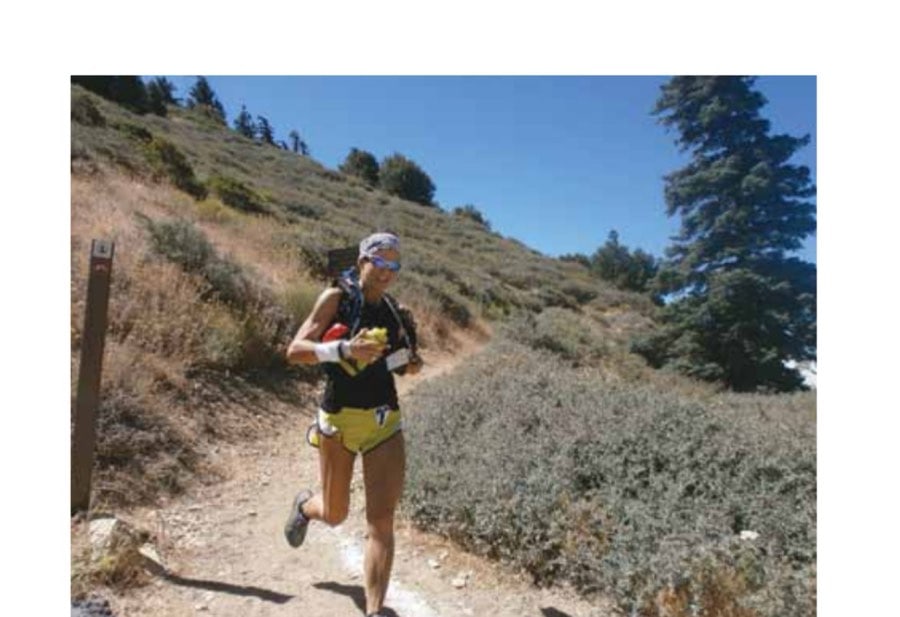
Finally, wearing the strangely predictive bib number 26, at 7:25 in the morning and 26:25 on the race clock, Diana rounded the last turn onto the grass of the park and headed for that huge banner reading, “FINISH.”
Afterward, she was optimistic for her own future and for that of other midpack runners. She felt that this was such a big breakthrough in confidence that she was never going back to those 30-hour-plus days. It might have taken her four tries to get her imagined “five hours” back, but she ended up with six hours instead: not a bad deal. She looked forward, saying, “For all future ACs, I have other goals that I now know are possible. Maybe second sunrise [about 25:30], or even sub-24. I love this race with all my heart, and I really think it loves me back. It’s where I’ve always belonged.”
Middle- or back-of-the-pack runners wanting to break new ground should take what Diana says to heart. ”Remember, sometimes you just need to surprise yourself in order to believe it’s possible. Who knows, maybe I sort of stuck myself in this certain time range, because that’s the kind of runner I thought I was. I mean, 27 or 28 hours at AC seemed to me amazing and a great goal to shoot for, partly because it was fast (for me). I just never thought I was the kind of person that could ever have a second sunrise or better—that was for other people. Now that I’ve busted out of that mental box, I can see it. I am one of those people.”
This article originally appeared in Marathon & Beyond, Vol. 18, No. 5 (2014).
← Browse the full M&B ArchiveMore like this
1,000+ stories from 19 years of Marathon & Beyond
The complete archive of the legendary long-distance journal — digitized and free to read.
