

Motorola Marathon
IN SPITE of what you might have been reading in the newspapers and seeing on the news lately, Austin, Texas is famous for more than President George W. Bush’s daughter Jenna competing with Robert Downey, Jr., to see who can have the most run-ins with the police over purchasing and using substances denied them by law. The press attention to this non-story is what happens when the press finds itself in the doldrums of a slow news day.
Austin itself pays little attention to the doings of Jenna Bush. The city has too much else happening to waste time on that. The Texas state capital is a bustling, vital, energetic, hip city that takes pains to set itself aside from just about anywhere else in the Lone Star State. The city is growing so quickly and changing so radically that the charter bus driver bringing marathon pasta eaters back from the Motorola complex where the official pasta feed was held became lost and overshot his exit by several miles before some runners from Dallas seated in the back of the bus asked if we hadn’t already passed our exit. We had, by more than four miles.
The Basics
Motorola Marathon
PHONE: 512/478-4265, 877/601-MOTO
FAX: 512/478-4225
E-MAIL: info@motorolamarathon.com
WEB SITE: www.motorolamarathon.com
RACE DIRECTOR: John Conley
YEAR RACE ESTABLISHED: 1992
CERTIFIED: USATF
TYPE OF COURSE: Point to point, starting far north of the city and winding through the suburbs, then through the urban downtown, then along the river, finishing in a riverside park; loses approximately 400 feet from start to finish.
COURSE CLOSURE: All course support is removed from the course route behind the runners on a gradual schedule based on an eight-hour finishing time; the finish line clock runs for a total of eight hours; the finish area officially closes at 3:00 P.M.
START TIMES: Wheelchairs go off at 6:55 A.M., marathoners and relay teams at 7:00 A.M.
COURSE RECORDS:
| Open male: | Mohamed Naizipov, 2:11:14 (2001) |
| Open female: | Elena Paramonova, 2:32:55 (2001) |
| Male master: | Eddy Hellebuyck, 2:16:47 (2001) |
| Female master: | Alevtina Naomova, 2:37:46 (2001) |
PRIZE MONEY: $90,000 to open male and open female winners.
NUMBER OF VOLUNTEERS: 1,500
MARATHON FINISHERS IN 2001: 4,191
MALE/FEMALE FINISHERS: 64% males, 36% females.
COURSE MARKINGS: Every mile, with split times every 5K.
FUTURE RACE DATES: 17FEB02, 16FEB03, 15FEB04, 20FEB05.
ENTRY COST FOR 2002: $50; no limit.
AWARDS: Monetary prizes to top finishers; awards to top finishers in age-group divisions. Police-Fire Department, Military, and Clydesdale awards also. The depth of the awards is based on percentage of finishers; if men ages 35 to 39 are 10 percent of field, then 10 places deep. Minimum depth is 3.
AREA HOTELS: Lots of choices. Visit the marathon Web site (www.MotorolaMarathon.com) or contact the Austin Convention and Visitors Bureau at 800/926-ACVB or visit their Web site at www.austin360.com/acvb.
GETTING THERE: Austin is not a major metro center, and it is out there by itself in the very middle of Texas; but due to its importance as a tech center, air travel is relatively good, although it can be expensive. Austin is served by Austin-Bergstrom International Airport. The only interstate highway going through Austin is the north–south I-35; Austin is about halfway between Waco and San Antonio.
The building frenzy in Austin is supercharged, and the signage directing drivers around and through the area is far inadequate. The only plus side of taking an eight-mile, out-and-back, out-of-our-way trip with the wayward bus was the reassurance that just because we were out-of-towners didn’t mean we didn’t fit right in with what was going on around town—pleasant, starry-eyed, good-natured confusion.
The one place everyone seems to find with little trouble is Sixth Street, the rockin’-rollin’ jazzin’-jumpin’ heart of downtown (and one of the places where under-aged Jenna Bush goes when she wants to chill with her friends and down a Prohibition brewskie). It’s also where during Mardi Gras week, the local college crowd mixes with the motorcycle gangs and the tourists to see who can get arrested first for disturbing the peace. In some ways the storefronts along Sixth Street are very much like but totally different from the colonial townhouses in Alexandria, Virginia: 10 feet wide and 100 yards deep so that anyone walking into one of the hangouts has to walk sideways and hold his drink close to his chest.
Yet a half mile away from Sixth Street are tree-shaded residential neighborhoods where life is peaceful, nearly bucolic, but where the sound of traffic on nearby thoroughfares is becoming intrusive.
Austin suffers most from its own success, a problem that periodically faces cities “discovered” by insiders and industry. Austin is host to Motorola (and some 10,000 employees, known as “Motorolans”) and has been since 1974. Fortunately for its economy and unfortunately for its
Must See/Must Avoid
Austin is a bustling but pretty benign city, although we’re told that you take your life and limb into your own hands when you venture down to the Sixth Street area during Mardi Gras. Normal cautions after dark prevail, although you’re more likely to get hit by a car being driven by someone gawking around trying to find a street sign that isn’t there than you are to be imperiled by someone up to no good.
GO SEE IT
University of Texas. You almost can’t avoid the UT campus if you visit Austin. The campus is supposedly the largest in the United States, covering 357 acres that host some 50,000 students. Local Texans are unusually proud of the massive stadium, a tribute to the university’s football team. We’d someday like to visit a university campus where one of the local boosters takes us by the library and brags about it. The campus does house some impressive research centers to balance out the sports-nuttiness: the Harry Ransom Humanities Research Center, Texas Memorial Museum, and the LBJ Library. The campus is certainly worth visiting, but if you go, give yourself more than one day.
Steam Trains. Okay, so they’re big and noisy and they pollute a lot, but we’ve got a weak spot for steam locomotives and Austin hasn’t got one—it has three of them! And the trains not only run on a regular basis but you can take trips on them. The Hill Country Flyer runs on Saturdays in the winter and summer and on both Saturday and Sunday in spring and fall, taking passengers on a 33-mile journey to Burnet, departing from Cedar Park. The locomotive is the old Southern Pacific #786, an 82-year-old monster. The Twilight Flyer, also departing Cedar Park, runs on selected weekends and certain holidays and makes a two-hour trip. The River City Flyer makes two 90-minute runs (1:00 and 3:00 P.M.) on Sundays, taking passengers on a tour of historic Austin; it leaves from Fourth and Trinity Streets. For info: 512/477-8468.
Congress Avenue Bats. This attraction isn’t for everyone, certainly, but for those of us who’ve marveled at the bats in Death Valley as they come out at twilight to feast on swarming insects, this is just the ticket. More than one million Mexican free-tail bats set out each night between April and November from under the Congress Avenue Bridge. This is the largest colony of urban bats in North America. You can watch from near the bridge at Town Lake or, better still, get a window table at one of the nearby restaurants and watch the show. For more info: 512/327-9721. Really, if it weren’t for bats and birds we’d be wading knee-deep in insects.
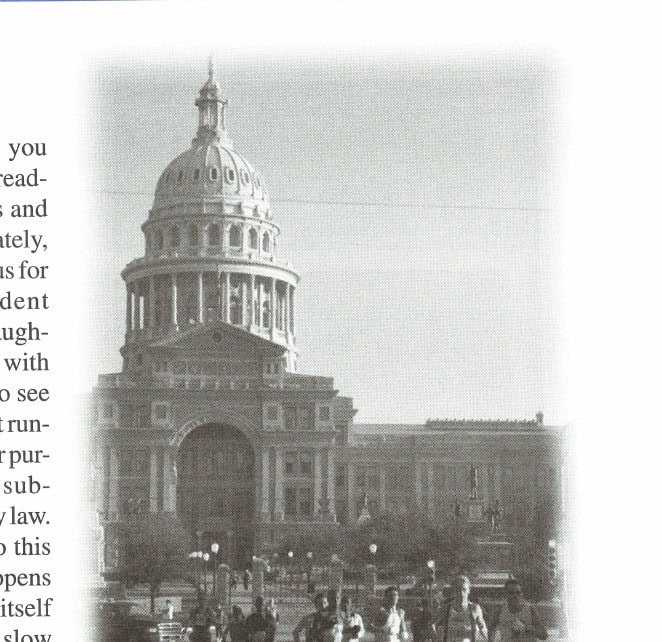
State Capitol Building. Texas likes to do things big, and they certainly didn’t fall short on the impressive—and dominating—state capitol building on Congress Avenue. Built in 1888, it was at the time the world’s seventh largest building under one roof. An underground extension was added later, and, incredibly, the underground extension is twice as large as the original building. Tours are provided nearly every day. Call 512/305-8400.
RunTex. This isn’t a blatant plug for RunTex, although they’re one of the best running stores in North America. Austin is such a runnable city (with an estimate of about 25,000 runners) that it would be a shame to visit it and not take advantage of the paths and trails available. And one of the best ways to get the right info about where’s best to run is to go by one of the three RunTex stores (Townlake South, Gateway North, or Central Park) and get plugged in. The phone numbers of the three stores are, respectively, 512/472-3254, 512/343-1164, and 512/454-WALK.
AVOID IT
In speaking with local ultrarunners, they indicate there isn’t any place in town where they have not run. Joe Prusaitis, who’s written for us and who is on the marathon committee, puts it this way: “I have six children who are all young adults, and they’ve been to all the same places [I’ve run] after I’ve already gone to bed. Like any city, we have crime and other social issues, but it is not focused on any one bad place.” Everyone does advise visitors to avoid I-35 and Mopac during rush hours, as driving there during those hours is a crime. Even Sixth Street after dark is okay, but you’ll have difficulty finding a place to park near it.
quality of life, the city has been discovered by other high-tech companies, including Dell. The area has become known as “Silicon Hills” after the area’s Texas hill country appellation. Some 600 software companies employ 22,000 people in a city with a population of nearly one million.
THE FLUX OF HIGH TECH
Unfortunately, high-tech companies are also extremely volatile and too often willing victims to the world economy on which they thrive or expire. They and the area in which they function can be in the stratosphere one month and in the crapper the next. When we visited for the marathon, Motorola had just announced a layoff of thousands of employees; and Dell, for the first time in its history, was also imposing layoffs.
Austin is riding, like a partially built boat, with the high-tech swells; its difficulty is that they are trying to build and rebuild the boat while it is afloat. A major chunk of the heart of its downtown has been demolished to make room for modern, high-rise high-tech headquarters. Consequently, trying to get from one side of downtown to the other is like playing chess while blindfolded. One-way streets lead to dead ends as construction crews work seven days a week to get the buildings up and the detours out of the way.
At the same time, the city thrives because it is the Texas capital (locals brag that the capitol building was built with an eye toward making it the tallest state capitol in the nation; it’s actually seven feet taller than the Capitol Building in Washington, D.C.; sorry: it’s a Texas thing.); it is home to the University of Texas–Austin (which is huge); and it’s located in what is, hands down, one of the loveliest spots in the state of Texas. If you think of flat and boring, you ain’t never been to Austin, pardner. Austin is a series of plains and hills and cliffs and sheltered creeks, and a river (the Colorado) runs through it.
Situated in the center of Texas geographically, the area is difficult to pigeonhole politically. LBJ’s legacy is housed nearby, yet local folks of differing political persuasions seem to get along just fine. They are apparently far enough removed from the D.C. Beltway to be unaffected by its divisiveness.
Because of its varied topography and the constant construction, you might think holding a marathon here would be difficult. You’re right. Course alterations to accommodate the growing city are almost an annual rite of passage—and a constant challenge to the organizers. But the marathon has two very powerful things going for it: Motorola’s continued involvement and a high-profile running community anchored by Paul Carrozza’s RunTex stores.
Motorola, which had some dedicated runners in its upper management a decade ago, joined with local runners, under the direction of Lyle Clugg, to launch the enterprise in 1992. The initial running boasted 1,780 starters, an impressive beginning to be sure; the race featured five-runner relay teams, prize money, and started at Motorola’s Oak Hill facility; the course was also a bit on the hilly side, running, as it did, through the south Austin region. Leaving the millennium (i.e., the year 2000), the race had 7,012 entrants and was paying $88,500 in prize money.
CONTINUOUS EVOLUTION
The race evolved virtually every year and has done so again. Between 2001 and 2002, Motorola’s role as benign organizer has changed. In the past, a Motorola employee was hired full-time to coordinate the marathon. For 2002, Motorola is still very much involved, but the baton for running the race has been passed to RunTex, with a board of directors taking more of a role as the official organizers, who are also responsible for picking the nits and oiling the wheels where needed to make the thing run smoothly.
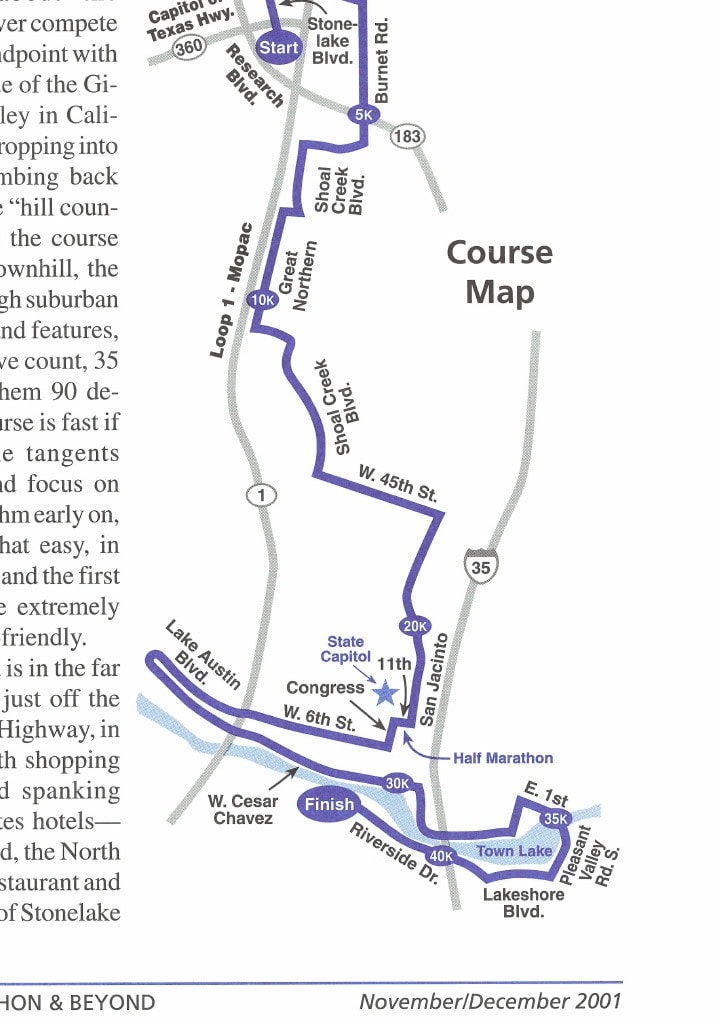
The new “organization” is obviously optimistic, in that they’ve announced race dates running to the year 2005. As we go to press, the race course is most likely what you see below. Check the races’ Web site to confirm. We would predict that because of the city’s massive construction projects, the course will never be quite the same twice.
And how about the course? It will never compete from a scenic standpoint with Big Sur or Avenue of the Giants or Napa Valley in California. To avoid dropping into canyons and climbing back out of them in the “hill country” and to keep the course flat to slightly downhill, the course runs through suburban and urban areas and features, at our conservative count, 35 turns, many of them 90 degrees. Yet the course is fast if runners take the tangents through turns and focus on getting into a rhythm early on, which is somewhat easy, in that the start area and the first several miles are extremely wide and runner-friendly.
The start area is in the far north of Austin, just off the Capital of Texas Highway, in an area thick with shopping malls and brand spanking new inn-and-suites hotels—and, we might add, the North by Northwest Restaurant and Brewery (corner of Stonelake and Loop 360), billed as “the official kickoff point for the Austin Motorola Marathon” and site of the post-marathon party (featuring all-day happy hour prices, 11:00 A.M. until late). As far as brew pubs go, Austin seems to be on a one-city campaign to turn around Texas’s rather dismal beer status (i.e., Lone Star and Shiner) by tapping 19 upscale brew pubs.
The start is right out front at North by Northwest and covers six traffic lanes. And the starting line temperature for 2001 was about as ideal as it gets: dry, still air and temps in the mid-40s.
Because the race is $90,000 thick in prize money ($10,000 each to the male and female winner), the organizers bring in rabbits to take the lead pack through the half-marathon in smart fashion. With most of the course’s 400-foot net elevation drop coming on the front half of the course, the pacemakers have to work to keep the pace from being too fast early on.
The course winds through flat suburban territory, which gradually changes to urban, going from tree-lined residential areas to the downtown.
After the halfway point, the course heads west for a spell, paralleling the river but several blocks off it, then hits Lake Austin Boulevard and turns back on itself, queuing into Cesar Chavez Boulevard, which runs closer to the river. The course parallels the river, then takes a 90-degree right at Pleasant Valley and crosses the river, then takes a 45-degree turn to bring it back along the river but on the far side, where it runs along Riverside Drive, a blend of graceful neighborhoods and tight little blocks of congested habitation with a corner mini-mall every few blocks. It is along this portion of the course where Jenna Bush tried to use a fake ID.
A FAB FINISH
The 2002 Motorola Marathon course will bring the finish back into the familiar downtown park area on the banks of the Colorado River, known to locals as Town Lake. Used as the finish venue from 1994 through 1998, the Auditorium Shores brings runners back into familiar territory, as the post race area is adjacent to the Palmer Auditorium marathon expo site. Many downtown hotels are walking distance from the finish line, and the Austin skyline provides an inspiring backdrop to celebrate completion of the run. There is plenty of parking nearby in the Auditorium parking lot, and the city lot is one block away. The bus stop shuttling runners back to the start is just beyond the finish line. All the necessary facilities are alongside the finish line in a row of tents. Runner “Recovery Packs,” filled with food and water, will be handed to runners as they spill out onto the park area, where there is ample space to sit down and immediately put back every calorie, and then some, that runners have just expended on the course.
As far as weekend marathon events go, one of the highlights is the runner’s expo at the Palmer Auditorium (Friday and Saturday). Dominated by RunTex (whose anchor store is just across the street from the auditorium), the expo features more than 60 exhibitors, well-organized number pickup, and an ambitious program of presentations on the back stage.
Runner’s High/Runner’s Low
| HIGHS | LOWS |
|---|---|
|
|
Runner’s World has long been involved with the Austin Motorola Marathon, and their presence is evident in pacing-team seminars. There are also presentations by members of the race’s board of directors, who are familiar with the course. They give insights on how to break the course down and use its features to your advantage, as well as marathon morning dos and don’ts, and sports-medicine approaches on how to minimize postrace problems and maximize recovery. RunTex dominates the front of the expo, creating an entire running store under the dome, where they sell their own products, yes, but also the official race merchandise.
If there’s one problem with the expo, it’s parking. There’s quite a bit of construction going on around the auditorium, and some of the potential parking was closed off to expogoers.
The “official” pasta feed at the Motorola Oak Hill Campus is limited to 800 people and is nicely set up in the campus cafeteria, where the pasta is plentiful and delicious and where Ozarka water is everywhere (it is, in fact, everywhere for the whole weekend; if a runner becomes dehydrated, it sure isn’t Ozarka’s fault). The pasta-feed program is a little Motorola promotion heavy, but they’ve certainly earned the right to make use of the captive audience. For 2001, John “The Penguin” Bingham was the guest speaker. Pasta feeders pay one dollar for a bus ride from the Palmer Auditorium to the Oak Hill Campus and back, and if you pick the right bus, you get more miles for your money than you expect, as the driver cuts back and forth through various neighborhoods, trying to find Palmer. It’s not as bad as being hijacked—in fact, it’s sort of fun seeing parts of Austin that obviously surprised and delighted the bus driver enough that he kept going back to them.
SATURDAY EATS GALORE
If you aren’t one of the 800 to go to the Motorola pasta feed, you’re not out of luck, other than missing John Bingham’s talk. Austin has one of the most eclectic melanges of restaurants of anyplace in Texas. MexTex, Thai, Italian, Creole—you name it, it’s there. (Check Celebrate Austin magazine at www.celebrate-austin.com or www.Austin360.com.) Since it’s a Saturday night in a city that’s still frantically building to catch up to the increasing population, do make reservations. Since you’ll likely be eating earlier (in order to get to bed early) than Jenna Bush and her friends, you should have little trouble booking a table even at the most “in” spots.
The ideal Austin weekend, were we to plan it, would be to stick around for several days afterward, after making a connection with one of the local runners to get some pointers on where to walk and jog to wind down and loosen the muscles, then where to go to maximize the tourist possibilities.
It merely shows our prejudice, but we’d hook up with one of the (many) local ultrarunners, because they usually know the out-of-the-way scenic spots that aren’t all that easy to get to.
There are lovely running paths along the river, but we enjoyed being guided by one of the ultrafolk through the Ladera Norte and Far West sections, where the locals train for races, such as the Western States 100. There are lots of hills and acre after acre of quiet, tree-lined streets featuring homes that lean heavily toward brick and stone construction; many of the homes in the steeper gorges are built right into the existing stone and are beautifully done. Make sure they take you through Bull Creek Park, a lovely recessed creek with a path running along it that’s within 30 yards of a major highway, but drivers zooming by haven’t a clue of the path’s existence.
When you’re done with your run, you will likely brunch at the Magnolia Cafe, the local runners’ fuel station; there’s a nonsmoking section, and the food is plentiful and delicious.
If you’re driving around Austin, there are two aspects of the experience we found rather curious: as in most of California, almost nobody gets impatient and lays on their horn, but on the negative side, if you want to change lanes and fill an open spot there, don’t signal your intentions, as the other drivers take it as a challenge and try to fill the spot you want so that you can’t have it. Hey, we just report ’em, we don’t explain ’em.
And on that reporting note, we feel obliged to disclose that our first brush with beer came at eight years old when our German grandfather gave us a six-ounce glass of beer to nurse through a Saturday afternoon of Western movies with the admonition, “Here. You’d better sip this to wash the trail dust from your throat.” He was the biggest fan of Western movies we’ve ever known, even though he never got west of Pittsburgh, Pennsylvania. We can only imagine his yawn-laced reaction to the baby Bushes beer brouhaha. We know he’d have loved Austin.
The Bottom Line
We have weighed various aspects of a marathon within a 1,000-point scoring grid. Besides the author of the article, two dozen runners at the race were randomly chosen to score the race for us (MM = Motorola Marathon). The results follow:
1. HISTORY/TRADITION
Evaluate the race’s sense of history and tradition.
[Possible points: 30 MM score: 19]
2. ENTRY FORM
Is the race entry form clear, concise, attractive, complete, and easy to fill out?
[Possible points: 20 MM score: 19]
3. ENTRY COST
For most races, the entry fee covers between 30 and 50 percent of the cost of putting on the event. Rate the value of your dollar relative to this race.
[Possible points: 30 MM score: 27]
4. LOCALE/SCENICS
Is the race held in an area that is easy to get to and scenic and offers adequate food and housing services and nonrace activities for family and friends?
[Possible points: 50 MM score: 41]
5. REGISTRATION
Is registration well organized and efficient? Does it bog down unnecessarily?
[Possible points: 20 MM score: 19]
6. PRERACE ACTIVITIES
Evaluate activities, such as pasta feeds, parties, and so on, during the days before the race.
[Possible points: 50 MM score: 41]
7. EXPO
Does the expo offer a fair number and variety of booths relative to the race’s size? Are there quality exhibitors and good guest speakers?
[Possible points: 50 MM score: 41]
8. COURSE
Take into consideration the following: degree of difficulty, certified, sanctioned, quality of road or trail surface, adequate mileage and directional markers, aid stations, medical coverage, race communications, accessibility to course for friends and family, typical weather, and so on.
[Possible points: 400 MM score: 351]
9. RACE AMENITIES
This category includes race T-shirt, finisher’s medal, finisher’s certificate, adequate and efficient finish area, ease of sweatbag retrieval, showers, postrace refreshments, awards ceremony, raffles, results postcard, results book, and so on.
[Possible points: 250 MM score: 228]
10. VOLUNTEERS
Are the volunteers experienced and adequate in number?
[Possible points: 100 MM score: 90]
TOTAL SCORE FOR MOTOROLA MARATHON
876 points
This article originally appeared in Marathon & Beyond, Vol. 5, No. 6 (2001).
← Browse the full M&B ArchiveMore like this
1,000+ stories from 19 years of Marathon & Beyond
The complete archive of the legendary long-distance journal — digitized and free to read.
