

My First Marathon …On Fresh Legs, With A Fresh Mind
It’s not like me to miss a class. OK, so maybe I played hooky once or twice (per week) in high school, but that was different. I was young and, by senior year, vehicularly equipped. Understandably, I felt desperate for sunshine, willing to forgo lectures on the Civil War and the world of derivatives for a little lakeside comfort. But mind you, I was always back at school in time for soccer practice. Oh, the priorities of youth.
But once college commenced, showing up became mandatory. No excuses. Not even a sick day, not even for a bad case of mononucleosis, which rendered me useless and asleep for close to 16 hours a day senior year. I simply scheduled my collapses for between classes, fighting every urge to doze at my desk.
So, how in the world did I miss the lessons of Marathoning 101? Whose professional hands did I slip through when I embarked on my newly chosen sport? Because all the talk of building a base, the 10 percent increase rule, limits on anaerobic workouts, and the importance of easy and off days never made a dent in me.
I was so anxious to become an official marathoner that I shut my ears and eyes to common-sense running wisdom. I operated like the family dog, Sam, a large, floppy-eared golden retriever who will fetch a tennis ball until he pukes from exhaustion. I thought success was a direct correlate of desire and diligence, that the solution to all problems was to push a little harder. And without a guru to measure my steps, I was as willful as a spoiled 2-year-old who won’t quit writhing and screaming until you give her the damned cookie. Some say stubborn, obstinate, impossible, and unyielding; I prefer persistent.
Before I get lost in this tangent, I should probably start at the beginning.
Running began in my life as a means to an end, a way to condition myself for “real” sports, namely soccer and basketball. Hitting the track at Wallace Wade Stadium (of Duke University) every day at lunchtime the summer before I started college, sweat pouring, felt like traveling back in time to when I was 7. There I was, transported to the dinner table, only instead of eating my green vegetables, I was putting one foot in front of the other for six strenuous laps around the track. Like a good little girl, I did what was expected of me.
Within the shadow of dear old Dad The sun beat down on my neck like fire; my lungs stung from oxygen debt. And there shadowing every foot strike was my father, a dedicated marathoner for over 20 years, intent on convincing me that masochism wasn’t a prerequisite of the sport of long-distance running. “You see, it’s not so bad,” he would say as I wheezed and panted and tried to recover from the hard effort. “
Yeah, not as bad as a root canal maybe,” I would wager between breaths, “or childbirth.” I should add here that not a week goes by that my mother doesn’t remind me that she endured all 14 hours of my labor without medication, not that she is complaining or anything.
Still, the real masochist of the family was my dad. How else to explain abandoning a warm bed by 5:00 a.m. to hit the dark streets of the neighborhood for upward of 12 miles? Sure, I rose shortly thereafter to practice my jump shot in the driveway, but that was a productive use of time, right?
After all, anyone can run, but it takes real skill to shoot off the dribble. I had been successfully indoctrinated into the belief that real sports required dexterity, agility, strength, hand-eye coordination, and the ability to react and improvise. All running asked was that you keep plodding forward in as straight a line as possible with maximum velocity. Where is the excitement in that? It sure doesn’t compare
Courtesy of Jill Hudgins
▲
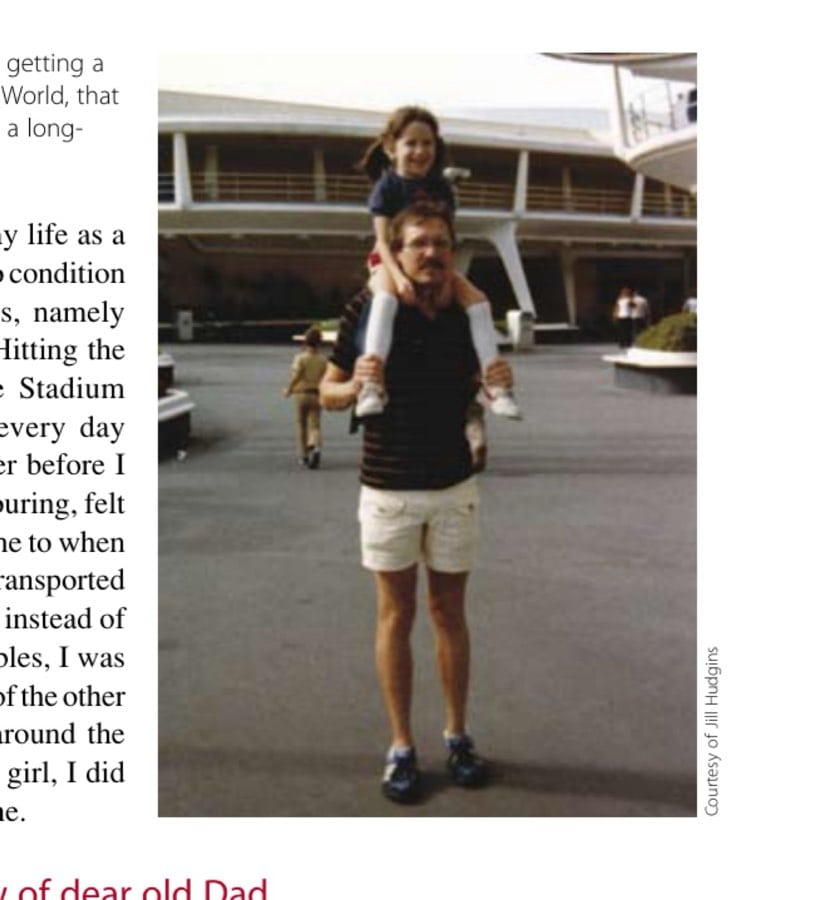
I didn’t know at age five, getting a free lift from Dad at Disney World, that I’d follow in his footsteps as a longdistance runner.
Why not start at the top? No, I was determined to start with 26.2. I had at that time only one race under my belt: a 5K Christmas run eight years prior when at age 10 I found myself bored by the prospects of playing spectator at another one of my father’s races. I could scarcely walk for the week afterward, resolute in my commitment to stick to “real” sports, but subconsciously I was already hooked. Sure, it took some time to return to the scene, but once I commit to something, it’s with every ounce of me. That was why, with only a few 10-mile weeks under my belt, I registered for my first marathon.
Courtesy of Jill Hudgins
to a game-winning three-pointer at the buzzer, shot over the outstretched arms of two defenders. But something shifted when I left the nest for the first time and moved into a college dorm. Something about my newfound independence infused my regimented running workouts with eagerness and excitement.
Whereas before I had dreaded the exercise ahead, often procrastinating at the start and mining the excuse pit for any reason not to run, now suddenly I couldn’t wait to get out the door. It was my new morning fix.
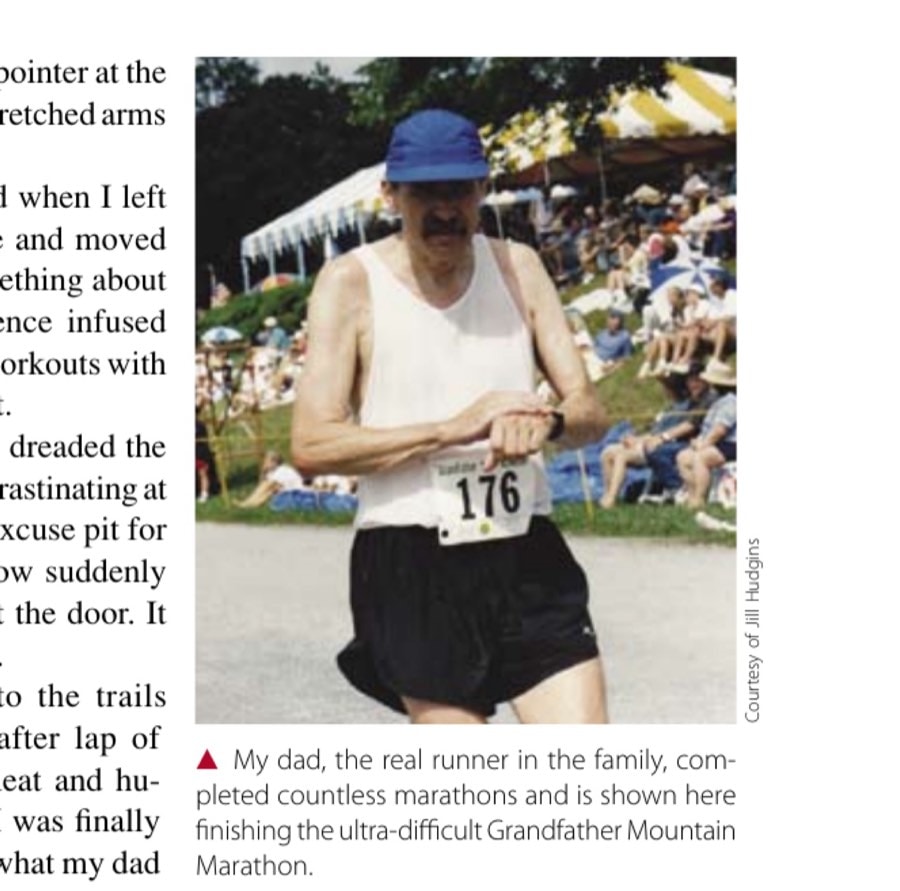
Wearing grooves into the trails of Lullwater Park, lap after lap of ▲ My dad, the real runner in the family, comAtlanta’s characteristic heat and hu- pleted countless marathons and is shown here midity dripping off me, I was finally finishing the ultra-difficult Grandfather Mountain beginning to understand what my dad Marathon. had known all along: namely, that joy is to be found in the simplest of athletic pursuits, that all the other sports I had tried—soccer, basketball, volleyball, softball, baseball—were merely a warm-up for my running life. I planned to continue this newfound passion into old age, until my legs could no longer carry me. Obsessive and addictive were the words my mother used; I preferred driven and passionate.
Unfortunately though, because I was born without the perspective and patience gene, my entrance into the sport was fraught with difficulties. It didn’t even occur to me to work my way up the ranks, lingering in the 5K and 10K distances before moving on to the half-marathon and then the full.
▲
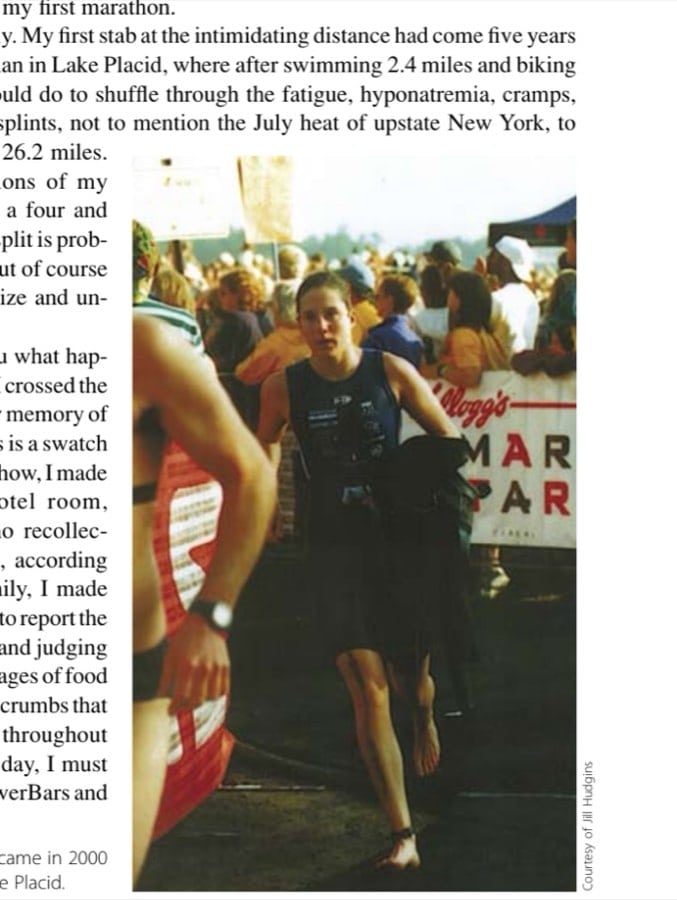
My first marathon came in 2000 at the Ironman in Lake Placid.
Courtesy of Jill Hudgins
I went from running two miles a day to upward of 10, 60-plus per week. More is more was what I figured, but not surprisingly, injuries were soon to follow: painful shin splints, then two tibial stress fractures, and all of a sudden, my running career looked to be ending before it had even really started.
Despite the many messages to slow and temper my training, I didn’t learn. I overloaded and overtrained, pushed and prodded, and then lambasted my body for breaking down on me. I simply couldn’t accept the reality of my physical limitations and withdrew and withheld all kindness toward myself. I persisted like this—injured, exhausted, and frustrated—for years.
Fast forward to December 2005, almost a decade later, and I’m finally toeing the starting line of my first marathon. Well, not exactly. My first stab at the intimidating distance had come five years earlier at the Ironman in Lake Placid, where after swimming 2.4 miles and biking 112, it was all I could do to shuffle through the fatigue, hyponatremia, cramps, sciatica, and shin splints, not to mention the July heat of upstate New York, to complete the final 26.2 miles. Given the conditions of my body and the day, a four and one-half-hour run split is probably respectable, but of course I’m quick to criticize and undervalue.
I would tell you what happened next—after I crossed the finish line—but my memory of the following hours is a swatch of deep gray. Somehow, I made it back to my hotel room, although I have no recollection of how. Then, according to friends and family, I made several phone calls to report the news of my finish, and judging by the opened packages of food and the subsequent crumbs that I found scattered throughout my room the next day, I must have gorged on PowerBars and
pretzels and Fig Newtons. I’ve never blacked out from drinking, but from what I’ve heard, the experience is much the same—a blur. Only in this case, my hangover consisted of sore muscles instead of a headache, bloating and deep hunger instead of nausea. I could have eaten a building by the time I came to and nearly did when I finally headed out for breakfast the morning after.
What I do know, despite the fog of my Ironman recollection, is that I got it backward. Before you give the ultimate triathlon a try, you at least run a marathon, and before you run a marathon, you complete a half, and before a half, a 5K or 10K will serve you well.
Why didn’t I realize that this kind of trial by fire is like trying to climb to the top of the Eiffel Tower without making use of the stairs? Sure, it might be acceptable to skip one or two along the way, but to bypass entire stories doesn’t make sense.
Chalk it up to my pathological inability to start small. The way I figured, why limit yourself to Saturday fun runs replete with doughnuts and bagels at the finish line when out there exists a more daunting challenge, one worthy of admiration from all. Even marathon running, when compared to the Ironman, looked like child’s play. And simply said, I couldn’t see the point.
It took a while to get the point But after my years of injuries, illnesses, and emotional setbacks, the tectonic plates shifted, the sun shone down with greater intensity, and I realized—the point is that there is no point. You run because you can, because you’re compelled to, because
Courtesy of Jill Hudgins
▲
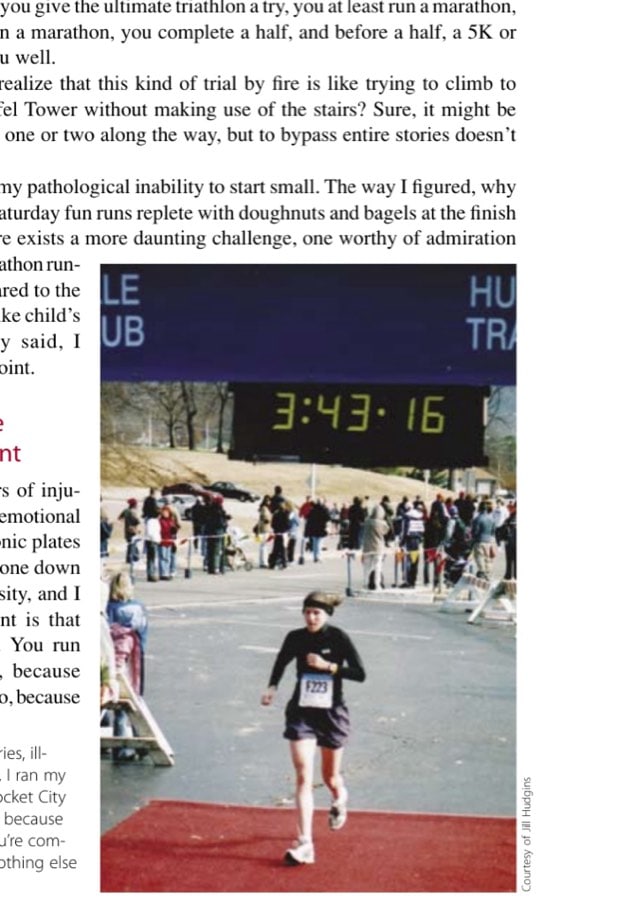
After years of injuries, illnesses, and setbacks, I ran my “first” marathon at Rocket City and realized you run because you can, because you’re compelled to, because nothing else will do.
nothing else will do. Even if, like me, you weren’t blessed with the natural talent to compete with the best, you still participate and push. You must learn to love and appreciate your limits and realize that although you will never be able to give Paula Radcliffe a run for her money, that you will always settle into the middle of the pack, it’s really OK.
I ran my race at Rocket City in Huntsville, stayed within myself, and appreciated each mile marker as it breezed past. Though I suffered some the last 5K, I finished the marathon hungry to do another, not because I’m trying to break any records, either with time or number (although I have to admit, the 50 marathons in 50 states club sounds appealing), but because the endeavor satisfies a need inside me that no other activity can touch. I run for no other reason than to live, and I’m determined to chart my own course, according to the shape of my own desires and the limitations of my own body, from here on out.
Everyone has to decide why to run, and if no reason can be had, be satisfied with how and what and where and when. It has taken me quite a while to get here, but I must cherish every step. I guess—when all else fails, and many times in my life it has—you should be kind to yourself and honor the act of just getting out the door. The way I see it, every footfall and arm swing is a victory in itself; it’s simply a matter of turning the mind and making it believe.
This article originally appeared in Marathon & Beyond, Vol. 14, No. 1 (2010).
← Browse the full M&B ArchiveMore like this
1,000+ stories from 19 years of Marathon & Beyond
The complete archive of the legendary long-distance journal — digitized and free to read.
