

My Most Unforgettable Ultramarathon (Vol. 15, No. 5)
HILLSBORO, NEW MEXICO, Ghost Town 38.5, January 16, 2011—The
first time I saw a running magazine, I thought it was a joke. Actually, I am sure that at some point prior to this encounter, there had to have been a running magazine somewhere in my past. My eyes must have skimmed over the cover of one at a bookstore. After all, much of the first 40 years of my life were spent in bookstores and not at the gym or circling a track.
But on that particular day, as I sat in my friend’s living room watching football, I came face to face with my unlikely fate. At first, I scoffed at the magazine and said something along the lines of, “How can there possibly be enough material about running to fill an entire magazine? What do you need to know in order to run? Left, right, left, right, what else is there?” I, like most people, said things like “I would only run if someone was chasing me with a knife.” But life has a funny way of altering your perspective. As often happens, as my age crept higher, my waistline expanded. But it wasn’t a midlife crisis or the need to shop for larger pants that changed my perspective; rather, it was fatty liver disease.
I needed a life insurance policy that required a physical exam, which, in turn, revealed the fact that I had elevated liver enzymes. With every doctor I visited, the number of liver enzymes rose exponentially. I received the final diagnosis from a liver specialist who gave me the choice: I could either take control of my health through diet and exercise, or he would perform a biopsy. I wasn’t sure what a biopsy entailed, but it sounded like something to avoid. As a result, I changed my lifestyle, became vegetarian, and started running.
Initially, I ran to appease the liver specialist. In fact, I often felt as if I were running away from his scalpel. But something happened as I went from being able to run only a few blocks to being able to run a few miles. After six months I ran my first 5K, the Fort Worth Zoo Run. Six months later I ran my first half144 l MARATHON & BEYOND l Sept/Oct 2011
marathon, the Tyler Half-Marathon. Most surprising to me, however, was that during that time, I fell in love with running. Incredibly, this form of exercise, which I had once mocked, became the first sport I ever really enjoyed.
Meditative time along the roads Along the way, running led to weight loss and brought my liver enzymes back into a normal range. More important, running became an essential part of my life. It gave me emotional and spiritual strength. It gave me an opportunity to detach from all things electronic, from worries and stresses, and from the pressures of life. While running, my soul would quiet. I am a pastor, and time spent running became time spent with God. In truth, running became a time of prayer.
With this new emotional, physical, and spiritual strength, I quickly went from living a sedentary lifestyle to being an avid runner, averaging a race a month. As the frequency of my running increased, so too did my desire to see how far I could push myself. I began attempting greater distances, and two years after the doctor’s diagnosis, I ran my first marathon, the Sedona Marathon, in 2010.
While Sedona marked an unbelievable achievement for me, I still wanted to discover how much farther I could go. A faithful subscriber to the magazines I once ridiculed, I read stories of trails that ribboned the sides of mountains. I read about people who pushed themselves to run 50K, 50 miles, 100 miles, and even more. Then, in September 2010, I opened the pages of Marathon & Beyond to read about other people’s journeys and, in the process, discovered my own. A full-page color advertisement lured me toward the Ghost Town 38.5 in Hillsboro, New Mexico. This race was scheduled to take place in the beautiful Gila National Forest, only three hours south of our Albuquerque home.
While the dream of running an ultramarathon motivated me to complete the necessary training, the reality of the
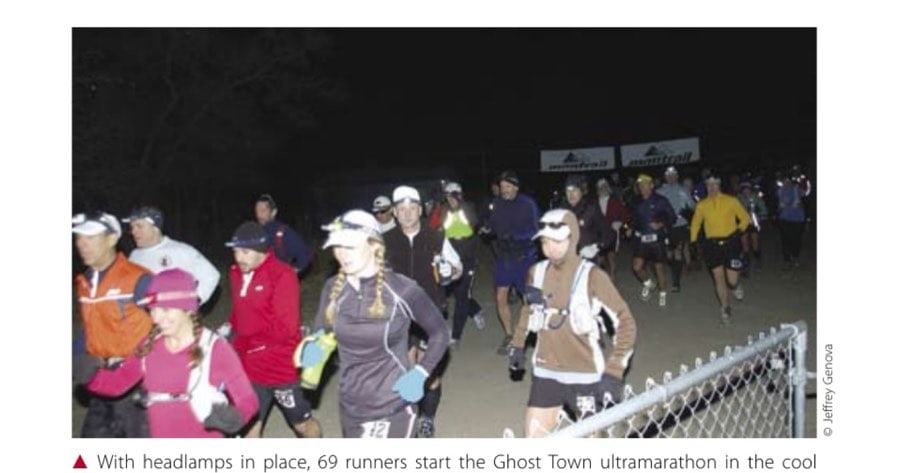
task at hand did not hit me until I stood at the starting line. A wave of emotions flooded over me, along with the suspicion that I might have lost my mind. While most sane people slept, I stood under a thick blanket of stars in the company of 68 strangers. With lamps affixed to our heads, we looked like a group of underdressed coal miners. Considering that we would spend much of that day slogging past abandoned coal mines, this observation contained more than a little irony. As I contemplated the journey we were about to undertake, I turned to a stranger in the darkness and asked, “What is wrong with us?” Before he could attempt to answer my rhetorical question, Susan Reynolds, our gracious and very wellorganized director, gave us a final word of encouragement and instruction. She shouted, “Go!” and we went. Thus began our 38.5-mile adventure.
Concerns for my sanity quickly faded as my feet began their “left, right, left, right” pattern. Injury-free training and two weeks of tapering left my muscles fresh and my legs filled with energy. In the early going, I actually had too much energy. When my watch beeped at mile three, I looked down to discover that I had run about a minute per mile faster than my intended pace. Although I slowed my pace after making this rookie mistake, the first 10K still passed quickly. At this point, we turned off the paved county road and onto the dirt trail that would be our playground for the next several hours.
The glory of early-morning racing
© Jeffrey Genova
After the first six miles clicked by, the next six were simply glorious. The farther we ran, the deeper we explored the national forest. With the first sunlight, nature
▲ With headlamps in place, 69 runners start the Ghost Town ultramarathon in the cool darkness of a New Mexico morning.
unveiled the beauty of snow-covered mountains. Some runners found the landscape so stunning that many stopped, pointed, and took pictures. Although the first 12 miles included over 1,000 feet of elevation gain, a combination of solid training, high-quality rest, and the camaraderie of new friends made the miles pass effortlessly.
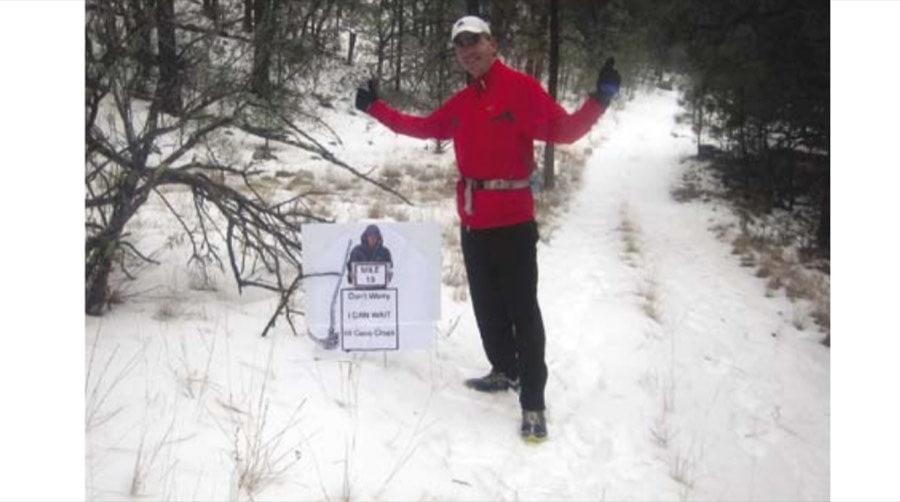
The easy running came to an end at the Forest Spur Trail. Although the temperatures at the lower elevations would approach an unseasonably warm 60 degrees on this January day, the Forest Spur Trail is part of an old mining route on the dark side of the mountain, which crests at 6,800 feet. Pushing through ankle-deep snow and sliding across frozen creeks slowed me considerably and drained much of my energy. The conditions of the trail required slow, measured, careful steps, and only the truly brave attempted to run through this section. A race official sat at the peak of the spur, dressed as a red monster. Nothing dispels the tension of running through ice and snow like a good sense of humor.
After this four-mile section of snow-packed trails, it was a relief to return to the main trail, where aid stations provided oases of strength and encouragement. In particular, one kind soul boiled 20 pounds of potatoes and covered them in salt, providing us with a delicious source of much-needed energy.
▲ Greg Henneman feeling good at mile 13 on the spur trail. While the lower elevations of the run were unseasonably warm, runners faced ice and snow at higher altitudes.
Just a few hundred yards after leaving the Hilltop Aid Station, I realized that I had accidentally left my MP3 player behind. In preparation for Ghost Town, I carefully composed a soundtrack to accompany my run. It started with the slower beats of Vic Chesnutt and Neil Young and over the hours grew to the faster rhythms of the Red Hot Chili Peppers and the Rollins Band. Initially, I did not think that running without music would be that big of a deal. It didn’t seem worth my effort to turn around and retrieve the MP3 player. After all, most of my training took place without music. I had brought the MP3 player along only in case I needed a pick-me-up. However, by this point in the run, I was alone in the middle of a small and divided field. Faster runners paced far ahead of me while slower ones lagged far behind. Although the woodpeckers and raptors provided occasional diversions, not having music resulted in long, lonely miles, and I often went an hour without seeing another human being.
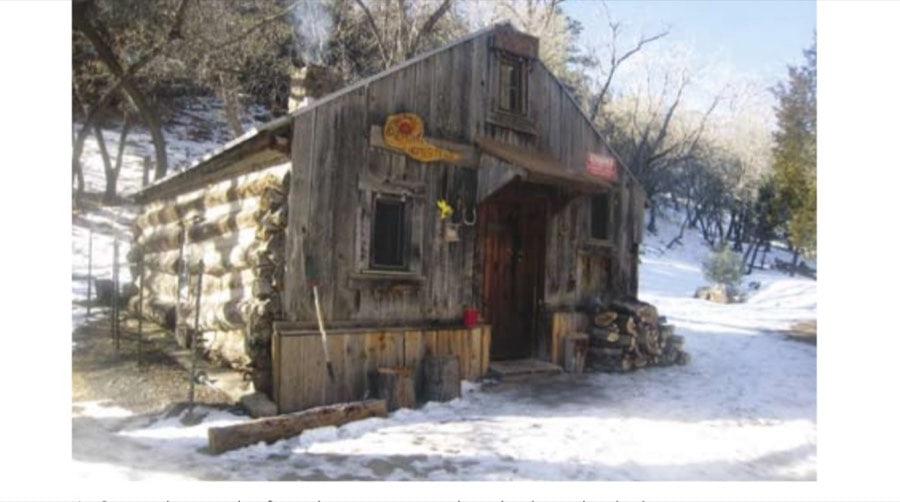
Ten miles away from any paved road, I came upon the remains of a mining post. As I stopped to admire a log cabin built in 1886, a man named Bill came out of the cabin to greet me. He told me that a century earlier this cabin had been a busy saloon and that the entire area had bustled with activity. I have never seen a more remote home, and I wondered whether this annual run was the only activity that disrupted Bill’s quiet life.
▲ Over a dozen miles from the nearest paved road, a log cabin built in 1886 serves as a living memorial to what was once an area bustling with mining activity. Nowadays, the only activity that passes near this cabin is the annual invasion of runners.
The injury that wasn’t My first real scare of the race came about two miles after meeting Bill. While I was walking up a steep incline, my feet slipped on loose rocks, my legs split in opposite directions, and the palm of my left hand scraped against the rocks. I screamed loudly enough to hear my voice echo through the mountain canyons. Because of the way I fell, I assumed that I seriously injured myself. I was amazed as I lay there and didn’t feel pain. I stood up and was curiously OK. I looked around, brushed myself off, and began running again.
About six miles later, while climbing another steep hill with loose rocks, I fell again. This time I felt a twinge in my hamstring and again feared the worst. My mind filled with visions of having to explain to friends and family why I didn’t finish the race. Could all of those months of training have been wasted with a pulled hamstring? After cresting that hill, I again felt fine. I wasn’t sure how I avoided hurting myself on those falls, but with strength beyond my own, I continued on.
Trudging through snow, climbing steep hills, and spending too long at aid stations left me behind schedule. While I believe that time goals in distance running are rather arbitrary, especially for a rookie like me, I really wanted to finish in less than nine hours. So on the return trip of the out-andback course, I flew down the mountain and passed the marathon mark without even noticing. Upon my return to Hilltop Station, I found my MP3 player sitting on the chair where I had left it, cranked up the music, and let it fly.
With less than 10 miles to go, I felt amazingly strong. While the guitar licks of Jimmy Page and the voice of Robert Plant echoed in my head, my legs turned over faster and faster. Although the battery on my Garmin had died and I didn’t know my pace or the time, I felt that my nine-hour goal was
within reach—until, suddenly, I felt a strange presence behind me. I had read about runners who experienced hallucinations on long runs. Could the figure behind me be a ghost from an abandoned silver mine? No. It was a woman dressed in running gear, yelling and frantically waving her arms in my direction.
While enthusiastically sprinting down the mountain, I had missed the turn off to the Stone Hut Aid Station and check-in point that was only about a tenth of a mile off the main trail. As I ran down the mountain I noticed an empty blue chair by the side of the trail, but I didn’t realize it was the marker to turn runners toward the check-in point. At that point, I shrugged my shoulders and kept going. Now I had to turn around, go back to the aid station, check in, and return the way I had come. This rookie mistake lengthened the race, interrupted my pace, and broke my spirits. Race officials and fellow runners were apologetic and sympathetic, but the mistake was mine. While my legs continued to turn over, it took a few miles for me to get over this blunder and refocus. During the time it took me to go back, check in, and return to where I began, the runners I led passed me for good.
Although running the trails through the Gila Wilderness provided amazing views, led me to find new and unknown sources of strength, and created lasting memories, I was relieved to see the dirt trail come to an end at the T on the county road. The last six miles of the run were a return to running on pavement. In contrast
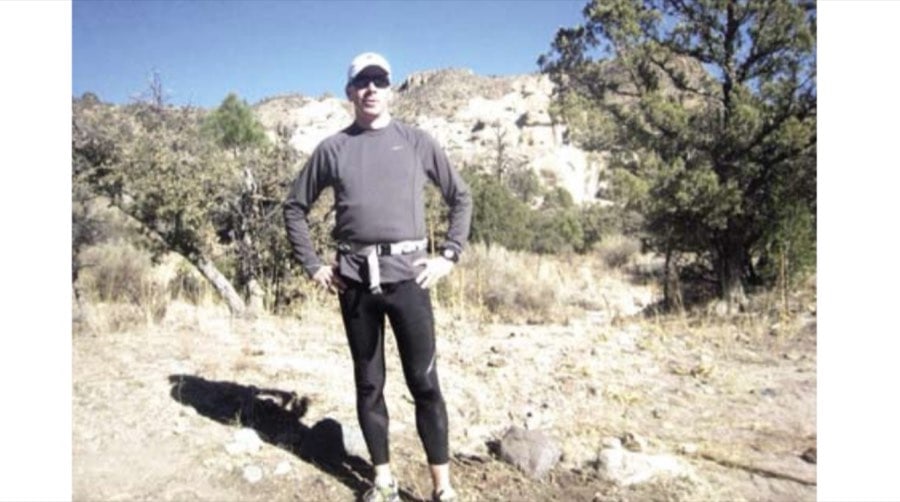
▲ Greg Henneman at the turnaround point at Cave Creek, 20.6 miles into the Ghost Town ultra.
to forgiving, softer trails, the merciless pounding on the cement quickly became wearisome. In hindsight, I wish that I had exchanged my lightweight trail shoes for more supportive street-running shoes at the last aid station, another rookie mistake and another lesson learned. However, my body did not grow truly weary until the last three miles, at which point my knees, muscles, and joints decided that they had had all the fun they could handle. I thought to myself, If only this race were a 50K. I would be done by now.
The family cheering section arrives The harshness of this final stretch broke when I heard a car’s horn behind me. Arms enthusiastically waved out the windows of our family car as my loving wife and sons shouted words of encouragement. As I turned the next corner, my wonderful family stopped by the side of the road to cheer me on. Jennifer told me I was farther ahead then she had expected I would be, and Noah, our oldest son, told me that I looked great. I’m still not sure whether any of these words were true, but I do know that seeing my family gave me more strength than I could get from all of the boiled potatoes in Sierra County, New Mexico. The love of my family carried me through the last difficult miles.
As I turned the final bend, I could see the town of Hillsboro. I picked up the pace significantly as I saw flags and banners near what I thought was the finish line. With all of my strength, I built up to a sprint and was disappointed to see that what I thought was the finish line was really flags in front of a rock shop located west of the actual finish line.
Although I was discouraged to realize I had another quarter mile to run, at this point I could see the cars lined up outside the finish line. I resumed a full sprint for the last quarter mile and was surprised to find such strength after having run more than 38 miles. From a distance I could hear the clanging of a cowbell and cheers of support. Sitting outside the finish line were runners of superior ability. These people had accomplished legendary runs at places like Leadville and wore belt buckles from Western States. These runners finished hours before me and would go home with awards. While their accomplishments and experience were in a completely different league from my own, they stayed and cheered for every single finisher. They made me feel as if my finishing was important to them. In fact, I felt as if I was being welcomed into an exclusive club where membership was not based on time but on heart.
It was at this moment that I realized that an ultramarathon is not simply about running farther than 26.2 miles. An ultramarathon is a community. The people who run these distances are not there to elbow a competitor out of the way in order to gain a single position. Rather, they call each other by name, support one another, and find joy in shared victories.
© Jeffrey Genova
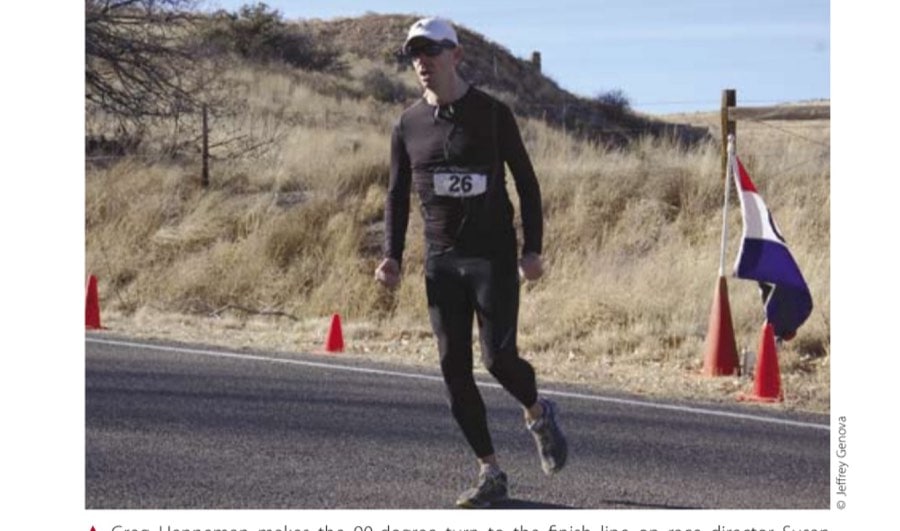
With this realization, I took the 90-degree turn off the county road and back onto Susan Reynolds’s property, where this journey had begun. As I crossed the finish line, I slapped the sign over my head with all of my remaining strength, expressing a mixture of frustration, exhilaration, and success.
The first person I saw on the other side of the finish line was Susan. Although I smelled horrible and 43 people had finished before me, she welcomed me with a warm embrace and offered congratulations as if I had finished first. It was not until she handed me my certificate that I knew my finish time: 9 hours, 11 minutes, and 34 seconds.
I was initially disappointed that I did not achieve my arbitrary goal of nine hours. In reality, 11 minutes out of nine hours is a rather insignificant amount of time. But more important, by completing this race, I accomplished something that I never thought I would be capable of doing. As I ran my hand over the back of my salty neck, I realized that I had joined a special community of runners who do not define themselves by the time on the clock but, rather, by the joy of the journey.
Of course, outside of this ultra community, most people have thoughts about running that are similar to those I once held. Some of these people have accused me of being crazy, an allegation that I do not deny. In the weeks following the race,
▲ Greg Henneman makes the 90-degree turn to the finish line on race director Susan Reynolds’s property.
friends often asked why someone would want to run 38.5 miles. The answers to those questions are as numerous as the runners who double-tie their shoes while others sleep. Perhaps I run to discover what I am really made of, perhaps to prove that nothing is impossible, and perhaps for no particular reason at all. What I do know is that it was well worth it and that I could never have done it alone.
And what I learned from it A trail ultra has its ups and downs, and by that I don’t necessarily mean from a topographic standpoint. It’s easy to get spaced out in an ultra. It is important to watch for trail
markings. Not all off-course excursions are the fault of a race director who failed to mark the course. Sometimes the fault is our own. The sudden arrival of your cheering section can make all the difference in the world.
Ultrarunners are seldom bloodthirsty competitors. Although they try their best to do their best, they are a very tight-knit, easily accessible community that is embracing and encouraging. Fast or slow, you are one
with the community of runners. Race directors are special people whom we should thank for all the work and dedication they lavish on our sport. In addition, we should shower their wonderful volunteers with praise.
Although there are portions of trail ultras where we are literally alone, in ultramarathons we are never truly alone—never.
This article originally appeared in Marathon & Beyond, Vol. 15, No. 5 (2011).
← Browse the full M&B ArchiveMore like this
1,000+ stories from 19 years of Marathon & Beyond
The complete archive of the legendary long-distance journal — digitized and free to read.
