

My Most Unforgettable Ultramarathon (Vol. 16, No. 2)
CALICO, CALIFORNIA, January 20, 2008—The Calico Trail Run 50K, mile 17. Four years later, the words “mile 17” still mean for me the point at which it occurs to you that this thing, whatever it is, might not be worth it. It’s the crossroads and the low point rolled into one. It is the point where you most want to give up and the point where you have to decide not to. It’s amazing how many things, things that aren’t ultramarathons, have a mile 17.
In the beginning I wasn’t a born runner. I had made it through high school and college without ever joining a cross-country team or so much as taking up recreational jogging. But in my mid-20s, the metabolism of a hummingbird I had taken for granted had abandoned me, and all the hours I had spent tapping out novels on a keyboard— five books written before the first one was published—hadn’t exercised anything but my typing skills, leaving me bereft in a series of fluorescent-lit fitting rooms with a stack of ever-larger jeans.
Preferring a challenge to endless hours on an elliptical machine, I signed up for a 5K before I could run a mile. By the time spring turned to summer, I was hooked. The 5K became a 10K became a half-marathon became a full, and before I had even crossed the finish line of the 2007 LA Marathon, my first, I was thinking about running an ultra.
The romance of it appealed to me. It felt powerful to be able to cover seemingly inhuman distances on my own two feet. It felt primal to go off road and sprint into the mountains with the rattlesnakes and the coyotes. Leaving the ordered streets and prim sidewalks behind felt like going rogue. I liked saying to people I met at cocktail parties that I was going to run “an ultra,” a race so rarefied that almost none of them had heard of it.
Austin Baker
Besides, my knees were killing me. The constant pounding on hard asphalt for road races had resulted in chronic patello-femoral pain, the far-too-cavalierly named “runner’s knee.” I had spent weeks in physical therapy and hours with ice packs strapped to my legs, and I had purchased corrective braces and therapy equipment to use at home. By the time I ran the LA Marathon, I was doing almost an hour of physical therapy each night to counteract the pounding I did during the day.
I was logging hundreds of miles on the asphalt path that winds down the beach from the Pacific Palisades south through Santa Monica, which smells like money and fresh roast coffee, and past Venice, California, which smells more like patchouli and hot dogs. The path took me past the famed Muscle Beach, past a theme park on a pier, past homeless encampments and tattoo parlors and surfers and sailboats bobbing in the Pacific. I ran surrounded by flocks of pigeons that competed with the seagulls for discarded scraps and met the occasional pelican, enormous creatures above all that petty bickering. It was good for my soul, but my joints were paying the price.
By comparison, trail running was like bounding across pillow-top mattresses for 30 miles. Once I had switched my long runs to dirt and traded in flat bike paths and an ocean view for mountains with mule deer for company, all of my previous repetitive stress injuries, including the “runner’s knee,” melted away. My therapy equipment collected dust.
My body rejoiced. I had never been a fast runner, only a determined one, and the longer the distance, the more endurance and bullheadedness were prized over speed, which suited me just fine. I had found my sport.
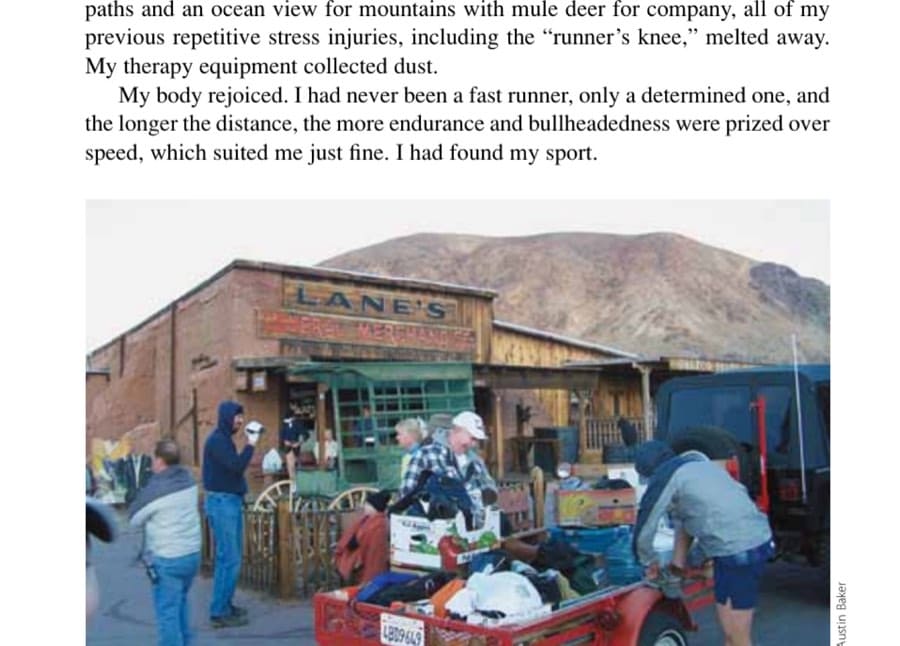
▲ Participant drop bags being loaded near the start line in the historic ghost town of Calico.
I wasn’t thinking about any of that at mile 17, though.
Sand, sand everywhere I had chosen this, my first ultra, specifically because it went straight through the Mojave Desert, beginning and ending at a ghost town called Calico, a former silver-mining hub founded in 1881 and completely abandoned by 1907, which is now a historical landmark.
Sure, the release I had to sign was more specific than most. Runners are used to being warned that our death on the course would be no one’s fault but our own, that our heirs were forfeiting their right to sue for our stupidity, that doctors should be consulted, and that failure to properly train for such a physically challenging endeavor was our own dang fault. But this particular release form went a step further, enumerating the various creatures and conditions I might find in such an inhospitable place. There were, for example, several kinds of rattlesnakes, including the western diamondback. Did I realize that? And don’t forget the Gila monsters (poisonous) and the tarantulas (also poisonous), plus the mountain lions (not poisonous—just big teeth).
Never mind all that, though. Running through high desert fed right into the romance of long-distance running. And it really wasn’t until mile 17 that it occurred to me that perhaps this wasn’t quite so romantic. In fact, I thought then, it was probably time to set myself down and give serious thought to the possibility that I was an unqualified idiot who deserved to die alone in the desert, snake-bitten and dehydrated, my corpse a snack mix for buzzards and coyotes. Mile 17 was the moment when the euphoria of “finally running an ultra” had worn off, when the thrill of the challenge morphed into the drudgery of 5 million steps, when my legs were tired and a look at my watch told me that most of the world—full of happy, intelligent, sensible people—was still asleep. Because I hadn’t just run 17 miles, which admittedly isn’t that far for us distance runners—I had run 17 miles through sand, which is very far indeed.
I hadn’t given sufficient thought to the fact that deserts are full of the stuff, which sounds ridiculous to me now. Of course, deserts are sandy. Anyone who has ever watched Saturday-morning cartoons knows this. I had been assured the night before by a race veteran that the sand was “hard packed” and, therefore, no big deal. We had been sitting around communal tables at the prerace spaghetti feed, and I was star struck to be sharing underseasoned food with these knowledgeable, sinewy men. (They did seem to be mostly men.) Looking back, I can only assume he was delirious. The sand was a very big deal. Running through it is like having weights around your ankles. By mile 17, my quads were calling for mercy.
The wind had also started to blow. I had just fought against the gale and through the sand to the crest of a hill—there are hills in the desert, contrary to
Austin Baker
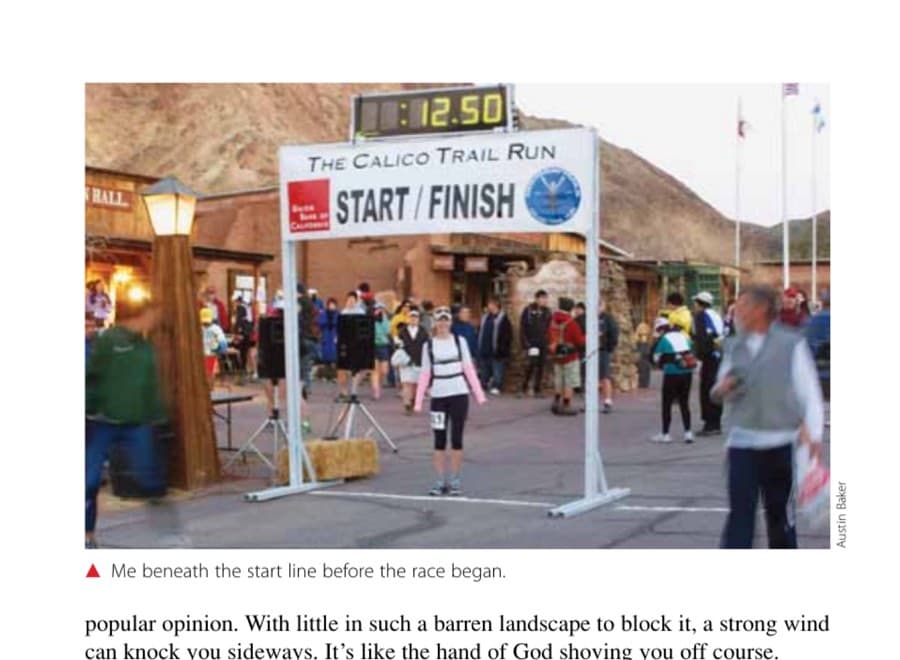
▲ Me beneath the start line before the race began.
popular opinion. With little in such a barren landscape to block it, a strong wind can knock you sideways. It’s like the hand of God shoving you off course. It was, to say the least, dispiriting, and I was verging on anger, both at myself and the elements, when I turned and came face to face with something much worse.
Facing the fear Less than two years before, my husband and I had hiked and then climbed to the summit of Half Dome in Yosemite National Park. Half Dome is one of the park’s most famous peaks, and the cable route is the most popular ascent. Six people have died on the route, and I came terribly close to being one of those.
It was one of the last weekends that year that park officials were going to allow climbers to summit. After this, rangers would come through and remove the metal cabling that hikers without their own climbing equipment use to make the last ascent. Those final 400 feet are more like rappelling than anything else, your upper body using the cables to pull yourself up and your feet providing the traction. Using the cables, it’s a Class 3 climb. Without them, it’s a Class 5, which includes the words “near vertical” and warns that unroped falls will likely lead to severe injury or death.
There were so many climbers ascending ahead of me that the wait to get on the cables was half an hour. I stood at the bottom of that ascent, craning my neck to look at the summit towering above me and the line of people heaving themselves
up. Toward the top, they looked like miniature action figures scaling the slick granite face. I remember watching and thinking, There are too many people on those cables. They weren’t meant to hold that kind of weight.
Mine was not the first common sense to be sacrificed at the altar of “too late to turn back now,” and it won’t, I’m afraid, be the last. I waited my turn amid the piles of discarded gloves left by other climbers and picked through by the new arrivals who, unlike me, hadn’t brought their own protection against the skinchewing metal cables.
The ascent, hand over hand, was uneventful. I sat on top of the highest point looking out over one of America’s most beautiful places. The park is nestled in the heart of the Sierra Nevada Mountains. There are granite peaks, thundering waterfalls, and giant sequoia groves that are home to trees thousands of years old. It is a place of such magnificence that, in an 1864 bill signed by President Lincoln, it was the first parkland set aside by the federal government for public use (although the first official “national park” was Yellowstone). It is a place that has inspired the likes of John Muir and Ansel Adams.
I wasn’t enjoying it. I was thinking about the descent on those cables and how much I wanted to get it over with. I joined the queue to go down, a mercifully shorter line, and took my place between my husband, who went down first, and an unknown male climber, who was above me.
Halfway down the granite face, one of the anchors that locked the metal cable into the rock failed. I was the only climber on that section, my husband having made it to the next anchor below and the stranger above also safe. Without the pole to hold the cable up, I was slammed against the granite face, hanging by my arms, my legs slipping out from under me. The strength in my hands was all that stood between me and a nearly 5,000-foot free fall to the valley floor, and my hands are not very strong.
I had two thoughts: 1. It was a good life while it lasted. 2. I have to make sure that when I fall, I don’t hit my husband and knock him loose on the way down. There were no safety systems. None of us were clipped in, which made the act of strength by the stranger above me all the more impressive. Hanging on with one arm to the cable, he reached down with the other, grabbed hold of the loose anchor, and reinserted it into the rock. With the cable fixed, I could regain purchase with my feet and take most of my body weight off my arms. I don’t remember the rest of the descent, only that I could not get down fast enough, and once I was on flat ground, the stranger was gone, leaving my professions of gratitude to die on my lips. (Since then, the park has recognized the safety
Austin Baker
▲ The final ascent up Half Dome in Yosemite, taken just before the climb that nearly resulted in my fall.
problems of the overcrowded cables and requires permits to climb, only so many of which are issued each day.) While my body was relatively unharmed, my mind was not. From that day to this, I have carried a deep fear of rocky descents. An overly steep trail crowded
with boulders can reduce me to tears, and that day at the Calico 50K, I had tired legs under me and ahead was a jagged split in the earth running down, down, down to the desert floor below. It was littered with sharp, loose rock and trail markers at a perilous angle.
I stood at the top like a small child terrified of stepping onto a mall escalator. Other runners went around me, hopping from rock to rock as they zigzagged to the bottom. Too far in to turn around, I whispered to myself, “Yes, you can. Yes, you can,” and started down, one slow and careful step at a time. I looked only at my feet, unable to bear the sight of what lay farther ahead. Soon that strategy, too, failed me. My pulse revved and a sheen of nervous sweat, more pungent than the cleansing perspiration of strenuous exercise, squeezed out of every pore. I sat down in the middle of the trail.
Another runner hopped around me, taking long, loping steps, even as the scree came loose and rolled out from under her shoes. “You OK?” she called out as she passed. “Fine,” I replied with forced cheer. “I’m just going down this way.”
And I did. I scooted all the way down on my butt. Three-quarters of the way down, I was met by a race volunteer coming up wearing a Marines sweatshirt. “Somebody who passed told me about you,” he said. “I’m just making sure you’re all right.”
Never better, I assured him, and went right on down, still on my heinie. I might have been exhausted and disheartened. I might have been terrified. I might have even been in the grips of a full-fledged panic attack and just a little bit humiliated, but I was not a quitter.
When I got to the bottom the same volunteer was waiting for me. “You’re OK?” “I’m OK.” I looked down at my feet. The first flat ground I had seen in half an hour was covered in spent bullet shells. Apparently, the area, usually uninhabited and far from any municipal codes, was often used by gun enthusiasts for shooting practice. It was good incentive to keep moving, and I was taking all the incentive I could get.
The shuffle step The miles ticked by. To entertain myself, I had spent the last few hours with an audiobook playing through my headphones. Audiobooks had been a lifesaver during those 25-plus-mile training runs, keeping me entertained and my mind on something other than the distance still to go. The desert was getting monotonous. Dignity fell away as miles and miles went by with not so much as a bush to disguise rest breaks.
“Just go ahead,” a male runner said to me as I scanned the empty horizon for a suitable pit stop. “I won’t look.” We certainly were all in it together then. It was during those brief stops that the release we had all signed came to mind: rattlers, scorpions, poisonous spiders.
While “mile 17” is the crossroads, “mile 29” is the point where you just dig in and hold on because no matter how terrible it is, you’ve gone this far. The audiobook that had been my companion became an annoyance, like a fly buzzing in my ear. I jammed my finger down on the stop button. My legs felt like lead. I knew I had slowed far below my goal pace. I wasn’t sure when, but I hadn’t planned to be out on the course nearly so long. I was shuffling as much as I was running. All of the shorter races I had run, sometimes even collecting hardware, had not prepared me for the soul stripping of a first ultra.
Years later, I still remember with excruciating detail the final miles, including that extra mile thrown in to make 31 miles into 32, which at the time felt like an injustice the likes of which should have been tried at The Hague.
The average finishing time that year was 6:30:31. Mine was 8:48:20. I was out on the course more than two hours longer than most. Only two other people out of 146 took longer to finish than I did. And you know what? Nobody asks about that. I went on to run other ultras, both 50K and 50 miles, and to achieve respectable times. No one is more impressed by those than this one. The only thing that matters to anyone, and years later to me, is that I finished. I put one foot in front of the other hundreds of thousands of times, even when I had to do it on my butt. I remember this when I’m in the middle of writing a book. Not every step is heroic, and not every word is brilliant, but if I just keep going, I will cut a path through the desert.
And what I learned from it 1. Each new distance is an entirely new event. A marathon is not “more or less” a 50K. There will be wholly new and unforeseen challenges. 2. Be prepared for the psychological low points. 3. Dignity is overrated. If you need to sit down on your butt and scoot down the incline, go ahead. No one is going to put an asterisk next to your race results for it. 4. Your time won’t matter to 99.9 percent of the people you know. 5. Redemption can always be found in the next race . . . or the one after that . . . or the one after that.
This article originally appeared in Marathon & Beyond, Vol. 16, No. 2 (2012).
← Browse the full M&B ArchiveMore like this
1,000+ stories from 19 years of Marathon & Beyond
The complete archive of the legendary long-distance journal — digitized and free to read.
