

My Most Unforgettable Year Of Marathon Running
HERE, THERE, & EVERYWHERE, 1989—Few runners can run one mile under 5:20, let alone string together 26 of them. This is what it takes to run a sub-2:20 marathon. In 1989, Americans ran 83 sub-2:20 marathons. Twelve of those were mine, setting a world record for most sub-2:20s in one year.
There was no plan set out to accomplish this goal. Until halfway through the year, I didn’t know that the record even existed. I can thank my friend and competitor Kjell-Erik Stahl from Sweden for creating it and setting me on a path that early in my running career I would have never imagined.
In 1980 I ran my first sub-2:20, qualifying for the Olympic Marathon Trials. Up to that point I had run almost a dozen marathons, mostly in the 2:22 to 2:23 range. A friend and coworker at Ford Motor Company persuaded me to start training seriously to break 2:20. At the time I thought I was training seriously.
He also suggested I pick a fast course that would guarantee qualifying. In 1980, the Mardi Gras Marathon had bragging rights as one of the fastest courses. It was a completely straight course and flat as a pancake over the Lake Pontchartrain Causeway, the longest bridge over water in the world—23.8 miles long. Twentythree years later, this race is still the best conditions I’ve ever run under. It had good competition and a strong tail wind. I not only broke 2:20, I smashed my best time with a 2:14:15. More important, it made me believe I could break 2:20 again.
That record-setting year, 1989, is still an anomaly when compared with my other sub-2:20 years. Over a 15-year span, I averaged five sub-2:20s a year and never more than six. Surprisingly, I clicked off only two in 1988.
To run 12 sub-2:20s in one year, not only do you need good weather conditions and great competition, but they must also go hand in hand with excellent training. In 1989 I averaged 14 miles a day with 11 days off for various reasons like travel. I totaled 5,124 miles. Also, I didn’t run marathons in February, August, or September.
Long before Bart Yasso coined the phrase “Yasso 800s,” I was cranking out 10 800s on the track. It never dawned on me that the average of those 10 would equate to my marathon time. It seems to hold true. My best 10 would start at 2:22 and cut down to 2:14. Many of my training partners could handle about half of these and then trail off. Usually the short rest of just 100 meters in between each interval would be their undoing. When I wasn’t racing, I would add another speed workout of 5 1-mile repeats, averaging 4:43.
Something about brutal Michigan Michigan has produced many great distance runners, such as Greg Meyer, Lisa Weidenbach, Herb Lindsey, Todd Williams, Dathan Ritzenhein, and many great runners from the Hansons-Brooks Distance Project. We aren’t blessed with the year-round great weather of California, but maybe it’s to our advantage. We are a hardy and determined lot that knows how to deal with difficult weather conditions. Just getting out the door on a blustery winter day conditions you to overcome all the thoughts that it would be easier to just sit inside and watch TV.
I’ve never really liked doing indoor track workouts, and 1989 was no different. Finding a facility that was available in the evening was never easy. Sometimes I crossed the border to Windsor University in Canada. In January I would
ad
usually manage to get a group of decent runners to work out. They would all try to hammer each other from the starting gate. I knew the group wouldn’t be around long if we kept this up, so I suggested each team member take a turn leading one of the intervals. This worked for a few months, but by March I was the only one still putting in the work.
Unlike some of the great training teams today, I wasn’t fortunate enough to have national-caliber athletes to train with. Instead I was in a running club that made running fun. The Redford Road Runners were a great group of people who were as much about socializing as running. I felt like part of a big family, and they changed my perspective. I was no longer just an elite runner. I could relate just as well to people who weren’t elites but who took their running seriously. Little did I know that they would help prepare me to be a race director of large fun runs.
Ford Motor Company also made it possible for me to train and compete. I worked in a building that had lockers, showers, and an excellent cafeteria. From my building I could run around many impeccably kept-up homes in Dearborn. I had a fairly busy job, but I had the flexibility to get in five to six miles during my lunch hour. For a number of years I was able to take numerous days off without pay, but this year wasn’t one of them; my boss made sure I had plenty of projects to work on.
Marathons weren’t the only races I ran in 1989. I competed in a variety of distances and set two national age records. At the Dexter Ann Arbor Half-Marathon, I set an age 37 record of 1:05:06. And a 24:04 gave me another record at the 8K Allen Park Street Fair race.
Houston—we have liftoff This was a new marathon for me on a course I wasn’t familiar with. I was encouraged to come to Houston by Kathy Molitor, a friend I met at the Rio Marathon. She went on to compete as a USA athlete in the Pan Am Games marathon in Indianapolis. She gave me a tour of the course and pointed out some beautiful fountains and old-money homes. I was most impressed by the finish at the George R. Brown convention center. I thought it was an ideal place to recuperate after the race. There was lots of room to pick up your gear, postrace treats, and awards, all in the confines of a beautiful, warm place. I used this idea for my own event in Detroit, the Fifth Third Turkey Trot on Thanksgiving Day. The wonderful thing about using a convention center is that it can accommodate large numbers of participants. The Trot has grown from 4,000 to 20,000 in just eight years, and we could not have done it without a convention center.
Houston was the slowest of my 12 sub-2:20s but probably required the most effort. December is never an ideal training month due to the holidays, and it’s hard to be disciplined when you have so many opportunities to attend fun parties. I chose Houston because other runners had told me how well it was organized,
not just for the course and weekend activities but also for bringing in great competition. I prefer running marathons with a good field of athletes. It’s much harder to run a fast race when you have to do all the work by yourself. Unfortunately, during the second half of the race I was left in no-man’s land. I had to keep telling myself to run smart. What I remember most about the race was saying a prayer to myself with two miles to go. I was close to a sub-2:20 and felt I deserved one for the effort I was putting in. So I made a request to give me this one. Result: 2:19:51, 18th place.
In January I got a call from Andy and Yolanda Rodriguez, directors of the New York City Marathon medical staff. I had met them years earlier through their daughter Gloria, an NYCM volunteer. We had traveled together to the Manila Marathon, a race I had won. They asked if I would be interested in accompanying them to the Barcelona Marathon. They would be there to help prepare the medical staff for the Olympics to be held in 1992. I jumped at the opportunity. We arrived in Barcelona several days early so that we could meet with some of the organizers. They graciously invited us to see some of the cultural activities and view some of the most unusual architecture in the world. You can’t go to Barcelona and miss some of Gaudi’s sculpture and especially La Sagrada Familia, a church that towers over the area.
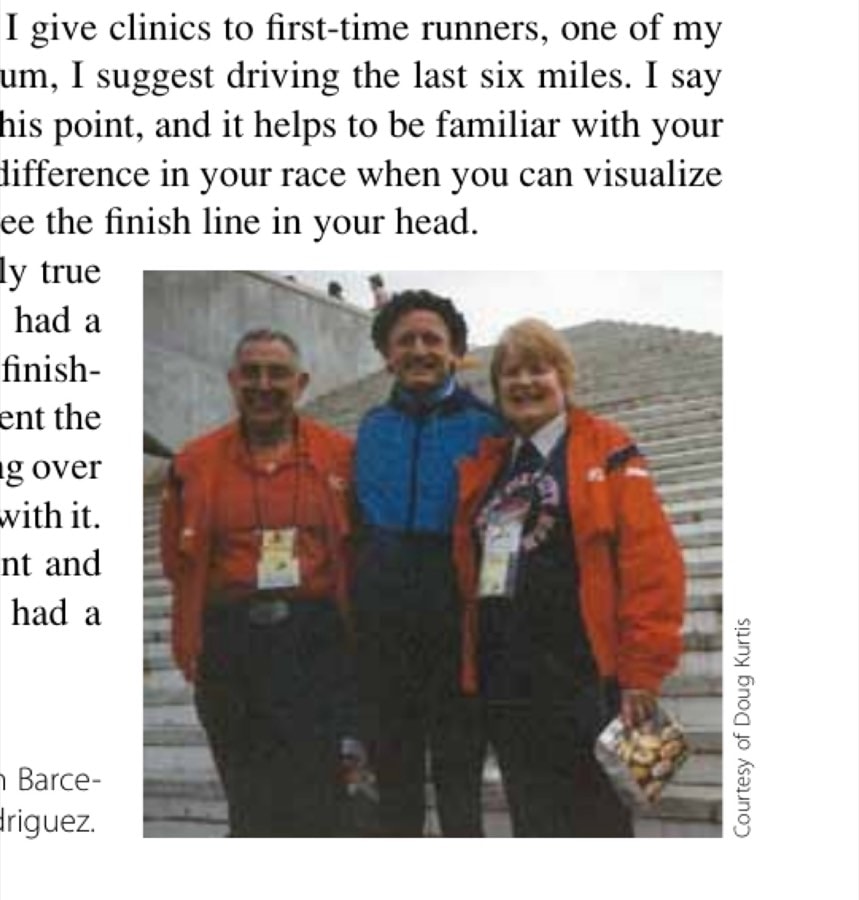
Going out early also gave me time to run the last six miles of the course, which had a few twists and turns. When I give clinics to first-time runners, one of my tips is see the course. At a minimum, I suggest driving the last six miles. I say this because we are most tired at this point, and it helps to be familiar with your surroundings. It can make a huge difference in your race when you can visualize where you are on the course and see the finish line in your head.
This turned out to be especially true for Barcelona. The last few miles had a number of twists and turns before finishing near the Olympic stadium. I spent the last few days before the race running over this section, so I was very familiar with it.
The field of athletes was decent and of similar caliber, so I thought I had a chance to do well. ▲
Wearing the winner’s laurel wreath in Barcelona, Spain, with Andy and Yolanda Rodriguez.
Courtesy of Doug Kurtis
Barcelona, Spain—making my friends look good
I ran a smart tactical race that put me in third place with a couple of miles to go. The leaders were never more than 10 yards ahead of me for most of race. I felt good but couldn’t judge the effort of my competitors. I took the risk to push past them through those last tricky turns and tried to get out of their line of sight. By the time they realized the finish line was in sight, it was too late to catch me. My time spent on the course paid off, and I won by just six seconds. Result: 2:16:37, first place.
New Jersey Waterfront Marathon—US National Championships I really don’t remember a lot about my race. Almost 3,000 runners were expected to start from the midspan of the George Washington Bridge and finish in Meadowlands on the 50-yard line of the New York Giants football stadium. I had run some of the course the year before as part of the Olympic Trials. This time it was the US National Championships with some significant prize money.
Things had changed so much from the ’70s and early ’80s when I first started running marathons. I remember running a number of sub-2:20s at the Boston Marathon and coming home with just a tiny medal. When the prize money finally arrived at marathons, I was smart about picking ones that gave me a reasonable chance for success. As a marketing graduate, I never understood why the adidas reps wanted me to compete in just the major marathons like New York City. Sure, they had great crowds of spectators, but I would get little recognition finishing beyond the top 10. I preferred being the big fish in a little pond where I was more likely to have my name and sponsor logo appearing in the local paper.
Getting free travel expenses was nice, but I could more than make up for that by paying my own way to a marathon that had decent prize money. By 1989 I had switched shoe sponsorship to Nike and my rep, Alberto Salazar, encouraged me to run any marathon I was interested in.
I returned to New Jersey in part because I was impressed with the organization. The organizers went all out with the pomp and circumstance, which included a prerace dinner circus theme and performances from a local symphony orchestra. This was a fun place to run, and the course was interesting.
My place showed the competitiveness of the event. The field of high-quality athletes definitely helped me break 2:20. Result: 2:17:42, 10th place.
Ottawa, Ontario Marathon—running along the river Like an odd movie you order from Netflix, I had to look at the details to remember why I chose this particular race.
Two years earlier, I ran a 2:19:59 on the same course. I finished second to Peter Maher, a two-time Olympian who would also beat me in Detroit years later. I returned in better form and thought I had a chance to win. I ran almost two minutes faster and still got second.
At one point in my career, I had the world record for most victories, a record that has been legitimately broken by Chuck Engle, who has currently won 150 marathons. But I’ve also finished second 20 times in marathons. There is nothing that drives you crazier than running in second place. My friends like to tease me by saying I was the first loser. First place gets all the glory, but I’ve never been one to complain about my performance. I usually cross the finish line knowing I’ve run the best I could do on the day. I was fortunate to be one of the most consistent performers in the world.
I do remember three things about Ottawa. First, there was the gorgeous bronze statue of Terry Fox in the middle of town that was very inspirational. Second, the Parliament Peace Tower clock next to my hotel, whose bells rang every 15 minutes, really helped me sleep the night before the race. Yeah, right!
Third, I thought the course, which ran along the Rideau River, was unique in that during the winter it provided a way for locals to actually skate into work. Result: 2:18:06, second place.
$6.95/$9.00 CDN
10 Best Ultras for First-Timers Toughest & Easiest Marathons July/August 2013 • Volume 17, Issue 4
Reflections on Boston 2013 Racing the Kalahari Most Important Races & Runners in History
10 IS 0
SU th E
Daytime phone ________________________________ 1 year Digital—$32.95 2 year Digital—$61.00 3 year Digital—$90.00
1 year (6 issues) $36.95—U.S.; $57—foreign; $54.60*—Canada 2 years (12 issues) $69—U.S.; $109—foreign; $107.10*—Canada 3 years (18 issues) $101—U.S.; $161—foreign; $160.65*—Canada International and Canada issues air mailed. *includes 5% GST
Cleveland Marathon—a long history of success I’ve always had a lot of success in Cleveland. I finished second twice, once to former Olympian Tony Sandoval. Tony caught me with a couple of miles to go and asked how I was doing. I said just fine. Then a friend of his on the sidelines yelled out to him, “Win it,” and he took off on me. I missed a 2:14 by two seconds.
Jack Staph and his crew always put on a first-class event and invited me to all the fun pre- and postrace events. I loved it when the host hotel was located at the Ritz Carlton. I’ll never forget watching a huge freighter negotiating a sharp right turn on the river just below the window of my room. I was almost late getting to the start line because I was waiting to see if it was going to make it. The following year, I brought my kids to watch the race. It was a good thing I had my sister there to watch them because we woke up to discover my youngest son was completely covered with chicken pox.
Most years there was usually a convention going on at the hotels where we stayed. I thought the bowlers’ convention would be the rowdiest, but they were all in bed by 10 o’clock. It was the ladies from Weight Watchers who were the partiers. They were running down the hallways at 2:00 a.m., knocking on each other’s doors and trying to take photos of each other in their pajamas. I had to walk out of my room to ask that they tone it down.
I’ve competed in Cleveland 10 times and completed half of those under 2:20. This year it was a bit warm, and I drank a little too much electrolyte drink. At mile 25, I finally succumbed to what my stomach had been telling me for the last five miles. This may have been the first time I ever threw up during a race. Result: 2:16:19, fourth place.
Grandma’s Marathon, Duluth—confirming my hotel This race was really the highlight of my year. It was the second of a dozen Grandma’s Marathons. I was ready for a great race. A friend of mine was staying at a unique hotel called Fitgers. It is an old brewery converted into a hotel and shops. His room had a great view of Lake Superior, and the bed was set up in a loft. After seeing his room, I told race director Scott Keenan that if I won the marathon I wanted to stay there the next year. I’ve stayed at Fitgers ever since. The management wouldn’t want me to stay anywhere else.
But this year I shared a room with my nemesis, Stahl. He’s the greatest marathoner to come out of Sweden. Although he had major sponsors, I found it funny that he wore a favorite pair of shorts that was threadbare and tattered. I wanted to toss them in the garbage can, but he insisted they brought him good luck. At the starting line, he kept smiling at me, so I finally asked what was up. He pointed to the holes in the heels of his socks and said that they were lucky for him, too. I couldn’t stop laughing until the gun went off.
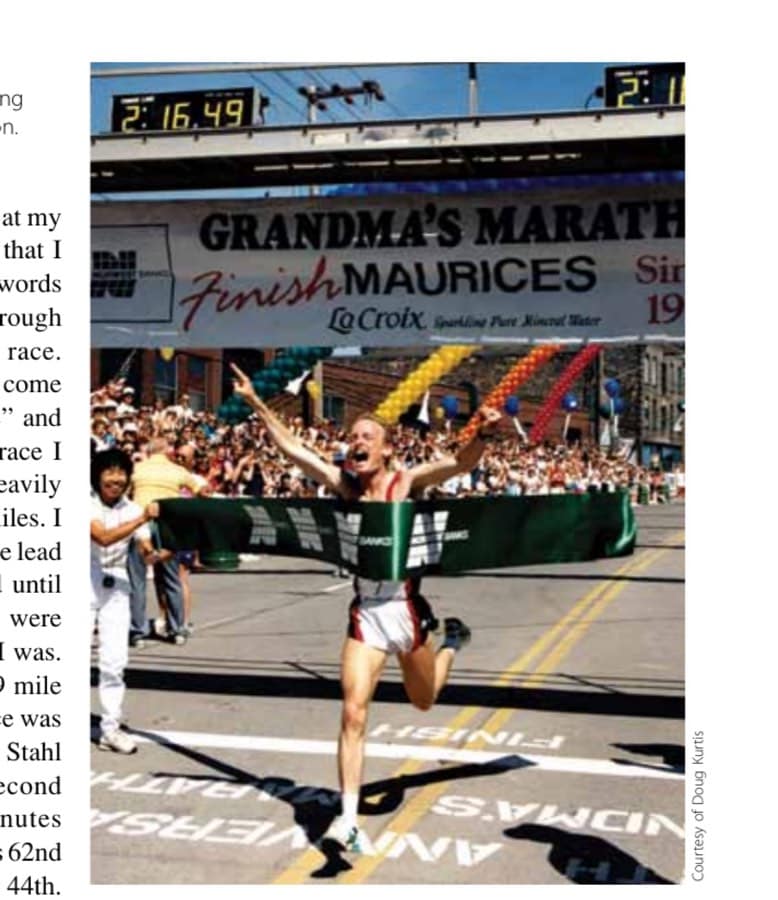
I tell runners at my occasional talks that I use mantras or words that help me through portions of the race. Two that usually come up are “patience” and “relax.” In this race I relied on them heavily for the first 19 miles. I just sat in with the lead pack and waited until I felt the others were more tired than I was. I threw in a 5:09 mile at 19, and the race was essentially over. Stahl would finish second almost two minutes behind. It was his 62nd sub-2:20 and my 44th. After the race, I asked him what was the most he had done in one year. When he told me he had done 11, I knew there was a chance I could break it. At least I would make the attempt. Result: 2:16:49, first place.
Emerald City Marathon—beating the train to #5 This was my fifth Emerald City Marathon and would be my fifth straight victory. Twice I had a runner leave me midway through the race and put me so far behind that I couldn’t see him. And twice I caught them in just about the same spot at a train track between mile 22 and 23. One of them was former Michigan standout Bill Donakowski. This time my only real challenge was a train that was crossing the track in the same spot. As I got closer, I kept wondering what I would be able to do. With my continued luck, the caboose cleared the course just as I arrived. While it’s fun to win, it’s tough to do it alone, especially at a sub-2:20 pace. All I had were a few friends on the course and a lead cyclist. Seattle native Mark Winder ran his best but finished 14 minutes behind me.
Courtesy of Doug Kurtis
▲
Showing some excitement—winning Grandma’s Marathon.
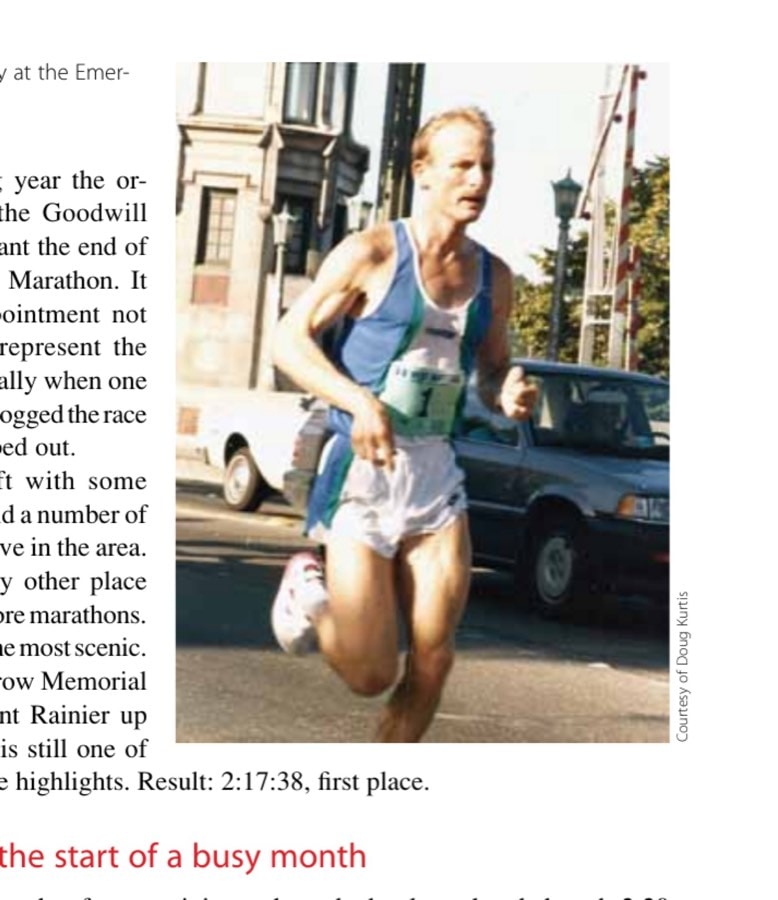
The following year the organizers put on the Goodwill Games, and it meant the end of the Emerald City Marathon. It was a big disappointment not to be chosen to represent the USA team, especially when one member basically jogged the race and another dropped out. But I was left with some great memories and a number of friends who still live in the area. Detroit is the only other place where I’ve won more marathons. It was also one of the most scenic. Crossing the Murrow Memorial Bridge with Mount Rainier up above the clouds is still one of my all-time course highlights. Result: 2:17:38, first place.
Twin Cities—the start of a busy month I had a couple of months of great training and now had a plan to break the sub-2:20 record. Minneapolis/St. Paul has a reputation as being a first-class organization with a pretty course and top-notch competition. Like other sports, I’ve discovered that you perform well at certain places better than others. Running at home always has many advantages. Personally, I love downhill courses like Boston. In 1994 I ran my final sub-2:20 on this course.
My performances at Twin Cities seemed like a lot more work than some of the others. One year I ran a good portion of the race with Brad Hawthorne. He and I had a number of duels, and his younger legs usually won out. But I was impressed that he was always willing to share the workload. One year we were running together at mile 18 when masters winner Antoni Niemczak of Poland came flying by us. He made a wave with his hand, almost taunting us as he suggested we run with him. Brad and I responded at almost the exact same moment with a wave of our finger. This wasn’t my first run-in with Antoni. He had been banned twice for taking banned substances. He looked so fresh going by us that I thought he must have found a way to cut the course. At another marathon we got
Courtesy of Doug Kurtis
▲
En route to victory at the Emerald City Marathon.
into a shoving match when I suggested I would disqualify him if he kept cutting all the corners off at each turn. A note to Twin Cities finishers: if you haven’t visited the inside of St. Paul’s Cathedral near the finish line, it’s worth a walk over to witness the spectacular architecture and sculpture inside. Result: 2:18:15, 11th place.
Detroit Free Press—first to three-peat
Courtesy of Doug Kurtis
I love running my hometown marathon. I’ve run this marathon 17 times. (FYI: my wife has run this marathon 18 times.) In 1999, I became its race director and completely changed its future. After seeing what was possible at other marathons around the world, I made some major changes. In my first year, I moved the start from Windsor, Canada, to Detroit so that we could eliminate busing runners early in the morning. To do this, I had to get the approval of the Ambassador Bridge Company to let the runners cross their bridge. After six months of bugging them, they knew I wasn’t going away. The sunrise as the runners cross into Canada has been one of the race’s top selling points. As a bonus, I was able to bring the runners into Tiger Stadium for the finish line. This would be one of the last major sporting events in Tiger Stadium. The course also crosses back into the USA via a one-mile underwater tunnel, making it one of the most distinctive marathons in the world.
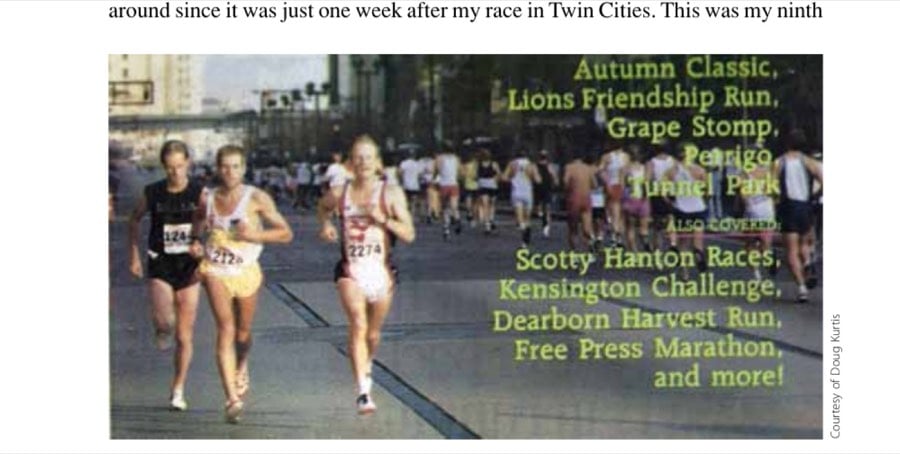
In 1989, I knew the course like the back of my hand, and I had tremendous support from my family and local runners. Canadian Rick Mannen had finished second behind me the year before and must have thought he had a shot this time around since it was just one week after my race in Twin Cities. This was my ninth
▲ Getting ready to make my move on Rick Mannen in the Detroit Free Press Marathon.
marathon this year. Mannen said that he had run four marathons the year before and he was tired all the time. My training was all about learning to run tired. It seemed that the more I ran, the more confident and relaxed I would be at race time. The press called me “rubber-band man” because of my ability to snap back after each race. More important to me was seeing the paper’s headlines as the first three-peat champion. After finishing second three times, I was on a roll in Detroit. I went on to win it six straight times. To date, no other male runner has won it more than twice. Notch number nine was on this year’s post. Result: 2:17:34, first place.
Chicago—learning to relax One thing that has stayed with me from this race occurred during mile three. I was running past a shoe rep who noticed that I was holding my arms up too high. He yelled out, “Relax the arms!” Now I think about this throughout many of my marathons.
During Olympic Trials qualifying time, I often had a swarm of runners hanging onto me. They knew how consistent I had been, and they looked at me as their ticket to the Trials. I usually felt flattered. More important, it’s a lot easier to run fast when you have good competition around you. Many of these runners were chasing their first sub-2:20. This would be my third in a month. Acquaintances would sometimes comment that if I ran just a few marathons, I would run much faster times. Running faster wasn’t important to me. I had found my niche and much preferred the opportunity to travel to many great places rather than spend most of my time just training. I found competing fun and still do.
Large races like Chicago provide a greater opportunity to have someone to race with. Just walking around downtown Chicago is inspiring. I’m not one to sit around in my room waiting for the race. I suppose you would say I can’t relax. But I like visiting museums and shopping. Plus it’s fun walking around the expo and meeting other runners.
At major races like Chicago, the elite runners are often given special hospitality: snacks, drinks, and massage. I took advantage of the free massage, but I’m glad I went in two days before the race. Usually, therapists are pretty good about making it light and easy. I had to keep telling this therapist to back off. She hurt me enough that I was sore the next day. Fortunately, I was fine once I had warmed up before the race.
I know many runners who use the first few miles of the marathon as their warm-up. This might make sense if you are prone to going out too fast. I usually need a couple of miles of brisk running and some minimal stretching to be able to start out at 5:20 pace, even more so if the temperatures are cold since I keep my uniform as light as possible. I’m still surprised at how many runners I see who are overdressed. Most runners’ body temperatures rise above 100 degrees
once they are warmed up. Extra clothing is just a receptacle for holding water that weighs you down and makes you less comfortable. I was fortunate to have decent weather conditions for all of my races in 1989. Chicago was no exception, and I took advantage of it. Number 10 continued to build my confidence that I could break the record. Result: 2:18:31, 12th.
Columbus—in the zone If you looked at a 1989 calendar, you would see that this was actually my fourth sub-2:20 in five weeks. It was a perfect day to run, a little chilly at the start but ideal by midway. One of Michigan’s finest runners, Paul Aufdemberge (whom I would coach a few years later), came upon me at about the 15-mile mark. I remember seeing him holding his gloves in his hand. I told him not to save them and that I would buy him another pair. So he tossed them and took off on me. I wished him well. At mile 23, however, I was cruising right by him and on my way to tying Stahl’s record.
When I give motivational talks to first-time marathoners, one tip I offer is to be prepared for your photograph at the finish line. How often do you see runners stopping their watch as they cross the finish line? I tell runners to practice smiling with their hands up in the air at the finish line in shorter races so they are ready to capture their first marathon finish in the best possible way.
I don’t understand why so many winners of a race look so blasé when they cross the finish line tape. For me, winning a race is a big deal. I’m in the moment and excited as can be to have the opportunity.
I couldn’t win Columbus, but I put up two fingers representing “11” when I crossed the line. It was very exciting. Result: 2:18:14, 15th place.
Bangkok—a premonition Bangkok was one of my favorite overseas marathons. Culturally, it’s one of the most interesting places I’ve visited: floating markets, dramatic temples, alligator wrestling, and elephant rides. My hosts did everything to make my trip special and distinctive. They called it the land of smiles.
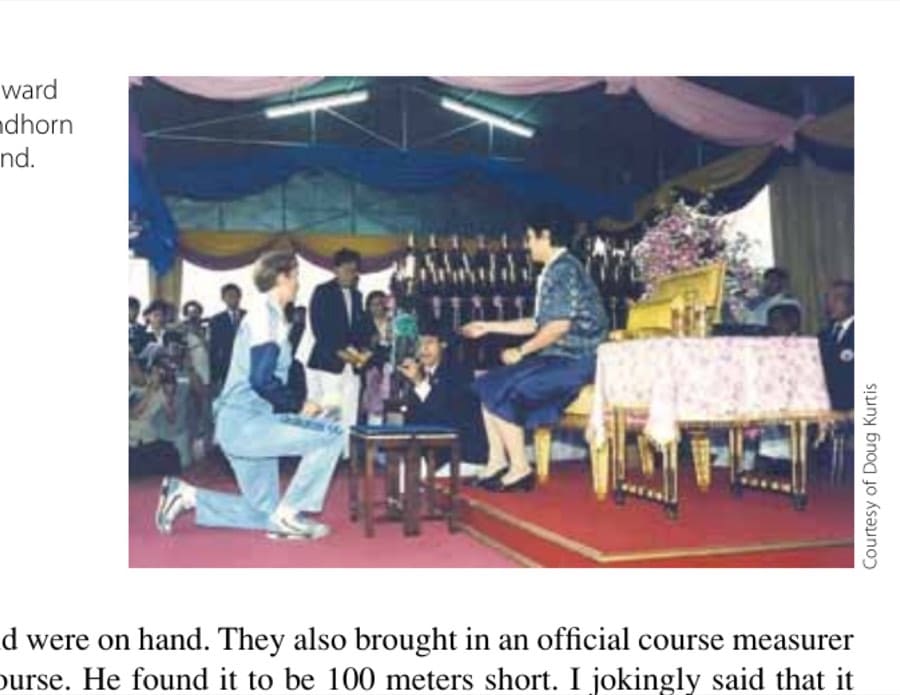
This was my third trip to Bangkok. The year before was King Bhumibol Adulyadej’s 60th birthday, and we were able to finish the race on what was the official opening of the Kanchanaphisek Bridge, a beautiful cable-stayed bridge. What was really unforgettable was receiving our award from Princess Sirindhorn. Before kneeling at her throne, we were given instructions on how to present ourselves to her. As an example, you never turn your back on a princess. You always back away. After finishing second twice (does this sound familiar?) to drug cheat Eddy Hellebuyck, I finally had an honest opportunity to win. This year was the Association of International Marathons (AIMS) convention. All of the top race directors from
Courtesy of Doug Kurtis
▲
Receiving my award from Princess Sirindhorn in Bangkok, Thailand.
around the world were on hand. They also brought in an official course measurer to certify the course. He found it to be 100 meters short. I jokingly said that it would probably cost me a sub-2:20. The temperatures were always so hot that I really wasn’t expecting to break the barrier. But with just two kilometers to go, people in the lead press truck started yelling at me that I had a chance to break the record. I was so focused on just winning the race that I didn’t really make the conversion from kilometers to miles to have a sense that I was only 15 seconds off, about 100 meters short. Still, I had already made plans for one more shot at the record. Result: 2:20:15, first place.
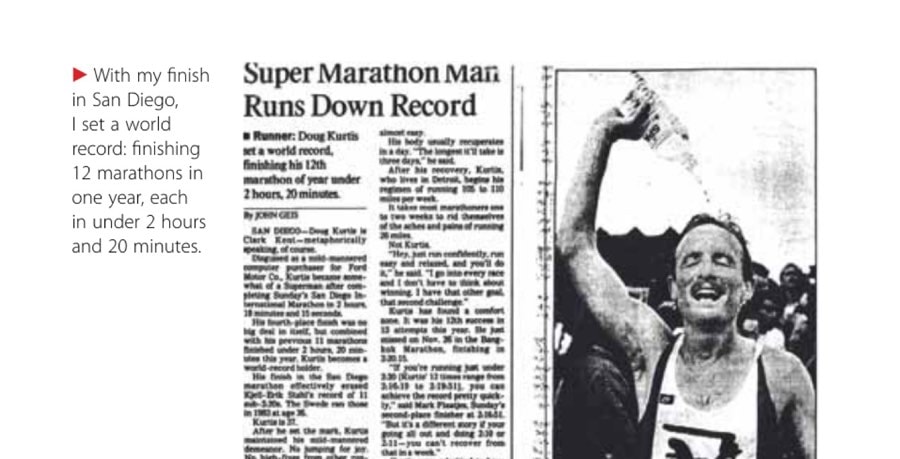
San Diego—almost didn’t happen Back at work from Bangkok, I asked my boss at Ford Motor for one day off, without pay, to chase the world record. Throughout most of my career at Ford, I was blessed with great bosses who understood my running opportunities. But this year, that wasn’t the case. No matter how much work he piled on, it was never going to be good enough for him. Telling me I couldn’t pursue a world record was his chance to step on me. Fortunately, his executive was a former runner and someone who knew how hard I worked. So I went to him with my plight, and he told me to ignore my boss’s decision. A few weeks later he found me a new position and an awesome boss.
The race couldn’t have been set up any better. I ran with the top three runners through the halfway point and felt pretty comfortable and confident that I could break Stahl’s record. There was no point in chasing the leaders when they picked up the pace. I wasn’t going to take any chances of blowing up. By halfway, I was right where I wanted to be. Some runners think that if they are able to run ahead of the split times, they will reach their goal time. I call that “time in the bank.” But it usually doesn’t work out well. I use what I call “energy in the bank,” finding
Courtesy of Doug Kurtis
▲
With my finish in San Diego, I set a world record: finishing 12 marathons in one year, each in under 2 hours and 20 minutes.
a pace that feels right within yourself and saving energy for the last miles when most runners feel tired. I spent an entire year running marathons without a watch, learning how to focus on my body, not my splits. Even when I wear a watch, I pick a few mile markers to gauge where I am. In San Diego, I knew I had to hit 2:08 at mile 24 to be able to break 2:20. I had two minutes to spare, and I cruised to a new world record. This was my 50th sub-2:20, and it put me a dozen behind Stahl’s career total. It would be another record to chase while I still had the ability. Result: 2:18:15, fourth place.
And what I learned from it You sometimes hear about professional athletes being “in the zone.” It’s hard to explain how you get there. There are many things that come into play: experience, motivation, fitness, confidence, and the right opportunities. If athletes knew how to make it happen, we would do it all the time. It’s a rare circumstance, and I was fortunate to have a once-in-a-lifetime year in the zone.
In 1974, when I ran my first marathon (Boston—but that’s another story), I thought I would never run another one. When I ran my first sub-2:20, I was happy just to qualify for the Olympic Trials. To set a world record seemed like an impossible dream. I never thought of myself as a Don Quixote. To me, realizing dreams come from many things, such as hard work, the blessing of physical skills, a bit of luck, and being able to view life and commitments as fortunate circumstances. Very few people have the chance to set a world record. I managed to set three. Philosophers say it’s all about the journey. I would agree. Once you set a record, it’s time to move on. Someone will eventually break your record, so all you really have is the fact that you know you broke someone else’s record. You set a new bar for the next person to focus on. What can’t be taken away is your achievement. When someone writes my obituary, I hope this question is asked: did he have passion? How do you accomplish significant things without it? As a runner, writer, and race director, I’ve experienced a lot of success. Talent and hard work help to get you there, but passion puts you on a whole different level. Without it I could not have set a world record.
Doug Kurtis’s Sub-2:20s 1989 Date
Marathon #
City
Pl
Time
Sub #
1/15
87
HOUSTON
18
2:19:51
39
3/19
88
BARCELONA
1
2:16:37
40
4/30
89
NEW JERSEY
10
2:17:42
41
5/14
90
OTTAWA
2
2:18:06
42
5/21
91
CLEVELAND
4
2:16:19
43
6/17
92
DULUTH
1
2:16:49
44
17
7/23
93
SEATTLE
1
2:17:38
45
18
10/8
94
ST. PAUL
11
2:18:15
46
10/15
95
DETROIT
1
2:17:34
47
10/29
96
CHICAGO
12
2:18:31
48
11/12
97
COLUMBUS
15
2:18:14
49
11/26 12/10
98 99
BANGKOK SAN DIEGO
1 4
2:20:15 2:18:15
50
Win 16
19
20
Note: Doug Kurtis currently holds the world record for the most career sub-2:20s, with 76.
This article originally appeared in Marathon & Beyond, Vol. 17, No. 5 (2013).
← Browse the full M&B ArchiveMore like this
1,000+ stories from 19 years of Marathon & Beyond
The complete archive of the legendary long-distance journal — digitized and free to read.
