

My Workout Friend
This story is about the very best workout buddy I have ever had. It started like this: The weekend was hot. The temperature was 100-plus degrees. I spent Saturday on the Olympic Training Center’s archery range. I was shooting my bow in the state games and was standing in the hot sun all day. I was fried and boiled, red, burned, and hot.
Sunday is my long-run day, and the plan was for a three-hour run. There was absolutely no way I was going to put my poor parboiled body through another day in the sun. I found my free gym pass and was off for a three-hour run on a treadmill in a nice, cool gym.
As I walked upstairs to the treadmills, I noticed a person behind me heading for the same equipment. I circled around the treadmills and chose one farther down the line so the fellow or gal behind me could have first pick. I assumed the person walking behind me was on the treadmill beside me.
When I prepare to mount the treadmill beast, I am all business. I wear my trail-running pack, complete with water bottles and a Walkman. I am focused and don’t look around. I prepare the music and start to walk and then run. I am serious. I have very poor eyesight, no side vision, and must look straight ahead when running on a treadmill or I will fly off the back or sides.
I started to run. The music is Yanni. I run. I feel good. Out of the corner of my eye, I see the person next to me is running very well. I see perfect posture and form. I am impressed. Time passes. After 45 minutes of running fast and slow to the music (I think of them as Yanni intervals), I have to pee. I entertain the idea of asking the person next to me to watch my stuff while I run downstairs. No. I will keep running until that person stops. No one stays on the treadmill as long as I do. I am woman. See me run. I am on fire, running very fast and strong. The person next to me just keeps on running.
I start to plan a social contact with this runner. Maybe we can get a snack or health drink after our runs. I amuse myself with conversations we could have.
Obviously, this person is a real runner. This person must run marathons and ultramarathons like me, perhaps a running soul mate. After an hour of running, the treadmill comes to a stop and must be restarted. I am concentrating on restarting and getting back into the groove and notice the person next to me is similarly engaged. No time to pee. We continue running. Now it is a matter of pride. I will not stop until this person next to me stops. I run harder and faster. The person beside me responds. We have a competition. Fun. I am sweating and having a grand workout.
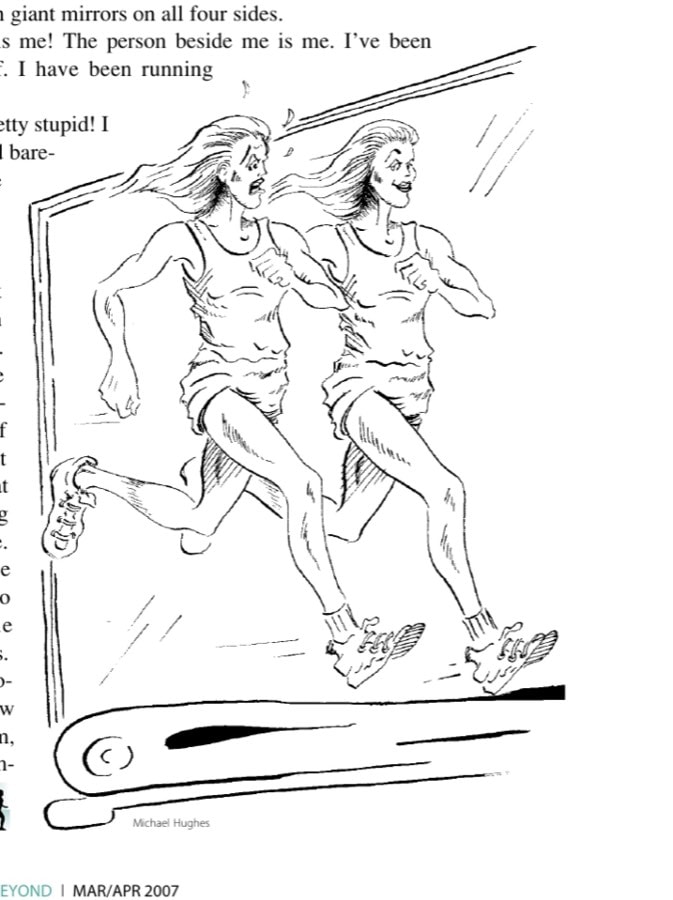
Finally after an hour and 50 minutes, I must stop and run down to the bathroom. I stop quickly and jump off the treadmill (not an excellent idea, by the way) and stagger and reel away. I turn to glance at my training partner, and I see a huge square pillar with giant mirrors on all four sides.
The partner is me! The person beside me is me. I’ve been admiring myself. I have been running against myself. Boy, I feel pretty stupid! I start to laugh and barely make it to the bathroom. I have never laughed so hard at myself! I stagger back upstairs to finish my three hours. Now I have the giggles. The remaining hour of running is just not the same now that I know my running partner is only me. I finish the three hours and get to laugh about the situation for days. Now I tell people I met a new friend at the gym, and she was the image of me! Michael Hughes
This article originally appeared in Marathon & Beyond, Vol. 11, No. 2 (2007).
← Browse the full M&B ArchiveMore like this
1,000+ stories from 19 years of Marathon & Beyond
The complete archive of the legendary long-distance journal — digitized and free to read.
