

On The Road With Barry Lewis
You could do worse than to be on the road with Barry Lewis. A lot worse. In fact, you would be hard pressed to find a better, easier traveling companion. Readers of Marathon & Beyond know Lewis to be a smart, reflective, and wise writer, not to mention just plain good at his craft. Racers of ultramarathons know that he’s fast—fast and tough as all get-out.
But if you really want to get to know a person, want to understand him and see how he thinks, what he cares about, who he is, try spending a week together, running what is perhaps the world’s most grueling race.
I first met Lewis in the Delhi airport. Along with a handful of other journalists, we had been brought to India to cover the Himalayan 100 Mile Stage Race. There were four of us American writers, a South African, a Brit, and an Austrian. We four Americans had all, unwittingly, been on the same flight from JKF to Delhi.
I saw the other two first and figured that they were probably there for the race. I saw a tall, fit man with a yellow Lance Armstrong “Livestrong” bracelet, reckoned that he, too, was to be part of my posse.
Our first encounter took me aback. Dave was working for The Washington Post, Steve for The Washington Times. Good, fine. Then I heard the tall fit guy say that he was here for Marathon & Beyond. Excuse me? I was here to write for Marathon & Beyond.
My primary assignment was from Running Times, but I had talked to Marathon & Beyond’s editor, Rich Benyo, who explained that if Barry Lewis—who had spent the last year writing the “On the Road” column—didn’t go, which, he later said, looked like it was the case, I could write the story.
Oh. So I had finally met Barry Lewis. We recognized each other’s bylines. And then we shared a laugh about how our beloved mutual editor signs off on his e-mails to those of us who send him lots of words. It was to be the first of many bouts of laughter.
THE LAST NIGHT OF COMFORT, AND A SHORT ONE AT THAT
© Barry Lewis
We were taken, individually, in separate cars, to a fancy hotel at 2:00 A.M., only to be awakened early the next morning for a flight to Bagdogra. On the plane, Lewis sat with Sean from Runner’s World, South Africa. Sean talked mightily. He
had done his homework, and when I passed their seats en route to the bathroom they stopped me, wanting to point out the mountains whose names Sean effortlessly pronounced: Kanchenjunga, Lhotse, Makalu, and of course, Everest. They
tried to train my eyes, to get me to focus, but I saw only clouds. I am often not the most perspicacious; even the highest mountains in the world can escape my notice. The race promised unparalleled views of these big boys; I figured I would
see them eventually. At the tiny airport in the northeastern part of India, nestled between Nepal, Bangladesh, and Tibet, we picked up two more runners, 20-something British guys, and we all loaded onto a bus. After a couple of miles of bumpy road, dodging
cars, trucks, cows, pigs, goats, and children, one of the Brits asked the driver if we could ride on the roof. He had done this when he had traveled before through Asia; he said it was the way to go.
We scrambled up and spent the next hour perched on the metal rack, dodging trees and electric lines. It was a wild ride—a butt-hurting, kidney-rattling preview of the trip to come.
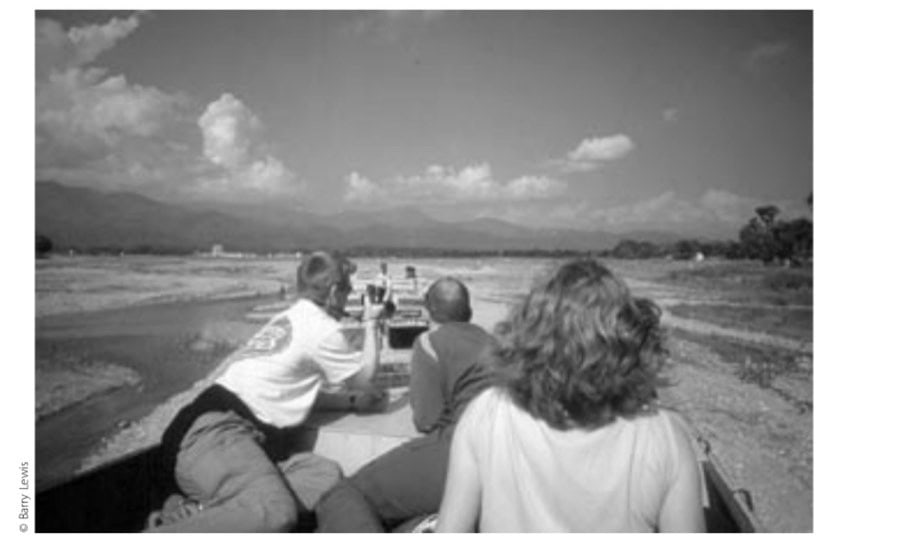
The view from the top of the bus (and of the back of the author’s head).
We were a multinational group—39 runners from 12 countries, with a handful of nonrunning journalists. It was easy to notice the superficial, the stereotypical differences among us. Indian English takes some getting used to, everything being, as it is, stated in the declarative: “You are enjoying this nice meal and you will be showing up on time to get in the jeep when you are finished eating in five minutes.” The Brits, comfortably wearing the legacy of imperialism, have the luxury of understatement and often undercut their own assertions: “Well, running 100 miles is rather hard on the body, isn’t it?” “Isn’t it?” appears as frequently as we Yanks use “You know?” The Austrians are silent and aloof; when they speak it is without humility. The singular Dane waxed melancholic, a dyspeptic Hamlet.
Lewis, I learned, is Canadian. It made sense. He did not show the American bluster that so often defines us. He was polite and reserved, while always friendly, always smiling. And always moving. It is one of the first things you notice about him: he is constantly in motion.
A PRERACE BRIEFING, WITH UNDERTONES OF POLITICS The prerace briefing was like every other prerace briefing, except for the warnings about stepping off the course on the left side and entering Nepal. India has the world’s largest volunteer army, and it is actively protecting the border against Maoist insurgents. We would be running on the road that formed the border, a liminal state, running on the borderlands. This felt different.
The next day a number of us took a bus, a field trip to Darjeeling on our one free day before the start of the race. Lewis and I sat together on the bus and told each other our stories, offered up bits of our lives, traded tales of races run, compared notes on people we both knew. We waited together at the station in Darjeeling to take the “Famous Toy Train.” I asked whether I could skip it. No, we were a group and as a group we moved. So we waited for the train.
There was a man sitting on the ground by the tracks. He had spread out a small cloth in front of him, and on it was a can of saffron-colored powder. I asked Lewis what he thought it was, what the man was doing there, and then he was gone—squatting in front of the guy, talking to him.
I followed. The man was saying unintelligible things in a language that was clearly not English, and Lewis was nodding and smiling and saying, “Yes, yes, I see.” And he seemed to, really, to see. And then the man dipped his finger in the powder and touched Lewis’s forehead, marking him, anointing him. He wrapped red string around Lewis’s wrist, again and again, winding it frantically, another bracelet next to the yellow band; and then he asked for money, and Lewis gave him 10 rupees, gave what he had.
I followed. The man marked my forehead, banded my wrist. Then he presented each of us a rock, round, a perfect orb, coated in the saffron-colored powder. The
men who were standing by, idling, watching the spectacle of a Western duo dipping a toe into Hindi culture, told us to put the rocks away. We boarded the train with rocks in our pockets. The holy man had given us each a certificate—he had asked our names and then filled them in, written an approximation of what he had heard. I showed the certificate to one of our guides and asked him, please, to read it for me. It was a receipt, he said, for a contribution to a church: a dedication to Shiva and Ram. I asked about the orange rock. He said it represented the god of wind; we had been given tokens of Godspeed. An auspicious start for a race, I thought. I told Lewis about this and warned, jovially, that he couldn’t use it in his article. It was mine.
A TRUE ROAD WARRIOR The encounter with the holy man was typical, emblematic of Barry Lewis. He has spent a lifetime living in worlds that were not his own—Israel, New Zealand, Siberia—and he manages, by dint of a warm and winning charm and an intense, seeking curiosity, to unearth the real stuff, the little stuff, the genius loci, the spirit of the place.
Cut off from home and family; united by a common purpose, a shared goal; a lack of creature comforts; extreme physical exertion; the relinquishing of civilian clothing for a uniform; no autonomy over meal and bedtimes; rebellion against the person in power, the commander—this has got to be what boot camp is like. This is how units are formed, how friendships are forged.
The first day of the race was the hardest run I have ever done. Climbing 6,000 feet on cobblestones as big as your head; asking yourself how much farther these 24 miles can go up and then realizing that these are the highest mountains in the world and they can go up a long damn way; legs cramping as the temperature dropped, climbing into a cloud—at nearly 12,000 feet it’s cold—this is what we do for fun? This is what we signed on for?
We reunited as a group in the food hut—a spare and Spartan wood building with a coal fire that radiated almost no heat. I planted myself in front of the fire and stayed there, shivering. I could not get warm. People piled clothes on me, and still I shivered.
Lewis sat down next to me and suggested hot chocolate. I demurred at first, then changed my mind. I held the small, warm mug in my frozen paws and drank. It helped. I settled in. The other runners milled around and complained. There was a lot of complaining. There was a lot of pooping and puking en route to this remote hut, perched on top of a peak that gave a heart-stopping view of the mother of all mountain ranges, the Himalayas. We saw Kanchenjunga nearby, no more than 50K away, looming large and icy. By contrast, Everest and its neighbors looked small.
© Barry Lewis
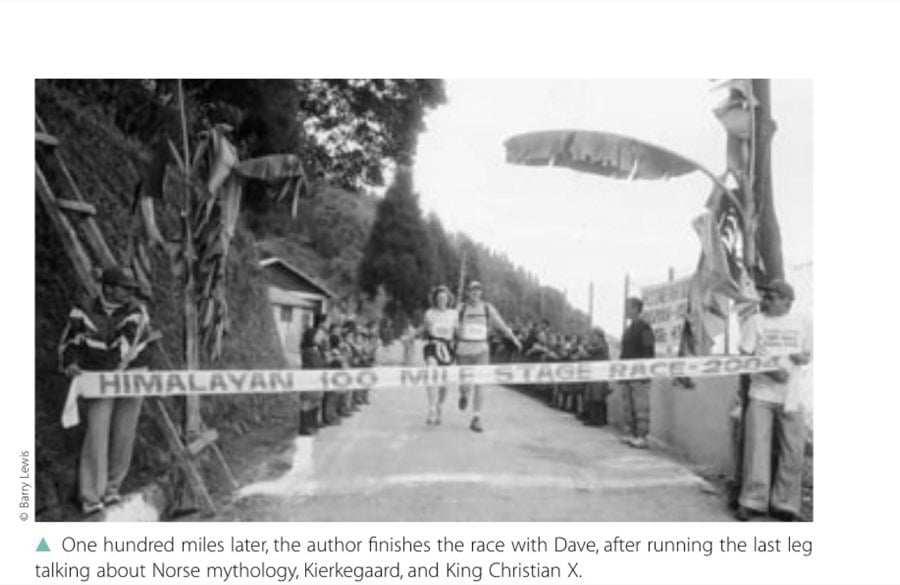
One hundred miles later, the author finishes the race with Dave, after running the last leg talking about Norse mythology, Kierkegaard, and King Christian X.
Finally I asked Lewis about his race. He said he had to stop for bathroom breaks four times. He had not been (he says “bean” for “been” in that funny Canadian way) feeling well, but it didn’t sound like complaining. The others were whingeing and whining. He was simply stating facts. Runners whine. I know this. But at races, at most races, after we finish we go home and complain to those who love us and must put up with us. Here, we had no one else to tell it to, and so we told it to each other. Everyone wanted to narrate his or her own race; everyone seemed unaware that we each had completed the same event, that we each had our own stories. We were narcissistic and boring and unaware.
A SHARED MISERY “You would not believe how bad I feel,” someone said, after I finished the race on the last day, well after she had already crossed the line. “Yes,” I said, “actually, I think we all know exactly how bad you feel.” It is
one of the things that makes us least appealing, us runners, this blinkered selfabsorption. Lewis was different. The third day, the day of the Mount Everest Challenge Marathon, had been longer than any of us expected—only the race director believed
it was a marathon—and we had all overextended ourselves. We were depleted, drained. But Lewis kept moving, always moving, congratulating other finishers and helping them as he had me that first day. He rubbed Mimi’s shoulders and
suggested Bruce soak his legs in the cold water that ran out of a pipe on the lawn.
He offered Sean Advil, as he had done throughout the trip, not worrying whether he would have enough left for himself. Lewis gave Runner’s World Rob his blister repair kit. He generously encouraged the two 20-something Brits, Andy and Rob, telling them the worst was behind, that there were just two short days to the end. He reminded them, gently, of what they had said about the race that first day while riding on the roof of the bus: “How tough can it be?”
And he learned the stories of the people who had been serving us. We had gotten used to the colonial comforts of having unseen hands doing our bidding. Lewis found out what these workers did for the other 50 weeks of the year when they were not carrying our belongings through the mountains, when they were not refilling our water bottles or taking down our numbers. While for most of us it was a race, and an exhausting one at that, for him it was an exercise in discovery. He smiled and said hello to everyone—many of us did this—but then he took it a step further. He asked permission before he took photographs and asked sincere, interested questions, without ever seeming obtrusive or impolite.
Lewis and I and Rob from Runner’s World UK were the only journalists who were actually racing. My goal, as a senior writer from Running Times, was to beat the competition (whose U.S. circulation dwarfs ours). It was a friendly rivalry, at the race as it is in print. Rob is faster than I am but not an ultrarunner. I got him, both on the marathon day and in the 100-miler.
ad
© Barry Lewis
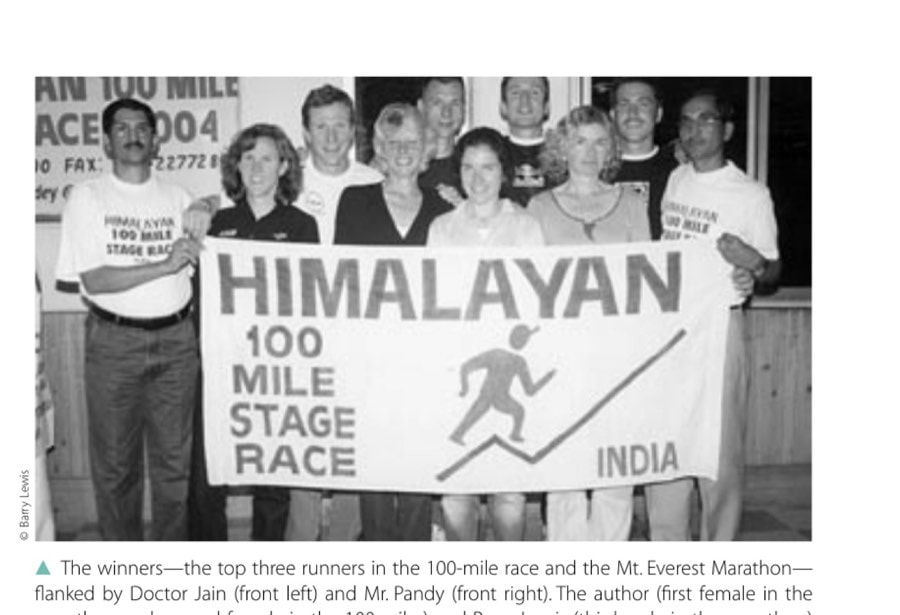
The winners—the top three runners in the 100-mile race and the Mt. Everest Marathon— flanked by Doctor Jain (front left) and Mr. Pandy (front right). The author (first female in the marathon and second female in the 100-miler) and Barry Lewis (third male in the marathon) are second and third from left.
HE RUNS NOT TO CONQUER I didn’t, however, feel competitive with Barry Lewis. It would have been pointless; he’s a lot faster. But it was more than that. It was because it’s impossible not to like him, impossible not to want only the best for him. Whatever twinge of envy
I might have felt morphed into respect and admiration and genuine fondness. People who have run or paced at 100-mile races say that you see a person’s truest self when they are in a state of utter physical exhaustion. Carefully constructed
layers get shed like sweaty running clothes. We all saw each other during that week, and for the most part, we all liked what we saw. Everyone on the trip liked Barry Lewis. Our group, the race director said, was the tightest, closest group he had seen in
the 14 years of the event. We had bonded. After the race, there were e-mails and photos sent around, as if we couldn’t let go of the experience. We made friends that we will keep forever, even if we never see each other again.
Lewis asked me, each day we ran, if I still had my “wind,” the round saffroncolored rock proffered by the holy man. I had it in my pack, carried it with me throughout the race. When I got home, I found it was no longer there. I had left my wind in the
Himalayas, unintentionally left it where it belonged. I hold on to the memory of it, though, as palpably as if it were here in my hand.
This article originally appeared in Marathon & Beyond, Vol. 9, No. 5 (2005).
← Browse the full M&B ArchiveMore like this
1,000+ stories from 19 years of Marathon & Beyond
The complete archive of the legendary long-distance journal — digitized and free to read.
