

One Mile Deep
Running the Grand Canyon from rim to rim offers runners the opportunity to experience one of the seven natural wonders of the world without ever having to miss a weekend of training. With well-maintained
trails, water sources along the way, and food and lodging on both sides, this epic run can be done without having to bring along a support crew. The challenge to make it across draws thousands of runners and hik
ers every year. While the distance is only 20 to 23 miles from trailhead to trailhead depending on the route you take, the heat, altitude, and lack of shade are so grueling that 250 people are rescued in the canyon every year.
Some of them don’t make it. “This is the best and hardest thing I’ve ever done,” Rebecca Warriner of Wake Forest, North Carolina, said of her first crossing. “Even though it’s only 20 miles, you should train for
a 50-miler if you attempt it,” the 34year-old mother of two said. ▲
The South Kaibab Trail is one of two trails from the South Rim to Phantom Ranch at the bottom of the Grand Canyon.
“When you hear ‘Grand Canyon,’ it’s different than when you actually see it,” rim-to-rim runner Sage Grossi of Tempe, Arizona, said. “It was bigger than what I expected.” Yet with a lot of training and a little planning, it can be the run of a lifetime. Here is what you need to know to plan a run from the South Rim to the North Rim. Running from the North Rim to the South Rim is fun, too, and actually a little easier. Regardless of which direction you go, remember to bring plenty of extra memory for your camera.
Planning your trip 1. The first thing to do is get reservations for a cabin on the North Rim, which is open from mid-May through mid-October. Reservations can be made 13 months in advance and sell out quickly, so do this a year ahead of time. You can make dinner reservations at the North Rim lodge after it opens for the year in mid-May. 2. Once you have secured a cabin on the North Rim, reserve a room on the South Rim in Grand Canyon Village. There are several motels and a campground.
© Cathy Tibbetts
3. Phoenix is the closest major airport to the South Rim, 234 miles away.
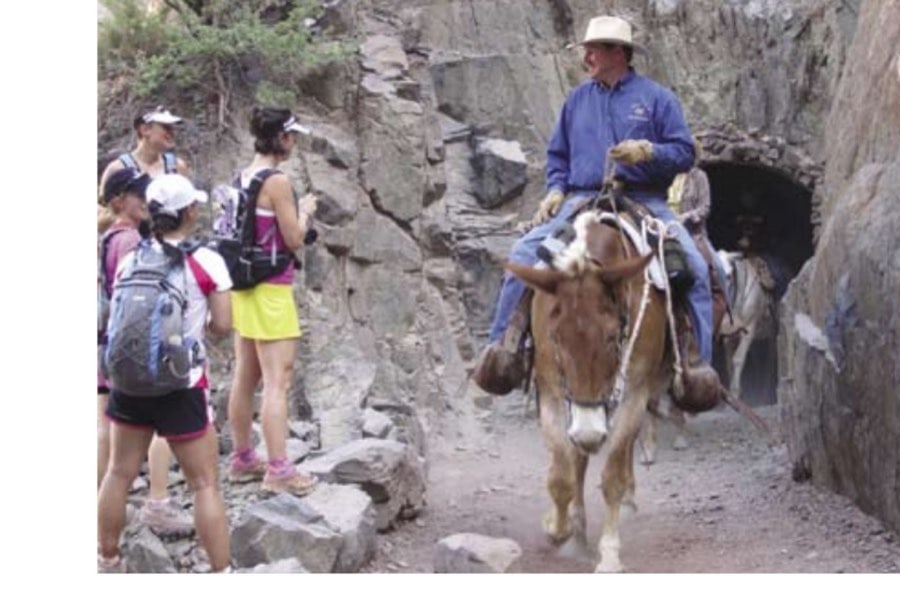
▲ Runners and hikers must step aside and wait for mule trains to pass.
Recommended gear list (No financial interest on my part) • Hydration pack with reservoir. My favorite is GoLite Rush pack, and everything on this list will fit in it. The Rush also has side pockets on the
waist belt for items you want to get at during the day. • Sunscreen • Lip block • Running shorts. I prefer skirts/shirt for day one. Start the run with arm warmers. The canyon floor is 30 degrees warmer than the South Rim, and
it’s easy to peel off arm warmers when you’re wearing a pack. • Waterproof top and bottom. It can rain, snow, and hail at any time of year at high altitudes. GoLite makes very lightweight and packable clothing. • Gloves • Hat • Sunglasses •
Long-sleeve technical shirt. At 8,000plus feet, the North Rim is cool if not cold, raining, or hailing. Plus, you’ll want to get out of your dirty shirt. • Long lightweight pants. You’ll want something warmer than shorts for the evening. •
Small light such as Petzl Tikka. You may be finishing after dark. • Food/electrolytes • Toiletries. Cabins have shampoo and soap. Take just what you need for one night and leave it behind if you run back. •
Sandals or flip-flops are a nice luxury. I bring some old throwaway ones and leave them.
▲
Mary Knott on the North Kaibab Trail.
© Cathy Tibbetts
▲
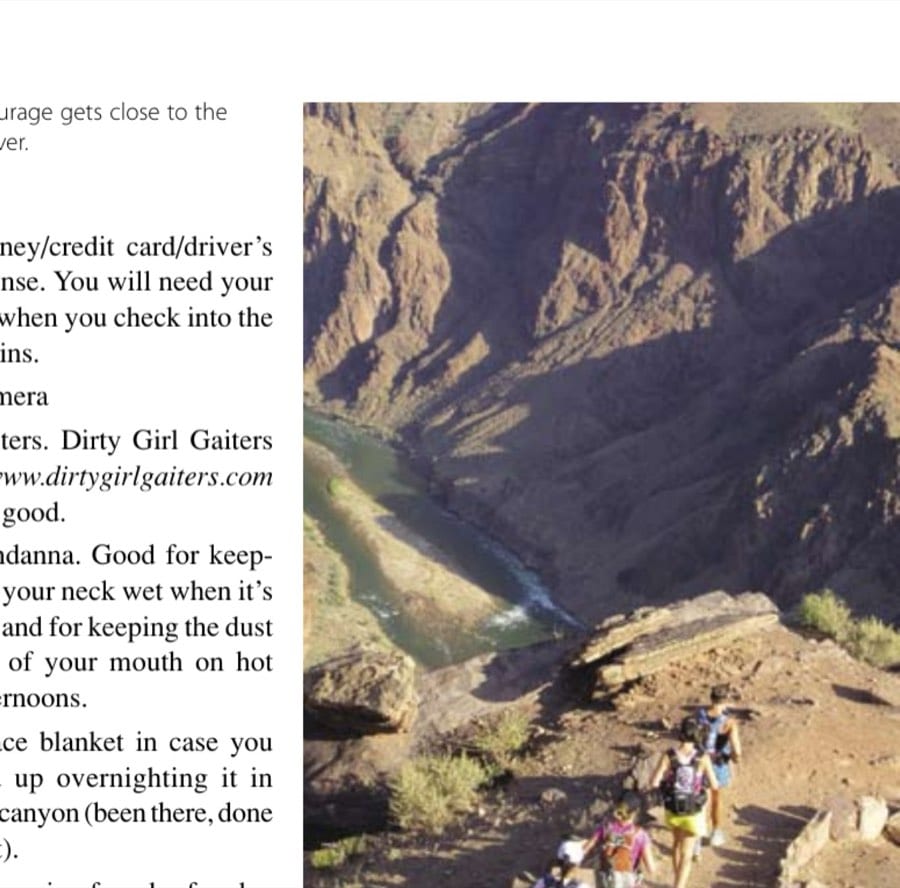
The entourage gets close to the Colorado River.
• Money/credit card/driver’s license. You will need your ID when you check into the cabins. • Camera • Gaiters. Dirty Girl Gaiters at www.dirtygirlgaiters.com are good. • Bandanna. Good for keeping your neck wet when it’s hot and for keeping the dust out of your mouth on hot afternoons. • Space blanket in case you end up overnighting it in the canyon (been there, done that). • One pair of socks for day two if you run back. • Put extra clothes for the North Rim in Ziploc bags in case it rains.
© Cathy Tibbetts
• For day two, I just wash my running skirt and shirt at night, and they are dry by morning. • The clothing from SkirtSports (www.skirtsports.com) dries out fast.
The big day (Distances are approximate) • Be on the trail by sunrise. The bottom of the canyon is 30 degrees warmer than the rim, and temperatures there soar over 100 degrees all summer. It’s good to get across early. • There are two trails from the South Rim to Phantom Ranch, which is at the bottom on the opposite side of the Colorado River. By way of the Bright Angel Trail (elevation 6,860 feet), it’s 9.5 miles with three water stops.
© Cathy Tibbetts
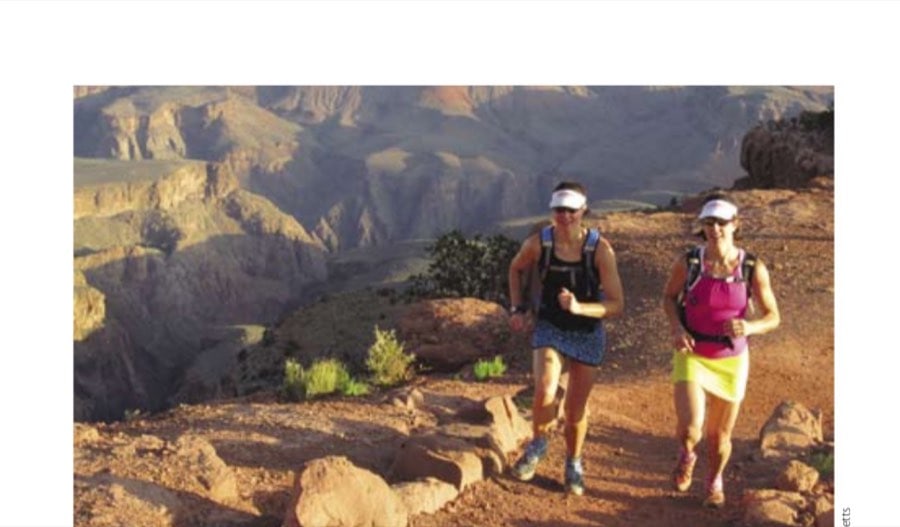
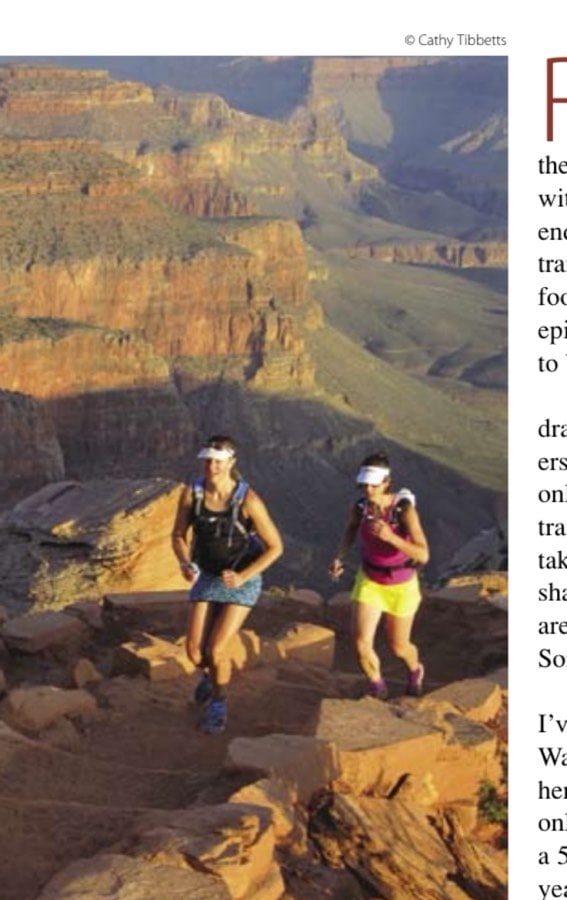
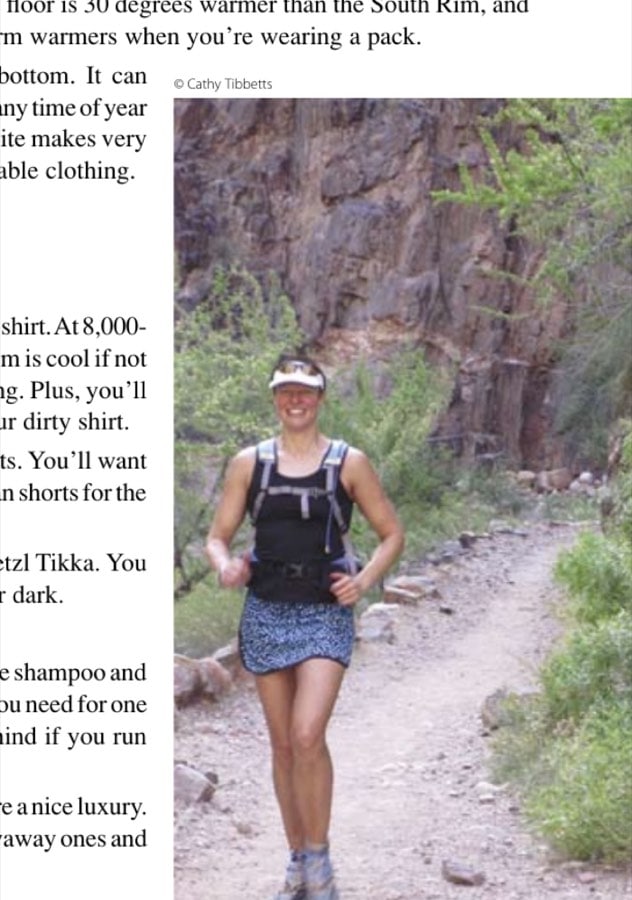
▲ Mary Knott and Rebecca Warriner run up the South Kaibab Trail.
By way of the South Kaibab Trail (elevation 7,260 feet), it’s 7 miles with no water stops. • There is water and a small store at Phantom Ranch (elevation 2,480 feet). From Phantom Ranch to the North Rim, you’ll take the 14-mile North Kai
bab Trail. The first water is seven miles away at Cottonwood Campground (elevation 4,080 feet). One more mile down the trail is another water stop at a residence for park personnel. Fill up your 100-ounce reservoir here
and carry more if you can, because this is where the real climb begins. The next and last water stop is four miles away and can take hours to reach. • From the last water stop, it’s two more miles to the end of the trail (eleva
tion 8,250 feet). This section of the trail is in the trees and more shaded. • At the trailhead/parking lot, turn left and take the Bridle Trail to the lodge. The sign says 1.5 miles, but it’s a long 1.5 miles. Resist the temptation to
take the road, which veers downhill and looks inviting but is farther.
Getting back to the South Rim 1. Do all of this in reverse, or 2. Take the shuttle—a beautiful 4 1/2 hour drive. Reservations can be made a year in advance.
What first-time runners had to say about running the Grand Canyon rim to rim After having a few days to reflect on their first Rim-to-Rim run, the ladies shared these thoughts about their adventure: •
Robin Vollinger, 43, teacher, Farmington, New Mexico: “I couldn’t believe how sore I was. I made sure I was the first one from my group to get in. If there was only one seat left on the shuttle, I wanted to make sure I got it.” •
Rebecca Warriner, 34, race director, Wake Forest, North Carolina: “There’s no amount of training I could have done to have trained my legs for six miles of downhill. If you haven’t done it at least one time, don’t expect
you’ll be running back the next day.” • Mindy Viering, 27, writer, Denver, Colorado: “I was fully aware of how physically challenging it would be and was well prepared with equipment and food. But I had no idea how long it would take and how hard the end would be.” •
Mary Knott, 32, veterinarian, Gilbert, Arizona, in an e-mail to family and friends: “I learned several things this weekend. This was the first time I had
ad
seen the Grand Canyon. It is impossible, without going to the canyon and hiking down below the rim, to even comprehend what we accomplished. I had imagined that we would wind down the canyon, hop across the river on some rocks, and then hike up the other side. The canyon was much more immense and vast than I could have ever dreamed. The Grand Canyon is most amazing not because of the canyon . . . but because of what it requires of you. It is unyielding and unforgiving. There is very little shade and very little water. It demands strength. Courage. Drive. Passion. Attitude. Will. Perseverance. Without those, you will be overwhelmed and likely unable to make the journey.”
Fun things to know • First thing first: a bar on the North Rim serves good margaritas. • The bar doubles as a coffee shop in the morning. It opens at 5:30 a.m. and serves delicious cranberry-orange scones and cinnamon rolls. •
There is a grocery store at the North Rim Campground, but it’s a long walk, or at least it seems that way after you’ve run rim to rim. • Watch for condors, whose wingspans reach 11 feet. They have been reintro
duced into the Grand Canyon after near extinction, and their numbers are growing. • Ribbon Falls, 5.7 miles past Phantom Ranch, is a short side trip and a refreshing place to cool off. • The Phantom Ranch store has T-shirts and bandannas that are sold only at that location. • There are restrooms along the way.
Contact information Grand Canyon North Rim Reservations: 877/386-4383; www.foreverresorts.com Grand Canyon South Rim Reservations: Mather Campground: 877/444-6777; www.recreation.gov Lodging: 888/297-2757; www.xanterra.com Trans-Canyon Shuttle: 928/638-2820; www.trans-canyonshuttle.com Grand Canyon Information: www.nps.gov/grca
This article originally appeared in Marathon & Beyond, Vol. 13, No. 6 (2009).
← Browse the full M&B ArchiveMore like this
1,000+ stories from 19 years of Marathon & Beyond
The complete archive of the legendary long-distance journal — digitized and free to read.
