

Outrunning The Sound Of The Doodlebug
ICourtesy of Roger Robinson
ran just one race in East Germany. Three days later the country ceased to exist. The Berlin Marathon, run on 30 September 1990, went for the first time through the recently breached Berlin Wall, under the arches of the Brandenburg Gate, and for five miles through the bleak streets of the East. It was the Marathon Without the Wall, the Run-Free Marathon, the Race of Unity, consciously historic, avowedly symbolic, openly emotional. We started from the Charlottenburg Gate to the music of Beethoven and Schiller’s “Ode to Joy”: “Be united, ye millions.” And the race enacted the music. The 26,000 competitors and million or so spectators made that
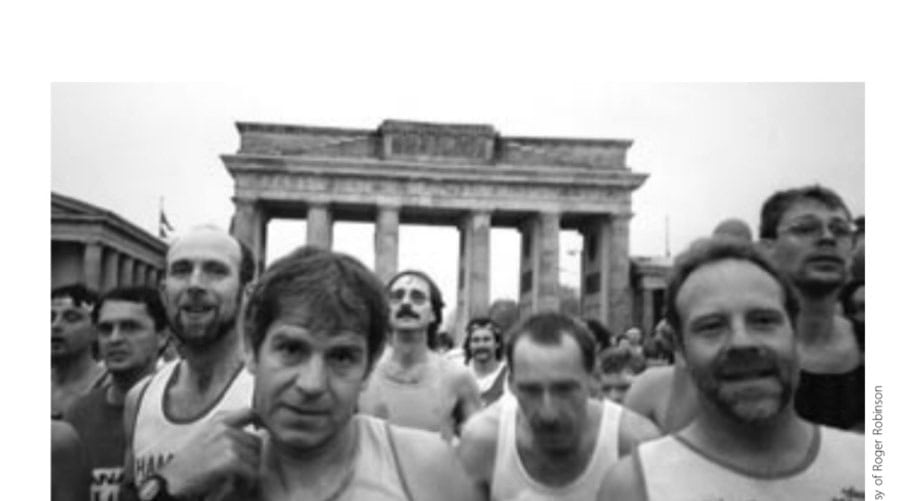
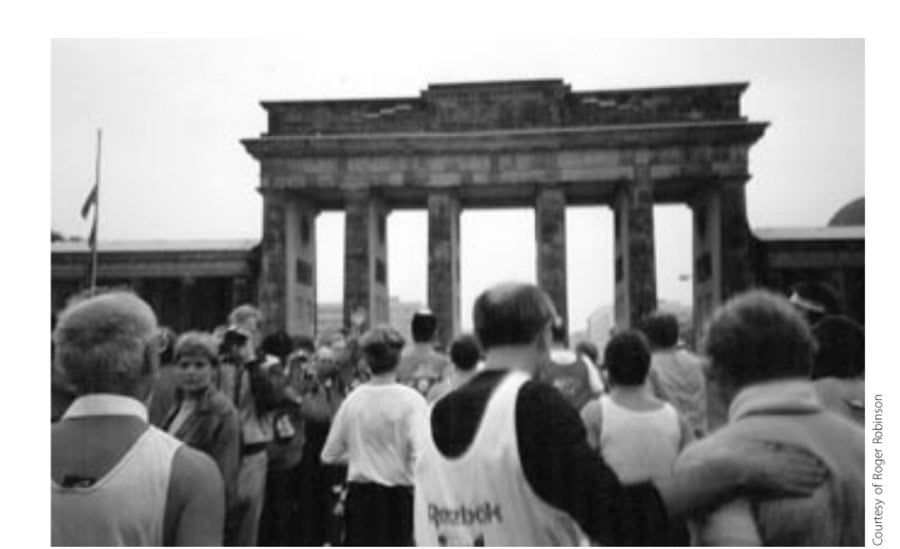
“Embrace, ye millions.” International runners approach the Brandenburg Gate.
marathon (to use a few of Schiller’s phrases) the most joyful, inspiring, divinely sparkling, magically binding of all the celebrations of reunification. It’s harder in 2005 to feel so optimistic, but these reflections on the heady days of 1990 may be a reminder that running, at least, has not gone sour. The day will come, I hope, for the Baghdad Marathon. I hope I’m still running then.
THROUGH THE BRANDENBURG GATE The runners in Berlin in 1990 celebrated, I’m happy to say, in the way of all runners: more vigorously and less reverently than any concert-hall audience listening to Beethoven’s Ninth, more spontaneously and less tidily than any military parade. As celebrants, runners are lively but disorganized, good at movement, hopeless at ritual.
Approaching the Brandenburg Gate at two miles, shuffling in that exuberant crush of slow joggers along the broad avenue between the trees of the Tiergarten Park, I thought of the other celebrative parades that had passed there. The victorious Prussians marched here in 1870, in triumph, and the united imperial German armies set out to war here in 1914; the Wehrmacht’s tanks and swastikas threatened the world from this wide, straight road in the 1930s; and in 1945 the Allied armies paraded here to symbolize Germany’s destruction. Army after army, along the avenue, through the Gate, war after war.
This time, instead of goose-stepping ranks and sinister trundling tanks, there came an untidy, cheerful, motley mob of undersized marathon runners, as sweaty, scruffy, and high-spirited as runners always are. Instead of uniforms, we wore stripes or flowers, Union Jack shorts or silver-fern singlets, CCCP T-shirts or Stars and Stripes tights, club colors from all over Germany and the world, or whatever idiosyncratic mix we felt like wearing that misty morning—baseball caps and woolly hats, tattered sweaters or plastic garbage sacks to discard if the weather warmed up. Instead of guns and fixed bayonets, we carried sponges and spare toilet paper, neither of which rates high on the dangerous weapons list. Instead of military marches, we ran to Beethoven, rock, jazz, rollicking German folk tunes, whatever the curbside bands and ghetto blasters played to stir us on.
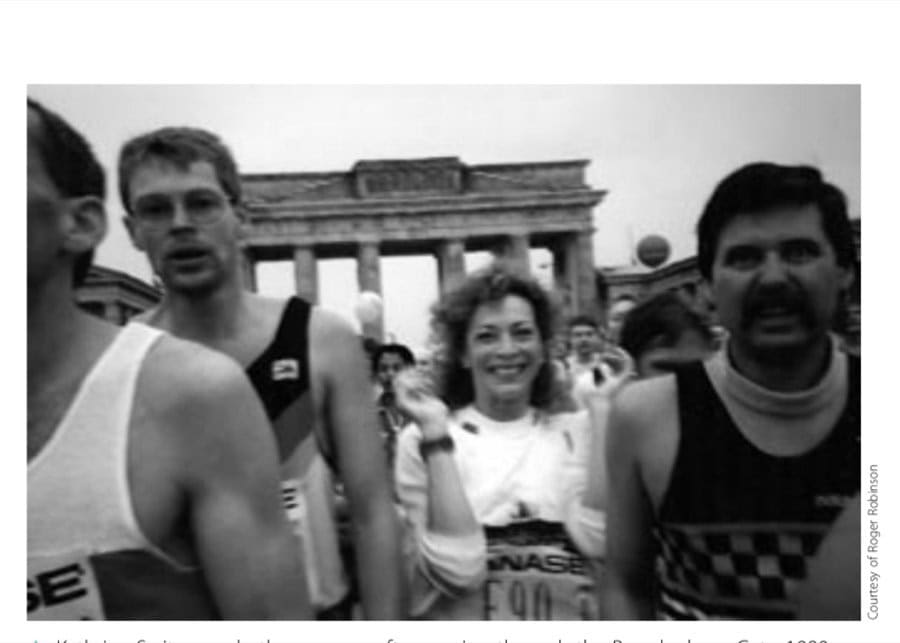
And instead of saluting some medalled general as we passed under the Brandenburg arches, we clapped, cheered, raised our skinny arms in victory, hugged each other, paused to pat the stonework, openly wept, took pictures, posed for pictures, exchanged cameras to take each others’ pictures, ducked clumsily round to go through the Gate again, got in each others’ way, got bumped and hugged and squeezed and smeared with other people’s sweat, shook hands, joined hands, did miniature Mexican waves, linked arms, said “Guten Tag” and “Vereinigung” to innumerable Brits and Americans, kissed some soggy-bearded foreigner, and finally, reluctantly, got pressed forward in the shuffling jam of runners to move down the great avenue of Unter den Linden.
Courtesy of Roger Robinson
Runners from several European nations after passing the Brandenburg Gate.
Nobody minded. Even when we had to walk or jog in place, jostled and squashed together, nobody grumbled or shoved. To save congestion at the Gate, the organizers had appealed to the runners to go around it rather than through the arches. Nobody did. In this marathon there were more important things to do than run a fast time. For me, the important thing was to be there. I had an injury, had scarcely trained for four months, and knew that I couldn’t race well over that distance and shouldn’t even try. I went because it was going to be so much more than a race and because of a kind of longing to clear the shadow of Berlin from my life. Running, so elementally simple, can often work like that.
THE SOUND OF THE DOODLEBUG My earliest memories, from my childhood in south London, are of Germans—of their bombs whistling down in the night, leaving heaps of rubble where friends’ houses had stood. One of my first words was “bomb site.” We played war in the overgrown debris, invading Berlin with toy pistols made of twigs. For some months, the family lived at Southend, on the Thames estuary, on the direct route for bombers in both directions between southern England and northern Germany. The engines came every night. “Are they theirs or ours?” someone would ask as the family roused and stumbled for shelter. We were all adept at telling the difference in engine sound, even me at the age of 3, my parents said, though my present mechanical obtuseness makes it seem improbable. I know for certain the snarl of a petrol-driven propeller plane still makes my stomach sink and the upand-down hoot of a siren sets my flesh uncontrollably creeping.
“The Germans” then meant just that remote throb of engines—“theirs”—invisible yet destructive, driving us night after night, clutching a toy for comfort, into the stuffy cupboard under the stairs or the metallic cage of the shelter that doubled as a dining table. Later, when I was starting school, about 1944, the noise the Germans made changed. It became a single, rasping, pulsating, approaching drone: the doodlebug. You hoped it kept on going and passed you by. You listened and waited. If you were unlucky, the drone of the flying bomb’s engine cut off and there came a terrible silence, and then slowly the thin rising whistle as the missile fell. I once saw a woman blown down the steps of a railway bridge that I had just run across with my mother as the whistle fell nearer.
I was 6 when the war ended. I can’t remember any time when “the Germans” were not part of my consciousness. As soon as I could read the papers, the news was all of the Cold War and the 1948-49 Berlin airlift. I learned German as a teenager and began to visit Germany. I felt no hostility, though the memories stayed. Germany was an emerging country. Once I nearly took a job there, as a broadcaster in Bremen, still a bruised and damaged city from the bombing of its port. I ran among the wreckage after my interview. I took hiking holidays in central Germany, loving the forests and enjoying convivial evenings in little country pubs, drinking beer and schnapps. As English we were always warmly welcomed. In my 20s, I was the only German-speaking member of an English athletics team visiting the Sauerland, the rural area around the Möhne and the other reservoirs that the dam busters had devastated. I spent exhausting evenings in bars shuttling from table to table to interpret 20 different conversations. “‘
Ere, what’s he sayin’, Rog?” the summons came again across the room. There were three main topics: track times (of course), goodwill between Germany and England, and resentment of the dividing line drawn across their country. Time after time I listened to anxieties about relatives out of touch, alive or dead, in the East, about the repression by the occupying Soviet army, about the threat to us all barely a hundred miles away. Germanic togetherness would rise among the Pilsener glasses. “We will together march, German and British, this enemy in the east out to drive,” I remember one rosy-faced vehement Sauerlander urging us all late one night, while I struggled to remember the German for “Not tonight, thank you.”
THE WALL The Wall was built in 1961. For 30 years, it scarred every thought of Europe. I saw it in 1977. It was the worst affront to humanity I have ever seen. I was in Germany that time to run for New Zealand in the World Cross-Country Championship, and we spent a week near the quaint old town of Lübeck, in the cold northeast of the country, only a few miles from the Wall. One bitter March day I
did my training with some new German friends. One had been brought up in East Germany but a few years earlier had been lucky enough to be “sold” to relatives in the West. That was then a common way of boosting the East German economy, my friends said. We ran that day from Lübeck until our way was blocked by the Wall. Runners never like to be blocked—a busy road is bad enough.
Freedom of movement is what running is about. Often a wall is a challenge, and I’ve had many a mischievous romp on English country estates or exclusive golf courses. But this was no joke. The barricade of concrete, topped with vicious coils of barbed wire, extended endlessly, high as a house, across the landscape. Guns were poked out from dark watchtowers, unseen dogs barked, and spotlights swept back and forth in the dark afternoon light like the eyes of hawks. There was an expanse of bare dirt on our side between the Wall and the border itself. Imagine keeping a strip of land hundreds of miles long only for killing. The worst thing you could imagine doing in such a place was to run. So we turned and set out quietly to jog back toward Lübeck, aware of the guns pointing across the bare dirt at our backs. I thought of a photograph I saw once in a newspaper, of a workman in overalls doing some small maintenance job on top of the Wall, with an armed guard standing over him.
LAYING GHOSTS All these old memories, from the sirens wailing through my 3-year-old consciousness to the gun turrets marring an international friendship run in my late 30s, lurked in my imagination when the Wall, astonishingly, fell late in 1989. I don’t want to overdramatize or exaggerate. Mine were common enough memories for my generation, not especially tragic or traumatic. My wife, Kathrine Switzer, felt at least as strong a pull. She was born in Germany, the daughter of an officer of the American army of occupation after the war, had spoken German as a small child, and had destitute German house servants as her first friends. (We have found and renewed an affectionate friendship with one of them, her much-loved nanny, now in her 80s, who lived out of contact in East Germany for 50 years.) When Kathrine returned to Germany as an idealistic sports-mad young journalist to cover the 1972 Olympics at Munich, she had found herself writing instead about the defeat of idealism by terrorism.
So we both had ghosts to lay and thought the Berlin Marathon could lay them. We share the belief that sport has significance far beyond the back pages, a key and creative place in 20th- and 21st-century history. When it was announced that the marathon would go this time through the Brandenburg Gate and into the East, it seemed to us likely to become one of our sport’s most significant moments. We wanted to be part of it, as in running you can—the only major sport where participants often outnumber spectators. The organizers offered to accommodate
Printer: Insert 2-page Portland Marathon ad
Printer: Insert 2-page Portland Marathon ad
us in a top West Berlin hotel, which was another temptation, as a contrast to the backpack-and-bratwurst style in which we had each first toured Germany. The decision that Reunification would follow only three days after the race clinched it. We could never resist a party.
FIRST RUN: BUCHENWALD We had three runs in Germany before the marathon. Each was unforgettable; like stopovers on a journey through time. We flew into Frankfurt armed with rail passes, hoping that traveling by train we could witness close up the last days of the DDR. We got more than we bargained for. Choosing Weimar for the first overnight because of its place in literary history, we discovered beneath all the peeling-paint dinginess a decoratively classical town that in 10 years would be restored into one of the great cultural meccas of Europe. The Goethe and Schiller museums were already open, and the theater was advertising a play by Vaclav Havel, then an imprisoned dissident writer who, in a reversal as absurdly unlikely as one of his own plots, was about to become president of Czechoslovakia and later the Czech Republic. But Weimar’s few hotels were already full, as the people gathered for the “Vereinigung” (Reunification). A kind proprietress at one hotel made a reservation for us by phone at an outlying place—not far away, she said, “Mit dem Taxi, 10 Kilometer.” On a scrap of paper she wrote “Hotel Am Ettersberg, Buchenwald.”
We arrived at night, and as we drove up there, climbing high up through the black woods, and glimpsed the sign flash in the headlights, we realized why the name seemed familiar: Buchenwald. “I expect we’re staying in the officers’ quarters,” I said as a nervous black joke. We were. The hotel, we could see next morning, is in one of a row of functional accommodation blocks adjacent to a parade square. We dared not think what kinds of parade had been held there. The hotel now serves pilgrims to the site of one of the most horrific of the concentration camps.
We ran early the next day. A chill wind whipped across the top of the Ettersberg, and we ran in full tracksuits. It was still September. Laboring a winter up there without proper food or clothing, you would hardly need gas chambers. Marked walkways take you around the site. We jogged somberly, stopping where the signs said the workshops and crematoria had stood, and at the great holes in the earth that had each held 10,000 bodies, and at the quarry where thousands more—“the strongest and fittest,” the sign said—had been forced to slave until they dropped. There is a terrace at the edge of the high escarpment of Ettersberg with monumental stones engraved with the names of the 20 or 30 nations whose people died here, overlooking a view that would be picturesquely beautiful if the air had not been so dank with mists and sadness. The place was a concentration of horror.
present . . . 19th Annual
Mt. Goat Hill Runs Start Time: 10:30 A.M. (CST)
, 20 05
Kickapoo State Recreation Area, west of Danville, IL
19
A great way to get in some hill training rc h
aM y, a urd t a Lake Mingo Trail Run
S7th Annual
Saturday, June 11, 2005 Kennekuk Cove County Park, Danville, IL 7.1 difficult and rugged trail run around beautiful Lake Mingo Postrace picnic with food, drink, prizes & music
A choice of events for your pain or pleasure:
• The Illinois/Indiana Tuffest 15K, with 18 MAJOR hills
• Benny Branson Memorial 10K • 5K Walk
Postrace party at the Little Nugget Steakhouse
Race Director Deb Reddy 217/431-4243 Online registration www.active.com
Visit the Kennekuk Road Runners, America’s Running Club
www.kennekuk.com PO Box 1701 Danville, IL 61834
AGrand Slam Event
Kennekuk Road Runners: We train hard, race hard, and party hard.
We jogged on, to look at the memorial tower at the highest point on the site and the statue showing radiant prisoners welcoming rescuing Soviet troops in campy ardent-socialist-realist style. With a deepening cynicism, I read everywhere the signs that commemorated the heroic anti-Fascists who had died here, so they announced, without finding a single hint anywhere that the reason they died here was that they were Jews. Compassion for Jews was never part of Communist Party doctrine. Nor was concern for truth. Less surprisingly, there was no reference either to the fact that the occupying Soviet army continued to use Buchenwald for at least 10 years after the war as an internment camp for dissident Germans. It had a reputation then, according to the taxi driver who drove us away later, for viciousness as terrible as the Nazis had inflicted. What offended me most, I think, was that such an appalling monument to inhumanity, a place where people would go to grieve for those who had innocently died, should be reconstructed merely as a vehicle for political propaganda. Orwell’s Ministry of Truth had been busy at Buchenwald.
We felt incongruous, running in the festive colors of modern sports clothes around that melancholy place, but it was very early and we meant no disrespect. Better a couple of sad joggers than a parade of yet more soldiers. I felt conscious, as I had at the Wall in 1977, of my good fortune at having been free to run all my life. The people before us here had to march under guard to hew at the quarry. We could trot down on the springy autumn grass. The most basic of the many pleasures of running is that freedom to move over the surface of the earth.
One last vignette. In the taxi back to the Weimar train station, we were held up for 20 minutes while a convoy of Russian tanks and vast, long, cylindrical missiles trundled ponderously out of a hidden site below Buchenwald, on to the road east and down the hill. A week or a day ago these descendants of the doodlebug had been armed and aimed at London. Today they were leaving. We felt we were witnessing the moment of turning in a tide of history. Our taxi driver just cursed them every inch of the way.
SECOND RUN: BERLIN The second prerace run was in Berlin, through the pleasant paths of the Tiergarten Park and, magnetically, to the Brandenburg Gate. It was like a street fair there that day. Hawkers sold wurst and postcards and fragments of the “Wall,” apparently as infinitely subdivisible for sale as Shakespeare’s mulberry tree once was. They also sold Russian army uniforms and paraphernalia. I dearly wanted to buy a uniform for my American brother-in-law, then a colonel in the Pentagon, to wear to work. But I couldn’t find one big enough.
For all the noise and tourist kitsch, it was a wonderful and moving moment to jog through the Gate, just step over from one side to the other. We ran almost jubilantly along the 200-yard-wide strip where the Wall had stood. Kathrine warned
me about unexploded mines or cartridges, but I ran there anyway. The Germans can be trusted to tidy up, and it seemed to matter. I think they should make the whole strip, indeed the whole East-West border, into a landscaped linear park for runners and walkers and cyclists—a permanent, active commitment to the freedom of movement, stretching from one end to the other of the city or the nation.
We were puzzled, as we ran back from the Gate, by the long lines of buses parked the entire length of the avenue, literally hundreds of elderly motor coaches, all from Poland. They were marked Gdansk, Wroclaw, Szececinek. . . /QQ: Szczecin? XQQ/ Everywhere we went we saw Polish people shopping, standing in lines, or scurrying from store to store or staggering back to their buses loaded with washing detergent, tape recorders, beer, VCRs, tampons, cigarettes, toilet rolls, shavers, and windbreakers. Discarded supermarket trolleys littered the pavements as the buses, sagging and overloaded, trundled slowly away eastward. We pieced the story together. Until Reunification, Poles could freely enter East Germany and now, with the Wall gone, they had free access for the first time to West Berlin, city of affluence. They were shopping here in busloads. Perhaps they would resell the scarcer goods back home, or perhaps they were the appointees of their family or community. They had until Tuesday, after which the Poland/Germany border would close and visas be required. The Poles had their own urgent race to run, with just four shopping days left to the end of their brief Christmas.
THIRD RUN: OLYMPIC STADIUM The third of our historic prerace runs was another stop on the time machine, taking us further back, to 1936 and the imposing neo-Grecian Olympic Stadium, the Third Reich’s hubris in monumental concrete. We ran there along with 10,000 visiting international athletes on the “World Breakfast Run” the morning before the marathon. It was a riot of fun, a cheering stream of people, more scampering than jogging, giggling and clowning like kids on their way through the streets and then milling about in a frivolously un-Nazi manner around the stadium.
We slipped away from the jolly crowd to look for the names of Jack Lovelock and Jesse Owens on the roll of gold medalists and sensed their spirits, still lyrically outracing Hitler’s propaganda. We thought, too, of a friend whose name was not there, Marty Glickman, who in 1936 was one of two Jewish athletes dropped from the relay by the American team management in deference to the hosts’ racial preferences. Jesse Owens was the only U.S. team member to protest against that decision, even though it enabled him to win his fourth gold medal. More history. We jogged the back straight for Marty—the second relay leg that should have been his. Marty had a distinguished career as a sports broadcaster, but he never forgot that injustice. When he died two years ago, we felt glad to have paid him our small tribute in Berlin.
THE MARATHON
Courtesy of Roger Robinson
No one was excluded from the Berlin Marathon the next day. It had many debts to pay. Visiting competitors had contributed to a fund to assist East German runners with travel and accommodation costs, to help it be the marathon without the Wall. The results were appropriate. The women’s winner was a young medical student, Uta Pippig, who in the first weeks of 1990 had simply stepped across where the Wall had been to live, and run, in the West. The first man was an old friend, a droll, cheeky Australian with a lopsided grin, who calls himself “the boy from Ballarat”—Steve Moneghetti. He took his place in history with the world’s best time of the year, 2:08:16. Nice guys did come first on 30 September 1990.
My own race, as I have hinted, was more of a sightseeing tour of Berlin’s history and my own emotions and memories than a serious competition. While Steve Moneghetti and Gidemas Shahanga were doing their own Berlin airlift out front, back in the pack, it was more like a carnival than a race. The moving crowd chattered and cheered, and under every road and rail bridge along the course they performed a kind of vocal Mexican wave, a jubilant shout that echoed back and forward along the long, moving mob.
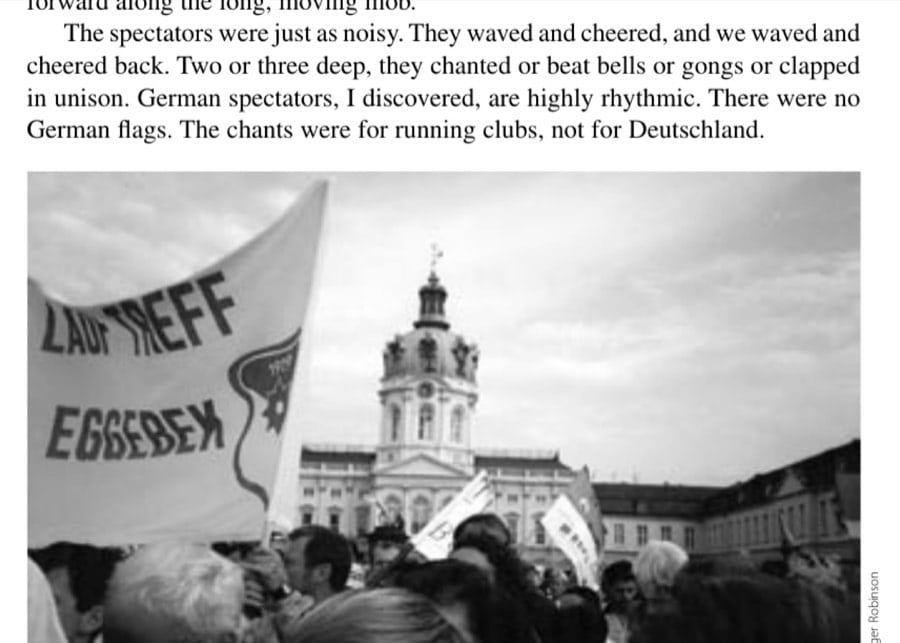
The spectators were just as noisy. They waved and cheered, and we waved and cheered back. Two or three deep, they chanted or beat bells or gongs or clapped in unison. German spectators, I discovered, are highly rhythmic. There were no German flags. The chants were for running clubs, not for Deutschland.
Runners at the start of the 1990 Berlin Marathon.
Through the Eastern sector, the crowds thinned and became quieter. The people looked watchful and withdrawn here, like dogs that have been much kicked and hesitate to romp. No wonder, when we looked at the Orwellian bleakness they have lived among for 45 years. We reached Karl-Marx-Allee at four miles, block after oblong block of dull flats as far as you could see. Everything was angular, hard edged and soulless.
The giant inspirational murals, Soviet-realist-style pictures of workers working, students studying, housewives houseworking, and everybody radiating communality, looked mockeries against the barren reality of their homes. It was the marathoners who brought to that grim street the genuine communality of people sharing something they had chosen to do.
As we turned back across the River Spree toward the West, there were views of an older Berlin, a culture and learning and spirituality that had been shuttered—baroque domes, gothic spires, the once-distinguished Humboldt University, and the elegant roofline of the Platz der Akademie, with its wondrous ensemble of Schauspielhaus (theater) and the French and German cathedrals. In there, the world has since discovered, are one of the most beautiful squares in Europe and a concert hall of exquisite shape, sound, and decor. We had heard a Mozart concert there the night before the race.
But out where we were running, on Leipzigerstrasse now, we were almost back at the border, near Checkpoint Charlie. Looking up, I saw on the walls of an old library the pockmarks of bullet holes. Potsdamer Platz, where the Wall stood over one of the most notorious killing grounds, was still just a space, a wide vacuum of bare, sandy earth, winding away between the buildings into the distance. Even from the warmth of our mobile carnival it seemed creepy, a threatening place, a gap, disconcertingly empty in the middle of the great city. The youngsters who were gunned down there, and the dogs that howled and hunted them, and the guards who held the guns, and the searchlights that flickered in the dark, had not quite gone. The place teemed with sad and sinister shadows. Even the runners went quiet for a few moments.
Then we were back among huge cheering crowds again as we reentered the West and the color and life and energy that were still missing in the East. We passed glittering shops and big, pretentious hotels and landscaped canals, archways of balloons and choruses of cavorting children. A brass band oom-pah-pahed for us in the authentic lederhosen beat.
At eight miles we were running through Kulturforum, a modern arts complex built (rather hastily, I thought) to replace the older galleries that for 30 years had been locked away behind the Wall. Outside the National Gallery I read the signs for an exhibition called “Zwischen Romantik und Realismus”—Between Romanticism and Realism. It described my condition exactly. The first eight miles had been a ceremony of purification, inspiring and joyful, though perhaps idealistic. Runners
Courtesy of Roger Robinson
Kathrine Switzer and other runners after passing through the Brandenburg Gate. 1990
are indeed great romantics. You have to be to put up with running marathons. But “Realismus” was making itself felt. You can’t run, rejoice, and rubberneck all at the same time for an hour without starting to ache. There were 18 realistic miles still to run. And my injured leg was twangling unromantically, too.
So a bit before 10 miles, where the course considerately passed close to our hotel, we two scarred veterans of many a completed marathon chose, for once, Romance over Realism, slipped through the cheering crowds, and sidled into the plushy foyer of the Hotel Grand Esplanade. It’s so plushy that there was a television in the bathroom, and I watched the rest of the race through a consoling froth of bath bubbles and steamy coffee. If you’re going to wimp out, do it in style.
If that dereliction makes this whole narrative a fraud, so be it. But I prefer to agree with what Steve Moneghetti said at the awards ceremony—yes, I rose from the foam in time to be there: “I feel like a Berliner. I’ll remember this win for the rest of my life. The race was inspiring, historic, and very significant for the cause of freedom I represent.”
REUNIFICATION We all felt like Berliners, finishers and wimps alike, and I felt, even in the bath, that I had accomplished what I had come to Germany for. There was one highlight still ahead—the night of Reunification itself. There was talk of demonstrations and violence, but all we saw were quietly happy Germans standing in the broad avenues near the Gate with an air of fulfillment. The runners had been much more upbeat
and demonstrative, but many of us were foreigners, and we have been through less pain than the Germans. Nor did we have their cause to feel nervous about what too much mass jubilation can lead to. The vast crowds waited patiently for midnight, cheered the moment of Reunification, and oohed at the fireworks.
But the best and most significant part was two or three hours earlier. Driven by some undefined compulsion, we all, that whole huge agglomeration of people, crowded on both sides of the Brandenburg Gate, crept and shuffled slowly from both directions toward and through the arch, round the press of bodies under the stonework, and crept and shuffled slowly back again toward the relative space four or five hundred yards away. It had the inevitability of being a small twig in a very slow stream. We moved slowly, but we moved; we passed from West to East, or from East to West, and back again, pressing past people from the other side who were squeezing by us under the arch with the same purpose, without hostility or showing papers or being shot.
That strange slow mass movement was uncomfortable and probably dangerous, yet the night would not have been complete without doing it. The official symbols of Reunification were the music and lights and speeches, but the people made our own. It was passing through the arch that truly symbolized the historic opening of that once fatal border. The runners did it first, and the crowds followed their footsteps.
Printer: Insert Athens Marathon ad
Courtesy of Roger Robinson
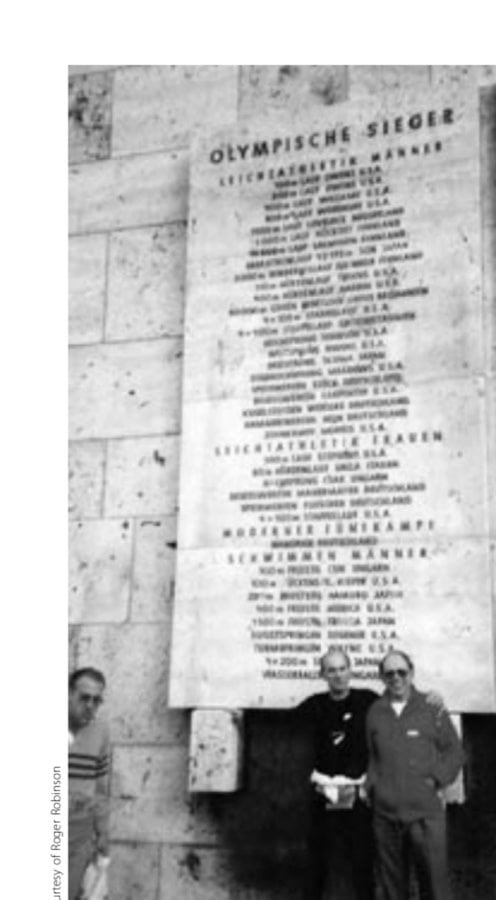
Author Roger Robinson with 1956 Olympic gold medalists Chris Brusher (who died in 2003) at the memorial to 1936 Olympic Champions, Berlin Olympic Stadium.
I realized in those few days why processions and dancers, marchers and floats, are so essential to a successful celebration. There has to be movement. That’s why the British, in their funny but wise,
old-fashioned way, pop the Queen into a coach with prancing horses and trundle her around the streets, and that’s why New York has ticker-tape parades and not tickertape sit-downs. That, too, is why running has become
such a distinctive modern form of celebration. This marathon did for Berlin what another marathon does once a year for New York, also in its different way a divided city that the runners, uniquely, unite. We are a modern form of what used to be called a “prog
ress”: a group in motion, with meaning. In Berlin, the meaning of the motion was freedom of movement. Germany had inflicted on me image after image of destruction and restriction—the metal-mesh dining-room cage of my early childhood, the whine of the
falling bombs, the wreckage of Bremen, the murderously impenetrable Wall of Lübeck, the death pits of Buchenwald. Now I had a new image: a gate that I had run through. A barrier had been turned into an international symbol for unity and
welcome. An arch had been changed from the sign of a hostile border to an invitation to pass through in peace. A race had become a mobile ode to freedom. A run had laid my German ghosts. I had outrun the sound of the doodlebug.
This article originally appeared in Marathon & Beyond, Vol. 9, No. 2 (2005).
← Browse the full M&B ArchiveMore like this
1,000+ stories from 19 years of Marathon & Beyond
The complete archive of the legendary long-distance journal — digitized and free to read.
