

Perspectives On Kenyan Marathon Running
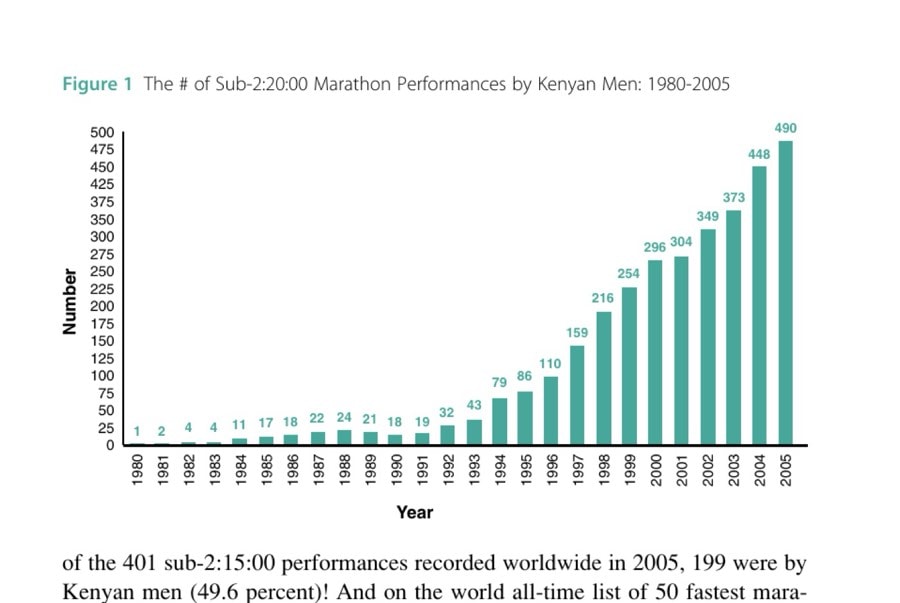
It just might be true that never before in history has a single country so dominated an event in track and field and distance running as Kenyan men have dominated the marathon during the past five years. Breaking 2:20:00 in the marathon has long been considered the benchmark for elite athleticism in this event: racing the distance averaging at least 5:20 per mile. In 2005, as shown in figure 1 on page 66, 490 out of the 1,126 sub-2:20:00 men’s marathon performances worldwide were achieved by Kenyans—that’s 43.5 percent of the total! Far back in second place was Japan (106 performances, or 9.4 percent). Even more astounding is the quality of Kenyan marathon achievements:
Victah/www.PhotoRun.net
▲
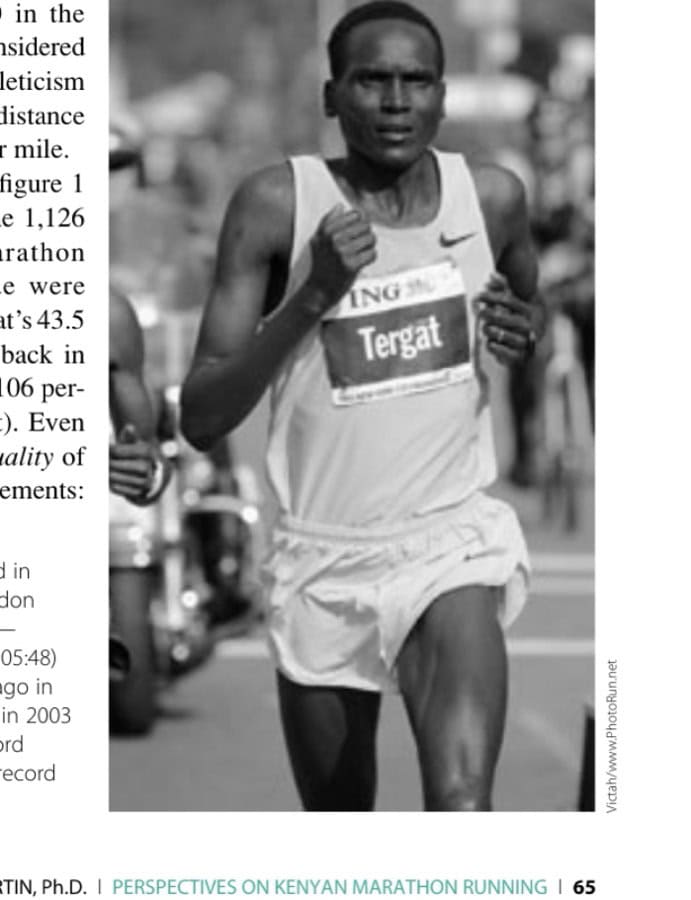
Paul Tergat finished second in his first three marathons (London 2001—2:08:15; Chicago 2001— 2:08:56; and London 2002—2:05:48) and then fourth at both Chicago in 2002 (2:06:16) and at London in 2003 (2:07:59) before his world record 2:04:55 at Berlin in 2003. The record still stands.
490 448 373 349 296 304 254 216 159 86
110
2005
2004
2003
2002
2001
2000
1999
1998
1997
1996
1995
1994
43
1993
1992
1991
1984
1990
1983
1989
24 21 18 19 32 11 17 18 22
1988
4
1987
4
1986
2
1985
1
1982
79
1981
500 475 450 425 375 350 300 275 250 225 200 175 150 125 100 75 50 25 0
1980
Number
Figure 1 The # of Sub-2:20:00 Marathon Performances by Kenyan Men: 1980-2005
Year
of the 401 sub-2:15:00 performances recorded worldwide in 2005, 199 were by Kenyan men (49.6 percent)! And on the world all-time list of 50 fastest marathon performances (as of the end of 2005), 29 of those belonged to Kenyans; the remaining 21 were divided up with a few each among the United States, Brazil, Japan, South Africa, Ethiopia, Portugal, France, and Morocco.
Kenya is a little smaller than Texas, with a population of 34.7 million, a 40 percent unemployment rate, and a life expectancy of 48.9 years. The country is divided into several ethnic groups. The Kalenjin (12 percent) are the most talented at distance running, followed by the Kikuyu (22 percent) and the Kisii (6 percent). The marathon dominance by the Kenyans is a relatively recent phenomenon, starting in the late 1990s and developing with no really good explanation. Taking a brief jaunt back into history provides some interesting perspective. The first sub-2:20:00 marathon performance by anyone over the standard 42,195-meter marathon distance was 2:18:41, by Jim Peters of England on June 13, 1953, at Chiswick, England. The first Kenyan man to break the 2:20:00 marathon barrier was Joseph Kinyabi, running 2:16:31 at Kisumu (in Kenya) on June 6, 1976 (table 1 on page 68). Thus, 23 years elapsed from the time of the initial sub-2:20:00 marathon until a Kenyan runner achieved it.
NO LONG-RUNNING DOMINANCE At the 1968 Mexico City Olympic Games, Kenya sent two marathoners, who placed 19th (Naftali Temu) and 48th (Paul Mose). In the 1972 Munich Olympic Games, Kenya’s lone entry in the marathon (Richard Juma) failed to finish. In the Montreal Olympic Games, Kenya was one of the boycotting nations, and it also
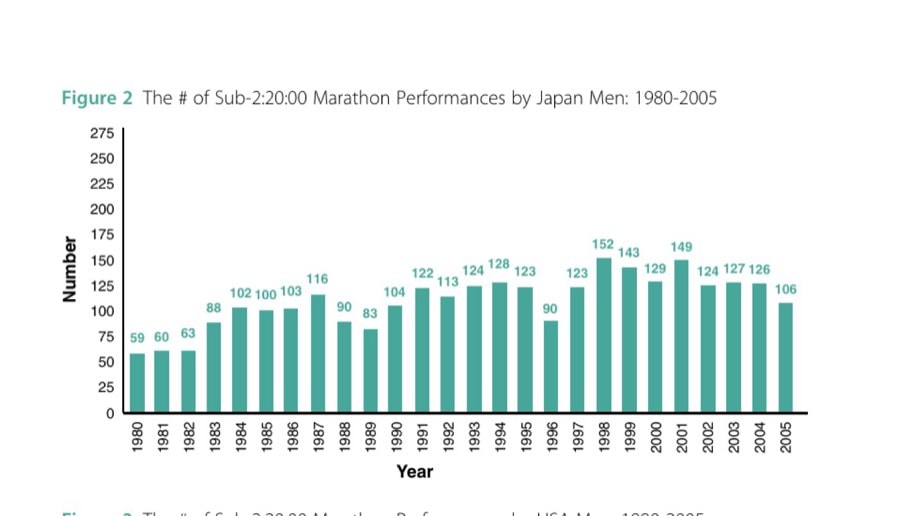
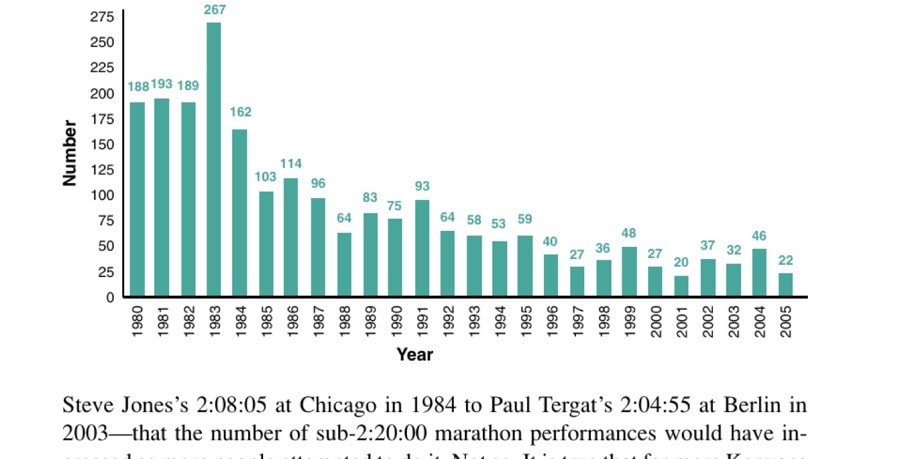
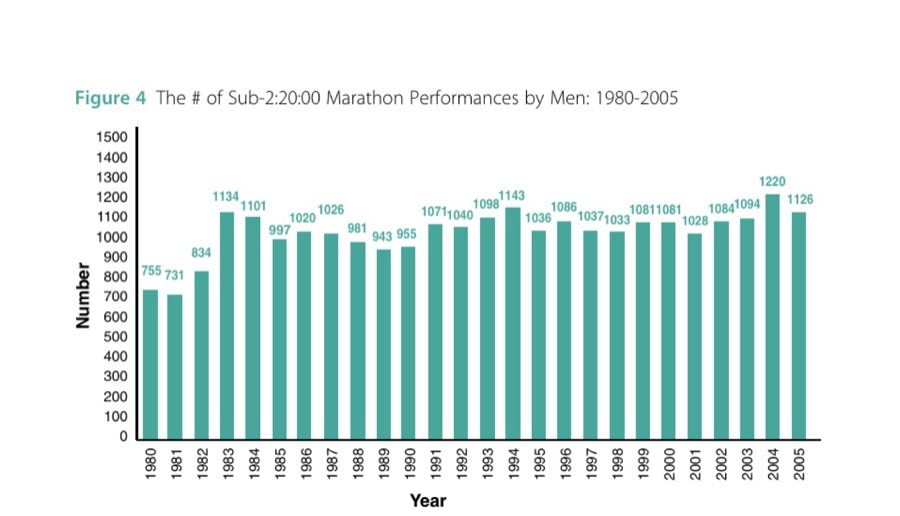
sent no marathon runners to the Moscow Olympic Games of 1980. Why Kenya was apparently uninterested in the marathon is a mystery. As seen in table 1, Kinyabi’s performance was 1,637th in the historical sequence of sub-2:20:00 performances recorded worldwide. Thus, it was not the Kenyans who initiated the breakthrough in racing marathons during the decade of the 1960s but rather the Japanese (table 2 on page 69) and the Americans (table 3 on page 69). As seen in figure 2 on page 70, Japan has been unique in maintaining a steady development of talent over the past 25 years. Figure 3 on page 70, on the other hand, records the dramatic falloff in top-level marathon achievements by American athletes that began just after the 1984 Olympic Games in Los Angeles, for reasons still not clearly understood. Table 1 also points out that the majority of early Kenyan top-level marathon performances were achieved by Kenyan athletes on academic scholarships in the United States, attending schools such as the University of Texas at El Paso and helping to make them powerhouses in sports such as cross-country. Since 1984, shown in figure 4 on page 71, despite the worldwide boom in marathon activities, the annual total of sub-2:20:00 marathon performances has remained remarkably constant. You might have expected instead during this nearly 20-year period—when the world record quickened by 3½ minutes, from
TABLE 1 The First Dozen Kenyan Sub-2:20:00 Marathon Performances:
1976-1983 Joseph Kinyabi
2:16:31
1
Kisumu
06 Jun 1976 (#1637)
Philip Ndoo
2:17:26
2
Kisumu
06 Jun 1976 (#1638)
Kip Sirma
2:19:39
30
New York
26 Oct 1980 (#3745)
Ben Moturi
2:18:01
3
Dallas
05 Dec 1981 (#4501)
James Maweu
2:17:46
1
Tucson
24 Jan 1982 (#4501)
Ben Moturi
2:17:30
10
Boston
19 Apr 1982 (#4762)
Joseph Nzau
2:11:40
2
Chicago
26 Sept 1982 (#5114)
Ben Moturi
2:19:09
43
New York
24 Oct 1982 (#5285)
Ben Moturi
2:19:32
2
Hamilton BER
30 Jan 1983 (#5429)
Joseph Nzau
2:09:44.6
1
Chicago
16 Oct 1983 (#6260)
Simeon Kigen
2:10:52
3
Chicago
16 Oct 1983 (#6262) Debut
Gabriel Kamau
2:14:54
8
Chicago
16 Oct 1983 (#6267)
TABLE 2 The First Dozen Japanese Sub-2:20:00 Marathon Performances: 1961-1963 Takayuki Nakao
2:18:54
1
Nagoya
21 Mar 1961 (#27)
Takayuki Nakao
2:18:52
1
Auckland
20 Oct 1962 (#30)
Toru Terasawa
2:19:14
2
Auckland
20 Oct 1962 (#31)
Toru Terasawa
2:16:19
1
Fukuoka
02 Dec 1962 (#33)
Takayuki Nakao
2:16:54
2
Fukuoka
02 Dec 1962 (#34)
Kenji Kimihara
2:18:02
3
Fukuoka
02 Dec 1962 (#35)
Makoto Nakajima
2:19:10
6
Fukuoka
02 Dec 1962 (#38)
Makoto Nakajima
2:19:52
7
Fukuoka
02 Dec 1962 (#39)
Toru Terasawa
2:15:16
1
Oita
17 Feb 1963 (#41)
Kazumi Watanabe
2:15:40
2
Oita
17 Feb 1963 (#42)
Haruo Otani
2:15:57
3
Oita
17 Feb 1963 (#43)
Kenji Kimihara
2:16:19
4
Oita
17 Feb 1963 (#44)
TABLE 3 The First Dozen USA Sub-2:20:00 Marathon Performances:
1962-1968 Buddy Edelen
2:18:57
4
Fukuoka
02 Dec 1962 (#36)
Buddy Edelen
2:14:28
1
Chiswick
15 Jun 1963 (#52)
Buddy Edelen
2:15:10
1
Kosice
13 Oct 1963 (#58)
Buddy Edelen
2:18:13
6
Tokyo
21 Oct 1964 (#95)
Buddy Edelen
2:14:34
3
Chiswick
12 Jun 1965 (#139)
Norman Higgins
2:19:13
1
Culver City
11 Dec 1965 (#152)
Norman Higgins
2:18:26
5
Boston
19 Apr 1966 (#188)
Michael Hazilla
2:18:47
1
Detroit
26 Nov 1966 (#205)
Thomas Laris
2:16:48
2
Boston
19 Apr 1967 (#239)
Eamonn O’Reilly
2:16:40
1
Santa Rosa
21 Apr 1968 (#309)
Thomas Heinonen
2:18:30
1
Minneapolis
19 May 1968 (#324)
Ambrose Burfoot
2:14:30
6
Fukuoka
08 Dec 1968 (#367)
Figure 2 The # of Sub-2:20:00 Marathon Performances by Japan Men: 1980-2005 275 250 225
Number
200 175
152
150 125 88
100 75
102 100 103
122
116 90
104
113
124
128
123
143
123
149 129
124 127 126 106
90
83
59 60 63
50 25 2005
2004
2003
2002
2001
2000
1999
1998
1997
1996
1995
1994
1993
1992
1991
1990
1989
1988
1987
1986
1985
1984
1983
1982
1981
1980
0
Year
Figure 3 The # of Sub-2:20:00 Marathon Performances by USA Men: 1980-2005 267
275 250 225
Number
193 189 200 188 162
175 150 125
103
114 96
100
83 64
75
93 75
64 58 53 59 40
50
27
36
48 27
25
20
37 32
46 22
2005
2004
2003
2002
2001
2000
1999
1998
1997
1996
1995
1994
1993
1992
1991
1990
1989
1988
1987
1986
1985
1984
1983
1982
1981
1980
0
Year
Steve Jones’s 2:08:05 at Chicago in 1984 to Paul Tergat’s 2:04:55 at Berlin in 2003—that the number of sub-2:20:00 marathon performances would have increased as more people attempted to do it. Not so. It is true that far more Kenyans are attempting to break 2:20:00 today than eight years ago and to break into the jackpots awaiting the top performers at big-city marathons. But big-race prize money existed prior to 1998, so it is not just the thought of wealth for them and their families that motivates them.
THE REASONS REMAIN A MYSTERY And so, the explanation for the surge in Kenyan marathon excellence beginning in the late 1990s remains a mystery. From barroom banter to sophisticated
2005
2004
2003
2002
2001
2000
1999
1998
1997
1996
1995
1994
1993
1992
1991
1990
1989
1988
1987
1986
1985
1984
1983
1982
1981
1500 1400 1300 1220 1143 1134 1200 1126 1098 1094 1101 1086 1084 1026 10811081 1071 1040 10371033 1100 1020 1036 1028 981 997 943 955 1000 834 900 800 755 731 700 600 500 400 300 200 100 0 1980
Number
Figure 4 The # of Sub-2:20:00 Marathon Performances by Men: 1980-2005
Victah/www.PhotoRun.net
Year
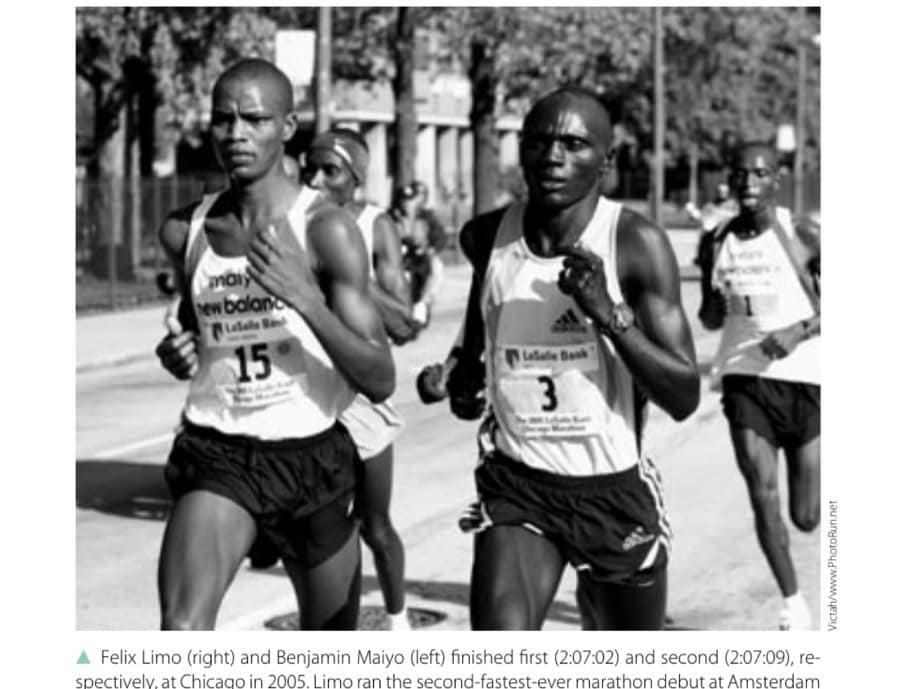
▲ Felix Limo (right) and Benjamin Maiyo (left) finished first (2:07:02) and second (2:07:09), respectively, at Chicago in 2005. Limo ran the second-fastest-ever marathon debut at Amsterdam in 2003 (finishing second in 2:06:42). Maiyo was second at Boston in 2006 (2:08:21).
surmising, the long list of plausible factors proposed to explain their excellence falls short because these factors exist in other countries as well: simpler lifestyles, more active childhoods, living at altitude with tolerable training weather year-round, absence of dietary processed foods, hilly terrain for training, a desire to run fast enough to enter into the big bucks of big-time racing to provide a better life, and on and on.
Sport science and the application .of rigorous thought do provide some perspective. For example, although the VO2max and lactate thresholds of Kenyan runners and the results of their muscle biopsies are similar to those of European marathoners, it appears that Kenyan athletes do more of their training at or around race pace, which may increase their running economy. This might permit them to maintain race pace longer before fatigue slows performance.
REFERENCES La Torre, A., F. Impellizzeri, A. Dotti, and E. Arceli. 2005. Do Caucasian athletes need to resign themselves to African domination in middle- and long-distance running? New Studies in Athletics 20(4):39-49. Saltin, B., H. Larsen, N. Terrados, J. Bangsbo, T. Bak, C.K. Kim, J. Svedenhag, and C.J. Rolf. 1995. Aerobic exercise capacity at sea level and at altitude in Kenyan boys, junior and senior runners compared with Scandinavian runners. Scandinavian Journal of Medicine and Science in Sports 5(4):209-221.
Victah/www.PhotoRun.net
▲
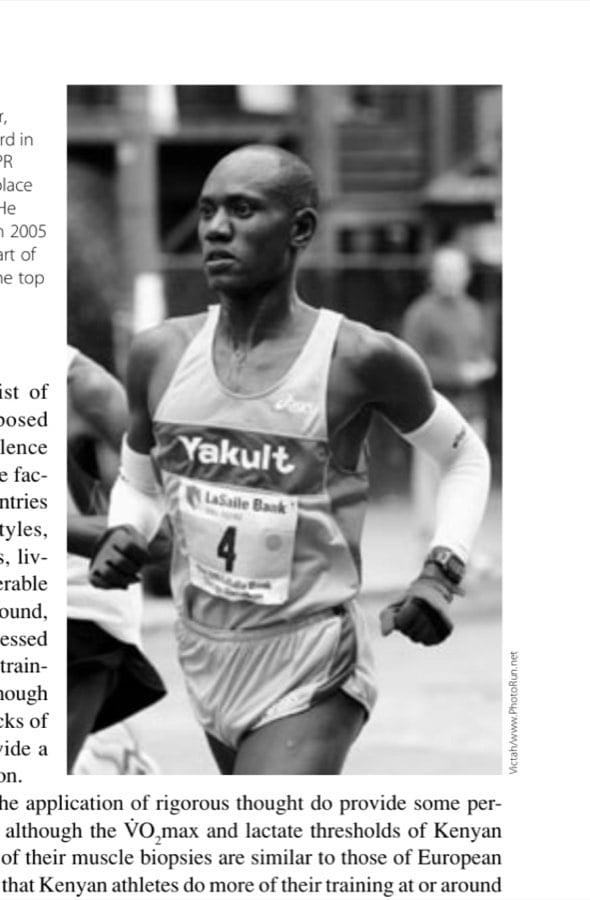
Daniel Njenga began athletics as a steeplechaser, setting a world junior record in 1994. He has a marathon PR of 2:06:16, with a second-place finish at Chicago in 2002. He finished third at Chicago in 2005 (2:07:14, shown here) as part of the 10-Kenyan sweep of the top places that year.
This article originally appeared in Marathon & Beyond, Vol. 11, No. 1 (2007).
← Browse the full M&B ArchiveMore like this
1,000+ stories from 19 years of Marathon & Beyond
The complete archive of the legendary long-distance journal — digitized and free to read.
